
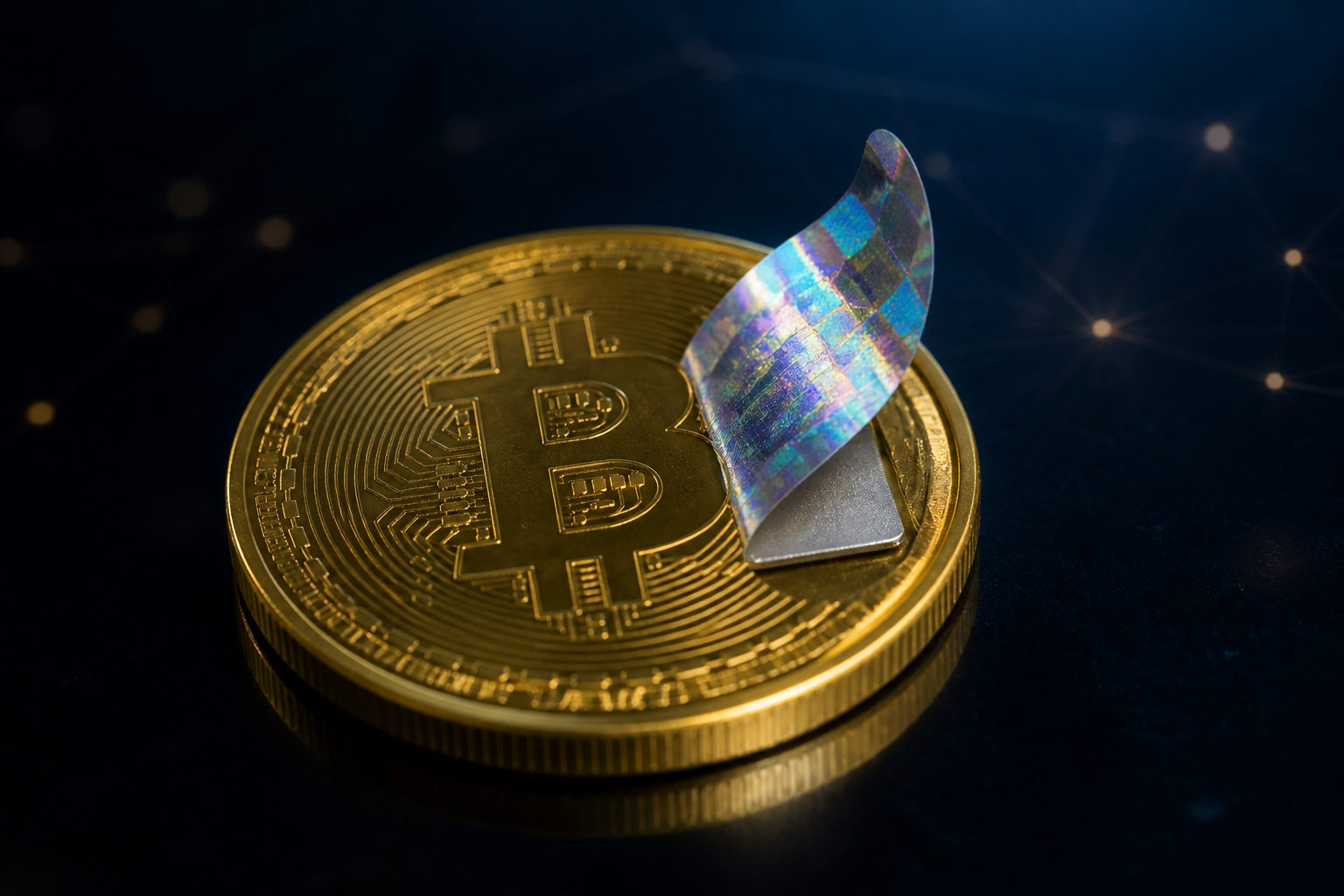
Physical bitcoins work by hiding a private key inside a coin, card, or similar object. The bitcoin itself never moves into metal or plastic; it stays on the blockchain, and the item only gives someone a way to claim it.
What a physical bitcoin actually is
The phrase sounds simple, but it often creates the wrong picture. Many people imagine a physical bitcoin as a literal bitcoin token, like cash or a gold coin. That is not how Bitcoin works. Since the genesis block on 2009-01-03, Bitcoin has existed as entries on a distributed ledger, with control based on private keys rather than possession of a physical object.
A physical bitcoin is usually a collectible item that contains, or points to, a private key tied to a blockchain address. If that address holds BTC, whoever can safely use the private key can move the coins. So the object is better understood as a container for access, not as the asset itself.
This distinction matters because the object can look valuable even when the on-chain balance is gone. A polished metal coin may have no bitcoin attached to it at all. On the other hand, a plain card with a still-secret key may control real BTC.
How the mechanism works step by step
The easiest way to understand the idea is to break it into stages. First, someone creates a Bitcoin address and its private key. Next, the private key is sealed inside a physical item. Then BTC is sent to the public address. After that, the holder can either keep the item unopened as a collectible or reveal the key and transfer the bitcoin into a wallet they control.
| Stage | What the holder sees | What happens on-chain | Main risk |
|---|---|---|---|
| Key creation | An issuer prepares an address and private key | A control credential is created | The key may be copied |
| Sealing | The key is hidden under a seal or inside the object | No blockchain change | The seal may not prove exclusivity |
| Funding | The object appears to have stored value | BTC is sent to the linked address | A buyer may skip address verification |
| Transfer | The item can be gifted or sold | Blockchain ownership does not auto-update | The original creator may still know the key |
| Redemption | The holder opens the seal and imports the key | BTC is moved to a new address | Once revealed, the item is no longer safely self-contained |
The transfer stage is where many new readers get tripped up. Handing the object to someone else does not tell the Bitcoin network anything. The network only recognizes valid signatures from the private key. If another person has seen or saved that key before the item changes hands, the new owner may not have exclusive control.
That is why older physical bitcoin designs often used tamper-evident stickers. The goal was to signal that the private key had not been exposed yet. It can reduce uncertainty, but it does not remove the trust problem. A manufacturer could have retained a copy at the moment the key was created.
Why it can represent value without being the bitcoin itself
Bitcoin lives on the blockchain, not inside the object. The smallest unit is 1 satoshi, equal to 0.00000001 BTC. Whether the private key is hidden in a brass coin, a paper wallet, or a card with a scratch-off layer, the value remains attached to the blockchain address that key controls.
That makes a physical bitcoin closer to a bearer-style claim tool than to a physical commodity. If the linked address still contains BTC and no one else has access to the key, the item may function as a redeemable package. If the coins have already been moved, the object may still have collector interest, but its blockchain value is gone.
Gold is a useful contrast. A gold coin is the asset in your hand. A physical bitcoin is an access mechanism for an asset recorded elsewhere. The object may be attractive, rare, or historically interesting, yet none of those qualities prove exclusive control over the BTC.
Why most people now treat them as collectibles
Physical bitcoins became famous because they gave a tangible form to an otherwise abstract system. They are easy to display, easy to gift, and helpful for explaining the idea that private keys control coins. They also fit into Bitcoin culture because the network has long had ties to real-world goods. One historic example is Bitcoin Pizza Day: on 2010-05-22, Laszlo Hanyecz used 10,000 BTC to buy two pizzas, widely remembered as the first recorded BTC purchase of physical goods.
Still, that history does not make physical bitcoins the standard way to hold BTC. In practice, people who want direct control usually prefer software wallets or hardware wallets. Those methods make it easier to know where the keys came from, who has seen them, and how backup and recovery work.
The network rules stay the same no matter what kind of container holds the key. Bitcoin targets a new block roughly every 10 minutes. The block subsidy halves every 210,000 blocks, about every four years. After the 2024-04-19 halving, the current block reward is 3.125 BTC, and that remains in place until the next halving expected around 2028. A key hidden in a metal coin does not change any of that.
| Form | Typical use | Strength | Weak point |
|---|---|---|---|
| Physical bitcoin | Collecting, gifting, display | Tangible and memorable | Trust in the issuer is hard to remove |
| Software wallet | Regular management and spending | Direct access and convenience | Device security matters a lot |
| Hardware wallet | Longer-term self-custody | Stronger key isolation | Requires backup discipline |
How to evaluate one if you buy or receive it
The first question is whether you care about collectibility or redeemable BTC. Those are not the same thing. If the object is mainly a collectible, the design, condition, and provenance matter most. If you care about the bitcoin attached to it, the key questions are more technical.
- Check for a public address. Without it, you cannot independently inspect whether the object points to funded BTC.
- Look at the seal. An intact seal may be useful, but it is only a surface signal.
- Decide whether to redeem quickly. If your goal is actual control, moving the BTC into a fresh wallet you control is usually the cleaner path.
- Separate collectible value from blockchain value. Some items remain collectible after redemption, while others were only interesting because of the funded address.
That final point is the practical one. As long as the private key was generated or handled by someone else, your confidence depends on their process and honesty. Redeeming the BTC into a newly generated wallet under your own control removes much of that uncertainty.
Bitcoin also has a hard cap of 21,000,000 BTC, with issuance expected to continue until about 2140. That scarcity belongs to the network itself, not to any decorative object. A physical bitcoin can symbolize that scarcity in a memorable way, but it does not create scarcity on its own.
FAQ
Does a physical bitcoin literally contain bitcoin inside it?
No. It contains a private key or a way to access one. The BTC remains on the blockchain the whole time.
If someone gives me a physical bitcoin, do I automatically own the BTC?
Not automatically. You only have clear control if no one else knows the private key, or if you redeem the BTC into a new wallet address that you control.
Is an unopened physical bitcoin safe by default?
No. An unopened seal may suggest the key was not exposed after assembly, but it cannot prove the creator never kept a copy in the first place.
How is it different from a hardware wallet?
A hardware wallet is built for secure signing and self-custody. A physical bitcoin is often a collectible object that happens to package a key, which creates a different trust model.
What happens after I reveal the private key?
You can move the BTC to your own wallet, which is often the sensible step if you want direct control. After that, the object may still have collector value, but it no longer works as an unopened bearer-style package.
If your goal is real ownership rather than display, the useful move is simple: verify the public address, treat the seal as limited evidence, and transfer any BTC to a wallet whose private key you generated and control yourself.