
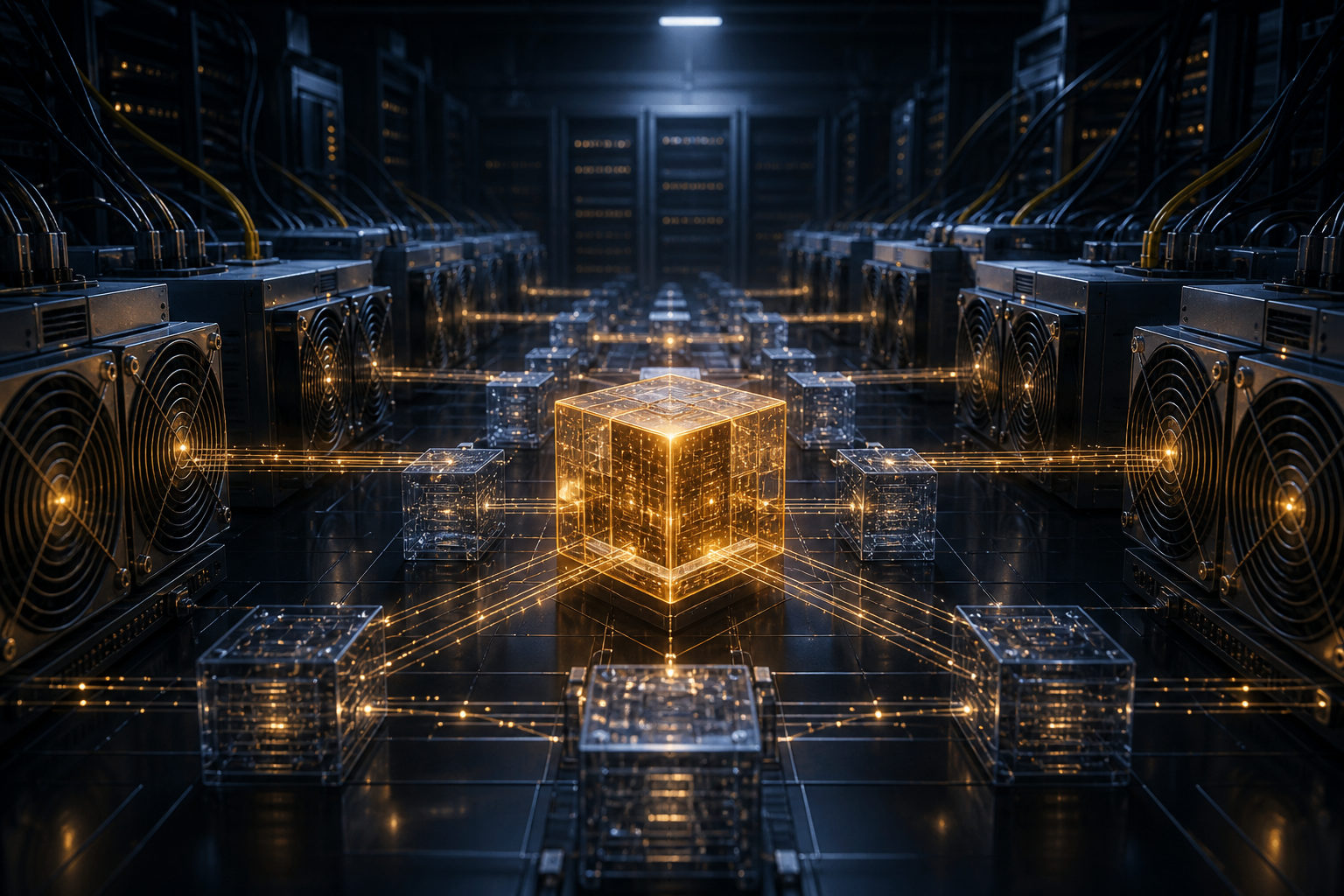
Bitcoins have to be mined because Bitcoin needs a public way to confirm transactions, choose who updates the ledger, secure its history, and issue new BTC without a central operator.
What mining actually does
The word “mining” can be misleading. It sounds as if miners are simply digging coins out of the system. In practice, mining is mostly a competition to package valid transactions into a new block and add that block to the blockchain.
A useful way to picture Bitcoin is as a shared ledger that anyone can inspect and anyone can try to use. People broadcast transactions to the network, but conflicting transactions cannot all be accepted. If the same bitcoin is spent twice, the system needs a rule for deciding which transaction came first and which one should be rejected. Since Bitcoin has no company, bank, or single server in charge, that decision has to come from the network itself. Mining is a core part of that process.
Miners collect pending transactions, check that they follow the protocol rules, and build candidate blocks. They then perform repeated computations in an attempt to produce a block that meets Bitcoin’s proof-of-work requirement. When a miner finds a valid result, that block can be broadcast to the network. Other nodes verify it, and if it passes those checks, the block becomes part of the chain.
Why Bitcoin needs mining instead of a central bookkeeper
If Bitcoin had a central administrator, there would be no need for mining in its current form. One operator could simply keep the ledger and approve or reject payments. Bitcoin was designed to avoid that model, so it needed another way to answer a hard question: who gets to write the next page of the ledger?
Mining assigns temporary write access
In a traditional payment system, the answer is simple: the institution that runs the system updates its own database. Bitcoin cannot rely on that structure because anyone is allowed to join the network. Mining creates an open competition where participants earn the chance to produce the next block by doing proof-of-work. The right to record transactions is not granted by identity, status, or permission from a gatekeeper.
Mining helps stop double spending
Digital information is easy to copy, which makes digital cash difficult to build. Without a reliable ordering mechanism, the same coins could be sent to different recipients at nearly the same time. Mining helps solve this by placing transactions into blocks and extending a single chain of history. As more blocks are built on top of a transaction, rewriting that history becomes harder.
Mining makes attacks expensive
Bitcoin’s security does not depend on everyone being honest. It depends on the cost of trying to cheat. Miners commit real-world resources such as hardware, electricity, time, and operations. Because adding blocks is costly, anyone who wants to alter past records or disrupt confirmations must bear major costs as well. That does not make attacks impossible in theory, but it changes the economics in a way that protects the network.
Mining ties issuance to fixed rules
Mining is also how new bitcoin enters circulation. The total supply is capped at 21 million coins. Bitcoin began with the genesis block in January 2009, and new blocks are produced about every 10 minutes. The block subsidy is cut in half about every 4 years, or every 210,000 blocks. The halving years so far are 2012, 2016, 2020, and 2024. This matters because issuance is handled by protocol rules rather than by discretionary decisions from a central issuer.
The bookkeeping contest analogy
If proof of work feels abstract, think of mining as a global bookkeeping contest. Imagine a ledger shared across the internet. Anyone can try to become the next record keeper, but before they can write the next page, they must solve a hard puzzle. The puzzle is difficult to solve, yet easy for everyone else to verify.
That structure produces several important effects. First, nobody can claim bookkeeping power for free. A participant has to spend resources to compete. Second, verification stays simple. Full nodes can independently check whether the proposed block follows the rules, without trusting the miner personally. Third, changing old entries is not just a matter of editing text. An attacker would have to redo proof of work and catch up with later blocks as well.
This is why the question is not really “Why are bitcoins mined?” in the everyday sense of extracting a commodity. The deeper answer is that Bitcoin needs a decentralized method for selecting block producers, ordering transactions, and making ledger history costly to tamper with. The release of new coins is part of that system, but not the whole point.
Miners, nodes, and users play different roles
Mining is important, but miners are not the entire network. Bitcoin works because different participants do different jobs, and those jobs are not interchangeable.
Miners compete to create blocks
Miners gather transactions, assemble candidate blocks, and perform proof of work in an attempt to publish the next valid block. They are the actors who push the chain forward in real time and receive newly issued bitcoin under the protocol rules.
Nodes enforce the rules
Nodes do not need to mine in order to matter. They verify transactions and blocks independently. A miner may find a block first, but if that block violates the rules, nodes can reject it. This is an important distinction: miners compete for block production, yet they do not get to rewrite the protocol on their own.
Users submit transactions and judge confirmations
Ordinary users send and receive bitcoin through wallets and watch for confirmations. They do not need to mine in order to use Bitcoin. Even so, understanding mining helps users understand why confirmations matter and why finalized transaction history carries weight.
Can regular people still mine bitcoin?
In principle, yes. In practice, the answer depends on resources, technical ability, and expectations. Bitcoin mining has become highly competitive, and it is no longer something most people can approach casually with standard consumer hardware.
Modern participation usually involves specialized equipment, stable power, cooling, network reliability, and ongoing maintenance. Many participants use mining pools, which combine the work of many miners and distribute outcomes according to the pool’s rules. That does not change the base mechanism. The network still relies on proof of work to choose which block gets added next.
For most people, learning how mining works is more useful than rushing to buy hardware. You can study block confirmation, run a node, inspect mempool and block activity with public tools, and learn how transaction ordering affects payments. That gives you a much clearer view of why mining exists in the first place.
Mining is not the same as easy income
People often hear about mining and jump straight to earnings. That misses the first reality check. Mining is a cost-heavy and operations-heavy activity, and the business side depends on conditions that can change.
- Hardware matters: efficiency, reliability, and maintenance all affect operations.
- Electricity matters: power cost is one of the core constraints.
- Cooling and space matter: mining equipment produces heat and noise.
- Operational discipline matters: downtime, configuration mistakes, and failures can hurt performance.
- Protocol rules matter: halvings change the pace of new issuance, and fee conditions can affect miner incentives.
So when someone asks why Bitcoin has to be mined, the first answer is about network design, not personal profit. Mining exists to secure a decentralized ledger under public rules. Any discussion about participating should begin with that fact, then move on to costs, risks, and technical demands.
FAQ
Why can’t Bitcoin just use a few trusted companies to keep the ledger?
It could have been designed that way, but then users would need to trust those companies to process payments fairly and keep records intact. Bitcoin was built to reduce dependence on central gatekeepers, so it needs a different method for choosing who records transactions.
Is mining only about creating new BTC?
No. New issuance is one part of mining, but the larger function is transaction confirmation, ordering, and network security. Without mining, Bitcoin would lose the mechanism it uses to protect ledger history in a decentralized way.
What happens when all bitcoin has been issued?
The supply cap is 21 million coins, and issuance falls over time through halvings. Even after new issuance stops, miners may still be incentivized by transaction fees to keep producing blocks and securing the chain.
Do I need to mine to use Bitcoin safely?
No. Most users only need a wallet to send and receive bitcoin. You can also verify activity through your own node or other public blockchain tools without becoming a miner yourself.
Is solo mining realistic for beginners?
It is possible in theory, but competition and operating demands make it difficult for many individuals. Before thinking about equipment, it makes sense to learn how proof of work, block validation, and mining pools actually function.
If you want to evaluate bitcoin mining seriously, start with three checks: learn how proof of work secures transaction order, separate the roles of miners and nodes, and review your hardware, power, cooling, and maintenance limits before spending on equipment.
Disclaimer: This article is for informational and educational purposes only and is not investment, financial, or legal advice. Crypto assets are highly volatile and you could lose your entire investment. Do your own research and decide carefully.