
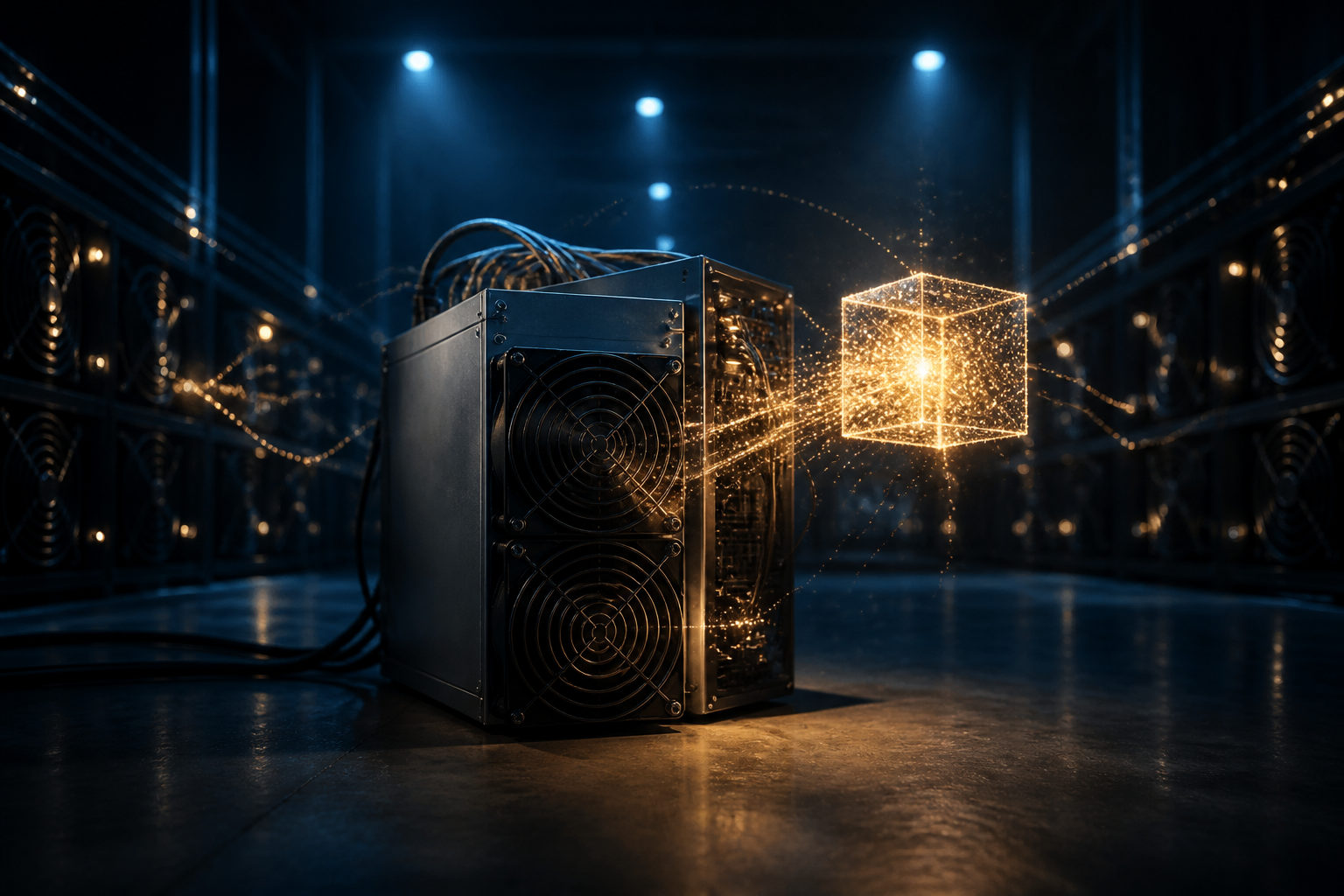
Bitcoins awarded to miners do not come from a company, exchange, or admin team. In Bitcoin, the protocol itself allows a valid new block to create new coins under fixed rules, and the miner of that block also collects the transaction fees included in it.
Where the mining reward actually comes from
A simple way to see Bitcoin is as a public ledger that anyone can inspect. Miners compete for the right to add the next page. They gather pending transactions, build a candidate block, and keep trying to produce a result that matches the network's rules. The first miner to do that earns the right to append the block.
The reward attached to that block has two parts. One is the block subsidy, which is the new bitcoin the protocol allows to be created in that block. The other is the set of transaction fees paid by users whose transfers were included. Both parts are assigned inside a special transaction in the block, commonly called the coinbase transaction. Here, coinbase refers to a block-level reward entry, not a trading platform deposit.
So when people ask who awards bitcoins to miners, the practical answer is that the network rules do. No one signs off on a payout by hand. A miner wins the chance to claim that reward only by producing a valid block that the network accepts.
How a miner wins the right to claim it
Bitcoin uses proof of work. Miners take block header data and run it through a hash function again and again, changing adjustable fields to search for a result that meets the current difficulty target. Each attempt is like another draw in a giant lottery. Skill does not let a miner skip the process; the edge comes from running more effective hardware and keeping it active over time.
The network aims to produce a block about every 10 minutes, but there is no central clock that appoints a winner. Many miners are trying at once. When one of them finds a valid block first, the rest of the network shifts to building on top of that block for the next round.
Sometimes two valid blocks appear close together. That creates a short-lived split, with some nodes seeing one block first and others seeing the other. The chain that later accumulates more proof of work becomes the main chain, while the losing block is dropped from the final history. If a miner's block loses that race, the reward in that block does not remain part of the accepted record.
How new bitcoin enters circulation
Many people first meet Bitcoin through price charts and trading screens, so it is easy to assume all circulating coins come from buying and selling. New supply mainly enters the system through block subsidies. Bitcoin began with the genesis block in January 2009, and the protocol set a hard cap of 21 million coins from the start.
The subsidy does not stay constant. Bitcoin halves the block subsidy about every 4 years, or every 210,000 blocks. The halving years that have already occurred are 2012, 2016, 2020, and 2024. That schedule means fewer new coins are introduced over time, while transaction fees are expected to matter more to miners in the long run.
There is another limit that matters just as much: miners cannot mint extra bitcoin by choice. Full nodes check whether each block follows the consensus rules, including whether the subsidy stays within the allowed amount for that period, whether the transactions are valid, and whether the block links correctly to the chain. A miner can compete to earn newly issued coins, but cannot rewrite the issuance policy.
What participation looks like in practice
In theory, anyone can try mining. In practice, participation is far more demanding than installing software on a laptop. Competition is intense, so miners usually deal with specialized machines, electricity costs, cooling, noise, space, maintenance, and downtime risk. Mining is closer to an infrastructure business than a casual app-based activity.
That reality is why many miners join mining pools. A pool combines the computing power of many participants and tries to find blocks as a group. When the pool succeeds, it distributes the reward among participants according to its own payout rules. For an individual miner, that often means smaller but more regular distributions instead of waiting a long time for a solo block that may never come.
Joining a pool changes the trust model. A solo miner keeps full operational control but faces highly uneven outcomes. A pool participant depends on the pool's accounting, technical uptime, payout method, and transparency. Before joining, it helps to understand who controls the payout address, how shares are counted, what happens during outages, and how easy it is to switch elsewhere.
Common points of confusion
Are miners paid by other users
Users do pay transaction fees, and those fees become part of the reward for the miner who includes the transactions in a valid block. The newly created bitcoin in the block subsidy, though, comes from the protocol's issuance rules rather than from another person's wallet.
Does the fastest computer always win
Mining power improves a miner's odds, but each block is still the outcome of repeated probabilistic attempts. More hardware usually means a better chance over time, not a guarantee in every round.
Is mining the same as buying bitcoin
They lead to the same asset through very different paths. Buying bitcoin means acquiring coins already in circulation from the market, while mining means competing for the right to add a block and claim the subsidy and fees attached to it.
FAQ
Who decides whether a miner gets the reward
The decision comes from Bitcoin's consensus rules as enforced by network nodes. Finding a block is only the first step; the block must be valid and remain on the accepted chain for the reward to count.
Does a mining pool award bitcoins to miners
A pool distributes rewards to its participants, so from the miner's point of view it can feel like the pool is paying them. The source of that money is still the block reward and fees earned when the pool finds a valid block under Bitcoin's rules.
Can you still mine bitcoin with a home computer
You can participate at a technical level, but that does not mean you will be competitive. In current conditions, general-purpose home machines usually struggle against specialized mining hardware on efficiency and operating cost.
Can a miner sell newly mined bitcoin right away
Once the coins are under the miner's control, any later decision to hold or sell is separate from the reward process itself. Selling happens in the market, while mining is the protocol-level process that created or assigned the block reward.
Where should someone check the live bitcoin price
Use a major market data site or a large spot exchange interface to check real-time pricing. When comparing quotes, pay attention to the trading venue, liquidity, and update timing so a brief move on one screen does not mislead you.
If you only keep two ideas from this topic, keep these: Bitcoin mining rewards come from protocol rules written into the system, and a miner only gets them by producing a valid block that stays on the accepted chain. Anyone thinking about participation should study hardware, power, cooling, hosting, and pool payout terms before spending money on setup.
Disclaimer: This article is for informational and educational purposes only and is not investment, financial, or legal advice. Crypto assets are highly volatile and you could lose your entire investment. Do your own research and decide carefully.