
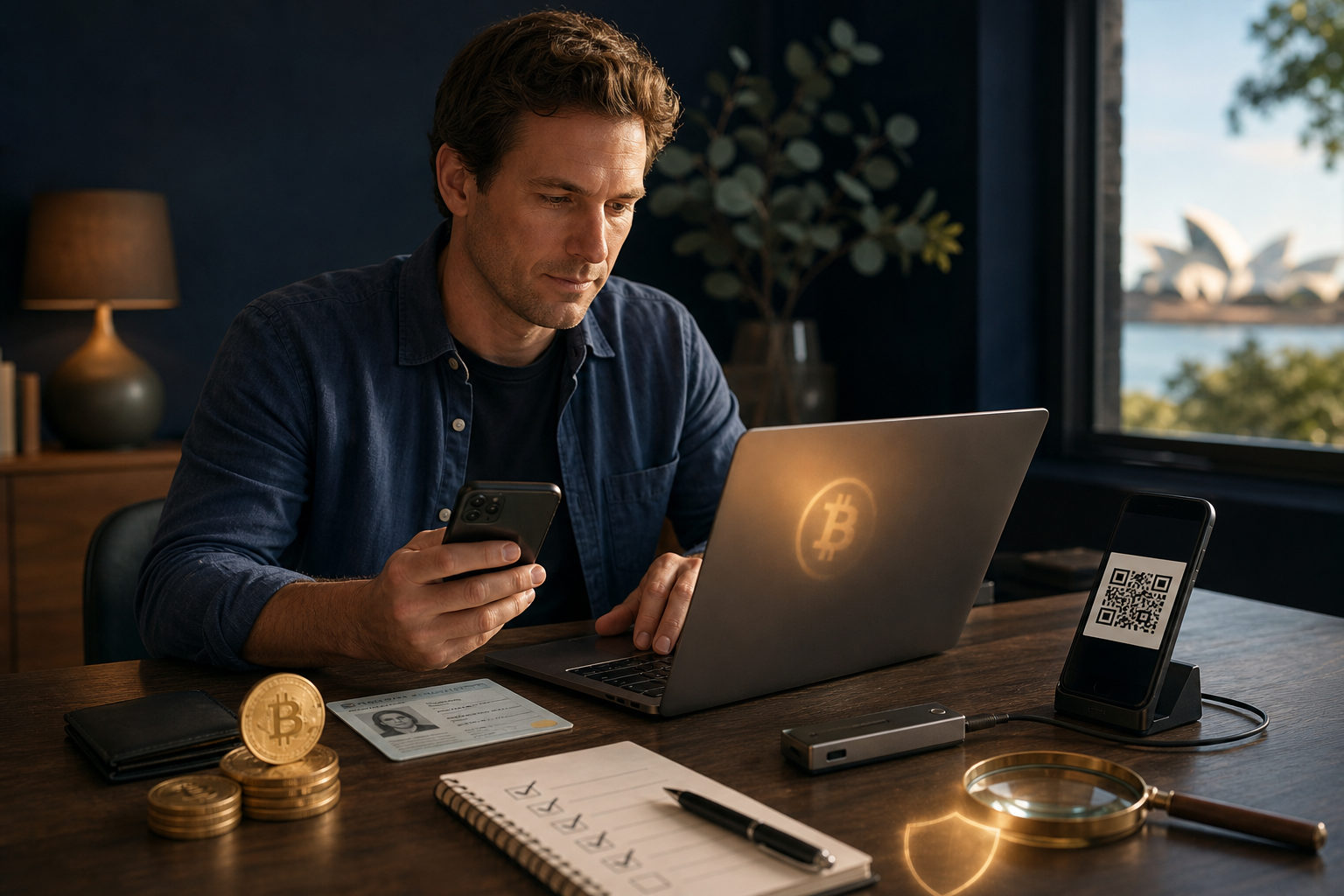
Buying Bitcoin in Australia comes down to five things: pick an exchange that is registered with AUSTRAC, verify your identity, fund your account (PayID and Osko are the fastest options), place your order, and then decide whether you want to move the coins into a wallet you control. Two things trip people up early: buying Bitcoin itself does not attract GST, but selling, swapping, or spending it later usually does trigger a capital gains tax event with the ATO — and that part has nothing to do with which exchange you used.
What you are actually buying
Bitcoin is a digital asset that runs on its own blockchain. A person or group using the name Satoshi Nakamoto published the whitepaper in 2008, and the first block was mined in January 2009. Total supply is capped at 21 million coins, and the smallest unit is a satoshi — one hundred millionth of a BTC.
Before you place an order, it helps to understand one distinction that trips up a lot of first-time buyers: what sits in your exchange account is a balance the platform owes you, not necessarily coins you fully control. Real control comes from holding the private keys yourself. As long as your Bitcoin stays on the exchange, you are relying on that company's operations, security, and withdrawal policies. Keep that in mind — it matters later when you decide whether to withdraw to your own wallet.
Who actually regulates crypto in Australia
There is no single crypto regulator in Australia — two agencies cover different pieces of the picture, and knowing which is which saves confusion later.
AUSTRAC (the Australian Transaction Reports and Analysis Centre) oversees digital currency exchanges under the Anti-Money Laundering and Counter-Terrorism Financing Act 2006. Any platform that lets you convert AUD into crypto and back has to register as a DCE, run know-your-customer checks, monitor transactions, and report anything suspicious. That is the actual reason you are asked for ID and proof of address when you sign up — it is not the exchange being difficult, it is a legal obligation.
ASIC (the Australian Securities and Investments Commission) has a narrower job. It only steps in when a crypto asset or service meets the legal definition of a financial product under the Corporations Act 2001, in which case a provider may need an Australian Financial Services Licence. Plain spot trading of Bitcoin generally sits inside AUSTRAC's AML/CTF framework rather than ASIC's financial-products regime, though this line has been getting more attention from regulators.
The scope has also been widening. According to industry compliance sources, AUSTRAC's coverage expanded from 31 March 2026 to reach a broader category of digital asset service providers, not just what people traditionally think of as an exchange. That could eventually pull more wallet and custody services into the registration net. Rules here are still evolving, so treat this as a general picture rather than a fixed list — check AUSTRAC's own register if you want certainty on a specific platform.
Step one: pick a platform that is actually registered and actually works for you
When comparing platforms, four things matter more than a flashy sign-up bonus: is it AUSTRAC-registered as a DCE, does it support the payment methods you will actually use (PayID and Osko matter a lot in Australia), can you withdraw Bitcoin to an external wallet, and does it offer proper account security like two-factor authentication and withdrawal whitelisting.
Australian-based platforms that come up repeatedly include CoinSpot (operating since 2013, with 24/7 live chat support), Swyftx, and Independent Reserve — all of them lean on AUD deposits and instant PayID/Osko transfers as a selling point. International exchanges such as Binance can offer lower headline fees, especially for high-volume traders, but their local banking relationships have been rockier: there have been periods where a change of third-party payment provider disrupted AUD deposits and withdrawals, and some Australian banks apply extra scrutiny — or outright block — transfers heading to offshore platforms. If smooth, predictable funding matters more to you than shaving off a fraction of a percent in fees, a local exchange is usually the easier path. If fees are your main concern, just go in knowing your bank might add friction.
| Platform | Fee structure | PayID / Osko | Worth knowing |
|---|---|---|---|
| CoinSpot | Instant buy listed around 1%; switching to a market order (limited to roughly 15 major coins, Bitcoin included) can bring the cost down to around 0.1% | Yes, typically instant and free | The fee difference between order types is large — check which one you are actually using before you confirm |
| Swyftx | Base trading fee around 0.6% plus a spread (Bitcoin spreads reportedly from about 0.41%); third-party estimates put the blended average across all assets near 1.7% | Yes, typically instant and free | Your real cost moves with the spread, which can widen during volatile markets |
| Independent Reserve | Order-book style pricing, structured differently from the two above | Yes, typically instant and free | Interface leans toward more experienced traders; there is a bit of a learning curve for beginners |
| Binance Australia and other international platforms | High-volume traders have reported fees as low as around 0.075% | AUD deposit/withdrawal service has previously been disrupted by changes to local payment partners | Local banks sometimes delay or block transfers to offshore exchanges — funding reliability can lag behind the fee advantage |
If a website leans on promises like guaranteed returns, no-risk trading, or someone offering to buy on your behalf, that is not a normal purchase flow — it is a red flag. Legitimate platforms talk about identity verification, risk disclosure, and account security. They do not promise you profit.
Step two: get your ID and account details in order before you sign up
Have your documents ready before you start the sign-up form. This is not just the exchange being cautious — it is AUSTRAC's mandatory KYC requirement for any registered DCE, and a platform that skips it is taking on regulatory risk it cannot afford, so expect the checks to be strict rather than lenient.
Double-check that your name spelling, address, date of birth, and the email and phone number you use for verification all match across every document. A lot of stalled account approvals are not because you failed some test — they happen because the details you submitted do not line up with each other, most commonly a mismatch between the name on your ID and the name on your bank account.
- Do this: Have a working email, phone number, and photo ID (typically a driver licence or passport) ready, and make sure the bank account you link is in your own name.
- Why it matters: Mismatched names or vague details trigger manual review and slow everything down.
- Watch out for: Don't open an account using someone else's identity, and don't buy on behalf of someone you don't know well — a mismatch between account holder and payer is exactly what anti-money-laundering systems are built to flag.
Step three: finish verification, then lock down security before you buy
Once you are verified, resist the urge to buy immediately. Walk through your security settings first: a strong password, two-factor authentication, withdrawal whitelisting, login alerts, and device management. Bitcoin transfers are generally irreversible once sent, and a compromised account is not something you can usually appeal your way out of.
- Do this: Turn on 2FA the moment your account is verified, prefer an authenticator app over SMS codes, and store your recovery codes offline.
- Why it matters: Password leaks happen more often than people assume, and 2FA raises the bar for anyone trying to break in significantly.
- Watch out for: Never screenshot and send an SMS code to anyone, and don't store recovery codes in a notes app that syncs to the cloud.
Step four: funding — PayID, Osko, bank transfer, and where banks get in the way
Local Australian exchanges generally support PayID and the Osko real-time payment system, and most deposits through them land instantly at no cost — that is usually cheaper than funding with a credit or debit card, which tends to carry higher fees. But whether your deposit actually goes through smoothly depends as much on your own bank's policy as it does on the exchange.
Bank attitudes toward crypto-related transfers vary a lot, and third-party reviews on this topic don't always agree with each other. NAB, Westpac, and Macquarie are the names that come up most often on the stricter side — reported in various reviews to delay, limit, or in some cases block payments flagged as going to crypto exchanges, which occasionally pushes users toward opening a second account elsewhere just to fund a purchase. ING, Great Southern Bank, St George, and Up Bank are more often described as accommodating, generally supporting instant PayID/Osko transfers to AUSTRAC-registered exchanges without systematic blocks. Worth flagging: the specific daily dollar limits you'll see quoted for individual banks differ from source to source, and some are contradicted elsewhere, so this article deliberately does not repeat a precise per-bank limit. These policies change and reviews conflict, so confirm directly with your own bank before you rely on anything you read online, including this article.
| Bank posture | Examples | What you might see |
|---|---|---|
| Stricter / prone to blocking | NAB, Westpac, Macquarie | Limits, delays, or outright blocks on transfers to certain exchanges; actual enforcement varies by bank and over time |
| Generally more accommodating | ING, Great Southern Bank, St George, Up Bank | More often described as supporting instant PayID/Osko transfers to AUSTRAC-registered exchanges, though quoted limits vary by source — check with your bank |
If your deposit gets blocked or delayed, don't panic, and definitely don't trust anyone who offers to help you get around your bank's checks. Call your bank and ask what triggered it, or switch to a funding method your bank actually supports.
Step five: placing the order and reading the fee breakdown
Once funds land, you'll usually see two order types: an instant buy at the current market price, or a limit order where you set the price and wait. Instant buys are simpler; limit orders give you more control but are not always available on every coin — CoinSpot's market-order book, for instance, currently covers only around 15 major coins, though Bitcoin is one of them.
On your first purchase, don't obsess over timing the bottom. Focus instead on actually reading the order screen: how much AUD you are spending, roughly how much BTC you will receive, what fee the platform is charging, and whether the coin lands in a balance you can withdraw immediately. If any part of that screen doesn't make sense, don't hit confirm yet.
- Do this: Start small, confirm the fee disclosure and order type, then place the trade.
- Why it matters: Bitcoin's price moves fast, and chasing it without understanding the interface tends to turn a process mistake into what feels like a market loss.
- Watch out for: Don't spend your entire budget in one order, and don't keep clicking buy just because a group chat is telling you to.
Step six: deciding whether to move your coins to your own wallet
As long as your Bitcoin sits in an exchange account, you're depending on that company staying solvent, secure, and willing to process your withdrawal request. If you plan to hold for the medium or long term, learning to use a wallet you actually control — where you hold the private keys or seed phrase yourself — is generally the safer approach.
- Do this: Set up a wallet, write down the recovery phrase offline, then send a small test withdrawal before moving anything larger.
- Why it matters: A small test catches copy-paste errors or wrong-network mistakes before they cost you real money.
- Watch out for: Confirm it's genuinely a Bitcoin address (not another chain), double-check the characters after pasting, and never rely on an auto-generated link from a chat app.
What happens after you buy: tax is not optional
Under ATO rules, Bitcoin is treated as property — a CGT asset — not as currency. A few practical points follow from that:
- Buying itself is not a taxable event. Spending AUD to acquire Bitcoin doesn't trigger capital gains tax, and it isn't subject to GST either — Australia removed GST on buying and selling digital currency from 1 July 2017, which had previously created a double-taxation problem.
- Disposing of it usually is. Selling for AUD, swapping for another token, or spending Bitcoin on goods or services generally counts as a CGT event, and you'll need to work out whether that produced a capital gain or loss.
- Holding over 12 months can unlock a 50% discount. Individual investors (as opposed to people classified as traders) who hold an asset for more than 12 months before disposing of it may be eligible for a 50% CGT discount. That distinction between investor and trader depends on your trading pattern and intent, so it's worth getting right.
- There's no separate crypto tax rate. Any gain gets added to your other income and taxed at your marginal personal income tax rate, which currently ranges from 0% to 45% depending on total income.
- The ATO already has visibility into exchange data. It has been running a data-matching program collecting transaction data from Australian exchanges since 2019, with reporting naming platforms including Coinbase, CoinSpot, Swyftx, and Binance Australia among the sources. Assuming an exchange simply won't report your activity is not a safe bet.
Your actual tax outcome depends on personal circumstances — investor versus trader status, total income for the year, other asset disposals — so treat the above as a general map, not a calculation. For anything specific, check the ATO's own guidance or talk to a registered tax agent.
Spotting the scams that target Bitcoin buyers
According to Scamwatch and the National Anti-Scam Centre (both under the ACCC), investment scams were the costliest scam category in Australia in 2025, with reported losses around A$837.7 million, and cryptocurrency was the most common payment method used in those scams. Total scam losses across all categories in 2025 came to roughly A$2.18 billion, up 7.8% on the year before. In the first quarter of 2026 alone, Scamwatch logged around A$76.7 million in reported losses — down 17% year on year, which suggests enforcement is having some effect, but the risk is still very real.
Common scam patterns
- Fake support agents who impersonate exchange staff and try to get you to hand over a verification code, recovery phrase, or remote access to your device.
- Fake trading groups that let you “win” a small amount first, then push you to move larger sums to a fake site or wallet.
- “I'll buy it for you” offers where someone claims they'll handle the purchase on your behalf — you end up with neither control of the coins nor a way to get your money back.
- Phishing sites that copy a real exchange's design closely enough to steal your login on sight.
- Fake wallet apps from unverified sources that quietly steal your seed phrase or swap out withdrawal addresses.
Stop immediately if any of the following happens: someone pressures you with “buy now or miss out”, someone promises a fixed or guaranteed return, someone asks you to send your recovery phrase so they can “verify” it, someone asks you to install remote-access software, or someone asks you to send funds to a personal account instead of the platform's official deposit method. None of that is a normal part of buying Bitcoin — it's a script.
Managing what you bought so it doesn't go wrong later
- Separate trading funds from long-term holdings. Keep what you actively trade on the exchange, and move what you plan to hold long-term into a wallet you control.
- Back up your recovery information offline, kept in more than one place, and never copied into chat apps, cloud notes, or shared devices.
- Review your security settings periodically — login history, withdrawal settings, connected devices, and the inbox tied to your account.
- Don't post your holdings publicly. Screenshots of balances, addresses, or deposit confirmations are exactly what scammers look for.
- Keep records for tax time. Log the date, price, quantity, and fees for every buy and sell — it makes CGT calculations far less painful later.
Frequently asked questions
What's the actual first step to buying Bitcoin in Australia?
Pick a platform registered with AUSTRAC that supports PayID or Osko deposits and proper identity verification, then run a small test deposit. Your first purchase should focus on confirming the account, payment, and withdrawal steps work — not on how much you buy.
Do I have to pay tax when I buy Bitcoin in Australia?
No, buying itself isn't taxed and isn't subject to GST. Selling, swapping, or spending it later usually is, taxed at your marginal rate (0-45%), with a possible 50% discount for investors who hold more than 12 months. Check current ATO guidance for specifics.
My bank blocked my PayID transfer to an exchange — now what?
Contact your bank directly and ask why. Don't trust anyone who offers to help you bypass the check. Some banks are stricter about crypto-related transfers than others, so switching to a more accommodating bank for funding is a reasonable option if this keeps happening.
Do I need to move my Bitcoin to my own wallet after buying?
If you're just getting familiar with the interface short-term, leaving it on the exchange for a bit is fine. But if you plan to hold for the long haul, it's worth learning self-custody and starting with a small test withdrawal.
How do I tell a scam site or fake support agent from the real thing?
Treat anyone who messages you first, pressures you to transfer funds, or asks for a verification code or recovery phrase as high-risk by default. Only log in through the official app or a URL you typed yourself — never through a link someone sent you in chat.
If you're ready to start, here's the order to do it in
Confirm the platform is AUSTRAC-registered and supports PayID/Osko. Get your ID and a dedicated email ready, then turn on two-factor authentication the moment you're verified. Run a small test deposit to make sure your bank isn't blocking it before you fund properly. Keep a simple record of every trade for tax purposes. If you're planning to hold long-term, set up your own wallet and test a small withdrawal before moving anything larger. If at any point something doesn't make sense, someone is rushing you, or you're being asked for a verification code or recovery phrase, stop and step back.
Disclaimer: This article is for general information and educational purposes only and does not constitute investment, financial, legal, or tax advice. Cryptocurrency prices are highly volatile and you could lose your entire investment. Regulations, bank policies, and exchange fees can change at any time — verify current details with official sources and consider speaking with a licensed financial adviser or registered tax agent before making decisions.