
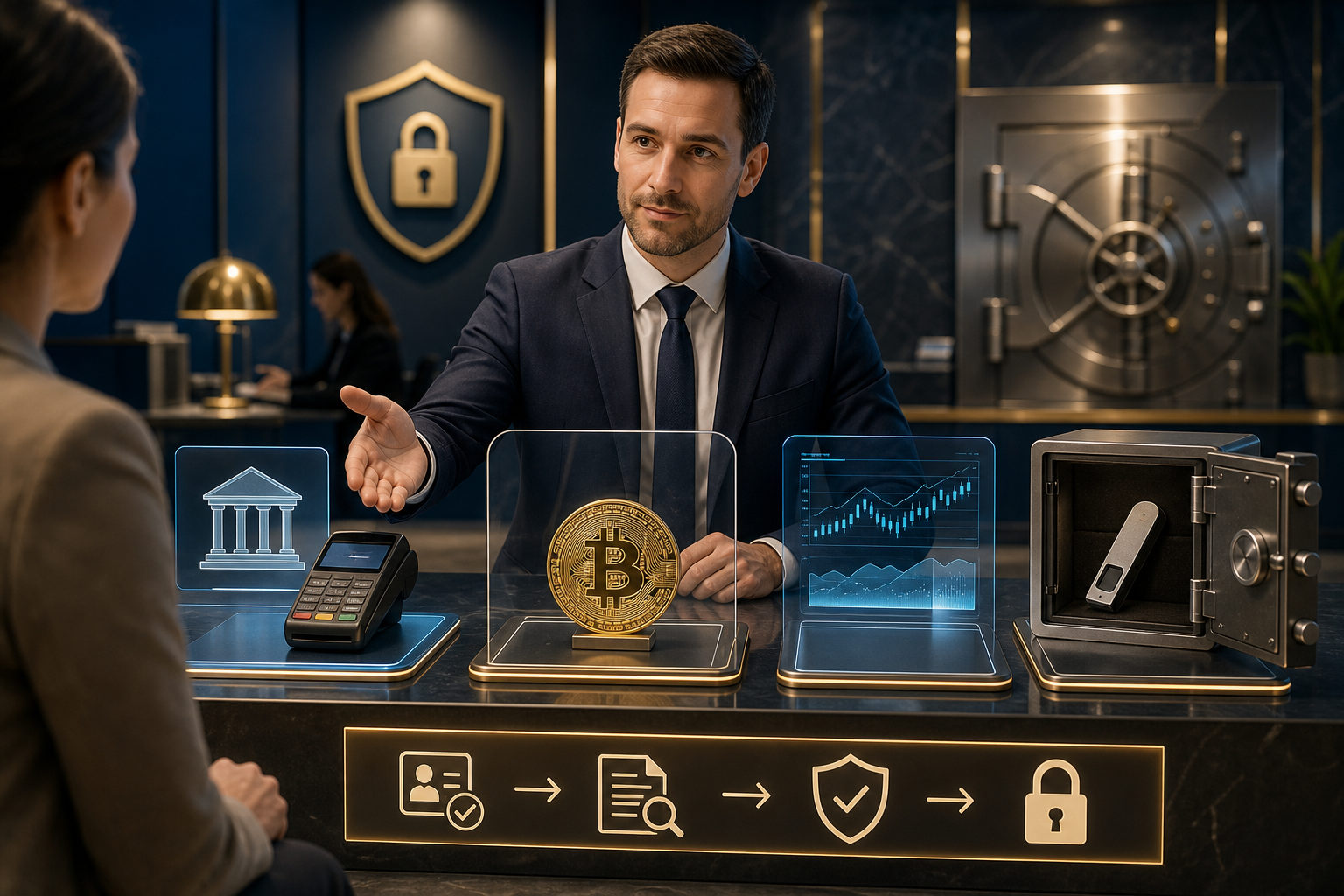
Banks usually do not sell bitcoin directly. In most cases, a bank is the money rail, while the actual bitcoin trade, custody setup, or withdrawal process is handled by a crypto service provider or another financial intermediary.
Why people think banks sell bitcoin
The confusion is easy to understand. If you can link a bank account, send a bank transfer, or open a finance app and see a bitcoin-related option, it feels natural to assume the bank is the seller. That is often not what is happening.
There are several different roles inside one customer journey. A bank may move fiat money, hold client cash, or provide access to a partner service. A separate company may execute the trade, hold the bitcoin on your behalf, or decide whether you can withdraw to your own wallet. Those differences matter because they define who owes you what.
So when people ask whether banks sell bitcoin, the best answer is this: sometimes a bank may be involved, but that does not mean the bank itself is the direct bitcoin seller in the way most users imagine.
A step-by-step way to tell what service you are actually using
Step one: identify the legal service provider
Start by reading the sign-up page, terms of service, risk disclosure, and payment instructions. Your goal is to find the legal entity that takes your order and holds responsibility for the service. The reason is simple: branding can shape your impression, but the contract tells you who actually runs the transaction.
The key caution here is that large financial brands can appear prominently even when a partner company does the real work. If the agreement names a third-party crypto firm, payment company, or custodian, you should not describe the arrangement as the bank directly selling bitcoin.
Step two: check whether you are buying bitcoin or only exposure to its price
Ask three plain questions before you deposit funds. Can you withdraw bitcoin to your own wallet? Can you make an on-chain transfer? Are you receiving transferable bitcoin, or only an account balance linked to price movement? These questions matter because many users assume every bitcoin-related product gives them direct control over the asset.
That assumption can be costly. Price exposure and actual bitcoin ownership are not the same thing. If you cannot move the asset to a wallet you control, you may be holding a claim, a product, or a platform balance rather than bitcoin under your own control.
Step three: separate payment, custody, and distribution functions
Look for language that explains who handles payments, who stores assets, who executes trades, and who reviews customer activity. A bank may only provide the payment rail. It may store fiat balances but not digital assets. It may also act as a distributor, placing a partner service in front of its customers without taking over all legal responsibilities.
This step matters because users often treat a familiar interface as proof that every part of the service comes with the same protections. That is not a safe assumption. A bank-branded entry point and a bank-operated bitcoin service are two different things.
Step four: verify whether you can withdraw bitcoin
Look for wallet features such as deposit and withdrawal menus, blockchain address fields, and network selection. The reason is direct: the ability to withdraw to your own wallet is one of the clearest signs that you may be dealing with actual bitcoin rather than a closed account balance.
There are two cautions here. First, buy access does not always mean withdrawal access. Second, even if withdrawal is available, make sure you can send to a wallet where you control the private keys, not just to another custodial account with a balance display.
Step five: review the full cost structure, not just the buy screen
Check spreads, trading fees, deposit fees, withdrawal fees, transfer charges, and any conversion costs that may apply. The reason is that two services can both say they offer bitcoin, yet the total cost to buy, hold, and move the asset can differ a lot.
The main caution is hidden friction. If fees are hard to find or written in vague terms, you may only discover the real cost later when you try to withdraw, sell, or transfer your holdings. If you cannot explain the fee structure in plain language, slow down before funding the account.
Step six: understand account controls and compliance checks
Before sending money, check identity verification rules, source-of-funds requests, withdrawal reviews, account restrictions, and login security procedures. Bitcoin-related activity often comes with added scrutiny, and a normal review process should not be confused with a scam.
Still, there is an important warning sign. If a service pushes you to send funds quickly but stays vague about review rules and withdrawal conditions, that is a problem. Clear rules are normal. Pressure without clarity is not.
If banks usually do not sell bitcoin directly, how do people buy it?
For most retail users, the common path is not walking into a bank branch and buying bitcoin over a counter. The usual path is using a bank account to move fiat money into or out of a regulated or compliant crypto service, then placing an order there. In other cases, users get exposure through a brokerage or another financial product rather than direct control of transferable bitcoin.
This distinction is not academic. It changes what you own, how you manage risk, and what rights you have after the purchase. Some people want price exposure only. Others want bitcoin they can move to a self-custody wallet. Those are different goals, and they should lead to different questions before any money leaves your account.
If your goal is actual control, focus on withdrawal rights, wallet compatibility, custody terms, and account security. If your goal is only investment exposure, focus on product structure, redemption rules, and the exact nature of your claim.
An anti-scam checklist with action, reason, and caution in every step
Step one: verify the entity before you discuss returns
Action: confirm the full company name, support channels, service terms, and dispute process. Reason: many scams borrow the language of established finance and lean on phrases such as bank partner, bank-grade security, or institutional access to make people relax too early.
Caution: if someone keeps talking about reputation but avoids naming the entity that receives your funds and holds your assets, stop there. What matters is who takes your money, who records your balance, and who processes a withdrawal request.
Step two: treat guaranteed returns and special access as danger signs
Action: stop if you see promises of principal protection, fixed yield, insider pricing, private allocation, or expert-led signals tied to bitcoin buying. Reason: bitcoin is a volatile asset, so sales claims that combine high return language with low-risk certainty should not be treated as normal banking service.
Caution: scammers often wrap risky or fake offers in familiar finance terms. A page can look polished. An app can look professional. Neither tells you whether the underlying service is real, solvent, or honest.
Step three: test the full flow with a small amount first
Action: use an amount you can afford to lose to test account setup, funding, buying, selling, and, if available, bitcoin withdrawal. Reason: many of the biggest problems do not appear in marketing copy. They appear when money moves, support is needed, or a withdrawal request is submitted.
Caution: the purpose of a small test is not luck. It is process validation. You want to see whether balances update properly, whether support answers real questions, and whether withdrawal rights work as described.
Step four: secure the account before you trade
Action: enable two-factor authentication, use a unique password, and protect your email account as carefully as the trading account itself. Reason: even if the service is legitimate, weak account security can still lead to direct loss.
Caution: never share one-time codes, recovery phrases, or private keys. A real support agent does not need your private key, and no legitimate verification process requires you to hand over wallet secrets or remote control of your device.
Step five: decide between custody and self-custody in advance
Action: decide before buying whether you plan to keep the asset with a third party or move it to a wallet you control. Reason: this choice shapes your risks, your responsibilities, and the kind of service you should even be evaluating in the first place.
Caution: many users spend all their time asking how to buy bitcoin and almost none asking where it will sit after purchase. Leaving assets with any third party means you take on counterparty risk, operational risk, and policy risk tied to that service.
Step six: do not treat a completed bank transfer as proof of completed bitcoin delivery
Action: after sending funds, verify the recipient name, order status, and asset credit record. Reason: a successful bank transfer only proves the money left your account. It does not prove that bitcoin was credited correctly or that you have the right to withdraw it.
Caution: stop immediately if you are asked for extra deposits to release funds, unlock an account, or pay a surprise charge before delivery. Requests of that kind are common scam patterns and do not match a normal purchase flow.
What bitcoin is, and why banks may be involved without being the direct seller
Bitcoin is a digital asset that runs on a blockchain network. Its genesis block appeared in January 2009, and its creator used the name Satoshi Nakamoto, whose identity remains unknown. The supply cap is 21 million coins. The network produces a block roughly every 10 minutes. Its smallest unit is one satoshi, which is one hundred millionth of a BTC.
Banks may appear in bitcoin-related services because they are strong at payments, cash management, compliance reviews, and custody structures. None of that automatically means the bank itself is selling spot bitcoin to retail customers. In many setups, the bank handles the familiar money side while a separate provider handles the digital asset side.
That separation is not a technical detail. It affects customer rights, withdrawal ability, dispute handling, and what kind of claim you really own at the end of the process.
FAQ
Can I buy actual bitcoin through a bank channel?
Sometimes you may access a bitcoin-related service through a bank-linked flow, but that alone does not prove you are buying spot bitcoin. Check the legal provider and the withdrawal rules before you assume you own transferable bitcoin.
Are banks selling bitcoin, or just moving the money?
Most often, banks are part of the fiat payment path rather than the direct bitcoin seller. The answer depends on who prices the trade, who books the asset, who holds custody, and who handles withdrawals and disputes.
Is buying through a bank-linked interface safer?
Not automatically. A familiar interface can reduce user error, but safety still depends on the service provider, fee transparency, account protection, custody terms, and whether withdrawal rights are clearly defined.
What should I read before sending money for a bitcoin purchase?
Read the user agreement, risk disclosure, fee schedule, custody terms, and withdrawal rules first. If those documents are hard to find or hard to understand, do not rush the funding step.
If I only want to track bitcoin price for now, what should I do?
Use major market data services to view live pricing rather than relying on random screenshots or messages from strangers. Then learn what drives bitcoin price, including supply and demand, liquidity, market sentiment, policy changes, and broader risk appetite, before making any decision.
The practical move is to break the process into parts and verify each one: who gets the money, who executes the trade, who holds the asset, whether you can withdraw it, and who is accountable if something goes wrong. If any one of those answers is unclear, stop before you send funds.
Disclaimer: This article is for informational and educational purposes only and is not investment, financial, or legal advice. Crypto assets are highly volatile and you could lose your entire investment. Do your own research and decide carefully.