
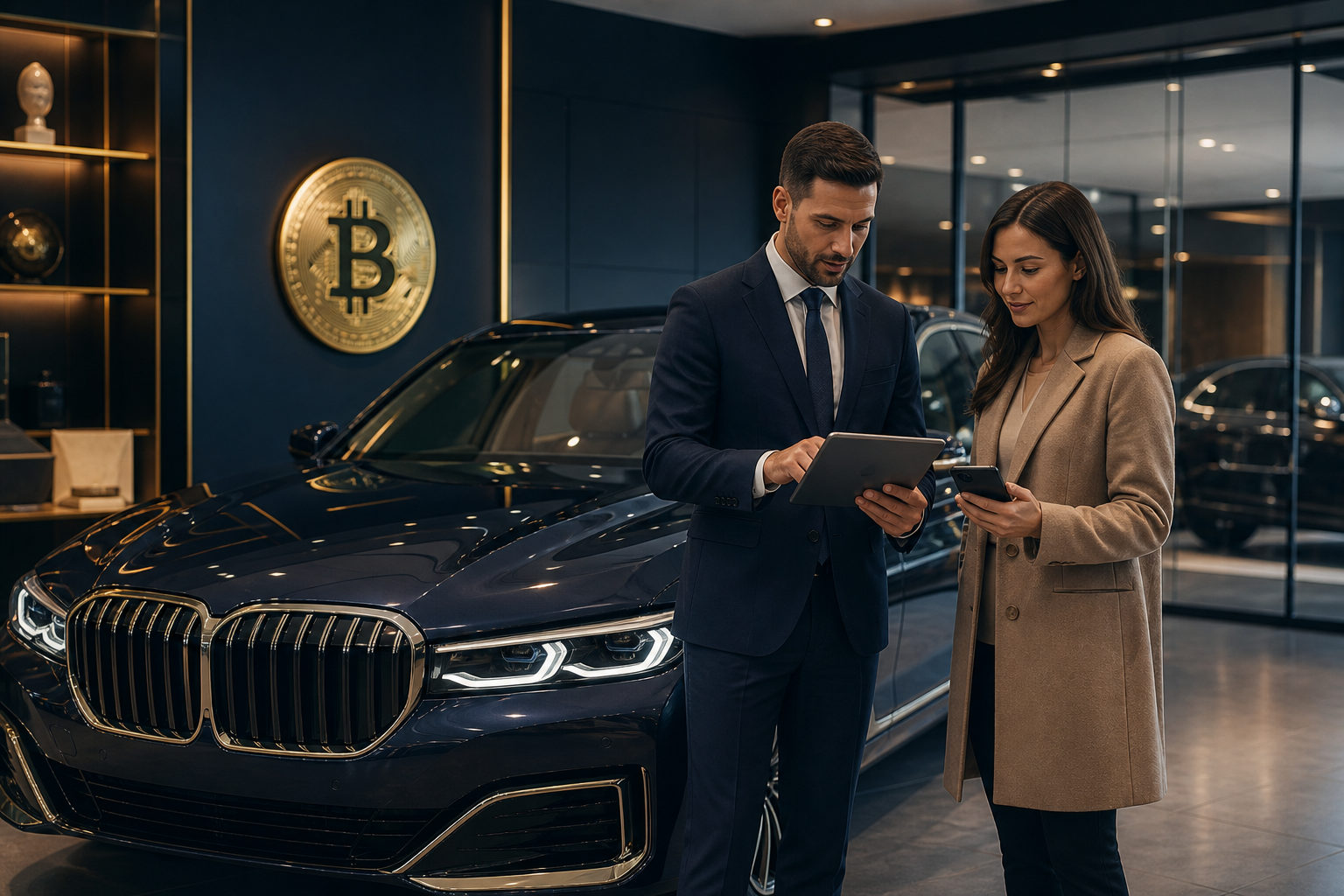
Does BMW accept Bitcoin? There is no single brand-wide answer. In practice, whether you can pay with BTC depends on the specific seller, the dealer's payment setup, and whether crypto is taken directly or converted into dollars through a third party.
Start with the real question: who is actually selling the car
Many buyers search this topic as if BMW were one seller with one payment rule. A vehicle purchase usually happens through a specific dealership, retail entity, or used-car business. That distinction matters more than the badge on the building.
A statement such as “we accept crypto” can mean several different things. It may refer to a local dealership policy, a temporary arrangement through a payment processor, or a case-by-case manual process handled by finance staff. None of those automatically means every BMW location accepts Bitcoin.
Your first job is to identify the legal seller. Ask for the full company name, confirm who will issue the sales contract, and verify who will receive funds. If those points stay vague, stop there and ask again before discussing payment.
Step 1: confirm the seller and get the answer in writing
Action
Ask the dealership or seller to state in writing whether Bitcoin payments are accepted for the vehicle you want. Request the name of the contracting entity, the billing entity, and the party responsible for delivery.
Why this matters
People often confuse brand recognition with payment policy. A dealership may be authorized to sell BMW vehicles while still following its own finance and risk procedures. The only answer that counts is the one tied to your specific seller and your specific order.
What to watch
- Do not rely on a social media reply, an ad, or a sales chat message alone.
- Do not treat “we can probably arrange it” as a valid payment policy.
- If the seller avoids naming the exact company taking payment, treat that as a warning sign.
Step 2: ask what “accepts Bitcoin” actually means
Action
Ask the seller to explain the payment model. Are they taking BTC directly into a wallet they control, or are they using a processor that converts your crypto into dollars at the time of payment?
Why this matters
These two setups lead to very different outcomes for pricing, settlement, accounting, and refunds. On the surface, both look like buying a BMW with Bitcoin. Under the hood, they are not the same transaction path.
If a third party converts the funds right away, the dealership may only care about the final dollar amount received. If the seller takes BTC directly, then wallet control, confirmation rules, and refund handling become even more important.
What to watch
- Ask who generates the payment request and where you will see the official wallet address or QR code.
- Ask when the payment is treated as complete.
- Be careful if the address changes mid-process or if someone asks you to send a “test amount” to one address and the rest to another.
Step 3: get the full payment flow before sending anything
Action
Request a written outline of the process. It should cover how the order is placed, when the payment request is issued, where the wallet address appears, how you submit proof of payment, who confirms receipt, when delivery is scheduled, and how cancellations are handled.
Why this matters
Large purchases create problems when different departments operate with different assumptions. Sales may say one thing, finance may require another, and delivery may wait for a separate internal sign-off. A written flow reduces confusion before money moves.
It also gives you a chance to spot missing pieces. If the seller cannot explain failed payments, duplicate transfers, or address verification, the process may not be ready for a high-value crypto transaction.
What to watch
- Do not accept a bare wallet address sent in a casual chat as enough proof.
- The payment details should match an order, invoice, or formal payment notice.
- If the process depends only on one employee's messages, the control structure may be weak.
Step 4: understand how the price is set
Action
Ask whether the vehicle is priced in dollars and then converted into BTC at payment time, or whether another method is used. Ask who pays processing charges, who covers the network fee, and how long any quoted amount stays valid.
Why this matters
Without live market data, no honest article should give you a current purchase figure. What matters is the pricing method. In most real-world cases, the car itself is still accounted for in dollars, while Bitcoin is simply the payment rail.
You need to know what triggers a repricing. A quote that looks acceptable can become a dispute if the dealer and the buyer are using different assumptions about timing, confirmation, or fee treatment.
What to watch
- Do not assume accepting BTC means the car is cheaper.
- Do not mix up a blockchain network fee with a dealer processing charge.
- If the seller promises a fixed conversion without clear conditions, ask for the exact rule in writing.
Step 5: verify the wallet address through separate channels
Action
Before sending BTC, verify the receiving address through at least two independent channels. One may be the formal order or payment notice. Another should come from a separate confirmation route, such as a call back to a published dealership number.
Why this matters
Address substitution is one of the simplest and most damaging crypto payment scams. If you send Bitcoin to the wrong address, the transfer on the blockchain is generally not reversible. That makes prevention much more important than cleanup.
What to watch
- Do not trust an address from a search ad, a forwarded image, or an unofficial “crypto payment page.”
- Do not scan a QR code from an unknown source.
- Save the contract, invoice, address verification notes, and transaction hash for your records.
Step 6: sort out refunds before payment, not after
Action
Ask what happens if the order is canceled, the delivery is delayed, the vehicle specification changes, or finance terms shift. Will the refund be sent in BTC, or will it be handled in dollar terms? Will it go back to the original payment source, or do you need to provide a wallet later?
Why this matters
Most buyers focus on whether they can pay. The harder question is what happens if the deal changes. A missing refund rule can turn a manageable issue into a long dispute, especially when price movement enters the conversation.
What to watch
- If the contract mentions Bitcoin payment but says little about refund handling, pause and ask for detail.
- Refunds should follow the documented order and the documented seller, not an unrelated person or company.
- If anyone asks you to send extra crypto to “release” a refund, treat that as a fraud signal.
Step 7: ask about identity checks and source-of-funds review
Action
Check whether the seller requires identity documents, proof of address, confirmation that the payer and buyer are linked, or added review for crypto-funded purchases. Find this out before payment so the transaction does not stall after funds have moved.
Why this matters
Vehicle purchases often involve stricter checks than ordinary retail payments. The seller may want the contract party, invoice details, registered owner, and payment source to line up. That does not automatically mean something is wrong. It means the transaction needs structure.
What to watch
- Do not send personal documents to an unverified personal email address or chat account.
- If one person pays and another person takes title to the car, ask whether that arrangement is accepted.
- Review requests should have a clear purpose and a clear scope.
Step 8: run your own anti-scam checklist
Action
Before sending BTC, check each of these points: the legal seller is clear, the public contact details match the people you are speaking with, the address has been verified twice, the refund path is written down, the sales and finance teams tell the same story, and no one is pushing you to move fast without paperwork.
Why this matters
Fraud works by creating urgency and confusion. A car purchase is already complex. Add Bitcoin and the need for careful verification goes up. Slowing down is not a sign of hesitation; it is part of proper transaction control.
What to watch
- A legitimate process should survive scrutiny.
- Avoid any setup that bypasses formal paperwork and points you to a personal wallet.
- If the seller cannot explain payment finality in plain language, future disputes become more likely.
If a BMW seller does take Bitcoin, that still does not answer every practical question
You still need to review the ordinary purchase terms: vehicle description, options, deposit handling, final payment timing, cancellation rights, and delivery conditions. Bitcoin changes the method of payment. It does not remove the need for a solid sales contract.
You should also be realistic about convenience. For some buyers, paying with BTC adds extra review, recordkeeping, and operational risk. It only makes sense if the process is clear on both sides and you are comfortable handling a blockchain transfer correctly.
How to check this without relying on random third parties
If you do not want to depend on a broker or a crypto payment middleman, start with the seller's official public channels. Contact the dealership directly, ask whether it accepts crypto-funded purchases, and request a written payment process tied to an actual order.
Treat outside ads and consultant claims as leads, not proof. If someone cannot clearly explain the seller, the delivery responsibility, and the refund rule, there is no good reason to send Bitcoin first and ask questions later.
FAQ
Can I buy any BMW with Bitcoin at any dealership?
No. Acceptance depends on the specific seller and its payment arrangements, not on the brand name alone.
The safest approach is to get a written answer tied to your order and to verify the legal entity receiving payment.
If a dealer says it accepts crypto, is that enough?
No. You still need to check how payment works, how the wallet address is verified, and how refunds are handled.
A short statement from sales is not a substitute for contract language and a formal payment notice.
How is the final amount usually calculated when paying in BTC?
In many cases, the vehicle is still priced in dollars and the BTC amount is calculated at the payment stage, or a processor converts the crypto into dollars right away.
The key questions are the quote validity period, repricing rule, fee treatment, and the point at which payment is considered complete.
Will a canceled order always be refunded in Bitcoin?
Not necessarily. That depends on the seller's written policy and the transaction structure.
You should ask about the refund asset, timing, and destination wallet before making payment, not after a problem appears.
How do I avoid sending Bitcoin to a scam address?
Use independent verification. Do not rely on a single chat message or a screenshot of a QR code.
Confirm the address through a second trusted channel and make sure it matches the formal order documentation.
If you are trying to find out whether BMW accepts Bitcoin, the most useful order is simple: identify the seller, demand the written payment flow, and verify the wallet address and refund rule before any BTC leaves your wallet.
Disclaimer: This article is for informational and educational purposes only and is not investment, financial, or legal advice. Crypto assets are highly volatile and you could lose your entire investment. Do your own research and decide carefully.