
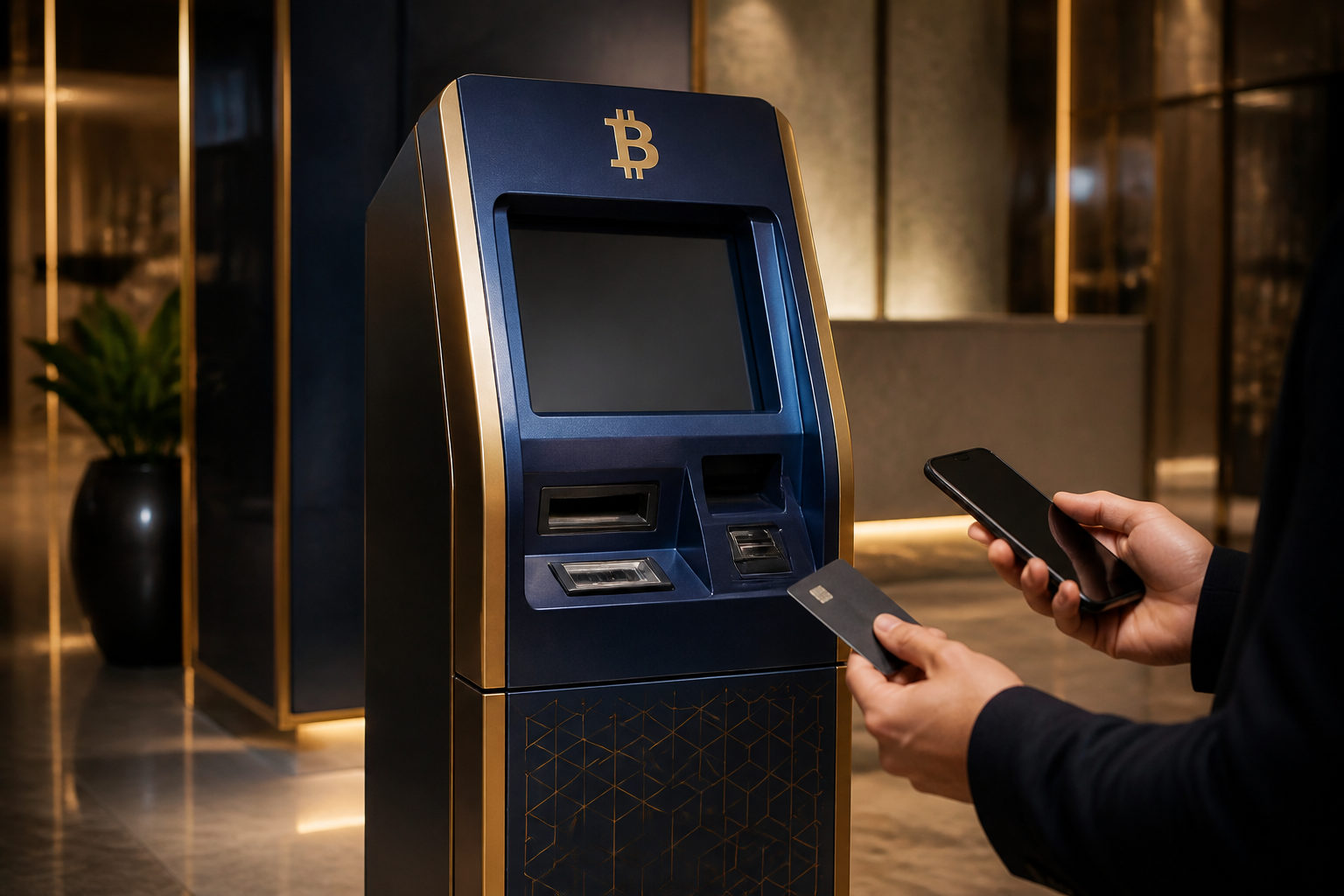
Most Bitcoin ATMs are not directly linked to your bank account. Whether a machine asks for card or account details depends on how it works, how you pay, and what checks the operator requires.
Start with the basic answer: a Bitcoin ATM is not the same as a bank ATM
People often assume a Bitcoin ATM must work like a regular cash machine because both use the term ATM. That assumption causes a lot of confusion. A bank ATM is built around your bank account. A Bitcoin ATM is usually built around buying or selling bitcoin through an operator's service, which may or may not involve bank details at some point in the process.
That is why the right answer is not a clean yes or no. Some machines let you insert cash and send bitcoin to your wallet without asking for a bank account. Others may ask for card details, account information, identity verification, or an operator account before the transaction can go through. The machine itself does not tell you enough. The setup behind it matters.
If you want the short version, keep this in mind: a Bitcoin ATM usually does not need to be tied to your bank account, but some transactions, some operators, and some verification flows may still bring bank information into the process.
Step 1: Identify what kind of machine you are using
Before you scan a wallet address or insert cash, check what the machine actually does. Some Bitcoin ATMs are buy-only machines. You put in cash, confirm the transaction, and the bitcoin is sent to your wallet. Others support both buying and selling. In a sell transaction, you may have to send bitcoin first and then collect cash or complete additional checks before funds are released.
This matters because the question of bank account linkage often depends on the direction of the trade. Buy-only machines can be simpler. When selling, asking for refunds, or dealing with interrupted transactions, operators may ask for more information, which can include bank or card details.
Do not rely on branding alone. A machine labeled Bitcoin ATM may still be connected to an operator platform that handles verification and payment off-screen. Read each prompt carefully. Watch for terms such as account registration, identity check, refund method, card entry, phone verification, or transaction limits. Those clues tell you whether the process stays simple or moves into a more account-based flow.
Step 2: Check the payment method first
The fastest way to judge whether your bank account is likely to be involved is to look at the payment method. Payment method shapes the whole transaction.
Cash purchase
If the machine accepts cash, many setups let you feed in notes and receive bitcoin in your own wallet. In that situation, the machine often does not need direct access to your bank account because the funding source is physical cash, not a debit from your account.
The reason is straightforward. The machine is acting as a point where cash is exchanged for bitcoin. Your banking app, debit card, and bank account are not necessarily part of the payment rail. The main caution here is not your bank account but your wallet address. If you send funds to the wrong address, the mistake is usually not reversible.
Card or account-based payment
Some operators add a card payment step, ask for account details, or require you to create an operator account before using the machine. Once that happens, you should no longer think of the machine as fully separate from your bank relationship.
There are practical reasons for that design. The operator may use the machine as a physical entry point while settlement, fraud checks, and refunds happen in a back-end account system. Your caution point is simple: if the screen asks for card authorization, account names, or refund account details, pause and review the terms before you continue.
You should know what happens if the transaction fails, whether a refund is possible, and what information the operator will keep. If that is not clear, do not submit your bank information just to see what happens next.
Selling bitcoin for cash
When you sell bitcoin through a machine, the end result might be cash in hand, so many people assume a bank account cannot be involved. That is not always true. Some operators still require registration, identity checks, or order validation before allowing cash withdrawal. Others may handle failed orders or exceptions through an account-based support flow.
The reason is risk control. Sell transactions can attract more scrutiny because the operator needs to confirm the transfer, detect suspicious behavior, and manage disputes. Even if the machine pays out cash, the process before that point may still ask for information beyond a simple wallet address.
Step 3: Review every piece of information the machine asks for
This is the step many first-time users skip, and it is where confusion starts. People ask whether Bitcoin ATMs are linked to a bank account, but what they really need to know is what information the machine will collect from them.
Go through the prompts one by one:
- Does it only ask for a wallet address? That is often a simpler flow, but address accuracy becomes critical.
- Does it ask for a phone number or text verification? That is not the same as linking a bank account, but it does move the transaction into a more traceable identity tier.
- Does it ask for an ID scan or a live photo? That is usually a compliance or fraud check, not bank linking by itself, but it still increases the amount of personal data you hand over.
- Does it ask for card details, account holder name, or refund account information? If yes, bank-related information has entered the process.
- Does it push you to an app or website to finish the transaction? If so, the machine may only be the front end while the operator platform handles the real transaction flow.
Why does this distinction matter? Because users often treat phone verification, identity checks, and bank account linking as the same thing. They are not. A phone number is not a bank account. An ID scan is not the same as authorizing a debit. Still, the more sensitive the requested data becomes, the more careful you should be.
A useful rule is this: if the machine or operator does not clearly explain what is being collected, who keeps it, and how failed transactions are handled, stop there. Lack of clarity is a risk signal on its own.
Step 4: Use the right order of operations
If you decide to proceed, do things in the right order. Set up your own bitcoin wallet first. Confirm the machine's payment method second. Only after that should you insert cash or approve any payment step.
The reason is simple. Bitcoin transfers usually cannot be reversed the way some card disputes can. If you pay first and start looking for a wallet address after that, you are more likely to rush, scan the wrong code, paste the wrong address, or follow bad instructions from someone nearby.
Keep three practical checks in mind. First, use a wallet you control. Do not let a stranger send you a receiving address and claim they will hold the bitcoin for you. Second, verify the address before and after scanning, at least by comparing the beginning and end. Third, if anyone tells you to send the bitcoin to a different address for testing, verification, or protection, stop at once. That is not a normal self-service Bitcoin ATM flow.
If the machine asks for bank or card information, ask two questions before entering anything: is this information necessary to complete the transaction, and what happens if the transaction fails? If the answer to either question is vague, do not continue.
Step 5: Learn the scams that mix bank accounts with Bitcoin ATMs
This topic comes up so often because criminals like to exploit the confusion. They know many people hear ATM and assume the process must be official, familiar, and tied to normal banking safeguards. That is exactly what scammers want.
Scam pattern 1: fake bank or government instructions
A caller may claim your bank account is under threat, frozen, flagged, or under review. Then they tell you to go to a Bitcoin ATM to protect your funds, verify ownership, or move money to a so-called safe wallet. This is a classic trick.
The logic is false from the start. A real bank, court, tax office, police agency, or support desk will not tell you to move money through a Bitcoin ATM to secure your account. If anyone connects an account problem to a Bitcoin ATM transfer, stop the conversation immediately.
Scam pattern 2: extracting your banking details before guiding the ATM transaction
Some frauds do not begin with the machine. They begin with a request for your online banking details, card number, or account login. After that, the scammer keeps you on the phone and walks you through a Bitcoin ATM transaction step by step.
This is dangerous because you may expose both sides of your finances at once: your bank information and your crypto transfer activity. Never let a stranger direct your actions at a Bitcoin ATM over a phone call, messaging app, or remote screen session. If someone tells you to read out codes, follow instructions in real time, or keep the call open while you buy bitcoin, end it.
Scam pattern 3: promises that failed transactions will automatically return to your bank account
Another common line is that if the bitcoin does not arrive, the system will automatically refund your bank account. You should not trust that statement unless it is clearly shown in the operator's own terms on the machine or official support materials.
Refund handling depends on the operator's policy, the payment method used, the order status, and the verification stage. There is no universal promise that every failed Bitcoin ATM transaction goes straight back to a bank account. Ignore any verbal guarantee made by a stranger.
Step 6: Keep records before and after the transaction
Before using the machine, confirm three things: whether it needs cash, a card, or account registration; whether the receiving wallet is yours; and whether the fee and failed-transaction process are clearly explained. After the transaction, keep the receipt or order reference, note the machine location, and check your wallet for status updates.
This is not busywork. Problems with Bitcoin ATMs often come later, not during the first screen. Users may wonder what data they submitted, whether the order is pending, or how support can trace a transaction. Without a receipt or order reference, sorting that out gets harder.
Also protect your records. A receipt may include a phone number, partial account information, or a transaction code. Do not post it online and do not send it to random people who offer to help.
FAQ
Do Bitcoin ATMs always require a bank account?
No. Many machines let users buy bitcoin with cash and do not require direct bank account linking for that step. Still, some operators may ask for card details, account information, or registration depending on the transaction flow.
The machine name alone does not answer the question. You need to review the operator's prompts and requirements on that specific device.
If I use cash, does that mean my bank account is completely out of the process?
Not always. Cash can remove the bank account from the payment source, but the machine may still ask for a phone number, ID verification, or other personal data. In some cases, extra account details may appear if the order fails or moves into a support process.
Cash purchase reduces bank involvement in many cases, but it does not guarantee a fully anonymous or data-free transaction.
When selling bitcoin, will the machine send money to my bank account?
Sometimes the result is cash, but there is no single rule for every machine. Some operators may add registration, identity review, or other processing steps before the payout is completed.
If the payout method and failure handling are not clear on screen, do not send your bitcoin until you understand the process.
Is phone verification the same as linking a bank account?
No. A phone number check, an identity review, and bank account linking are different things. They should not be treated as interchangeable.
That said, each extra data request raises the privacy stakes. Review what the machine wants and decide whether the trade is worth the information you are being asked to provide.
Can I follow instructions from someone who says they will guide me through the machine?
No. That is one of the clearest warning signs of a scam, especially if the person mentions account problems, refunds, or security checks. A normal Bitcoin ATM transaction should not require live coaching from a stranger.
If anyone tells you to stay on the phone, read verification codes aloud, or buy bitcoin to solve a bank issue, walk away from the machine.
If your goal is simply to tell whether a Bitcoin ATM is linked to a bank account, use a four-part check: identify whether you are buying or selling, check the payment method, review every requested data field, and confirm the refund and receipt rules. If any part is unclear, do not hand over cash, bank details, or bitcoin.
Disclaimer: This article is for informational and educational purposes only and is not investment, financial, or legal advice. Crypto assets are highly volatile and you could lose your entire investment. Do your own research and decide carefully.