
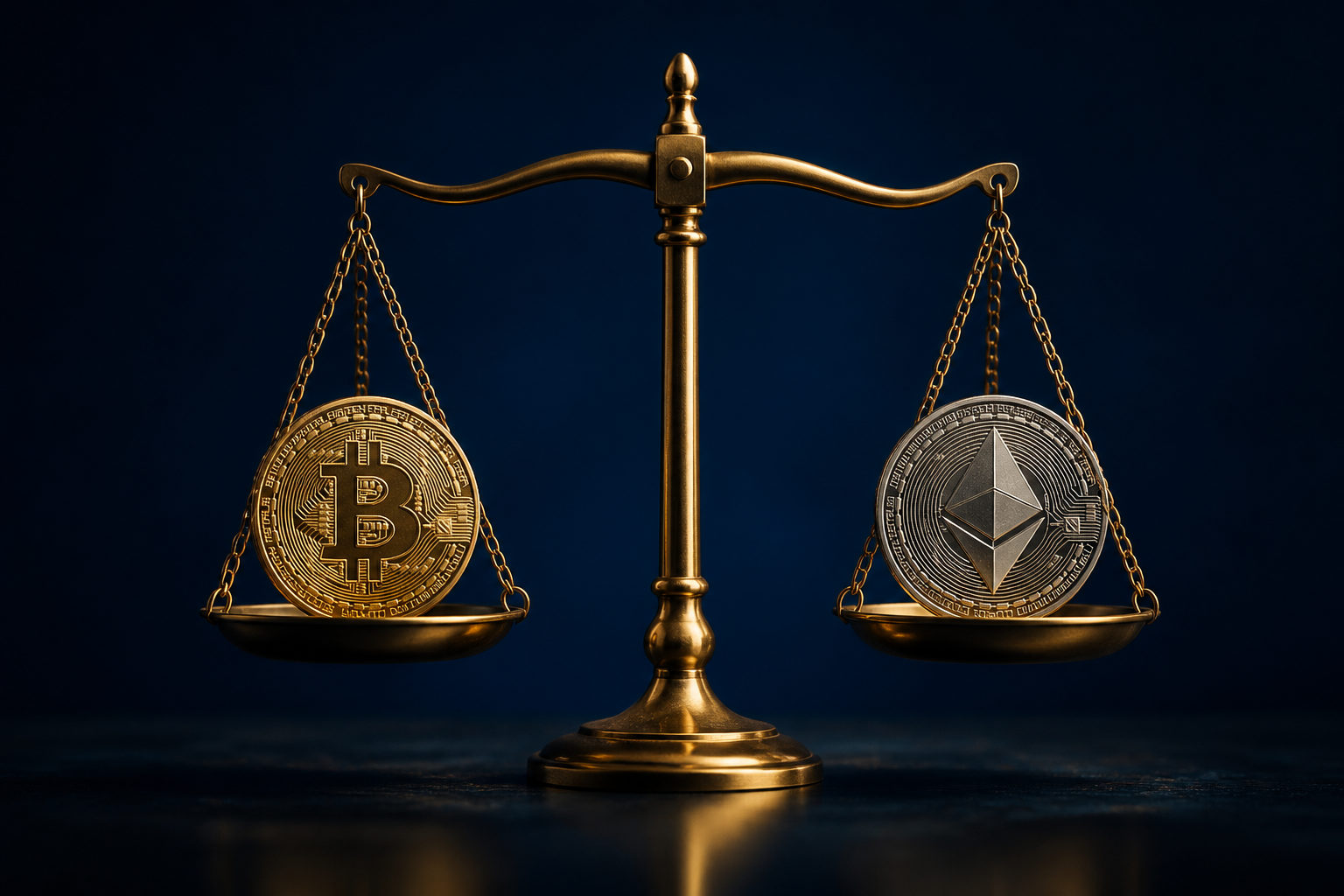
Bitcoin or Ethereum is not a simple better-or-worse call. Bitcoin usually suits people who want a scarce asset with a clear monetary story, while Ethereum often fits those who want exposure to a blockchain network built for applications.
They solve different problems
People often compare Bitcoin and Ethereum as if they were direct substitutes. They are both major crypto assets, but their core purpose is different enough that the comparison can be misleading if you stop at price alone.
| Asset | How it is usually discussed / viewed | Key appeal or supporting points | What that means for buyers |
|---|---|---|---|
| Bitcoin | Usually discussed as a scarce digital asset | Its appeal comes from a fixed supply cap of 21 million coins, a relatively simple rule set, and a history that starts with the 2008 white paper and the 2009 January genesis block | For many buyers, that makes Bitcoin easier to understand and easier to hold through market swings |
| Ethereum | Best viewed as a programmable blockchain network | It supports smart contracts and a wide range of on-chain activity | The case for Ethereum depends not only on the asset itself but also on how useful and active the network remains over time |
Which is the better investment depends on your goal
If your real question is whether Bitcoin or Ethereum is a better investment, start with your objective rather than market tribalism. Are you trying to hold a scarce digital asset for the long run, or are you looking for exposure to a network that may benefit from broader crypto usage?
| Asset | Who it tends to attract / appeal to | Core thesis | What investors are following or relying on | Trade-off |
|---|---|---|---|---|
| Bitcoin | Tends to attract investors who prefer a narrow thesis | Fixed supply, decentralization, and a monetary policy that is not tied to any central authority | The halving cycle, which happens about every 4 years or every 210,000 blocks, also gives Bitcoin a framework many investors follow closely | Something easier to explain |
| Ethereum | Can appeal to investors who are comfortable with a wider set of moving parts | Its upside case is tied to developer activity, user demand, on-chain applications, and the staying power of its ecosystem | The market may re-rate the asset based on those factors | That can create more ways for the market to re-rate the asset, but it also creates more things that can go wrong |
So the better investment is often the one you can explain in plain language before you buy it. If your thesis depends on buzzwords or blind faith, neither choice is good enough yet.
Risk is different, not absent
| Asset | Risk profile | Shared market risks | Additional or specific risks | Investor implication |
|---|---|---|---|---|
| Bitcoin | Not low-risk just because its story is cleaner | It can still go through sharp drawdowns, and it is still sensitive to liquidity conditions, regulation, and broad risk appetite across markets | A simple thesis does not remove volatility | |
| Ethereum | Carries those same market risks, then adds network-specific ones | Those same market risks | You are also judging whether developers keep building, whether users keep showing up, whether applications stay relevant, and whether competing chains pull activity away | In practice, that means Ethereum often asks more from the investor |
This is where many comparisons go off track. People ask whether Bitcoin or Ethereum is better, but what they really need to ask is which risk profile they can live with when the market turns against them.
How to choose between Bitcoin and Ethereum
A useful decision process is more practical than any online argument. Before buying either asset, answer a few questions honestly.
| Question | Bitcoin | Ethereum | Note |
|---|---|---|---|
| What is your main reason for buying? | Bitcoin often fits a long-term scarcity thesis | Ethereum often fits a network-growth thesis | |
| How much complexity can you follow? | Bitcoin usually requires less ongoing ecosystem tracking | Ethereum often requires more research | |
| How do you handle volatility? | Both can move hard in either direction | Both can move hard in either direction | Your reaction matters more than your prediction |
| What is your time frame? | A short-term trader and a long-term allocator can look at the same asset and reach different conclusions |
Some investors solve the problem by owning both. In that setup, Bitcoin may serve as the core holding and Ethereum as a higher-variance growth position. That approach only works if you decide your allocation rules in advance instead of changing them whenever sentiment shifts.
FAQ
Is Bitcoin or Ethereum better for long-term investing?
Bitcoin is often the cleaner choice for investors who want a simple long-term thesis built around scarcity. Ethereum may suit people who believe blockchain applications will keep expanding and are willing to monitor that thesis more closely.
Should beginners buy Bitcoin or Ethereum first?
Many beginners start with Bitcoin because its core idea is easier to grasp. Ethereum can still make sense first, but only if you understand that you are buying into an asset tied to a broader network and application ecosystem.
Is Ethereum a better investment than Bitcoin?
That depends on what you mean by better. Ethereum may offer a broader growth story, but it also comes with more execution risk, more competition, and more variables for investors to track.
Is Bitcoin safer than Ethereum?
If safer means easier to understand, Bitcoin often wins that comparison. If safer means less painful in a downturn, the answer depends just as much on your entry, position size, and discipline as it does on the asset itself.
How should I check price before buying?
Without live market data, the right move is to use a major pricing platform and compare spot price, liquidity, and trading activity across venues. Do not rely on memory or headlines when timing an entry.
Use a framework before you place an order
The best answer to the Bitcoin versus Ethereum question is usually personal, not universal. Write down why you are buying, how long you plan to hold, what kind of drawdown you can tolerate, and what would make you reduce exposure; if you cannot answer those points yet, start small and keep researching before committing more capital.
Disclaimer: This article is for informational and educational purposes only and is not investment, financial, or legal advice. Crypto assets are highly volatile and you could lose your entire investment. Do your own research and decide carefully.