
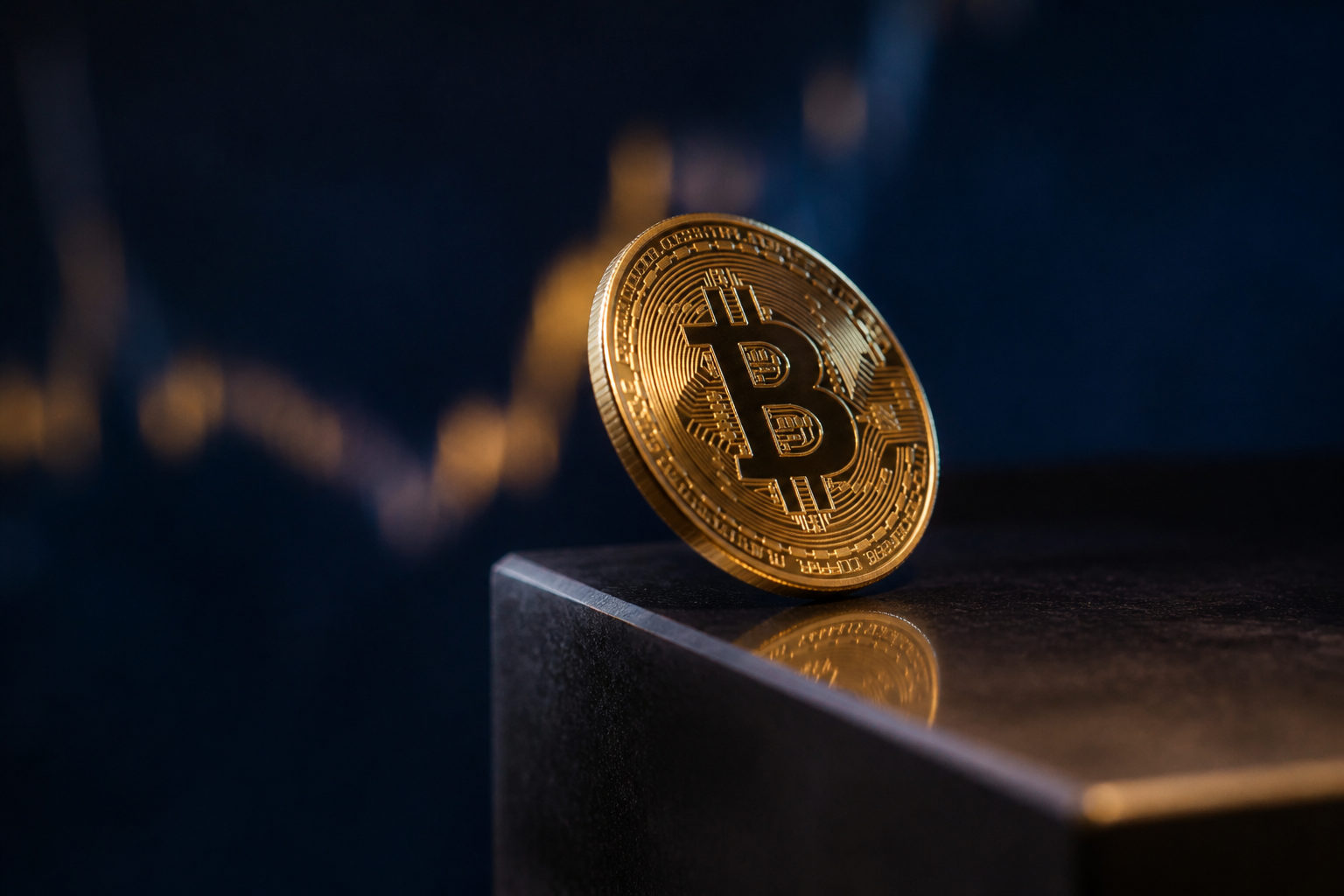
Bitcoin is not a stable investment. It is better viewed as a volatile asset that may fit a risk budget, not as a place for cash reserves, short-term savings, or money that must stay predictable.
What “stable investment” usually means
When people ask whether an investment is stable, they are usually asking three things at once: does it move in a relatively calm way, can it hold value without deep drawdowns, and is there a clear method for judging what it should be worth. By that standard, Bitcoin does not qualify as stable.
Its price reacts quickly to changes in risk appetite, liquidity conditions, regulation headlines, and market positioning. Optimism can push prices higher in a short span, while fear can produce sharp declines. Even investors who believe in the long-term case may find the path hard to sit through.
| Dimension | Typical stable investment traits | Bitcoin in practice |
|---|---|---|
| Price behavior | Lower volatility and smaller short-term swings | Large swings and frequent pullbacks |
| Valuation anchor | Cash flow, coupons, or clearer balance-sheet logic | Driven more by supply, demand, and market conviction |
| Holding experience | Relatively smooth | Often psychologically demanding |
| Best use | Capital preservation or near-term needs | Small allocation within a higher-risk portfolio |
That does not mean Bitcoin has no place in investing. It means the role has to be defined correctly. Treating a volatile asset as if it were a stable one creates problems long before the market proves you right or wrong.
Why some investors still make a long-term case for Bitcoin
The long-term argument for Bitcoin starts with its rules. Its total supply has a hard cap of 21,000,000 BTC, with issuance expected to continue until around 2140. The network targets about one block every 10 minutes. The block subsidy is cut in half every 210,000 blocks, roughly every four years.
Those halving events took place on 2012-11-28, 2016-07-09, 2020-05-11, and 2024-04-19. After the 2024 halving, the current block reward is 3.125 BTC, which means the network adds about 450 BTC per day in total. For many investors, that schedule matters because new supply is transparent and difficult to change on a whim.
This is one reason Bitcoin is often discussed as a long-duration asset rather than a stable one. A predictable issuance schedule can support a long-term thesis. It cannot guarantee a calm market price. Stable supply rules and stable returns are two different ideas.
That distinction is the center of the answer. Bitcoin can have a fixed monetary policy while still trading in a highly unstable way.
Why price stability is hard for Bitcoin
Limited supply alone does not create stable pricing. Demand still moves. And in Bitcoin, demand can shift fast because different groups use the asset for different reasons. Some hold it as a long-term store-of-value bet. Some trade it tactically. Some enter only when momentum is strong.
Those groups do not respond to news in the same way. Long-term holders may ignore a short burst of volatility. Short-term traders may rush to reposition. The market price ends up reflecting a mix of conviction, fear, leverage, and liquidity, all changing in real time.
There is also no single valuation model that settles the debate. A bond can be discussed through coupons and credit risk. A stock can be examined through earnings, margins, and balance-sheet quality. Bitcoin does not produce corporate earnings or pay a fixed yield. Investors are left to debate scarcity, adoption, settlement utility, and macro appeal. That keeps disagreement high, and disagreement often shows up as volatility.
| Driver | Effect on stability | What it means for investors |
|---|---|---|
| Market sentiment | Rapid shifts between optimism and fear | Short-term prices can overshoot in both directions |
| Liquidity conditions | Risk assets often rise and fall with available liquidity | Macro changes can amplify moves |
| Regulatory expectations | Policy signals change risk appetite | Headline risk can be material |
| Holder mix | More short-term capital can mean more churn | The investor base affects price behavior |
| Issuance schedule | New supply is transparent | Useful for long-term analysis, not a shield against volatility |
That is why asking whether Bitcoin is stable can be slightly misleading. The better question is whether your plan can handle an unstable asset without forcing bad decisions.
Who should be especially careful
Bitcoin is a poor fit for money that has a job to do soon. Emergency funds, rent, tuition, and near-term living expenses need reliability more than upside. If you might need to sell during a weak stretch, volatility becomes a practical risk rather than a paper one.
It is also a bad fit for investors who equate conviction with concentration. A volatile asset can dominate a portfolio if position sizing is not controlled. Once that happens, normal price swings start to affect sleep, spending decisions, and discipline. Many losses come from forced selling and emotional reactions, not from being wrong on the idea itself.
Another issue is operational risk. Owning Bitcoin is not just a market call. Investors also need to understand exchange risk, wallet choices, and the responsibility that comes with private-key control. A person can be directionally correct and still run into trouble through poor storage or weak security practices.
| Situation | Fit for Bitcoin? | Why |
|---|---|---|
| Money needed soon | No | Volatility can disrupt real-world cash needs |
| High tolerance for drawdowns | Better fit | More likely to stay with a long-term plan |
| Primary goal is stability | No | Bitcoin is not a low-volatility instrument |
| Small, long-term allocation | Reasonable to consider | Closer to its actual role in a portfolio |
| Little understanding of custody | Learn first | Operational mistakes can be costly |
How to think about Bitcoin in a portfolio
For most people, the right framing is not “Is Bitcoin safe enough to act like cash?” It is “Can I hold a volatile asset without letting that volatility control my behavior?” That shift matters because it pushes the focus toward sizing, time horizon, and purpose.
A practical approach starts by separating money by function. Funds for near-term obligations should stay in instruments built for stability and liquidity. Capital that is genuinely long-term and can tolerate large swings is the only pool that makes sense to evaluate for Bitcoin exposure.
- Define the job of the money before buying the asset.
- Keep position size small enough that a deep drawdown would not force a sale.
- Do not confuse a long-term thesis with a permission slip to ignore execution and custody.
- Use real-time market data from established price trackers when checking the current Bitcoin price.
- Decide in advance whether you will leave coins on an exchange or use a wallet you control.
One more point helps new investors: you do not need to buy a whole coin. The smallest unit is 1 satoshi, equal to 0.00000001 BTC, or one hundred millionth of a bitcoin. Thinking in whole coins can create false pressure and lead people to commit too much capital too quickly.
Bitcoin also carries a cultural and historical dimension that attracts long-term holders. The white paper, Bitcoin: A Peer-to-Peer Electronic Cash System, was published by Satoshi Nakamoto on 2008-10-31, and the genesis block arrived on 2009-01-03. Those facts matter because they show how long the system has been operating under publicly known rules. They do not make the asset stable, but they help explain why people continue to evaluate it as a serious long-term monetary experiment.
FAQ
Is Bitcoin suitable for conservative investors?
Usually no. Conservative investors tend to care most about lower volatility, predictable access to funds, and a smoother holding experience. Bitcoin does not consistently offer those qualities.
Does long-term holding make Bitcoin stable?
No. A longer time horizon may make the thesis easier to understand, but it does not remove drawdowns. The holding experience still depends on your position size, cash needs, and ability to avoid panic selling.
Does the halving make Bitcoin a stable investment?
No. A halving changes the pace of new supply, not the day-to-day psychology of the market. Since 2024-04-19, the block reward has been 3.125 BTC, which may shape long-term supply thinking without making short-term prices calm.
Do I need to buy one full bitcoin to invest?
No. Bitcoin is divisible down to 1 satoshi. The better question is not whether you can buy a whole coin, but whether the amount you buy fits your risk budget and time horizon.
How can I tell if Bitcoin volatility is too much for me?
Ask whether a major drawdown would change your spending plans, hurt your sleep, or pressure you to sell. If the answer is yes, the position is likely too large or the asset is the wrong fit for that pool of money.
If you are considering Bitcoin, label it correctly from the start: a volatile asset with a fixed issuance schedule, not a stable investment. That one decision will shape how much you buy, where you hold it, and whether you can stay rational when the market turns.
Disclaimer: This article is for informational and educational purposes only and is not investment, financial, or legal advice. Crypto assets are highly volatile and you could lose your entire investment. Do your own research and decide carefully.