
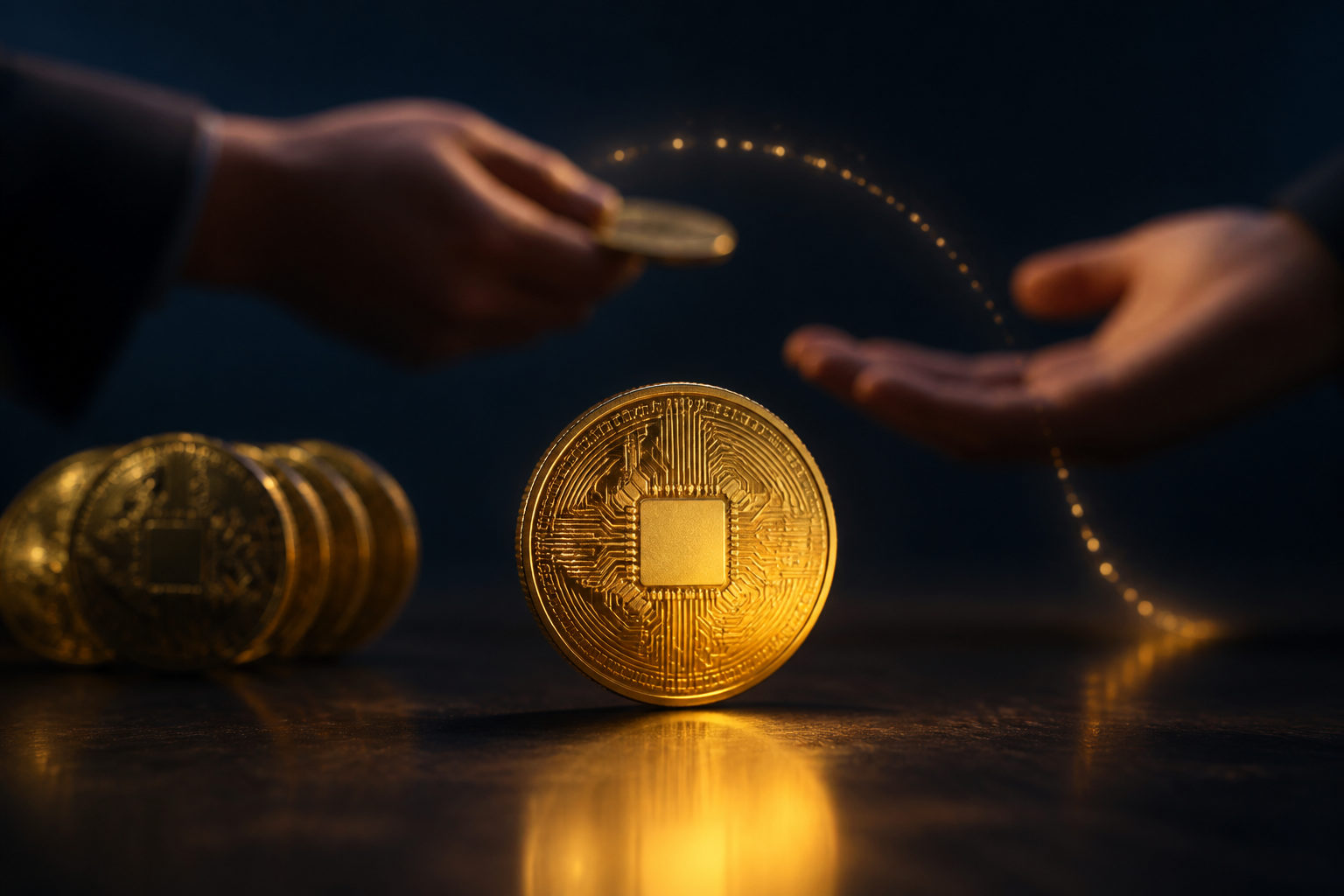
Are bitcoins worth money? Yes. Bitcoin has market value because people are willing to buy and sell it for dollars, and its supply rules, portability, and divisibility support that value. What it is worth at any moment is a separate question.
Why Bitcoin can have value in the first place
When people ask whether bitcoins are worth money, they often mean one of two things. First, can Bitcoin actually be exchanged for dollars? Second, does it have any reason to keep a price at all? The answer to the first is straightforward: if there is an active market with real buyers and sellers, Bitcoin can be exchanged for money. The second takes a bit more unpacking.
Assets do not need a physical form to have value. A bank deposit is mostly a ledger entry. A stock share is a claim recorded in financial systems. Bitcoin works as a digital bearer asset that can be transferred on its own network. That transferability matters because value is easier to assign to something that can move between holders without relying on a single company to update an internal database.
Divisibility matters too. The smallest unit of Bitcoin is 1 satoshi, equal to 0.00000001 BTC. That means a person does not need to buy a whole bitcoin to hold some exposure or use it in a transaction. A market is easier to sustain when participation is not limited to buyers of full units.
Scarcity is another major part of the story. Bitcoin has a hard cap of 21,000,000 BTC, with issuance scheduled to continue until about 2140. Market participants can inspect that rule, compare it with changing demand, and decide what they are willing to pay. That does not create a fixed price, but it does create a clear basis for pricing.
| Source of value | What it means | Why it matters |
|---|---|---|
| Active market | People buy and sell BTC for dollars | A real market price can exist |
| Scarcity | Hard cap of 21,000,000 BTC | Supply is limited by rule |
| Divisibility | 1 satoshi = 0.00000001 BTC | Ownership is possible in very small amounts |
| Transferability | Bitcoin can be moved on-chain | It can function across borders and systems |
| Transparent issuance | Creation of new BTC follows public rules | Investors can form expectations about supply |
Worth money does not mean price is stable
A lot of confusion comes from mixing up value with price direction. An asset can be worth money and still fall sharply. Bitcoin fits that description. It trades in open markets, which is exactly why its price can move fast in both directions.
Its price is set by supply and demand at the moment of trade. If more buyers want exposure than sellers want to part with, price can rise. If sellers rush to exit, or if the market becomes more cautious about risk, price can fall just as quickly. So the statement that Bitcoin is worth money should not be read as a promise of steady gains.
This is why two people can look at Bitcoin and reach different conclusions without either one misunderstanding the basic facts. One person may value it as a scarce digital asset with global transferability. Another may focus on volatility and decide it does not fit their portfolio. Both views can coexist because value in markets is expressed through changing bids and offers, not through a permanent official label.
| Common claim | Is it accurate? | Better way to read it |
|---|---|---|
| Bitcoin has value, so it must keep going up | No | Value means it can be priced, not that price only moves one way |
| Bitcoin is volatile, so it has no value | No | Volatility shows disagreement about price, not the absence of value |
| You need to buy one whole bitcoin | No | Bitcoin is divisible down to 1 satoshi |
| No central backing means no real worth | Incomplete | Markets also assign value through liquidity, scarcity, and use |
How Bitcoin’s supply rules shape its pricing logic
Bitcoin’s value story is closely tied to its issuance schedule. Satoshi Nakamoto released the white paper, Bitcoin: A Peer-to-Peer Electronic Cash System, on 2008-10-31. The genesis block followed on 2009-01-03. From the start, new coin creation was meant to follow a visible and predictable pattern rather than a discretionary one.
The block reward halves every 210,000 blocks, roughly every 4 years. That happened on 2012-11-28, 2016-07-09, 2020-05-11, and 2024-04-19. The next halving is expected around 2028. After the 2024 halving, the current block reward is 3.125 BTC, and that remains the reward until the next halving.
Bitcoin targets a new block about every 10 minutes. At the current reward level, the network adds about 450 BTC per day in total. That figure does not tell you where price will go next, but it does help frame the supply side of the market. When supply growth is relatively easy to estimate and demand changes with sentiment, adoption, and capital flows, price can swing hard as those forces meet.
This scheduled issuance is one reason many people see Bitcoin as different from assets whose supply can expand more flexibly. The rule itself does not guarantee appreciation. It does, though, give the market a concrete way to think about future dilution, scarcity, and long-term supply pressure.
| Supply rule | Stable fact | Why markets care |
|---|---|---|
| Hard cap | 21,000,000 BTC | Supports a scarcity narrative |
| Halving cycle | Every 210,000 blocks, about 4 years | New supply growth slows over time |
| Current block reward | 3.125 BTC | Sets the present issuance rate |
| Target block time | About 10 minutes | Makes supply timing easier to estimate |
| Daily new supply | About 450 BTC | Gives context for supply-demand analysis |
How to judge whether Bitcoin’s value matters to you
If your real question is whether Bitcoin can be sold for money, the answer depends on market access, liquidity, and whether there are active counterparties. If your question is whether you should own it, the right framework is more personal.
Start with volatility tolerance. Bitcoin can move sharply, and that can push people into emotional decisions at exactly the wrong time. A person who cannot sit through large price swings may still accept that Bitcoin has value while deciding it is unsuitable to hold.
Next comes purpose. Someone buying for long-term allocation is asking a different question from someone using Bitcoin for short-term trading or for direct transfers. The same asset can make sense in one context and be a poor fit in another.
Storage also changes the equation. If Bitcoin is held on an exchange, exchange risk becomes part of the decision. If it is self-custodied, private key management becomes central. Market value and safe ownership are related, but they are not the same thing.
| Decision area | Question to ask | Why it matters |
|---|---|---|
| Risk tolerance | Can you handle sharp price swings? | Determines whether holding is realistic |
| Purpose | Are you allocating, trading, or transferring? | Shapes your approach and time horizon |
| Custody | Will you trust a platform or manage keys yourself? | Affects security of the asset |
| Liquidity needs | Might you need dollars back quickly? | Influences venue choice and position size |
FAQ
Can Bitcoin really be exchanged for cash?
Yes, as long as you use a legitimate market or service where buyers and sellers are active. Its ability to trade for dollars is the clearest reason people say Bitcoin is worth money.
Why does something digital with no physical form have a price?
Markets price many non-physical assets. Bitcoin combines scarcity, transferability, divisibility, and market liquidity, which gives buyers reasons to assign value to it.
Does the halving make Bitcoin more valuable?
The halving reduces the pace of new supply. Since 2024-04-19, the block reward has been 3.125 BTC, which changes supply growth, but price still depends on demand at the same time.
Do I need to buy a full bitcoin for it to matter?
No. Bitcoin can be divided into very small units, and 1 satoshi equals 0.00000001 BTC. You can hold a fraction instead of a whole coin.
If Bitcoin is worth money, does that mean it is a good investment for me?
Not automatically. Market value answers whether Bitcoin can be priced and traded; suitability depends on your time horizon, risk tolerance, and ability to store it safely.
A practical next step is to check the live market price, review available liquidity on the venue you plan to use, and decide in advance how long you are willing to hold and where you will store the asset.
Disclaimer: This article is for informational and educational purposes only and is not investment, financial, or legal advice. Crypto assets are highly volatile and you could lose your entire investment. Do your own research and decide carefully.