
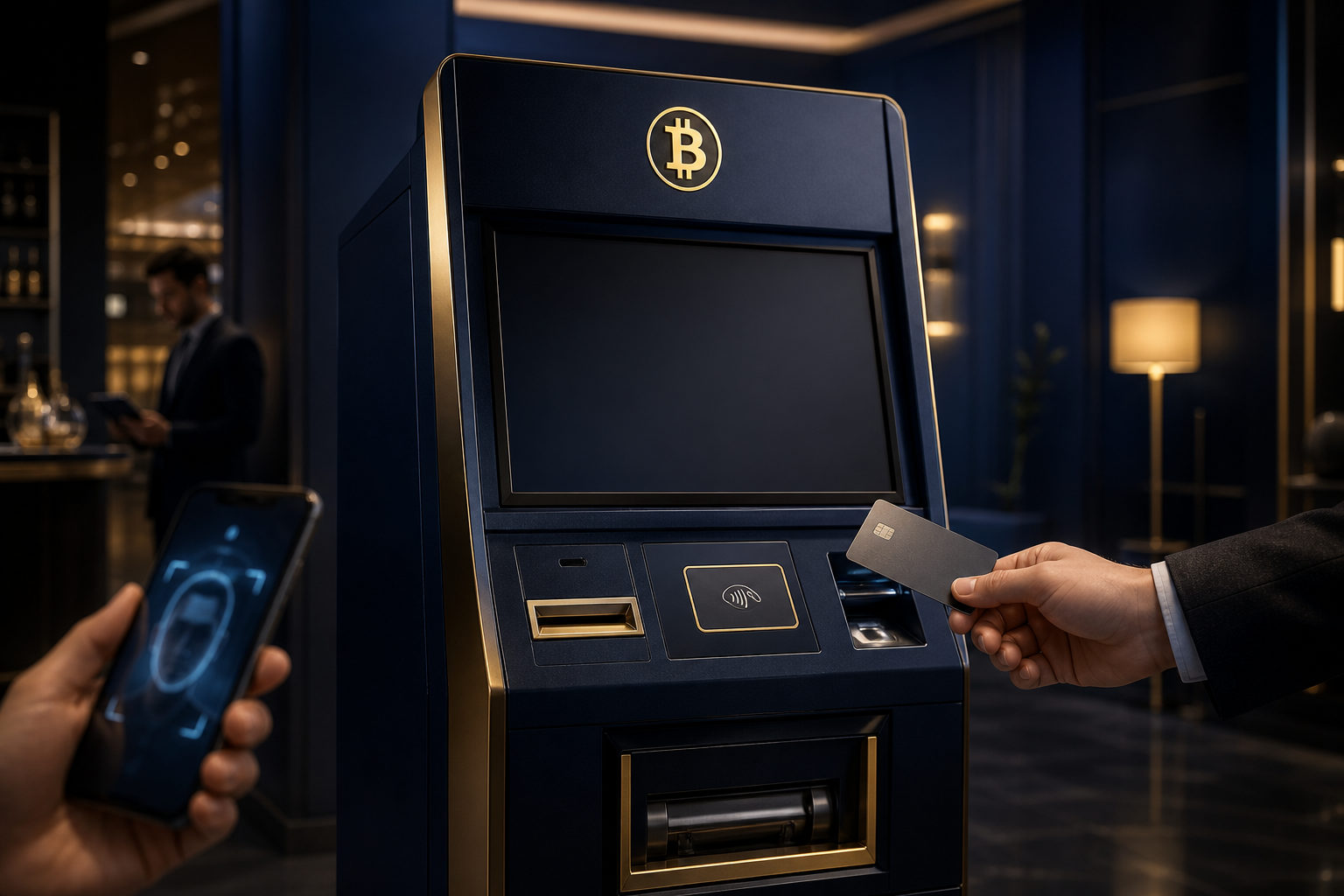
Bitcoin ATMs do not always accept credit cards. Whether you can use one depends on the machine operator, the payment options built into that terminal, your card issuer’s rules, and the identity checks required before the purchase goes through.
Start with the key distinction: a Bitcoin ATM is not a regular bank ATM
People often assume that if a machine looks like an ATM, it should work like one. That is where a lot of confusion starts. A Bitcoin ATM is a self-service crypto terminal operated by a private company, not a standard bank cash machine with one shared set of features.
Some machines are built mainly for cash purchases. Others may support card payments, but only under specific conditions. A machine can also have a card reader without accepting credit cards at all. That reader might be used for account access, loyalty programs, identity steps, or debit card transactions only.
There is another important difference. The question of whether a credit card can be used to buy crypto is not the same as whether a credit card can be used at a Bitcoin ATM. The first depends on your bank and card network rules. The second adds one more layer: what the ATM operator has chosen to support on that machine.
So the short answer is simple: some Bitcoin ATMs may allow card-based purchases, but you should never assume a credit card will be accepted unless the machine clearly says so and your issuer allows the transaction.
Step 1: Check the machine’s payment methods before you do anything else
The first step is not to insert your card. It is to confirm the payment methods on that specific machine. This matters because Bitcoin ATMs vary a lot, even when they look similar from the outside.
When you are at the machine, review the home screen, the buy menu, the fee page, and any help or support section. You are looking for clear wording on whether the machine accepts cash, bank cards, debit cards only, or card payments of any kind. If the screen is vague, do not fill in the missing details with guesswork.
This step protects you from a basic but common mistake: seeing a card slot and assuming it means credit cards are welcome. That is not a safe assumption. “Card” can mean many things in payment systems, and Bitcoin ATM operators do not all use the same wording.
The practical takeaway is straightforward. If the machine does not clearly list credit card support, treat credit card use as unavailable until you verify otherwise.
Step 2: Know the difference between credit cards, debit cards, and other card types
If the machine offers card payment, the next step is to identify what kind of card it actually accepts. Many users casually call every bank card a credit card, but payment processing does not work that way. Credit cards, debit cards, and prepaid cards are often treated differently.
There are good reasons for that. From the operator’s side, credit card payments can bring more dispute risk. From the bank’s side, crypto-related purchases are often watched more closely than ordinary retail spending. A machine might be willing to process a card transaction, while the issuer still blocks it.
That is why a failed card attempt does not automatically mean the machine is broken. The issue could be card type restrictions, issuer policy, additional verification, location-based rules, or a temporary payment channel limitation on that terminal.
Do not solve that uncertainty by trying the same thing again and again. Repeated failed attempts can trigger extra fraud checks on your account. It is better to pause, read the message on screen, and work out which part of the transaction is being rejected.
Step 3: Prepare your own Bitcoin wallet before you think about payment
Whether the ATM accepts credit cards or not, you should prepare your own Bitcoin wallet first. That is because a Bitcoin ATM usually sends the purchased bitcoin to the wallet address you provide during the transaction.
The operating step here is simple. Set up a wallet you control on your own device, complete the basic security setup, and confirm that you can access your receiving address. When the machine asks for a destination, scan only a wallet address that you personally verified.
The reason this matters is fraud prevention. A large share of ATM-related losses happen because someone is told to send bitcoin to an address they do not control. A scammer may pose as customer support, a seller, a recruiter, an authority figure, or even a friend. The script changes, but the goal is the same: get you to buy bitcoin and send it away.
The caution point is non-negotiable. Do not let another person choose the wallet address for you. Do not rely on a screenshot sent in a chat by someone you do not fully trust. And do not assume that a familiar logo or a confident voice means the address is safe.
Step 4: Review identity verification requirements before entering personal data
A lot of first-time users expect a card purchase at a Bitcoin ATM to feel like buying groceries. In many cases, it does not. Depending on the machine, the operator, and the payment method, you may be asked to complete phone verification, account login, ID capture, or facial checks before payment is approved.
The action here is to read the on-screen instructions carefully before you continue. If the machine asks for a phone number, make sure this is part of the operator’s normal process and not something a stranger is talking you through. If it asks for an ID, pay attention to how the step is presented and whether the process looks coherent and legitimate.
The reason for slowing down is simple. Once you enter card details, phone data, and identity information into a machine, you are handling several kinds of sensitive information at once. You should not do that in a rush or under pressure.
Watch for warning signs. If the machine looks tampered with, if the card reader seems loose, if the surroundings feel unsafe, or if someone nearby is trying to hurry you, stop the transaction. In this setting, walking away is often the smartest security move available.
Step 5: If the machine appears to support cards, use a strict decision sequence
If the screen suggests that card payment is possible, do not jump straight to the payment stage. Work through the process in order so you know exactly what you are confirming at each point.
- Select the buy flow carefully: Make sure you are entering the Bitcoin purchase path, not a sell or cash-out path. The reason is that two-way machines can show different options depending on which side of the transaction you choose. The caution point is obvious: one wrong tap can send you into a completely different workflow.
- Scan your own wallet address first: Use the receiving address from your own wallet app on your own device. This matters because some machines lock in the destination address before they show payment options. Do not scan an address printed by someone else or shown to you in a message thread.
- Read the payment screen line by line: If the machine lists a card option, check whether it says cards in general, debit cards only, or credit cards specifically. The reason is that the wording can change the whole outcome. The caution point is to read the smaller conditions, not just the large headline text.
- Think about issuer restrictions before swiping: If you have no idea how your bank treats crypto-related purchases, do not treat the ATM as a testing ground. The reason is that issuer-side fraud systems may block the attempt or flag your card. Avoid repeated retries.
- Complete required verification with care: If the machine asks for phone confirmation, ID steps, or account login, decide whether you are comfortable sharing that information. The reason is that convenience should not push you into handing over more data than you understand. Never share a verification code with anyone.
- Review the final transaction details before payment: Confirm the asset you are buying, the destination wallet, the payment method, and any conditions shown on the last screen. This is your last clean chance to catch a mistake. If anything looks off, cancel rather than guessing.
This is where a step-by-step approach pays off. Card payments and blockchain transfers do not leave much room for sloppy decisions. Speed is not the goal. Clarity is.
Step 6: Understand fees, exchange terms, and delivery before focusing on approval
People often frame the whole issue as a yes-or-no question: does the Bitcoin ATM accept credit cards. That question matters, but it is not the only one. Even if a machine allows the transaction, the total cost and the delivery method still deserve attention.
The operating step is to read the transaction summary before you approve anything. Focus on how the purchase will be delivered, what details are displayed on screen, and what you will need later if you must check the transfer. Some machines send bitcoin directly to your wallet during the process. Others may involve additional review or processing steps.
The reason this matters is that users often look only at the payment approval moment and ignore the structure of the transaction. A purchase can be technically successful while still being a poor fit for your expectations. You need to understand where the bitcoin is going, how you will verify that it arrived, and what records you should keep from the machine.
The caution point is simple. Do not confuse “fast” with “low risk,” and do not confuse “approved” with “good value.” If the machine’s explanation is not clear enough for you to repeat back in your own words, stop and reassess.
Step 7: Put scam prevention first, especially if someone is directing you to the ATM
This is the section many people need most. A major risk around Bitcoin ATMs is not the hardware itself. It is the way scammers use these machines to collect irreversible crypto transfers from victims.
The pattern is common. Someone contacts you and claims there is a refund problem, an account freeze, a payment error, an urgent investment window, a job processing issue, or a security threat. Then they direct you to a Bitcoin ATM, tell you to buy bitcoin, and instruct you to send it to a wallet address they provide.
The operating rule is blunt for a reason: if another person is telling you to go to a Bitcoin ATM, buy bitcoin, and send it to a specified address, you should treat that situation as highly suspicious. A real business, a real support team, or a real authority does not need you to settle problems that way.
The reason this scam works is pressure. The victim is pushed to act quickly, stay on the phone, avoid asking family or friends, and follow instructions without pausing. That pressure is part of the fraud, not proof of urgency.
The caution points are specific. Do not let anyone scan the QR code for you. Do not hand your card to a “helpful” stranger near the machine. Do not read a text verification code out loud. Do not send bitcoin to an address just because a caller says it is for verification, release, security, or tax processing.
If you were led to the machine by a phone call, a chat message, or a sudden warning from someone claiming to represent an institution, stop right there and verify the claim through the official support channel of that institution on your own.
Step 8: If your card fails, do not keep trying at random
If the ATM rejects your credit card, stop and diagnose before doing anything else. Random retries usually create more confusion, and they can also increase the chance of issuer-side fraud flags.
The practical sequence is to check the screen message, confirm that you selected the correct transaction type, verify whether the machine actually accepts credit cards or only debit cards, and think about whether identity verification was completed. If the machine suggests using cash or another method instead, do not force a credit card attempt just because that was your original plan.
The reason to be careful here is that frustration attracts bad decisions. People are more likely to accept help from strangers when a transaction is already going wrong. That is exactly when you should become more protective, not less.
The caution point is direct. Never let a stranger “fix” the transaction by taking your card, entering your details, or choosing your wallet destination. Delaying a purchase is inconvenient. Giving away control of your payment method or wallet is much worse.
Who should think twice before using a Bitcoin ATM for a card purchase
Not every buyer is a good fit for this method. If you are still unsure how Bitcoin wallet addresses work, how identity checks fit into the flow, or how to verify where your bitcoin is being sent, a Bitcoin ATM may not be the best starting point for you, even if the machine appears to accept credit cards.
The practical test is basic but effective. Ask yourself whether you can identify your own wallet address with confidence, whether you understand the payment screen, whether you can spot suspicious behavior around the machine, and whether you know what to do if a payment fails. If several of those answers are no, slow down before you proceed.
A public machine in a shop or kiosk is not automatically safe just because it is visible. Accessibility is not the same as suitability. The right question is not only whether you can use the machine, but also whether you can use it without guessing through key security decisions.
FAQ
Can every Bitcoin ATM take a credit card?
No. Some machines may support card payments, but many do not, and some only work with cash or certain card types. Acceptance depends on the operator, the terminal setup, and your issuer’s policy.
If a Bitcoin ATM says it accepts cards, does that always include credit cards?
No. “Card” does not always mean credit card. In many cases, it may refer to debit cards or another limited payment category, so you need to read the on-screen details carefully.
Can I buy bitcoin at an ATM before setting up my own wallet?
That is not a good idea. You should prepare a wallet you control before starting the transaction so you know exactly where the bitcoin will be sent. Rushing this part creates avoidable risk.
Will repeated card attempts eventually go through?
Not necessarily. Repeated failures can trigger more fraud checks and make the situation harder to sort out. It is better to identify the reason for the failure than to keep retrying.
Is it safe to follow phone instructions to buy bitcoin at an ATM and send it somewhere?
No. That is a common scam pattern. If someone directs you to a Bitcoin ATM and tells you to send bitcoin to an address they control, you should stop and verify the situation through an official channel on your own.
If your goal is to decide whether a Bitcoin ATM accepts credit cards, use a three-part check: confirm the machine’s payment methods, prepare a wallet you control, and review every verification and transaction detail before payment. If any part is unclear, do not swipe.