
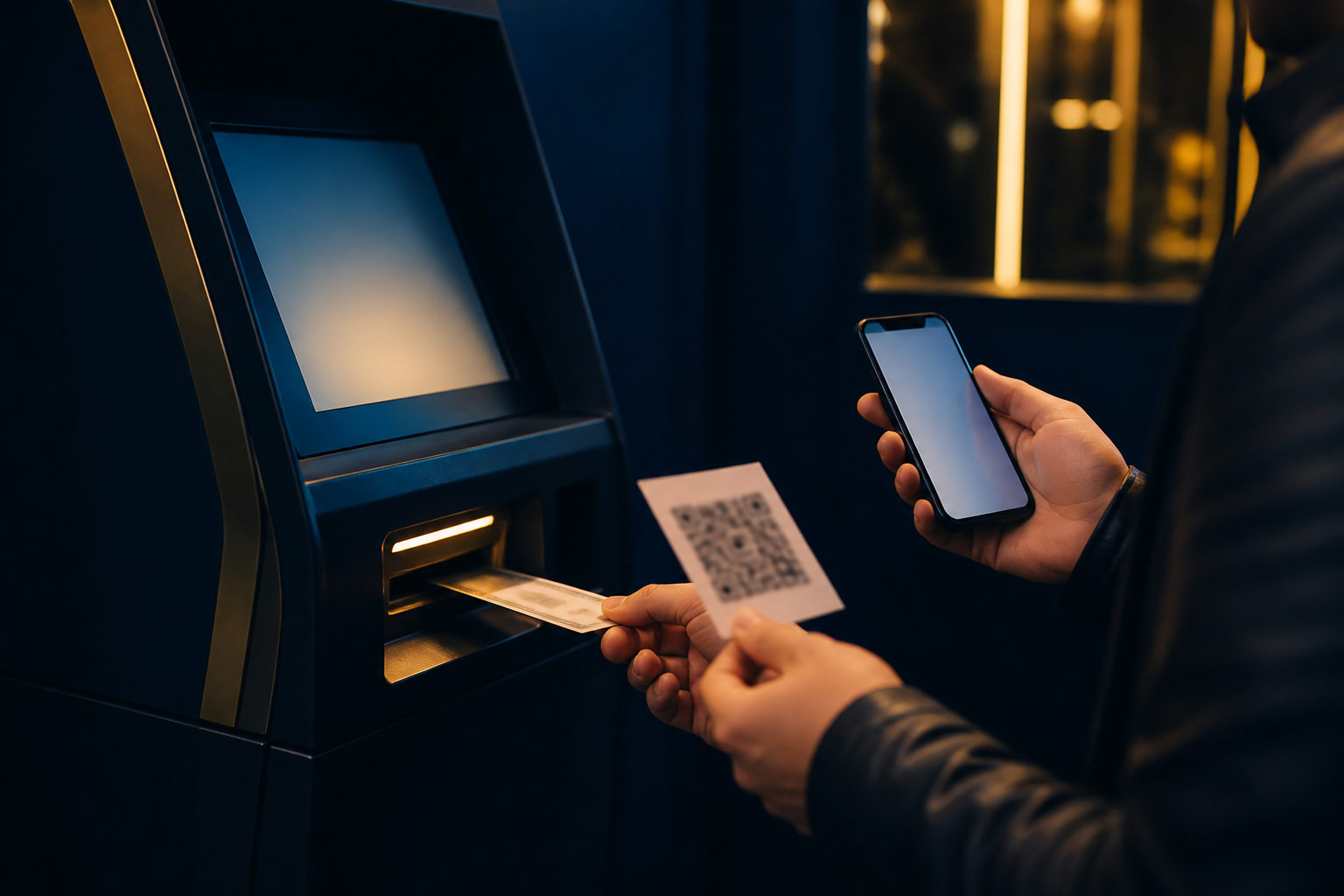
To use a bitcoin ATM to send money, you usually buy bitcoin at the machine and send it to the recipient’s wallet address. The process is simple on screen, but the real risk is address checks, fee review, and scam pressure.
What a bitcoin ATM is actually doing
Many first-time users expect a bitcoin ATM to work like a bank transfer terminal. In many cases, it does not. The machine usually converts your cash or payment amount into bitcoin and then sends that bitcoin to the wallet address you provide.
That distinction matters because blockchain transfers do not behave like ordinary card payments or bank transfers. If you send funds to the wrong address, scan a fake QR code, or act on a scammer’s instructions, reversal can be very limited.
| Stage | What you do | Why it matters | Main caution |
|---|---|---|---|
| Check the machine | Confirm it supports buying and sending bitcoin | Not every machine has the same functions | Do not assume every crypto ATM can send funds |
| Prepare the address | Get the recipient wallet QR code or text address | The machine needs an address to route the transfer | One wrong character can send funds elsewhere |
| Complete verification | Follow the on-screen identity steps | Many operators use compliance checks | Enter details only on the official interface |
| Pay | Insert cash or follow the payment prompt | This funds the bitcoin purchase | Review the full cost before approval |
| Track the transfer | Keep the receipt or transaction details | You may need them later | Do not leave without a record |
What to prepare before you start
You need the recipient’s wallet address. The safest way is to get the QR code directly from the recipient’s wallet app and scan it on the spot. If you must type or paste a text address, compare the first and last parts after entry, then check again.
You also need to assess the reason for the transfer. If someone is telling you to use a bitcoin ATM to fix an account issue, pay a deposit, release frozen funds, claim a prize, or settle a tax or fee problem, stop and reassess. Bitcoin ATMs are a common tool in fraud cases because they turn ordinary money into a transfer that is often much harder to recover.
Finally, keep records. Machines may print a receipt or show transaction details on screen. You do not need to be a technical expert, but you do need those details in case the recipient cannot find the transfer or you need to ask the operator about status.
| Preparation item | Usual form | What happens if missing | Best practice |
|---|---|---|---|
| Recipient address | QR code or text string | You cannot send correctly | Scan when possible |
| Machine function check | On-screen menu or machine label | You may reach the machine and find it does not fit your task | Confirm it supports Bitcoin buy-and-send flow |
| Verification access | Phone number or required user details | The process may stop halfway | Handle every prompt yourself |
| Record keeping | Printed receipt or visible transaction info | Later tracking becomes harder | Save a photo before leaving |
Step by step: how to send money with a bitcoin ATM
Step 1: Make sure the machine is legitimate and clear about its terms
Before you tap anything, check that it clearly offers Bitcoin services, shows fee information, presents warnings, and gives operator or support details.
If someone is on the phone telling you to stay on the line, skip warnings, or press certain buttons without reading the screen, treat that as a strong danger sign.
Step 2: Choose the Bitcoin purchase and send path
On many machines, the process starts with a buy option rather than a send-only button because the machine is selling you bitcoin first and then routing it to the wallet you provide.
If the machine offers several cryptocurrencies and the recipient asked for bitcoin, stay within the Bitcoin flow only. Choosing the wrong asset can be hard to fix.
Step 3: Scan the recipient QR code or enter the wallet address
This is the most sensitive part of the process. The machine only knows the address you enter or scan.
After scanning, compare the beginning and end of the displayed address against the recipient’s wallet screen. If you type it manually, compare it carefully with the original source. If the address came through a screenshot from a stranger, ask for a fresh code displayed directly in the wallet app instead of trusting an old image.
Step 4: Complete verification yourself
Many bitcoin ATMs ask for a phone number, a code sent by text, or another verification step. That is common and often tied to the operator’s compliance and risk controls.
Do not let anyone take your phone, read your messages, or enter codes for you.
Step 5: Enter the amount and review the fees
The machine may ask how much you want to spend, or it may show an estimated bitcoin amount as you insert cash.
Look at service fees and network fees. The amount you put in is not always the amount the recipient receives in net bitcoin terms. If the fee display is unclear, changes unexpectedly, or makes no sense to you, stop before approval.
Step 6: Pay, then do one final review before confirming
Once you follow the machine’s payment instructions, the transfer is close to final.
Check three things on the confirmation screen: the asset is Bitcoin, the address matches the intended recipient, and the fee outcome is acceptable to you. If the machine warns that the transfer cannot be reversed, use that warning as your last pause point.
Step 7: Keep the receipt and check transaction status
After completion, the machine may print a receipt or show order details and transaction information. Keep that record.
Do not assume that “submitted” or “completed” on the machine means the recipient can use the funds immediately. Bitcoin transactions move through the network and then wait for confirmations. Send the relevant transaction details to the recipient and check status through a known blockchain explorer, but avoid entering personal details on random websites.
How to think about fees and arrival time
One of the biggest misunderstandings with a bitcoin ATM is the gap between what you pay into the machine and what the recipient finally receives. There can be an operator service fee and a miner fee. Machines do not always present these in the same way, so read the screen carefully before you approve anything.
When the ATM says the transfer has been submitted, that usually means the transaction has been sent to the network. It does not always mean the recipient wallet will show spendable funds right away, because wallet apps and merchants can use different confirmation rules.
| Item | What you see | What it means | How to read it |
|---|---|---|---|
| Payment amount | The cash or value you put in | The source used to buy bitcoin | Not always the recipient’s net amount |
| Service fee | Operator fee shown on screen | The machine’s own charge | Check whether it is clearly disclosed |
| Network fee | Miner or transaction fee | The cost to broadcast and process the transfer | See whether it is already included |
| Status message | Sent, pending, waiting for confirmation | Different stages of on-chain processing | Do not confuse submission with final receipt |
The biggest risk: common bitcoin ATM scams
If someone tells you to go to a bitcoin ATM for an urgent problem, slow down immediately. Fraud cases often involve fake support agents, fake officials, fake investment guides, romance scams, refund scams, or pressure from someone claiming your account is at risk. The common thread is that they want you to convert ordinary money into a transfer that is harder to undo.
If the other person says you must act now, keep it secret, ignore the warning screen, or stay on the phone while they guide every step, that is a serious warning. Legitimate organizations do not usually ask people to settle penalties, deposits, or account issues through a bitcoin ATM.
| Scam approach | How it sounds | Why it is dangerous | What to do instead |
|---|---|---|---|
| Fake support or official contact | Your account has a problem and must be fixed immediately | It creates panic and rushes your decision | End the call and verify through official channels you find yourself |
| Investment funding instruction | You are told to use an ATM to deposit into a platform | The platform or address may be fake | Do not follow trading instructions from strangers |
| Friend or family emergency message | Someone asks you to send quickly on their behalf | The account may be compromised or impersonated | Confirm identity through a separate method |
| Prize or refund release | You must pay first to receive funds later | The up-front payment demand is the trap | Stop the process and pay nothing |
| Remote coaching | You are told to share your screen or read out text codes | The scammer is controlling the critical steps | Disconnect and review everything on your own |
Another practical risk is a fake QR code. When possible, ask the recipient to open their wallet app and display the current QR code directly, so you scan from the original source rather than from a forwarded image.
FAQ
Can a bitcoin ATM send money like a normal bank transfer?
Usually the process is different. In many cases, the machine sells you bitcoin and then sends that bitcoin to the recipient’s wallet address, so you need the correct address before you start.
Do I need my own bitcoin wallet to send money from a bitcoin ATM?
Not always. Some machines let you buy bitcoin and send it straight to the recipient’s address, but you should still keep the receipt and transaction details for tracking.
Why does the machine say the transfer is done if the recipient has not received it yet?
The machine may only mean the transaction was submitted. The recipient may still be waiting for the wallet to detect it or for network confirmations to reach the level they require.
Can I reverse a transfer if I entered the wrong wallet address?
You should not assume that is possible. Save every record right away, check the transaction status, and contact the operator if needed, but recovery options are often limited.
Is it safe if someone talks me through the bitcoin ATM process over the phone?
That is a major warning sign. If they push urgency, ask for secrecy, or tell you to ignore the machine’s warnings, treat the situation as a likely scam and stop.
Before you press the final confirmation button, review four things: the asset, the address, the fees, and the reason for the payment. If any one of them is unclear, do not send.