
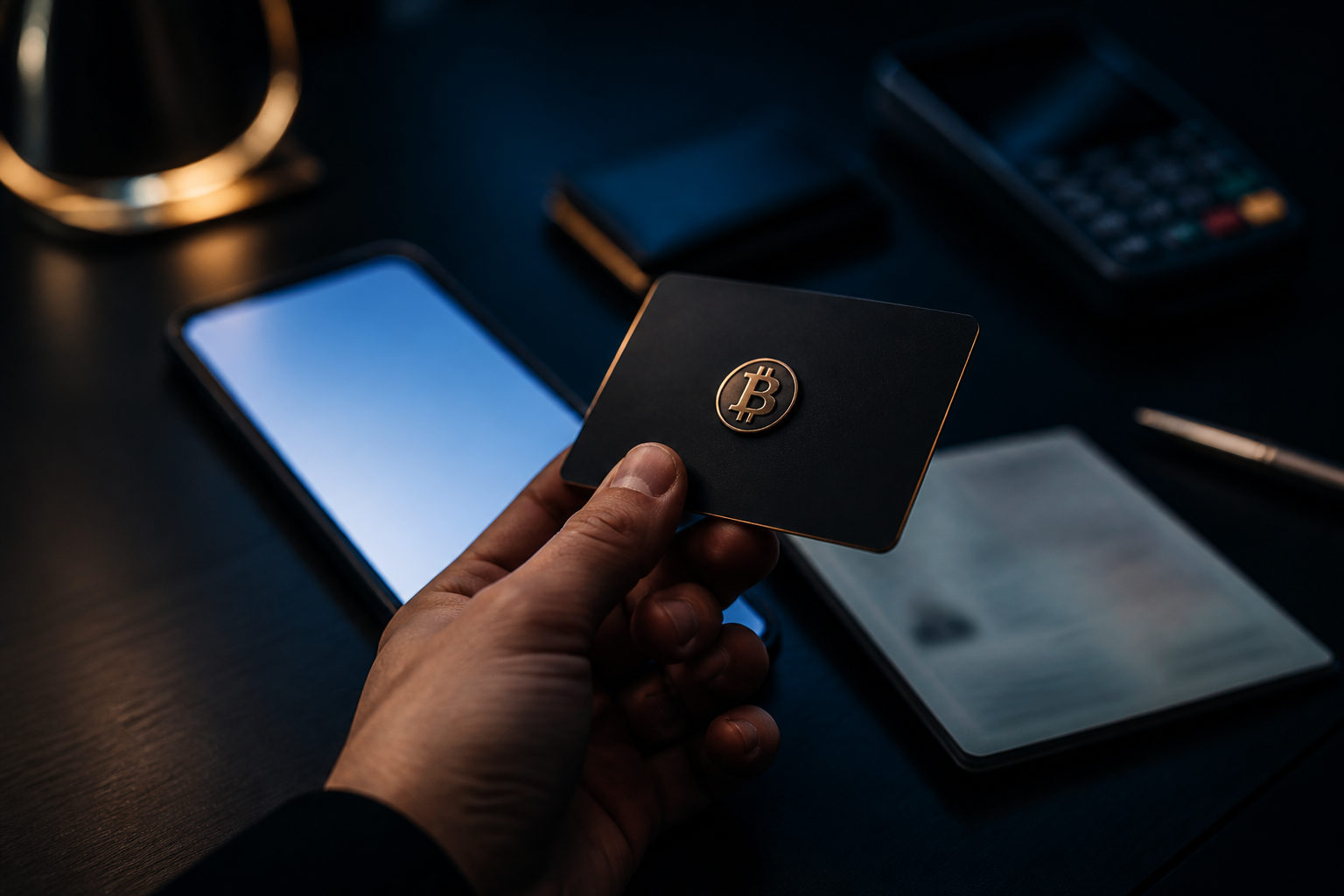
To get a bitcoin debit card, start with the boring part: make sure it is offered where you live, learn exactly how the card turns bitcoin into spendable fiat, finish identity checks, and test it with a small transaction before you trust it with real spending.
Know what the card actually does
A bitcoin debit card usually does not mean a merchant is accepting bitcoin straight from your wallet. In most setups, the merchant is paid in fiat through the normal card network, while the provider handles the asset conversion on your side, either before the purchase, at the moment of payment, or from a pre-funded balance inside the account.
That detail changes everything. Fees, refunds, statements, tax records, failed payments, and support disputes all depend on that payment flow. If you skip this step and rely on a headline that says the card “supports bitcoin,” you can end up using a product that stores crypto but only spends fiat after a manual conversion.
Step one: check whether you can even apply
Before you upload a document or download an app, check three things: supported regions, verification requirements, and whether the card is virtual, physical, or both. Some cards are available only in selected markets. Some accounts can be opened in more places than the card itself can be issued. Some providers offer a virtual card first and make the physical card optional.
Do not stop at the marketing page. Read the fee schedule, card terms, help center, and the section that lists restricted countries or unsupported services. A glossy landing page can sound broad and simple; the real limits tend to sit in the fine print.
ID verification matters just as much. Many card issuers ask for a government ID, a selfie, and proof of address, and some ask for more if the account triggers a review. You want to know that before you begin, not halfway through a sign-up flow with a rejected document and a locked dashboard.
Think about card format too. A virtual card is often the safer starting point for online purchases and trial runs. A physical card makes sense later if you truly need in-person payments or cash withdrawal features and the provider offers them on clear terms.
Step two: trace the money path before you care about rewards or branding
The useful question is not whether the service mentions bitcoin. The useful question is what happens to your bitcoin when you try to spend. Do you deposit bitcoin and manually convert it to fiat first? Does the platform auto-sell some of your balance at checkout? Does it require a separate fiat balance even though the account also supports crypto storage? Each model feels different in day-to-day use.
This is where people get tripped up. A service may support bitcoin deposits but not direct spending from that balance. Another may let you hold bitcoin and spend only after moving funds into a card wallet. Refunds can be even messier. A purchase funded through one balance may return to another according to the provider’s own rules.
Read the fee section slowly. Look for issuance fees, monthly charges, conversion fees, top-up fees, ATM charges, foreign transaction fees, inactivity fees, replacement card fees, and any wording that says extra costs may apply under certain conditions. Vague language is a warning sign. If you cannot tell when a charge appears, you cannot manage the card properly.
Then look for limits and controls. Some cards separate online transactions, in-store payments, ATM use, and international activity. Others let you toggle those settings inside the app. If the rules are clear, a failed transaction is annoying but manageable. If the provider keeps everything opaque, even a basic decline can turn into a support maze.
Step three: verify the provider before you trust the application page
A lot of risk appears before the card exists. Search ads, social posts, influencer referrals, and chat groups can all lead to fake pages that imitate a real issuer. The design may look polished. That proves nothing.
Look for a proper card agreement, a help center that explains virtual and physical card features, a visible support path, and a clear process for freezing the card or reporting suspicious activity. If the whole service seems to run through direct messages, rotating usernames, or “VIP agents,” walk away.
There are a few scam patterns worth taking seriously. One is the fake verification transfer: someone tells you to send bitcoin to an address to activate the card or confirm ownership. Another is the fake support request for seed phrases, private keys, one-time codes, or full login details. A legitimate card application does not need control over your wallet. It also does not require a transfer to a stranger’s address to prove you are real.
If the pitch leans on urgency, that is another bad sign. “Apply now, spots are almost gone.” “Complete this manual review today.” “Use this temporary payment address.” None of that belongs in a normal debit card signup flow.
Step four: prepare your documents properly and keep your details consistent
When you finally apply, consistency matters more than people expect. Your name, date of birth, and address should match across the form and your documents. Small mismatches can cause automatic reviews or rejection: a missing middle name, an address written in a different format, a cropped image, a document photo with glare, or a blurred edge that makes the system fail to read it.
Use clean images. No filters. No heavy edits. No cut corners. If proof of address is required, submit the type of document the provider actually lists as acceptable. Sending whatever seems close enough often creates a long back-and-forth that could have been avoided.
Once the account is open, set security controls before you move funds. Turn on two-factor authentication. Review device settings. Enable transaction alerts if the service offers them. A bitcoin debit card account is not just another app login; it is a spending gateway tied to money movement.
If you plan to receive a physical card, double-check the delivery address. Failed delivery can lead to delays, extra fees, or another review depending on the provider’s rules. If your address may change soon, the virtual card first, physical card later approach is usually cleaner.
Step five: test the card in a controlled way
Do not load a large amount of bitcoin the moment the card is approved. Do not attach it to a pile of subscriptions on day one either. Start small.
Make sure the card is active. Check which balance will be used for spending. Review how refunds are handled. If the app lets you choose funding sources or auto-conversion rules, pick the simplest setting you can understand without guessing. Then run a small purchase that is easy to track.
You are not only checking whether the card works. You are checking how the account records the spend, how quickly balances update, whether a failed transaction creates a temporary hold, and where money goes if the merchant issues a refund. Those details matter more than the first successful tap at checkout.
If the provider allows in-store payments, contactless payments, international transactions, or ATM access, inspect those switches too. A declined payment does not always mean the card is broken. Sometimes the relevant permission is off by default.
Step six: use it like a payment product, not like a magic crypto shortcut
After setup, the real work is staying organized. Watch the conversion method on every meaningful purchase. If bitcoin is being sold in the background to fund card spending, you should know that before you spend, not after you look at the statement and wonder why the numbers do not match your expectation.
Keep records. Save funding confirmations, conversion logs, card statements, refund screenshots, and support replies. If you ever need to dispute a charge or reconstruct what happened during a failed payment, complete records save time and stress.
Move fast when something looks wrong. Unexpected card activity, strange login alerts, unexplained balance changes, or a new device appearing in the account should trigger the same sequence: freeze the card, change the password, and contact the official support channel listed by the provider. Do not post full screenshots of your account in public. Do not hand the issue to random accounts claiming to be technical staff.
FAQ
Do I need to own a lot of bitcoin before I apply?
No. That depends on how the provider structures account opening and card funding. Some services let you complete verification and receive access first, then decide whether to move bitcoin into the account, and a small test is usually easier to manage than a large deposit.
Should I start with a virtual card or a physical card?
If your first goal is online spending, a virtual card is often the easier place to begin. It lets you test the payment flow and support quality before you commit to delivery, in-store use, or any extra features tied to a physical card.
Can a bitcoin debit card be used at an ATM?
Maybe, but only if the provider supports that feature and allows it in your region. Check the card rules, fees, and transaction controls first, because ATM access is not a standard feature across all crypto-linked cards.
Will a refund come back as bitcoin?
Not always. Refund handling follows the provider’s own system and may return to a fiat balance or another account balance instead of restoring bitcoin in the form you expected. Read the refund section before using the card for larger purchases.
What is the biggest scam risk during the application process?
Fake websites, fake support agents, and fake verification transfers are the main ones to watch. If anyone asks for your seed phrase, private key, one-time code, or a transfer to an unfamiliar address to activate the card, stop immediately.
Before you apply, write down the three things you care about most: regional access, transparent fees, and a real support path for disputes or freezes. Filter providers through those checks first, then start with a virtual card and a small test transaction.
Disclaimer: This article is for informational and educational purposes only and is not investment, financial, or legal advice. Crypto assets are highly volatile and you could lose your entire investment. Do your own research and decide carefully.