
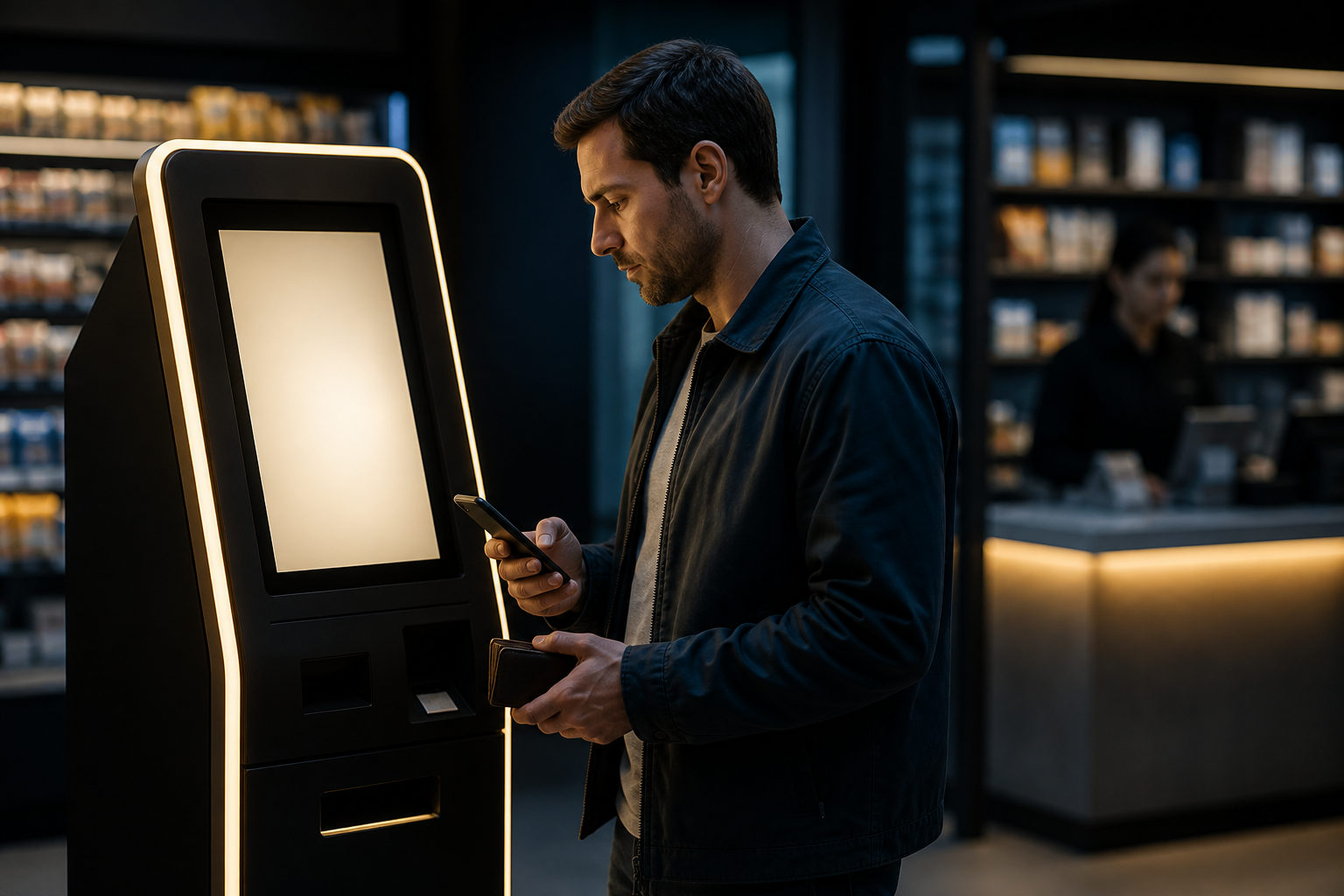
Some stores can help you buy Bitcoin, but the real question is what they are actually selling: Bitcoin sent to your wallet, a voucher, or access to another service.
Start by identifying the type of in-person service
When people ask what stores sell bitcoins, they usually mean one of three things: a retail counter that processes a Bitcoin purchase, a kiosk or terminal that sends BTC after payment, or a shop that sells a code you redeem later through a third party.
Those options are not equivalent. A counter sale may lead to Bitcoin being sent directly to your wallet, but it may also leave the asset inside a hosted account. A voucher sale may require another registration step before you can claim anything. A referral-style shop may do nothing more than point you to another company or an individual seller.
That distinction matters because many disputes begin with a mismatch between what the buyer thought was being purchased and what was actually delivered.
| Offline setup | What happens at the store | What you may receive | What to verify first |
|---|---|---|---|
| Retail counter | Staff assists with payment | BTC or a custodial balance | Whether withdrawal to your own wallet is allowed |
| Bitcoin kiosk or terminal | You scan an address and pay | Usually an on-chain transfer | Fees, identity checks, confirmation process |
| Voucher seller | You buy a code or receipt | A claim on future redemption | Redemption rules, expiry, refund policy |
| Referral location | Store collects details and redirects you | No immediate Bitcoin delivery | Who the real counterparty is |
Sort this out before paying if you want control of Bitcoin rather than a promise tied to someone else's account flow.
Step 1: Prepare your own wallet before visiting a store
Before walking into any shop, set up a Bitcoin wallet that you control. Bitcoin has operated since the genesis block on 2009-01-03, and any legitimate in-person sale still ends with BTC being assigned to a usable address.
Create a wallet, back it up, and open the receive screen before you begin the purchase. If you arrive without a wallet, the store may push you toward its preferred hosted setup.
Bitcoin's smallest unit is 1 satoshi, equal to 0.00000001 BTC, and a transfer sent to the wrong address is usually not something a clerk can reverse. Scanning your wallet's QR code is safer than typing a long address by hand.
Step 2: Ask whether the store sells withdrawable BTC
Do not begin with price. Ask whether your payment results in Bitcoin being sent straight to your wallet, whether it first lands in a hosted balance, and whether withdrawal is available without extra delays.
Many buyers think they have purchased Bitcoin when they have only created an account balance under someone else's control. The difference shows up later, when the user tries to withdraw and finds extra checks, waiting periods, or restrictions that were never explained at the start.
Also ask what proof you receive after payment. A proper process should produce a receipt, a transaction record, or a clear account statement showing what was bought and what happens next. If the answer stays vague, stop there.
| Question to ask | Why it matters | Warning sign |
|---|---|---|
| Can BTC be sent directly to my wallet? | Confirms whether you gain control of the asset | The store says it must stay on their side first, with no clear withdrawal rules |
| What identity information is required? | Prevents surprise data requests after payment | Requirements expand only after money is collected |
| What happens if the transaction fails? | Clarifies refunds and responsibility | No written process, no receipt, no formal support path |
| What is the total cost? | Helps uncover split or hidden charges | Extra activation or processing fees appear late |
Step 3: Check the cost structure and the delivery method
In-person Bitcoin purchases often feel straightforward until the charges are broken apart. A store may describe one quoted amount at the counter, then attach separate service charges, payment processing costs, or withdrawal-related costs later in the flow.
Ask: after all charges, how much BTC will be delivered, and when is that amount locked in? If the store cannot answer that in a way you can verify, you are being asked to pay before understanding the result.
Also clarify timing. If identity verification takes longer than expected, does the transaction get repriced? If the system creates an order but does not send BTC right away, can you cancel?
Step 4: If identity verification is required, submit data only through formal channels
Some physical locations work with service providers that require identity checks. What matters is who receives your information, on which device, and whether the process is tied to a named company rather than an employee's personal account.
Use the store's official terminal or an official app screen if verification is part of the process. Do not send ID photos or selfies to a clerk through personal messaging apps.
Watch for a specific red flag: requests to send a small payment to a personal wallet to “activate” or “verify” the transaction. A legitimate identity check does not require a side payment to an individual.
Step 5: After payment, confirm that a Bitcoin transfer was actually initiated
If the store claims to sell Bitcoin directly, do not leave immediately after handing over money. Verify that a transfer record exists. The Bitcoin network targets roughly 10 minutes per block, so your wallet may first show a pending state and update as confirmations accumulate.
The important distinction is between an order being created and Bitcoin being sent. An order screen may only mean that a request entered a queue. A transaction record, or at least evidence that a transfer was broadcast, shows that the process moved beyond an internal placeholder.
Ask for the transaction details or a formal receipt. If the store cannot provide either, you may discover later that nothing was transmitted at all.
Step 6: Do a basic custody check once you receive the Bitcoin
The purchase is not finished the moment BTC appears on the screen. Bitcoin has a hard cap of 21,000,000 BTC, with issuance expected to continue until about 2140, but scarcity does not protect you from weak custody.
Once the transfer is visible, confirm that you can access the wallet, that the backup is stored safely offline, and that you understand how to send Bitcoin out from that wallet if needed. Many problems tied to in-person purchases show up later, when a user changes phones, loses a recovery phrase, or realizes the wallet was never fully under their control.
Keep your purchase record and your wallet backup separate. A receipt may help with bookkeeping, but it should never become a container for recovery information.
Common in-store pitch lines that deserve extra caution
Pressure, urgency, and side payments are common tools when the process is weak or dishonest.
| Claim at the store | What it may mean | Safer response |
|---|---|---|
| You need to buy today or you will miss out | Emotional pressure to rush payment | Leave and decide later |
| Send the money to me and I will buy it for you | The transaction shifts from store to individual | Pay only through the formal store process |
| You must pay a verification fee first | Possible second-charge scam | Ask for written rules or walk away |
| Use our wallet, it is easier | You may not truly control the BTC | Prefer delivery to your own wallet |
| Scan this code from our group chat | Address source is unclear | Use only the address generated by your own wallet |
Some shops serve only as lead generators for over-the-counter deals with strangers. If the person taking your money, the person delivering BTC, and the party handling support are all different, the trust chain is weak.
Who may benefit from buying Bitcoin in a store
An in-person purchase may suit someone who wants face-to-face guidance for a first transaction. If you are unfamiliar with wallet setup, QR scanning, or transaction receipts, a legitimate retail environment can make the process easier to follow.
It is less useful for buyers who already know how to compare options and manage their own wallet flow. Store hours, extra checks, and less transparent fee presentation can make the process slower than expected.
Judge whether the store gives you a transaction that is clear at every stage and verifiable before you leave. If not, convenience is only an illusion.
FAQ
Can convenience stores sell Bitcoin directly?
Some locations may offer a Bitcoin-related service, but that does not always mean direct BTC delivery to your wallet. It could be a voucher, a hosted balance, or a sign-up path for another provider.
Does buying a voucher mean I already own Bitcoin?
Not necessarily. If you still need to redeem the code through another platform before BTC is released, the purchase process is incomplete and control has not yet passed to you.
Can I buy first and set up a wallet later?
You can ask questions first, but paying before you have your own wallet creates unnecessary risk. Without a receive address you control, it becomes much easier for others to steer you into custodial storage.
Is identity verification at a store a bad sign?
Not by itself. The real test is whether the verification happens through a formal process tied to a named service provider, with clear receipts and no side requests through private chats.
How long does it take to receive Bitcoin after paying in person?
That depends on when the seller actually initiates the transfer and how your wallet displays confirmations. Since Bitcoin targets about 10 minutes per block, the first thing to check is whether a transaction record exists at all.
If you plan to buy Bitcoin from a store, prepare your own wallet first, ask whether withdrawal to that wallet is supported, confirm the full cost before paying, and leave only after you have proof that the transfer process began.
Disclaimer: This article is for informational and educational purposes only and is not investment, financial, or legal advice. Crypto assets are highly volatile and you could lose your entire investment. Do your own research and decide carefully.