
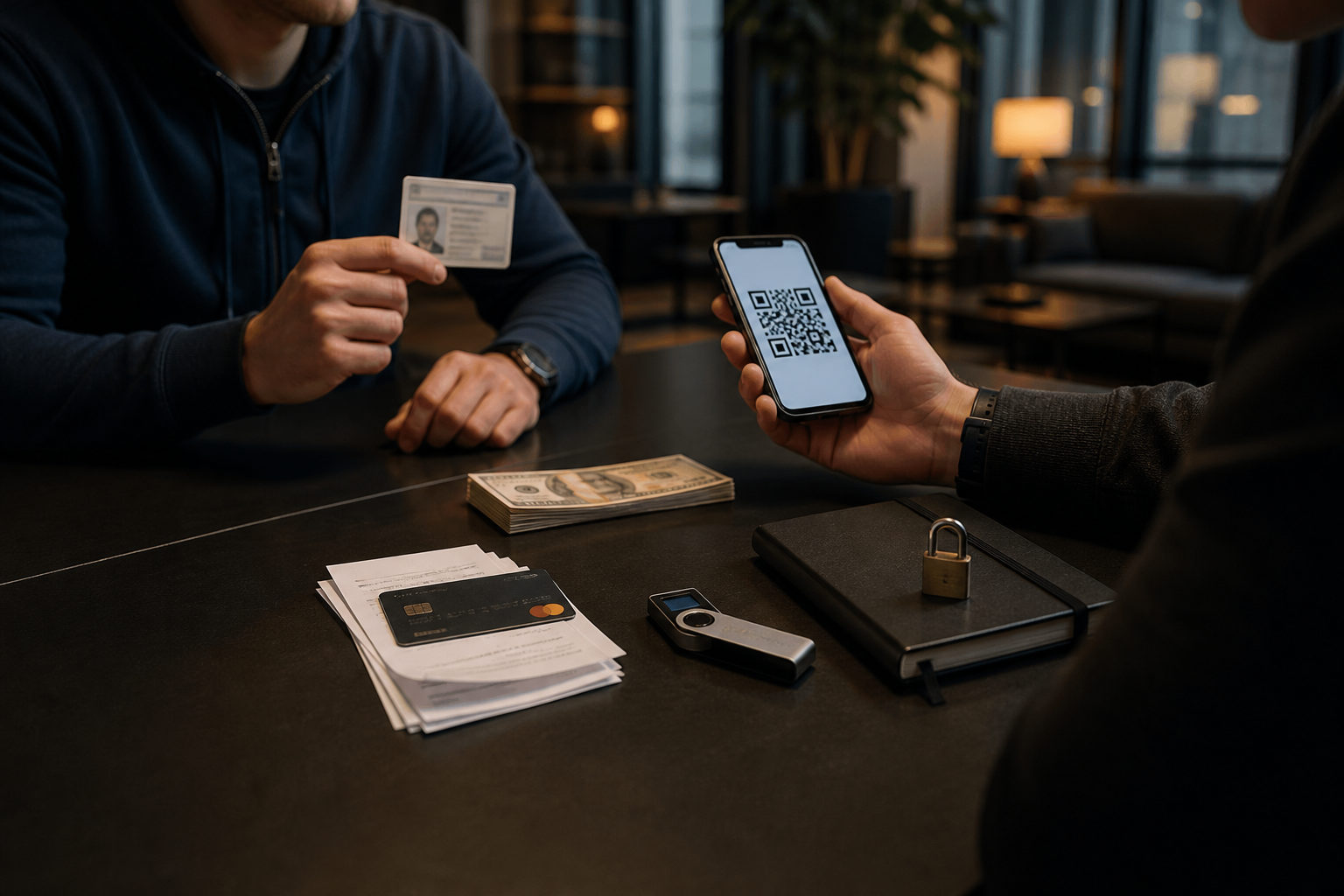
You can buy bitcoin without an exchange, but the safe way is to control your own wallet first, verify the person on the other side, and use small test trades before sending larger payments.
What buying without an exchange usually means
When people ask how to buy bitcoin without exchange involvement, they are usually asking whether they can get BTC without first depositing funds on a centralized platform. In practice, this often means a direct peer-to-peer purchase: you pay an individual seller, and that person sends bitcoin to a wallet you control.
That approach can feel simpler because you are not leaving funds sitting inside a trading account. It is also closer to the original idea behind Bitcoin as peer-to-peer electronic cash. The trade-off is clear, though: many checks that an exchange would normally handle for you now become your responsibility.
That includes verifying the counterparty, checking the payment route, confirming the receiving address, and keeping records in case the deal turns messy. So the main question is not only how to buy bitcoin without an exchange, but how to do it without handing an easy win to a scammer.
Step 1: Set up a self-custody wallet before you look for a seller
Your first move should not be hunting for the cheapest offer. It should be setting up a wallet where you control the seed phrase or private keys. If you skip this step, you are much more likely to make rushed decisions in the middle of a deal, install unknown software, or let someone else decide where your bitcoin will be held.
A wallet is not just a screen that shows a balance. It is the thing that defines control. If you hold the recovery information yourself, the bitcoin sent to that wallet is under your control. If someone else created the wallet for you, stored the backup, or can recover it, you may only be looking at numbers on an app rather than assets you truly own.
What to do in this step
- Choose a well-known self-custody wallet type with a strong reputation.
- Install it on a clean device using a trusted internet connection.
- Back up the seed phrase offline.
- Do not save that backup in chat apps, cloud storage, screenshots, or email drafts.
- Create a receiving address and check that you understand how to receive BTC.
Why this comes first
If you do not control the destination wallet, the rest of the transaction hardly matters. A seller can claim to send bitcoin, and you may even see something that looks like a balance, but control is what matters. Starting with your own wallet narrows the risk. It stops the seller from pulling you into a setup where they control the final destination.
What to watch out for
- Anyone asking for your seed phrase is a hard stop.
- Do not accept “I will hold it for you for now.”
- Check the receiving address before every transaction so malware cannot quietly replace it.
Step 2: Verify the person first, then discuss the deal terms
In direct purchases, the biggest risk is often not technical. It is human. You are not dealing with a standardized checkout flow. You are dealing with a person whose identity, habits, and intent may not be obvious. If the counterparty is not trustworthy, the rest of the process becomes fragile very quickly.
The correct order is simple: check the person, then discuss the amount, then agree on the payment method. Scammers often reverse that order. They start with a tempting quote or a promise of convenience, pull you into private chat, and then keep changing the process once your attention is fixed on getting the deal done.
Practical checks you can make
- See whether the person has a consistent identity and communication pattern.
- Notice whether they can explain the process clearly instead of only pushing you to pay fast.
- Ask whether they are willing to start with a small test trade.
- Be cautious if they keep changing payment details, names, or the story behind the transfer.
- Be cautious if they want payment sent to a third party who is not the person speaking with you.
Why this matters
Most fraud in direct bitcoin deals does not require advanced hacking. It relies on pressure, confusion, and false authority. If someone keeps rushing you, asks for secrecy, or refuses a small test transaction, the warning signs are already there.
Referrals do not remove this risk. A friend may introduce you to someone without knowing how that person actually handles money, wallets, or disputes. You still need to verify the exact person, the exact payment details, and the exact receiving address for your own deal.
Step 3: Run a small test trade before you do anything bigger
If you want a safer process, do not jump straight into a full-size purchase. Start with a small test transaction. Give the seller your wallet address, agree on the payment method, complete a small deal, and confirm that the bitcoin actually arrives in your wallet before moving further.
This step does several jobs at once. It confirms that your receiving address is correct. It shows whether the seller can actually send BTC rather than just talk about it. It also tests the communication quality between both sides. If simple things become messy at a small size, that is a bad sign for anything larger.
What to look for in the test trade
- Your own wallet should show the incoming transaction.
- The seller should be able to explain what they sent and when, not just throw a screenshot at you.
- Both sides should be clear on what counts as received and when the next step begins.
If a seller refuses a small test trade, that alone can be enough reason to walk away. For most buyers, the real answer to “how to buy bitcoin without an exchange” is not finding the fastest route. It is finding the route with the fewest blind spots.
Important caution
A successful test does not prove the next trade will be safe. A common scam pattern is to behave normally on one or more small deals, build trust, and then disappear when the amount gets larger. So every later step still needs the same discipline.
Step 4: Only use payment methods you fully understand
The payment stage creates many avoidable problems. One kind of problem is sending money to the wrong person. Another is using a payment route so messy that you cannot explain it later if a dispute appears. A good rule is to use only payment methods you understand, can verify yourself, and can document clearly.
Without an exchange, there is no standard support desk reconstructing the whole flow for you. If you cannot explain where the money went, why it was sent, and who was supposed to receive it, it becomes harder to defend your side later. That is why direct buyers should be extra careful with split transfers, proxy payments, last-minute account changes, or odd payment notes.
Things to confirm before paying
- Make sure the payment recipient is the actual seller, or that the identity trail is at least clear and consistent.
- Agree in advance on the amount, the order of operations, and when bitcoin is supposed to be sent.
- If the trade is split into parts, confirm the conditions for each part separately.
- Save your own records: chat logs, payment proof, and wallet receipts.
Why this level of care is necessary
Many disputes are not caused by Bitcoin itself. They come from vague process design. You think you are buying from one person, but payment is redirected to someone else. You think bitcoin was sent, but all you received was a fake interface or an edited screenshot. Once the payment chain becomes unclear, your position weakens fast.
Red lines
- Do not screen share while making the payment.
- Do not install remote-control software provided by the other side.
- Do not accept “send the money first and I will teach you how to set up a wallet.” The wallet should already be yours before money moves.
Step 5: Confirm the bitcoin is in your wallet before you treat the deal as finished
Many beginners make the mistake of treating “sent” as the finish line. It is not. The important point is that the BTC appears in a wallet you control and that you can tie that incoming transaction to the specific deal you just made.
That matters because once a bitcoin transaction is broadcast, your reference point should be your own wallet records and on-chain status, not promises inside a chat window. Screenshots, explanations, and excuses do not replace independent verification.
What to do after the transfer
- Check that the receiving address matches the one you originally provided.
- Save the deal records in one place: messages, payment confirmation, and wallet details.
- If you are not continuing with more trades, stop there instead of following extra “verification” or “unlock” steps invented by the other side.
After the purchase, review your wallet backup process again. A lot of losses happen after the trade, not during it. People leak seed phrases, store recovery data in connected apps, or keep infected devices in use long after receiving bitcoin.
Common scam patterns in direct bitcoin deals
Once you step away from a standard exchange flow, scammers try to use information gaps against you. The methods are often simple.
- Fake support or fake escrow: a second person appears to “help” with the trade but is really part of the scam.
- Fake wallet or fake app: you are told to install software that displays a balance without giving you real control.
- Fake screenshots: payment screenshots, transfer screenshots, and balance screenshots are shown, but your own wallet shows nothing real.
- Screen-sharing traps: “I will guide you” becomes a way to view codes, payment details, or take over the device.
- Trust-building before the hit: small trades work fine, then the seller vanishes when the amount gets bigger.
- Third-party payment detours: money is routed through unrelated people, making disputes harder to untangle.
A useful rule is this: if the process keeps getting more complex, the responsibility keeps getting less clear, and the pressure keeps rising, stop the trade.
Who this method fits, and who should slow down
Buying bitcoin without an exchange is better suited to people who already understand wallet basics, private-key control, and how to check incoming transactions. If you are still unsure how to receive BTC, back up a wallet, or spot an unusual request, going fully direct on your first attempt adds risk.
That does not mean you cannot learn. It means the order matters. Learn wallet control first, then learn direct trade discipline. If you start with a stranger, a payment request, and no solid process, the chances of skipping a critical check go up fast.
FAQ
Is it safe to buy bitcoin directly from another person?
It can be, but the safety comes from your process rather than the format itself. Control your own wallet, verify the seller, and use small test trades before sending larger payments.
What should I prepare before buying BTC without an exchange?
Start with a self-custody wallet that you set up yourself. That gives you a receiving address you control and reduces the chance of being pushed into someone else’s setup.
Should I accept a better price if the seller wants a direct transfer right away?
A lower price should not outweigh a weak process. If the seller refuses a test transaction, changes payment details, or pushes for urgency, it is smarter to walk away.
How do I know I actually received the bitcoin?
Check your own wallet, not the seller’s screenshot. You want to see the incoming BTC tied to the address you provided and recorded in a wallet you control.
Can I keep the bitcoin in a wallet recommended by the seller?
That is a poor idea unless you fully control the seed phrase or private keys. If the seller created the wallet or had access to the recovery information, the risk does not end after the purchase.
If this is your first attempt, use a fixed routine every time: set up your own wallet, verify the person, run a small test trade, confirm receipt in your wallet, and only then consider the next step. Anyone asking you to skip one of those checks is giving you a reason to stop.
Disclaimer: This article is for informational and educational purposes only and is not investment, financial, or legal advice. Crypto assets are highly volatile and you could lose your entire investment. Do your own research and decide carefully.