
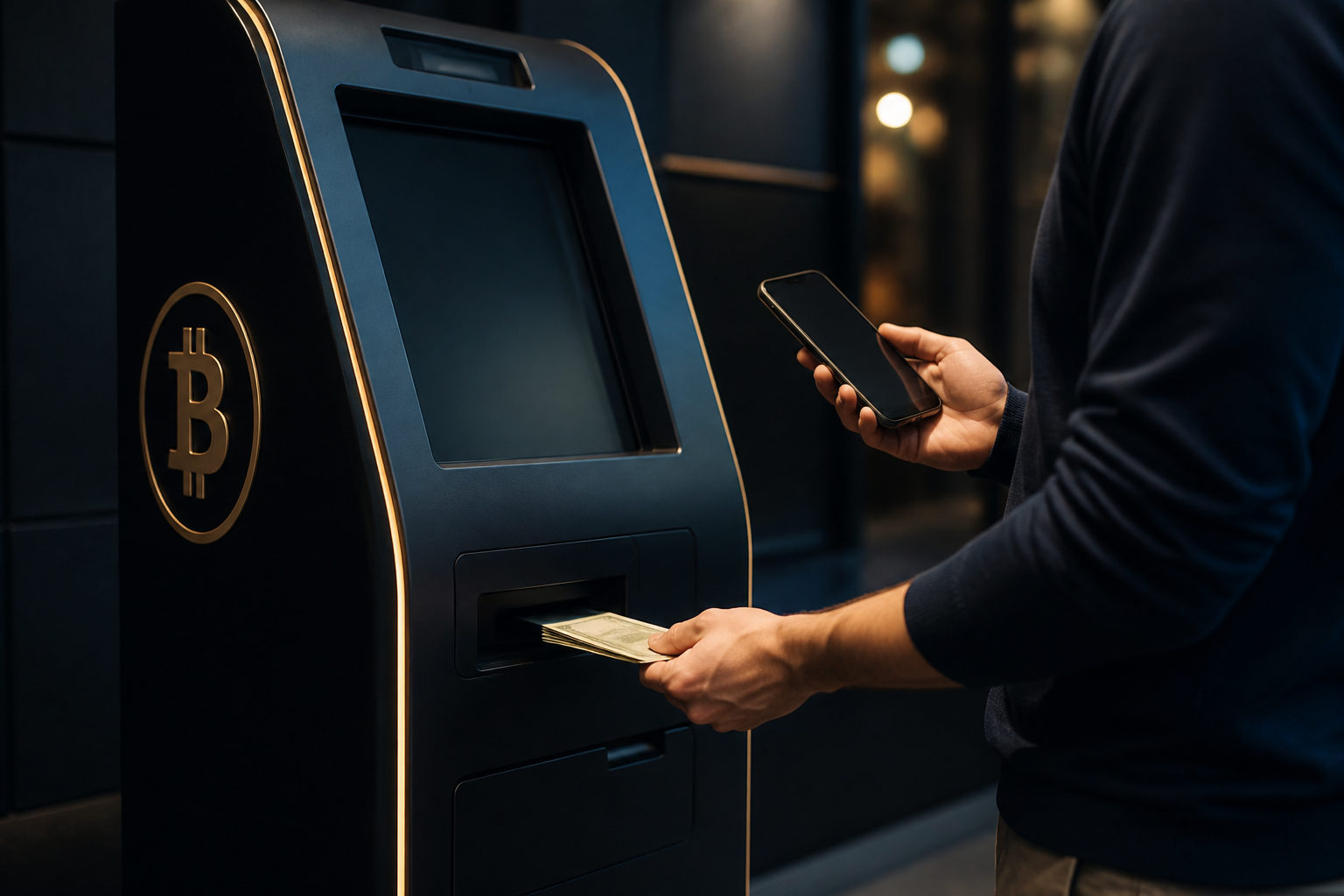
Yes, you can use a Bitcoin ATM to get cash, but only if that machine supports selling Bitcoin and paying out cash. Many machines only let users buy BTC, so the first question is not whether you own Bitcoin, but whether the device offers the right function.
Start by checking whether the machine actually supports cash withdrawals
Before you scan anything, read the screen carefully. Look for options such as selling Bitcoin, withdrawing cash, or cashing out BTC; if the menu only shows buying, adding cash, or purchasing crypto, that machine is not the right tool for this job.
This matters because Bitcoin ATMs are not all built around the same feature set. Two machines can both display Bitcoin branding and still handle transactions in completely different directions.
A common mistake is assuming that “Bitcoin ATM” means a two-way machine by default. If you send coins first and discover later that the machine only accepts cash-to-crypto purchases, fixing the problem may become difficult.
Step 1: Make sure you are using a wallet you control
Before you leave home, open your own Bitcoin wallet and confirm that you can send BTC yourself. You should know where the send button is, how to review a transaction before confirming it, and how to check whether the transfer has gone through.
The reason is simple: in a sell-for-cash transaction, the machine usually gives you a Bitcoin address or QR code, and you have to send BTC to that destination. If your coins sit in a restricted account, a custodial service with withdrawal limits, or an app you do not fully understand, the process can stop halfway through.
Control means more than seeing a balance on a screen. It means you can move the funds without asking another person for permission, and you can recover the wallet if your phone stops working. If a stranger offers to “help” by taking your device or entering details for you, treat that as a warning sign.
Step 2: Read the fee display, exchange terms, and ID requirements before continuing
Once you enter the sell flow, pause and review the full transaction page. Some Bitcoin ATMs show the amount of cash you are expected to receive; others split the information across a quoted rate, a service charge, and the amount of BTC to be sent.
You need to understand the result before you commit. Convenience often comes with higher costs, and the machine fee is only part of the picture. Your wallet may also require a network fee when you send BTC, so the total cost can be larger than it first appears.
Identity checks are another part of the decision. Some machines ask for a phone number, some request an ID scan, and some change their verification steps depending on transaction conditions. If you are not comfortable with what the machine asks for, stop there instead of pressing ahead and hoping it gets easier later.
One practical rule helps here: if the machine does not clearly explain fees, payout conditions, or how support works when something goes wrong, walk away. A vague process is a poor setup for a cash transaction.
Step 3: Send BTC only to the address generated by the machine at that moment
After you accept the terms, the machine will usually display a Bitcoin address, a QR code, or a printed order slip with payment details. Use your own wallet to scan that code, then check that you are sending BTC, not another asset, and compare the beginning and end of the address with what the machine shows.
This step deserves full attention because the payout depends on the machine matching your transfer to the active order. If you send the wrong asset, send to the wrong address, or rely on information from a text message or chat app instead of the machine screen, the machine may not recognize the payment at all.
Do not let anyone nearby hand you a “better” QR code. Do not trust a paper note, phone message, or verbal instruction from a person who claims to work with the machine unless that information appears on the device itself. In a public place, confusion is often part of the scam.
Step 4: Wait for the machine's conditions to be met before expecting cash
Sending BTC is not always the final action. Some machines pay cash right away once their requirements are satisfied, some print a receipt and ask you to return with a code, and some keep the order open until the transaction reaches the machine's own acceptance standard.
This is where many users get frustrated. They see “sent” in their wallet and assume the cash should appear immediately, but the wallet's view and the machine's payout rule are not the same thing.
Stay with the order details until the next step is clear. Save the receipt, order number, on-screen prompts, and the wallet transaction record. If the machine says to wait, do not send a second transfer out of panic; that can turn a simple delay into a messy support issue.
Step 5: Count the cash on the spot and confirm the order is closed
If the machine pays out, count the cash before you leave and confirm that the order status shows completion. If you receive only part of the result, or the screen still shows processing, remain there until you understand what the machine expects next.
This matters because in-person crypto transactions rely heavily on what you can document at the location. Once you leave, it becomes much harder to sort out whether the issue came from your wallet, the machine, or a mismatch in the order details.
Check your wallet record as well. Some users intend to cash out only part of their BTC and end up sending more than planned because they rush through the transfer screen and fail to review the transaction before confirming it.
When a Bitcoin ATM is a poor choice for getting cash
- You are in a hurry: If the machine requires its own confirmation process, cash may not be immediate.
- You do not understand the fee breakdown: If you cannot tell what you will receive, the transaction is not ready to approve.
- You cannot operate your wallet on your own: Needing a stranger to guide or handle the transfer creates avoidable risk.
- The environment is distracting: Noise, pressure, and people standing close to the screen increase the chance of mistakes.
- You dislike the requested verification: You do not have to continue just because you have already started reading the menu.
Scams and misunderstandings to watch for
Thinking a Bitcoin ATM works like a bank ATM
A Bitcoin ATM cash-out is usually a crypto sale followed by a machine-specific payout step. It is not the same as inserting a debit card and pulling cash from a checking account.
Letting someone on the phone tell you how to use the machine
If a caller, message sender, or supposed support agent tells you to send BTC while they guide you through the machine, stop the process. A genuine cash-out should depend on information shown by the machine during your own session, not on directions from a stranger.
Ignoring mismatches between the screen and the receipt
If the amount, order reference, asset name, or contact details do not line up, do not continue in the hope that it will sort itself out. A mismatch means the transaction path is already unclear.
Assuming that “sent” means “cash now”
Your wallet confirms that you broadcast a transaction. It does not promise that the machine has accepted it for payout yet. Always follow the live order instructions on the machine itself.
FAQ
Can every Bitcoin ATM give me cash for BTC?
No. Some machines only sell Bitcoin to customers who insert cash, while others support two-way transactions. You need a machine that explicitly offers a sell or cash-out option.
I sent Bitcoin, but the machine did not pay immediately. What should I do?
First, read the order screen or printed receipt to see whether the machine says more waiting is required. Keep the order details and wallet record, and do not send another transfer unless the machine clearly instructs you to do so.
Do I need to show ID to use a Bitcoin ATM for cash?
That depends on the operator and the machine's rules. Some ask for limited details, while others require stronger identity checks, so review that part before you start the transfer.
Can a store employee or another customer help me finish the cash-out?
It is safer to decline. Once another person handles your phone, wallet app, or QR code, they may redirect your Bitcoin or expose private information without leaving you with a clear way to prove what happened.
If I only want to know what my Bitcoin is worth, should I use a Bitcoin ATM?
No. A Bitcoin ATM is for executing a transaction in person, not for checking the broad market price. Use a mainstream market data tool to view the live BTC price before deciding whether an in-person cash-out makes sense for you.
The safest pattern is straightforward: confirm the machine supports selling, read every fee and verification prompt before proceeding, and send BTC only from a wallet you control to the address shown on that machine during your session. If any step feels rushed, confusing, or dependent on a stranger, stop there.