
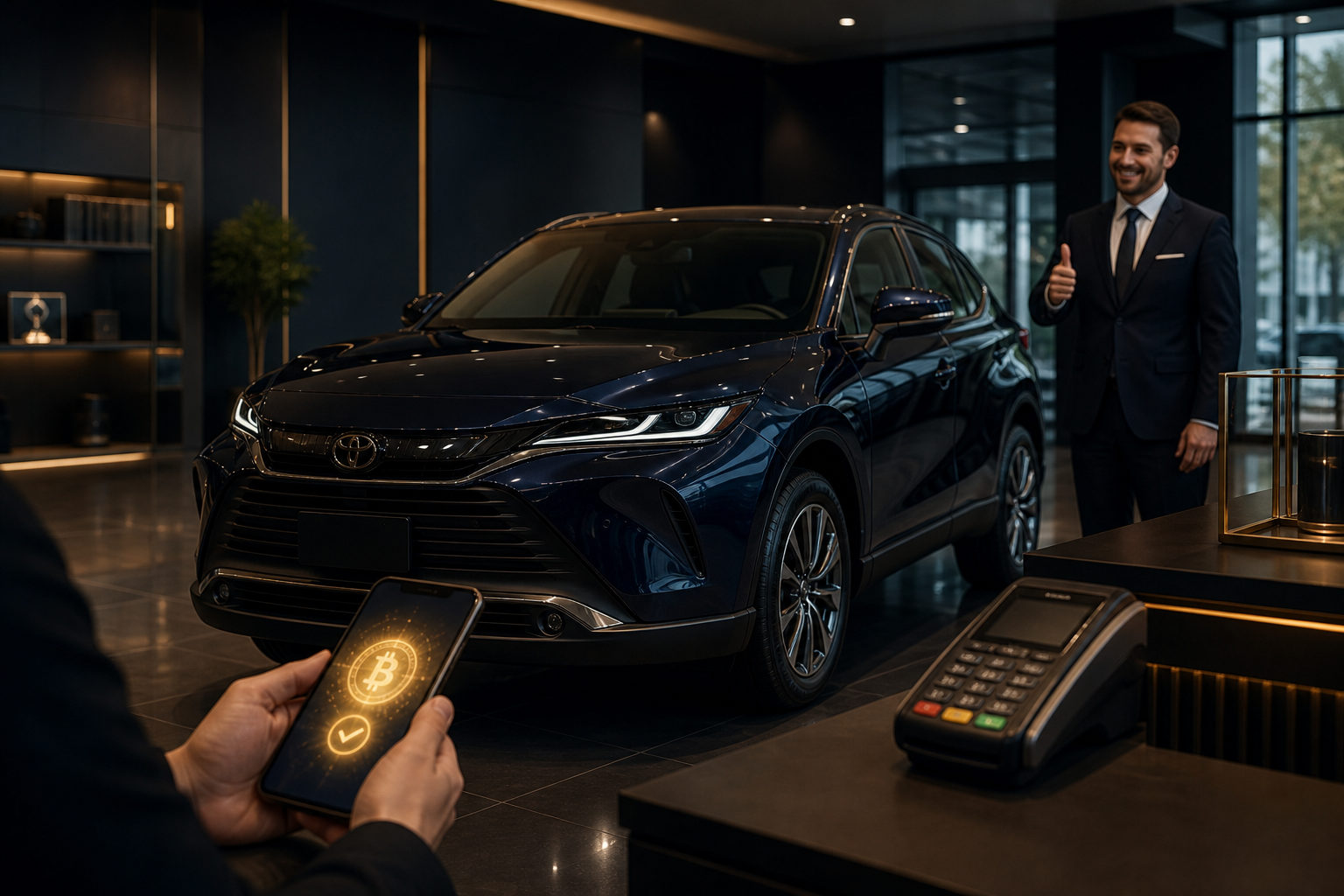
Does Toyota accept Bitcoin? There is no single global yes-or-no answer. In practice, the real question is whether the specific dealer selling the car allows a Bitcoin payment path, and how that payment is processed.
Start with the right question: brand policy and dealer policy are not the same
Many buyers search this topic because they want a simple answer: can I buy a Toyota with BTC or not? The problem is that a car purchase usually happens through a dealership, a dealer group, or an independent seller. That means the payment decision often sits with the seller handling your contract, not with the brand name printed on the sign.
This distinction matters because “accepts Bitcoin” can describe very different setups. One seller may take BTC directly. Another may use a payment processor that converts your Bitcoin into dollars before the seller gets paid. A third may talk about crypto in marketing but have no working process once paperwork begins. For a buyer, those differences affect receipts, refund terms, timing, and dispute handling.
If you are trying to answer whether Toyota accepts Bitcoin, the safest approach is to stop thinking in terms of one universal policy. Think in terms of a specific store, a specific vehicle, and a specific payment workflow.
Step 1: Identify exactly who is selling the vehicle
What to do
Before you discuss wallets or transfers, confirm the seller’s identity. Ask whether you are dealing with an authorized Toyota dealer, a dealer group, or an independent used-car business. Then ask who appears as the payment recipient on the contract, who handles the deposit, and who handles the final balance.
Why this matters
Bitcoin payments are high-risk if the receiving party is unclear. A formal dealership transaction should have a named legal entity, a standard sales contract, and a finance or accounting contact who can confirm payment instructions. If the person asking for funds is not the same party shown on the paperwork, your risk rises fast.
What to watch for
- Do not rely on a sales message alone. Ask for written confirmation.
- If someone says a manager or owner can take payment through a personal wallet, treat that as a major warning sign.
- The seller, invoice issuer, and payment recipient should line up. If they do not, pause the process.
Step 2: Ask what “accepts Bitcoin” actually means in that deal
What to do
Break the payment path into parts. Ask whether the deposit can be paid in BTC, whether the remaining balance can be paid in BTC, and whether fees tied to the purchase are included or handled another way. Ask whether the seller receives Bitcoin directly or whether a third party converts it to dollars.
Why this matters
A car purchase is not one payment event. It is a chain of actions: reservation, deposit, contract signing, final payment, title work, delivery, and sometimes financing or trade-in adjustments. A seller may be willing to process one piece of that chain in Bitcoin while keeping the rest in dollars through standard banking rails. If you only hear “yes, we take crypto,” you still do not know what the actual process looks like.
What to watch for
- Ask what counts as payment completion. Is it when you send the transaction, when the processor confirms it, or when the dealer’s accounting team records it?
- Do not assume that a transfer leaving your wallet means the car is secured.
- If payment instructions change late in the process, especially the wallet address, stop and verify before doing anything else.
Step 3: Confirm pricing and conversion rules before you send anything
What to do
Ask three direct questions. First, is the vehicle priced in dollars? Second, when is the BTC-to-dollar conversion rate set? Third, if the value moves between the moment you authorize payment and the moment the seller confirms it, who carries that difference?
Why this matters
Even when a dealer allows Bitcoin, the car itself is usually still priced in dollars. The real issue is not just whether BTC is accepted, but how the conversion works. If the lock-in point is vague, the amount you expected to pay and the amount the seller recognizes can drift apart, which creates arguments at exactly the wrong moment.
This is one of the biggest mistakes buyers make. They focus on the headline question and ignore the contract mechanics. Yet the contract mechanics decide whether the payment feels clean or turns into a dispute.
What to watch for
- Avoid vague language such as “we will check the rate at the time.” Ask for the exact trigger.
- If a payment processor is involved, ask whether the rate is fixed when the invoice is created or later in the flow.
- Read refund language carefully. A refund in dollars and a refund in BTC can produce very different outcomes for you.
Step 4: Treat fraud prevention as part of the payment process
What to do
Verify the payment details through more than one channel. If a wallet address or QR code arrives by message or email, confirm it through the dealership’s published phone number or a finance contact tied to the contract. Match the payment request against the buyer name, vehicle details, order reference, and any identifying vehicle information shown in your paperwork.
Why this matters
Bitcoin transfers are usually hard to reverse. Car purchases involve large sums, which makes them attractive targets for impersonation, account compromise, and payment instruction tampering. The threat may not even come from the dealership itself. A criminal only needs to insert a fake message or swap a wallet address at the point where you feel pressure to act quickly.
This is why “does Toyota accept Bitcoin” is only half the question. The other half is whether the payment request you received is genuine, documented, and tied to the real seller.
What to watch for
- Consider a small test transfer before sending the main amount.
- Do not trust an address just because it appears in a polished invoice image or chat screenshot.
- Keep records of the quote, contract, payment instructions, transaction details, and receipt.
- If someone pushes you to send funds immediately to hold the vehicle, slow the process down and re-check everything.
Step 5: Ask about failure scenarios before the transaction starts
What to do
Discuss the messy situations before payment. Ask what happens if financing falls through, if delivery is delayed, if the vehicle is not as described, or if the order is canceled. Then ask how refunds are handled, where they are sent, and in what form they are returned.
Why this matters
Buyers often spend all their energy figuring out how to pay and almost none on what happens if the deal breaks down. In a crypto-linked purchase, refunds can be harder than the original payment. A seller may be open to receiving value through a processor yet have stricter internal rules around returns or cancellations. If refund terms are unclear, you may be exposed to both transaction risk and price movement risk.
What to watch for
- Get cancellation and refund terms in writing.
- Do not send the full amount first and sort out the details later.
- If the deal also involves a trade-in, financing, insurance, or add-ons, confirm each item separately.
Common red flags buyers should not ignore
One red flag is a seller who speaks confidently about crypto but avoids basic written documentation. Another is a payment request that points to a personal wallet with no matching business paperwork. A third is any attempt to move the conversation away from the dealership’s normal channels and into private messages only.
Be careful with middlemen who claim they can “help” you buy a Toyota with Bitcoin by taking custody of your funds first. That changes the transaction from a car purchase into a trust-based handoff with far less protection. If the receiving party is not the actual seller, you need a very strong reason to continue, and in most cases the safest move is to walk away.
Also be careful with broad statements such as “this brand accepts crypto.” Even if the statement was true somewhere, it may not apply to your location, your dealer, or your transaction structure. The only useful answer is the one attached to your written deal.
A practical order of operations if you want to buy a Toyota with BTC
- Choose the exact vehicle and the exact seller first.
- Confirm the legal selling entity and the payment recipient.
- Ask for written confirmation on whether Bitcoin is accepted.
- Clarify whether BTC is used for the deposit, the full balance, or only part of the transaction.
- Confirm dollar pricing, conversion timing, and who bears short-term movement during payment.
- Review cancellation and refund terms before funding anything.
- Verify the wallet address or payment page through a second channel.
- Keep all documents and ask for a formal receipt once payment is recognized.
This sequence is not about making the purchase harder. It is about moving uncertainty to the front of the process, where it is still manageable.
FAQ
Can I assume Toyota worldwide accepts Bitcoin if one dealer says yes?
No. A dealer’s payment policy does not automatically represent every Toyota seller in every market. You need confirmation tied to the exact seller handling your contract.
If a dealer says it accepts crypto, does that always include BTC?
No. “Crypto” can mean a limited list of assets or a processor-specific setup. Ask the seller to state clearly whether Bitcoin is included and how failed payments are handled.
Is paying for a Toyota with Bitcoin simpler than paying in dollars?
Not always. The transfer itself may feel direct, but large vehicle purchases still require checks around pricing, accounting, fraud controls, and refunds. A smooth result depends on process quality, not on BTC alone.
Is it safe to send Bitcoin to a salesperson’s personal wallet?
That is usually a bad idea. If the receiving wallet is not clearly tied to the business named in the contract, the transaction becomes much harder to document and dispute.
How can I judge the cost if I do not have a live price in front of me?
Focus first on the vehicle’s dollar price and the written conversion rule for BTC. For live pricing, use the payment or trading interface you are actually using at the moment of the transaction rather than screenshots or verbal claims.
Before sending any Bitcoin, make sure you have three things: a written vehicle quote, a verified payment recipient, and clear refund terms. If any of those is missing, stop there and get the paperwork straight first.
Disclaimer: This article is for informational and educational purposes only and is not investment, financial, or legal advice. Crypto assets are highly volatile and you could lose your entire investment. Do your own research and decide carefully.