
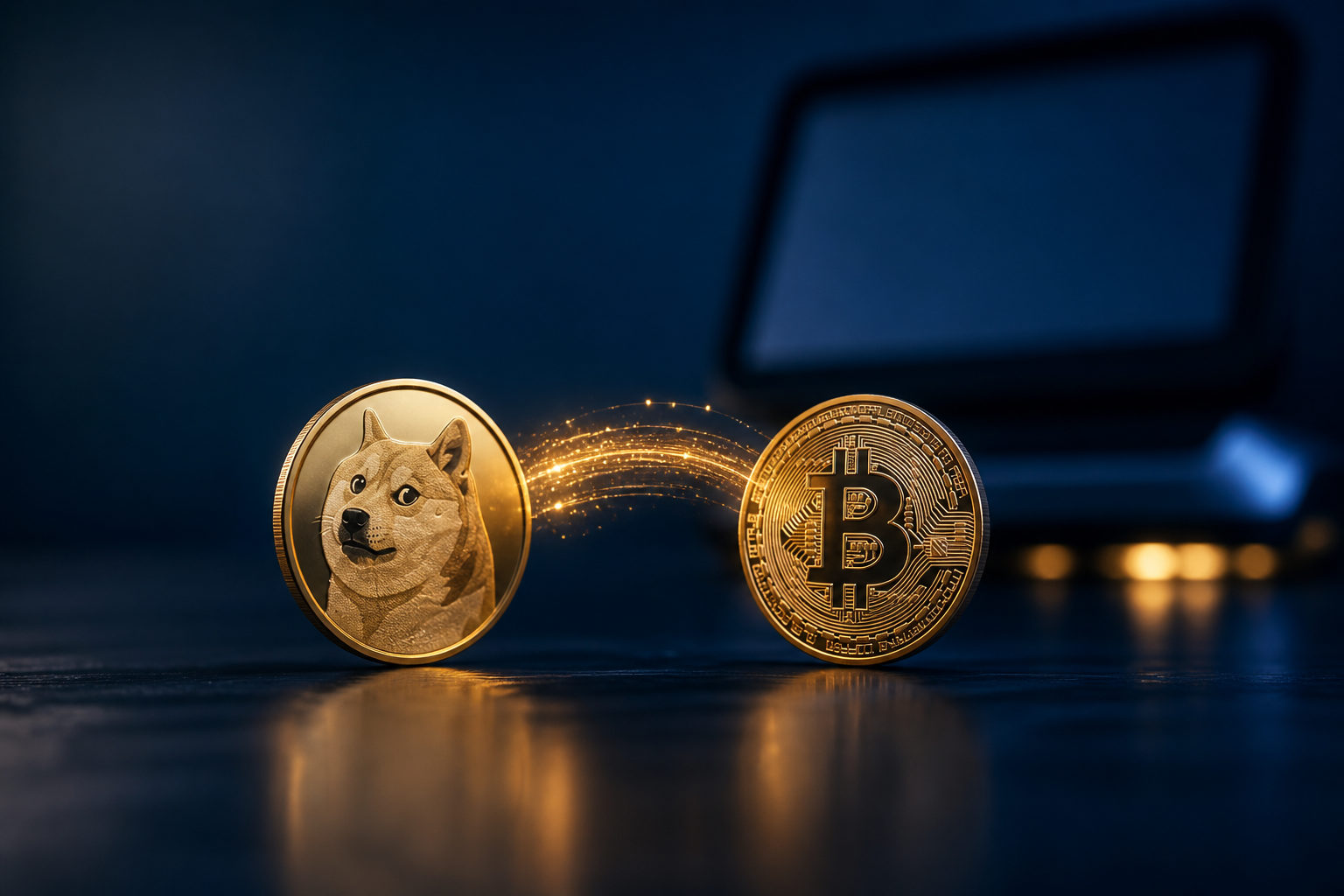
Yes, Dogecoin can be converted to Bitcoin. The usual route is either a direct DOGE/BTC spot trade or a two-step swap where Dogecoin is sold into a stablecoin and then used to buy Bitcoin. The real question is not whether it can be done, but which path gives you better execution after fees, spread, and transfer rules.
How Dogecoin is usually converted to Bitcoin
At a practical level, this is a crypto-to-crypto trade. If an exchange lists a DOGE/BTC market, you can trade Dogecoin directly for Bitcoin in one step. If that pair is unavailable, the common fallback is to convert DOGE into a stablecoin and then buy BTC.
Both methods can work well, but they do not always produce the same result. A direct pair cuts out one extra trade, which may reduce friction. The two-step route is often easier to price because stablecoin markets tend to have better depth on many platforms.
| Method | When it makes sense | Main advantage | Main thing to check |
|---|---|---|---|
| Direct DOGE to BTC trade | The platform offers a DOGE/BTC pair | Shorter path with fewer moving parts | Whether the order book is deep enough |
| DOGE to stablecoin, then stablecoin to BTC | No direct pair, or the direct pair is thin | Often better liquidity and cleaner pricing | Total cost across two trades |
| Swap inside a wallet or aggregator | You want everything in one interface | Simple workflow | Whether spread and network fees are clearly shown |
What to check before you place the trade
The first check is basic: does the service actually support both assets for the function you need? Some platforms support deposits and holdings, yet do not offer the trading pair you want. Others allow trading but restrict withdrawals, which matters if your plan is to move BTC to your own wallet after the swap.
The next check is cost. Many users focus on the displayed quote and miss the full trade economics. Your result may be affected by trading fees, bid-ask spread, network charges, and withdrawal fees. On simple “instant swap” screens, part of the cost may be folded into the rate rather than listed as a separate line item.
Minimum trade size and minimum withdrawal amount also matter. You might complete the conversion and still find that the BTC amount sits below the platform’s withdrawal threshold. For small balances, that detail can shape the whole decision more than the headline rate.
| Checkpoint | Why it matters | Common mistake |
|---|---|---|
| Trading pair availability | Determines whether a direct conversion is possible | Assuming deposit support means swap support |
| Fees and spread | Directly affects how much BTC you receive | Comparing only the quoted price |
| Liquidity | Shapes slippage and execution quality | Assuming a small test order reflects larger trades |
| Withdrawal rules | Determines whether BTC can be moved out | Checking limits only after the trade is done |
| Network selection | Affects whether transfers arrive correctly | Choosing the wrong network during deposit or withdrawal |
Why the best route is not always the shortest one
People searching whether Dogecoin can be converted to Bitcoin often mean something slightly different: can it be converted without losing too much value in the process? That is where execution quality matters. If a direct DOGE/BTC market has light liquidity, a one-step trade may still give a weaker result than a two-step route through a deeper stablecoin market.
Slippage is a big part of this. The price you see before confirming an order is not always the price you end up with, especially when using a market order. Thin books can move quickly, and a larger order can fill across multiple price levels. A direct path may look cleaner on paper while costing more in practice.
There is also hidden complexity in some conversion tools. A wallet or exchange may show a single swap button, while the service handles several internal conversions behind the scenes. That can be convenient, but convenience does not tell you whether the rate is competitive. The estimate page matters more than the button count.
A safer workflow for a first-time conversion
Start by checking whether the platform supports your region and whether it allows Dogecoin deposits, Bitcoin trading, and Bitcoin withdrawals. Friction often appears at the edges of the process rather than in the swap itself. A service that looks fine at sign-up may still limit the exact function you need.
Then compare the direct route with the stablecoin route. Look at the expected BTC received, not just the exchange rate on the screen. If the platform offers both market and limit orders, choose based on your priority: speed or price control. For users who care about execution, limit orders can reduce unpleasant surprises.
After the trade, verify that the Bitcoin balance is fully available and not sitting in a pending state. If you plan to move the coins to a self-custody wallet, review the destination address, the selected network, and your account security checks before submitting the withdrawal. Most avoidable mistakes happen in this final step.
| Step | What you do | What matters most |
|---|---|---|
| Check platform support | Confirm DOGE deposit, BTC trading, and BTC withdrawal features | Do not assume all services offer the full set of functions |
| Choose a route | Compare direct DOGE/BTC with a stablecoin bridge | Judge by total cost and execution quality |
| Review the estimate | Check expected BTC received and visible charges | Watch for rates that look good but hide wide spread |
| Place the order | Use the order type that fits your goal | Market orders favor speed; limit orders favor control |
| Confirm withdrawal readiness | Make sure BTC is available to withdraw if needed | Address and network errors are hard to fix later |
FAQ
Can I swap Dogecoin directly for Bitcoin?
Yes, if the platform offers a DOGE/BTC trading pair. If it does not, the usual alternative is to trade DOGE into a stablecoin first and then buy BTC.
Is a direct conversion cheaper than using a stablecoin first?
Not always. A direct pair uses fewer steps, but a deeper stablecoin market can still produce a better net result once spread and execution quality are included.
Why is the final Bitcoin amount lower than the quote I saw?
That difference can come from spread, slippage, or fees built into the quoted rate. It is more common when using instant conversion tools or market orders.
Do I need to move the Bitcoin to my own wallet right away?
That depends on your goal. If you want direct control over the asset, self-custody is the usual choice; if you plan to trade again soon, the key issue is whether your account security and withdrawal access are set up properly.
Is converting inside a wallet app a good option for beginners?
It can be, because the workflow is simple and everything stays in one place. Even so, you should still inspect the estimated output, service fee, and network cost before confirming.
If your goal is simply to convert Dogecoin into Bitcoin, the most useful move is to compare route availability, total cost, and withdrawal conditions before you trade. That gives you a clearer result than chasing the fastest-looking button.
Disclaimer: This article is for informational and educational purposes only and is not investment, financial, or legal advice. Crypto assets are highly volatile and you could lose your entire investment. Do your own research and decide carefully.