
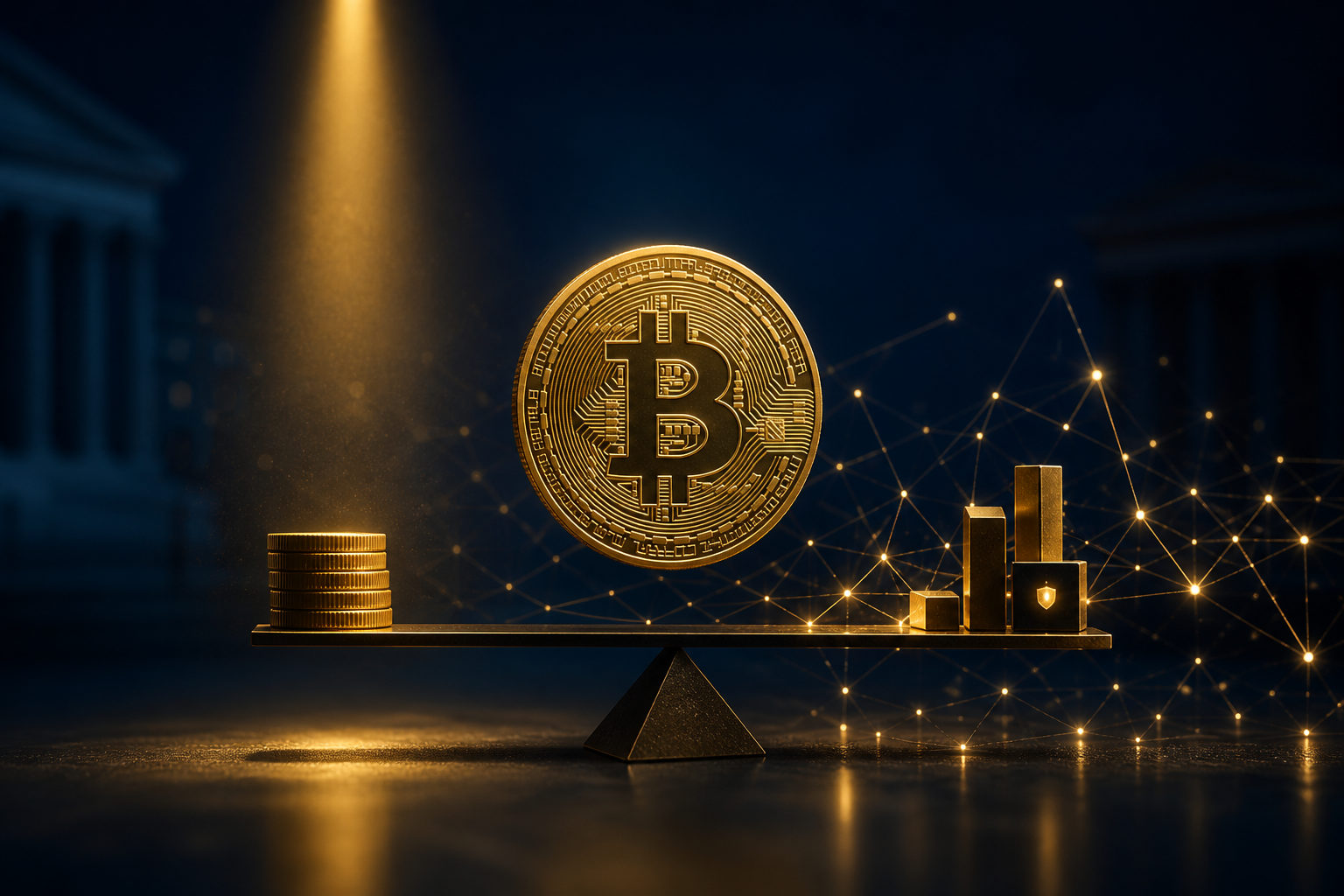
How does bitcoin increase in value? It happens when demand grows faster than the amount holders are willing to sell, so the market clears at a higher price.
Bitcoin does not “grow” in value on its own
People often ask this as if Bitcoin has a built-in growth switch. It does not. Bitcoin does not pay interest, and it does not produce business earnings the way a company can. Its value changes because the market keeps reassessing what it is worth as an asset, a payment network, and a scarce digital good.
That sounds abstract until you strip it down. If more buyers show up, and existing holders decide not to sell cheaply, price can move higher. If sellers get aggressive or risk appetite disappears, price can fall just as fast. So when someone asks how bitcoins increase in value, the plain answer is that the market becomes willing to pay more for them.
Scarcity matters, but scarcity alone is not enough
Bitcoin’s supply schedule is a huge part of the story. The total supply is capped at 21 million coins, which gives it a form of built-in scarcity that many other assets do not share. New bitcoin also enters circulation gradually through mining rather than all at once.
The network adds a new block about every 10 minutes. Mining rewards decline over time through halvings, which happen about every 4 years, or every 210,000 blocks. The halving years so far are 2012, 2016, 2020, and 2024.
Here is the catch: limited supply does not guarantee rising value. A scarce asset still needs buyers. If demand stays weak, scarcity is just a feature on paper. When demand is strong, though, a fixed cap can become a major pricing force because market participants know supply cannot simply be expanded to meet every wave of interest.
Demand is what turns a supply rule into a higher price
Demand for Bitcoin comes from different groups, and they do not all behave the same way. Some people buy it as a long-term store of value. Some use it for transferability across borders. Others care mostly about trading opportunities and volatility. Those motives are very different. They all feed into price.
Adoption can widen demand. Easier access can do the same. If buying, storing, and moving bitcoin becomes simpler, more people are willing to consider it. A liquid market also helps: when participants know they can enter or exit without too much friction, the asset becomes easier to hold in practice, not just in theory.
Then there is belief. Markets price stories as much as mechanics. If investors see Bitcoin as a hedge, a reserve-like asset, a speculative vehicle, or a piece of financial infrastructure, those views shape demand. Sometimes one story dominates for a while. Then it fades, and another takes over.
What usually pushes the market to reprice Bitcoin upward
No single trigger explains every rise in Bitcoin’s value. Price tends to move when several factors line up at once.
- Stronger demand than sell pressure: the most direct driver. More competition among buyers can lift the clearing price.
- Greater confidence in scarcity: the fixed cap and predictable issuance schedule can make long-term holders less willing to sell.
- Wider acceptance: as more market participants treat Bitcoin as a legitimate asset, demand can broaden beyond a narrow trading crowd.
- Better market access: smoother custody, transfers, and trading can lower friction and bring in new buyers.
- Rising expectations: price gains can attract attention, which can attract more buying. That feedback loop is real, though it can reverse hard.
That last point matters. Bitcoin sometimes rises because people expect it to rise further. This can amplify trends in both directions. Fast gains can pull in late buyers; sharp drops can force them back out. The market has a memory, but it also has mood swings.
Value growth is not the same as a short-term price jump
Many beginners confuse a sudden rally with a deeper increase in value. The two are related, but they are not identical. A short move can be driven by positioning, liquidations, headline reactions, or bursts of speculation. None of that automatically proves the long-term case has improved.
A better way to think about it is to separate structure from noise. Structure includes the supply cap, issuance schedule, portability, divisibility, and network rules. Noise includes emotional trading, crowd behavior, and temporary imbalances between buyers and sellers. Both affect price. Only one tells you why the asset may keep attracting demand over time.
Bitcoin is also highly divisible. One satoshi is the smallest unit, equal to one hundred millionth of a BTC. That matters more than many newcomers realize. Divisibility makes the asset easier to use, price, and accumulate even when one full coin feels out of reach.
How to judge whether the case for higher value is getting stronger
You do not need a price prediction to study this question well. Look at the drivers instead.
Start with supply: has anything changed in the issuance rules? With Bitcoin, those rules are known in advance, which removes a lot of guesswork. Then watch demand: are more people using it, holding it, or treating it as part of portfolio construction? After that, look at market function. If custody options, trading access, and transfer rails improve, participation often becomes easier.
And yes, psychology still matters. A market can overshoot in either direction when expectations become one-sided. That is why “how does bitcoin increase in value” is not really a question about one magic catalyst. It is a question about supply discipline meeting sustained demand, with market sentiment acting as an amplifier.
FAQ
Why does Bitcoin go up if it does not produce cash flow?
Its price can rise because buyers place value on scarcity, transferability, and the ability to hold an asset outside traditional financial structures. Markets do not price only cash flow; they also price utility, credibility, and future demand.
Does a fixed supply mean Bitcoin must appreciate?
No. A capped supply can support the case for scarcity, but price still depends on whether people want to own it. Without demand, scarcity alone does not create a higher market value.
What role does halving play in Bitcoin’s value?
Halving reduces the pace of new supply entering the market. That can change expectations around future scarcity, though it does not force the price to rise on its own.
Is Bitcoin’s value mostly driven by speculation?
Speculation plays a role, especially over short periods. Longer-term value depends more on whether the market keeps treating Bitcoin as useful, scarce, and worth holding.
Where should I check the live Bitcoin price?
Use a major market data platform or a large exchange interface for real-time quotes. Prices can differ slightly across venues, so comparing the same time window gives a cleaner read.
If you want a practical next step, stop asking only whether Bitcoin is “going up.” Track what would justify a higher price in the first place: supply limits, demand depth, ease of ownership, and how much conviction the market actually has on a given day.
Disclaimer: This article is for informational and educational purposes only and is not investment, financial, or legal advice. Crypto assets are highly volatile and you could lose your entire investment. Do your own research and decide carefully.