
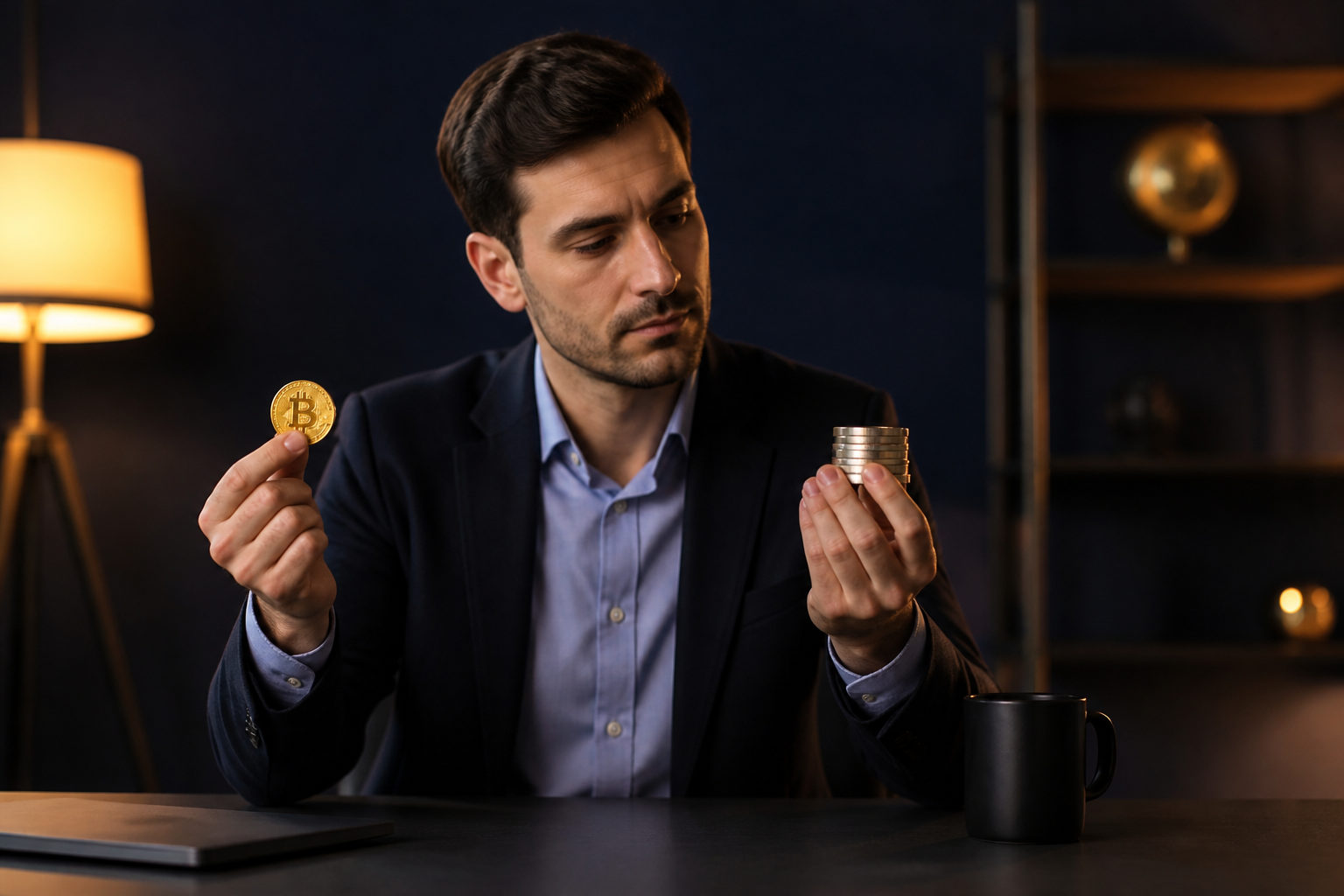
How many bitcoins do I need? There is no universal number. The practical answer depends on why you want Bitcoin, how long you plan to hold it, and how much volatility you can live with.
Start with purpose, not with a target number
Many beginners frame the question in a way that causes trouble from the start: do I need to own a whole bitcoin? In practice, that is the wrong anchor. Bitcoin is divisible, and its smallest unit is 1 satoshi, which equals one hundred millionth of a BTC, so ownership does not begin at one full coin.
The better question is what role Bitcoin is supposed to play for you. One person may want a small position just to understand how buying, storing, and sending it works. Another may treat it as a long-term reserve asset. Someone else may simply want a modest allocation inside a wider portfolio of risk assets. Each goal leads to a different answer.
| Goal | Main focus | How to think about amount |
|---|---|---|
| Learn by doing | Exchange use, wallet setup, transfers | Start small and do not chase round numbers |
| Long-term holding | Asset allocation, staying power, drawdown tolerance | Set a portfolio rule first, then size the position |
| Regular accumulation | Cash flow stability, consistency | Build exposure over time instead of forcing a lump sum |
| Short-term trading | Risk limits, exit rules, emotional control | Decide loss tolerance before deciding position size |
The four variables that actually determine how much Bitcoin you need
1. Your total financial picture
The size of a Bitcoin position should make sense inside your broader finances. If buying it would interfere with living expenses, emergency savings, or money you know you will need soon, then even a small purchase may still be too much.
A more useful process is to separate essential funds from risk capital. Once daily spending needs, reserves, and near-term obligations are out of the way, you can think more clearly about what share of the remaining pool you are willing to expose to Bitcoin.
2. Your time horizon
Time changes the meaning of size. A trader looking for short-term moves experiences position size very differently from a long-term holder who expects to sit through deep swings. The same amount can feel manageable in one plan and unbearable in another.
Bitcoin has a fixed issuance schedule. Its supply cap is 21 million coins, the network began with the genesis block in January 2009, and new blocks are produced about every 10 minutes. The block subsidy is cut in half about every 4 years, or every 210,000 blocks. Those rules matter to long-term holders, but they do not remove price volatility.
3. Your tolerance for drawdowns
People often ask about quantity when the real issue is emotional capacity. If a position is large enough to make you check the price constantly, lose sleep, or abandon your plan after a sharp drop, then the position is already too large for your current tolerance.
This matters more than the number of coins on paper. A smaller amount that you can hold through stress is usually more useful than an impressive amount that pushes you into bad decisions.
4. Your buying method
The same budget feels very different depending on how you deploy it. A lump-sum purchase puts more weight on one entry point. A gradual buying plan spreads that stress over time, though it demands patience and discipline.
If you often freeze because you are worried about buying at the wrong moment, a staged approach may fit better. It does not erase risk, yet it can make the plan easier to follow in real life.
Why the “whole coin” mindset often gets in the way
Owning a full bitcoin has symbolic appeal, but symbolism is not the same thing as suitability. That mindset can delay action for people who assume there is no point starting small, and it can push others into oversizing just to hit a neat milestone.
A more grounded framework is to judge your Bitcoin amount across three separate scales:
| Scale | Question to ask yourself | Why it matters |
|---|---|---|
| Money scale | Can this capital stay untouched for a long time? | Shows whether the position fits your finances |
| Psychology scale | Would a large drop make me rewrite my plan? | Shows whether the position is emotionally too big |
| Time scale | Am I trying to participate now or build slowly over years? | Helps choose between lump sum and gradual buying |
Once those three scales are clear, the question usually becomes easier. You stop chasing a magic coin count and start building a plan you can actually keep.
How to estimate a suitable Bitcoin amount for yourself
The order matters here. Set rules first, then translate them into a BTC amount. If you reverse that process, you may pick an arbitrary number and bend your finances around it.
- Define one main objective. Decide whether your primary aim is learning, long-term holding, regular accumulation, or active trading. One position should not be asked to serve several conflicting jobs at once.
- Ring-fence money you cannot risk. Protect living costs, emergency savings, and funds needed in the near term before considering any Bitcoin allocation.
- Choose a buying style you can repeat. If timing pressure makes you hesitate, gradual buying may be easier to stick with. If you already understand the swings and accept them, other approaches may suit you.
- Test the full process with a small amount first. Buy, move funds, review storage options, and make sure the mechanics feel manageable. Some people like the idea of Bitcoin more than the practical responsibility of holding it.
- Review your plan on a schedule, not in response to every price move. Your cash flow, risk tolerance, and purpose matter more than day-to-day noise.
If you cannot yet answer those points clearly, then your next step is probably not to buy more Bitcoin. Your next step is to build a framework for deciding how much exposure makes sense.
FAQ
Do I need to own one full bitcoin?
No. Bitcoin is divisible, and 1 satoshi equals one hundred millionth of a BTC, so you can start with a much smaller amount.
For most people, the quality of the plan matters far more than hitting a whole-coin milestone. A manageable position is easier to hold than one chosen for status.
How much Bitcoin should a beginner buy first?
The better test is whether the purchase would affect your daily life or make you panic during a sharp move. A first buy often works best as a learning step rather than a final statement about conviction.
If you have never used an exchange, withdrawn to a wallet, or checked how transfers work, starting small can teach you more than opening a large position immediately.
How should long-term holders think about the amount?
Long-term holders usually benefit from focusing on sustainability rather than a fixed coin count. The ability to keep adding over time and hold through rough periods often matters more than the starting size.
Bitcoin has a known supply schedule, including halvings in 2012, 2016, 2020, and 2024, but price behavior still changes sharply. A position that feels too heavy during stress may need to be reduced.
Is it better to buy all at once or over time?
That depends on what kind of risk bothers you more. If you dislike the idea of committing at one moment and then facing a big swing, spreading purchases over time may feel more workable.
If you prefer to act quickly and can accept the emotional impact of timing, a lump sum may still fit. The best method is the one you can follow without constantly second-guessing yourself.
Where should I check the live Bitcoin price before deciding?
Use major market data platforms or well-known exchanges and compare quotes across sources at the same time. You also want to see whether trading conditions look normal and whether the buying process is clear.
Still, live price alone should not decide how much Bitcoin you need. The final amount should come from your purpose, your time horizon, and your tolerance for volatility.
If you want a practical next step, write down your goal, separate money you cannot risk, and choose a buying method you can maintain. That process will usually tell you far more than asking how many bitcoins you are supposed to own.
Disclaimer: This article is for informational and educational purposes only and is not investment, financial, or legal advice. Crypto assets are highly volatile and you could lose your entire investment. Do your own research and decide carefully.