
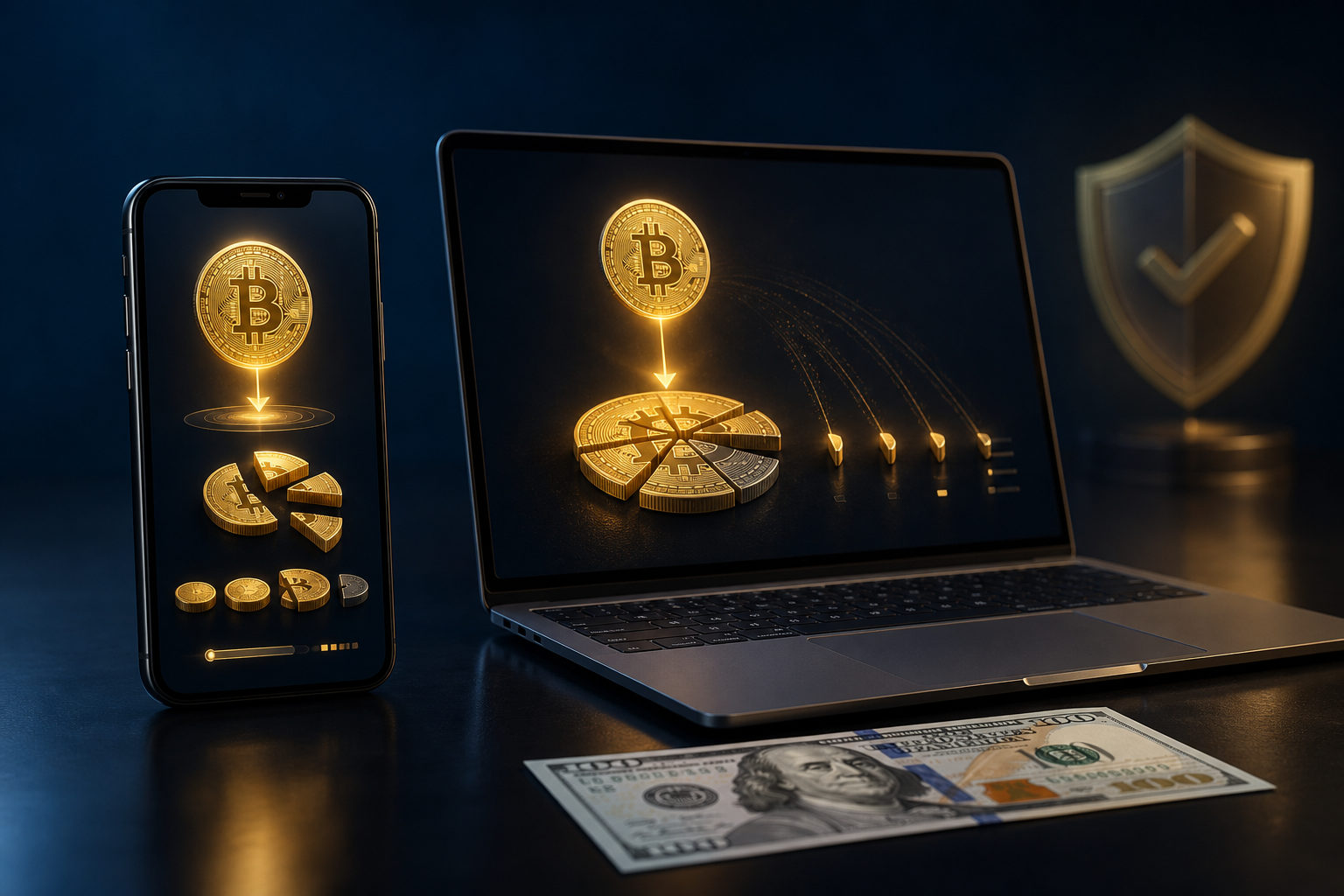
How much bitcoin can you get for $100? There is no fixed amount. It depends on the live BTC price at the time you buy, plus fees, spread, and whether you move the coins to your own wallet afterward.
Start with the basic idea: $100 buys a fraction of bitcoin
A lot of first-time buyers think they need enough money to buy one full bitcoin. That is not how it works. Bitcoin is divisible, so you can buy a small portion of it with a fixed dollar amount.
The smallest unit is called a satoshi, and 1 satoshi is one hundred millionth of 1 BTC. That means a $100 budget can still be used to buy bitcoin, even if you are only getting a small fraction. The real question is not whether $100 is enough. The real question is how much BTC remains after the market price and all costs are accounted for.
This matters because the number you see on a quote page is often only a reference price. The amount you actually receive is usually shown later, on the order confirmation screen. That is the figure that deserves your attention.
Step 1: Check whether you are looking at a market quote or a real buy price
If you want to estimate how much bitcoin $100 can buy, your first move should be to check the live BTC/USD price from a mainstream market source. This gives you a starting point. Since your budget is in dollars, the relevant comparison is the bitcoin price in dollars.
That said, a quote is not always the same as your final execution price. A service may show a market reference, then apply a spread when you place the order. On top of that, you may see a transaction fee, a payment processing fee, or a later withdrawal cost if you send the bitcoin to an external wallet.
The practical takeaway is simple: use the live price to understand the rough range, but do not treat it as the exact amount of BTC you will receive. For that, you need the preview or confirmation screen inside the purchase flow.
Step 2: Estimate the amount yourself before you place the order
The basic math is straightforward. Take $100 and divide it by the current bitcoin price in dollars. That gives you a rough estimate of the BTC amount before costs. It is useful because it helps you understand the size of the purchase, even if it will not match the final result exactly.
In practice, many services let you enter a dollar amount directly. If you type in $100, the interface often shows an estimated BTC amount right away. That is the easiest method for beginners because it reduces errors with long decimal places and quickly shows whether the service is adding costs on top or subtracting them from your purchase amount.
Be careful here. Some screens show an estimate before fees are finalized, while others show something much closer to what you will actually receive. If you do not read the labels carefully, it is easy to assume the larger number is final when it is not.
What changes the final amount of BTC you get
- Live price: If bitcoin is priced higher, $100 buys less BTC.
- Fees: Buy fees, payment fees, and other charges reduce the amount converted into bitcoin.
- Spread: The buy price can be less favorable than the reference market quote.
- Minimum order rules: Some services handle small purchases differently.
- Withdrawal costs later: If you move the bitcoin out, that can affect the total value you keep.
This is why there is no universal answer to the question. Two people each spending $100 can receive different amounts of BTC if they buy at different moments or use different services with different pricing structures.
Step 3: Decide where you want the bitcoin to stay after purchase
Many beginners focus only on the act of buying. A better approach is to decide in advance what happens after the purchase. Will you leave the bitcoin inside the provider account for now, or will you move it to a wallet you control?
This decision matters because it changes both the risk profile and the total cost. If you leave the bitcoin where you bought it, the process is simpler. That can be useful for a first small purchase. If you move it to a self-custody wallet, you gain direct control over the asset, but you also take on the responsibility of backing up your wallet information and checking addresses carefully.
For a $100 purchase, this question is especially important because extra costs can matter more on a small order. A beginner sometimes focuses on getting the best quote, then learns later that moving the bitcoin out adds another layer of expense or complexity. It is better to think about this before you buy.
If your main goal is to learn the process, a clear interface, transparent costs, and solid account security can matter more than chasing the absolute lowest fee. If your main goal is self-custody, then you should make sure you understand wallet backups before sending anything out.
Step 4: Review the order page line by line before paying
Small purchases are often where hidden costs hurt the most. When your budget is only $100, every extra charge changes the amount of bitcoin you receive in a noticeable way.
Before confirming the order, check whether the service treats your $100 as a total spend or as a net purchase amount. Those are not the same thing. In one case, fees may be included inside the $100. In the other, fees may be added separately. If you miss this distinction, your final BTC amount may be lower than expected.
Next, look at the estimated bitcoin you will receive on the confirmation page. That figure matters more than a headline fee number by itself. A service can advertise a modest fee while giving you a less favorable buy price through the spread. If you only compare the stated fee, you may think the deal is better than it really is.
It is also smart to check the following before you continue:
- Identity verification rules: Some services require verification before buying or withdrawing.
- Payment method costs: Different payment paths may carry different charges.
- Withdrawal conditions: You should know whether you can move the bitcoin out and what that process involves.
- Time limits on the quote: In a moving market, the estimate may change before you confirm.
If a service does not clearly show the estimated BTC amount, the fees involved, and the next steps after purchase, it is not a good starting point for a beginner.
Step 5: Scam prevention matters more than squeezing out a tiny extra amount
People searching for answers about buying bitcoin with $100 are often first-time buyers. That makes them a common target for scams. The trap is simple: because the amount feels small, people let their guard down. They think they are only testing the waters, so they become more willing to click ads, trust direct messages, or let someone else “help” with the purchase.
A safer approach is to do every critical step yourself: account setup, identity checks if required, security settings, and order placement. No legitimate buying process requires you to hand your password, one-time code, recovery phrase, or private key to a stranger.
Watch for these warning signs:
- Promises that you will get more BTC than normal: Real purchases depend on live price and fees. There is no honest guaranteed shortcut.
- Requests to send money to a personal account: Claims about “special rates” or “zero fees” are a common lure.
- Anyone asking for your recovery phrase or private key: That is an attempt to take control of your assets.
- Deals handled only through chat apps: If there is no proper order record or support path, your options are limited if something goes wrong.
- Fake support messages about failed orders or frozen funds: These are often used to pressure you into paying again or sharing sensitive information.
Even if you are only buying a small amount, the same security rules apply. A small first purchase is still worth protecting. In bitcoin, control matters more than appearances on a screen.
Step 6: After buying, verify the result and secure the account
Once the purchase is complete, do not stop at the balance display. Check the trade details. You want to see the execution price, the actual amount of BTC credited, the fees charged, and where the asset is currently held.
This step matters because many beginners remember only the dollar amount they spent. They do not review the trade record, which means they miss the difference between the original estimate and the final result. If the order still shows a pending status, do not keep submitting new orders without understanding what happened first.
Then handle security. Use a strong password and turn on two-factor authentication. If you plan to move the bitcoin into a wallet you control, make sure you understand how wallet backups work before sending anything out. A rushed withdrawal is one of the easiest ways for a beginner to make a costly mistake.
Two errors show up often after a first small purchase. One is ignoring account security because the amount feels minor. The other is trying self-custody before learning how recovery phrases and address checks work. Both problems are avoidable if you slow down and review each step.
FAQ
Can I buy less than one full bitcoin with $100?
Yes. Bitcoin is divisible, so you do not need to buy a whole coin. A $100 purchase typically gives you a fraction of BTC based on the live price and the costs involved.
Why is the amount I receive different from the price I saw first?
The first number you see is often only a market quote. Your final amount can change because of spread, fees, payment costs, and price movement during the order process.
Should I spend the whole $100 in one purchase?
That depends on your budget and your comfort with price swings. If your main goal is to learn the process, it often makes sense to focus first on understanding pricing, fees, and security rather than treating the trade like a race.
Is it okay to leave the bitcoin in the account where I bought it?
For a beginner, that can be the simpler short-term option, especially while learning the basics. If you choose that route, account security is essential. If you want direct control, you need to learn self-custody before moving funds.
What is the biggest risk when searching for ways to buy bitcoin with $100?
The biggest risk is not the market quote. It is fraud. Fake support staff, off-platform deals, personal payment requests, and anyone asking for your recovery phrase are all serious red flags.
Use this checklist before you buy
Check the live BTC/USD price, review the estimated BTC amount on the confirmation screen, read the fee details, confirm the payment method terms, and decide whether you plan to keep the bitcoin in the account or move it later. If any part of the process is unclear, stop before paying. With a $100 budget, avoiding one bad mistake can matter more than getting a slightly better quote.
Disclaimer: This article is for informational and educational purposes only and is not investment, financial, or legal advice. Crypto assets are highly volatile and you could lose your entire investment. Do your own research and decide carefully.