
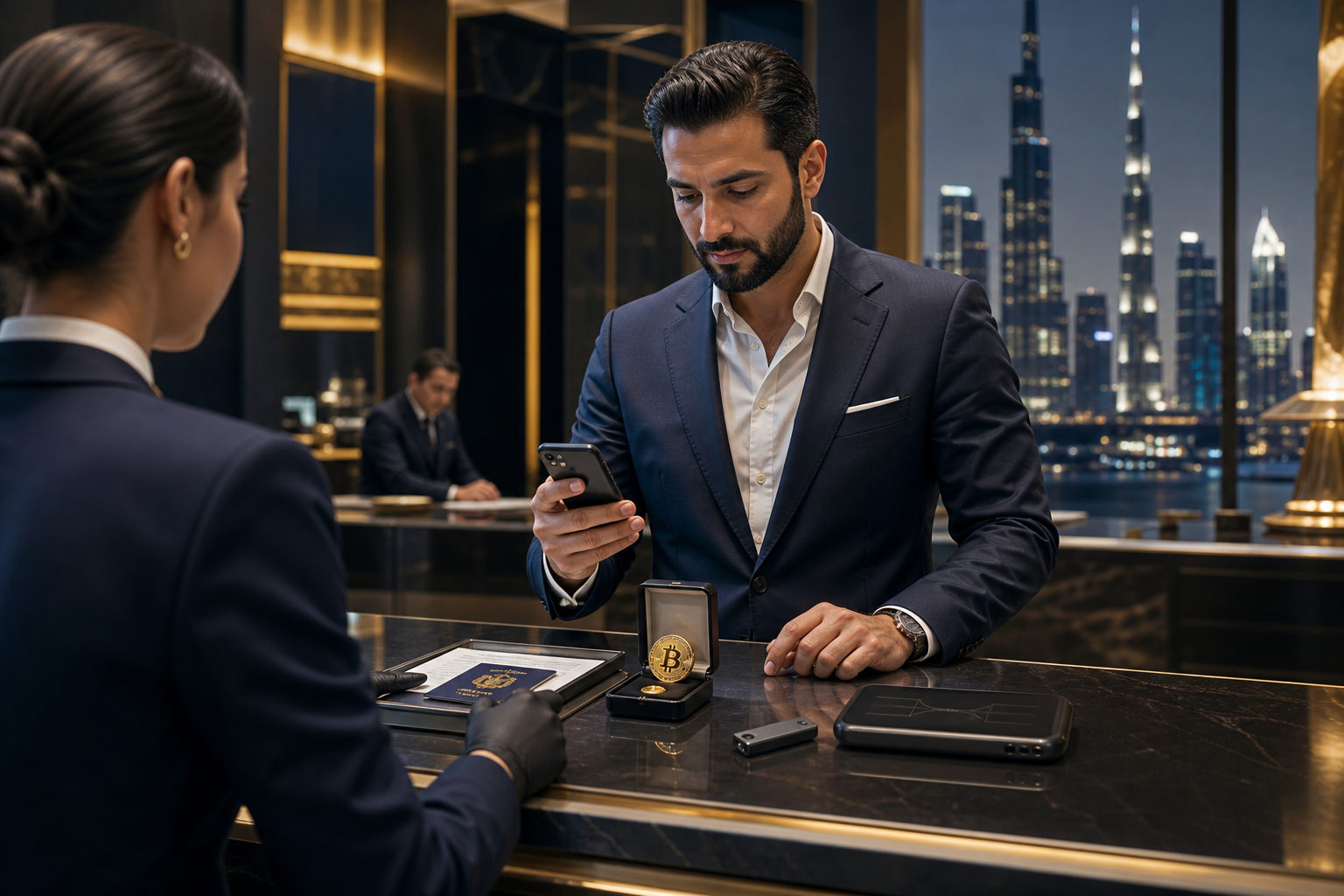
If you're asking how to buy Bitcoin in Dubai or anywhere else in the UAE, here's the short version: pick a platform that's actually licensed by one of the country's real regulators (VARA, SCA, DFSA, or FSRA), fund your account in dirhams through a bank transfer or a payment method the platform genuinely supports, complete identity verification, place your order, and then move the coins to a wallet you control. Get that order right and skip the shortcuts — the scams in this market almost always target people trying to move faster than the process allows.
First, know what you're actually buying — and whether it's legal here
Bitcoin is a digital asset that runs on a blockchain, with a hard cap of 21 million coins. It launched in January 2009 with the genesis block, and its smallest unit is the satoshi, one hundred-millionth of a BTC. New blocks get added roughly every 10 minutes.
Here's the part that trips people up: what you're buying isn't a number on an exchange's screen. It's an asset controlled by a private key, full stop. And in the UAE, buying and holding Bitcoin as an individual is legal and sits inside an actual regulatory structure — this isn't some gray-market workaround. The country just splits oversight across several bodies instead of one. Onshore Dubai, meaning everywhere except the Dubai International Financial Centre, falls under VARA, the Virtual Assets Regulatory Authority. Inside the DIFC free zone, the DFSA runs its own Crypto Token Regime, which currently recognizes only a short list of tokens — Bitcoin and Ethereum among them. Abu Dhabi Global Market, a separate free zone, is regulated by the FSRA. And federally, outside all three free zones, the SCA (Securities and Commodities Authority) oversees securities-style token activity. Same country, four different rulebooks, which is exactly why checking who actually licenses your platform matters more than checking its marketing page.
| Regulator | Where it applies | What it's generally known for |
|---|---|---|
| VARA (Virtual Assets Regulatory Authority) | Onshore Dubai, outside the DIFC | The largest pool of licensed retail-facing exchanges, brokers, and custodians in the UAE |
| DFSA (Dubai Financial Services Authority) | Dubai International Financial Centre (DIFC) | A narrower Crypto Token Regime covering a short list of recognized tokens, more institutional in tone |
| FSRA (Financial Services Regulatory Authority) | Abu Dhabi Global Market (ADGM) | One of the earlier full crypto frameworks globally, geared toward institutional and custody business |
| SCA (Securities and Commodities Authority) | Federal level, outside the free zones above | Securities-style oversight; some global exchanges license through this route instead |
To make this concrete: Binance moved its UAE resident accounts off the global Binance.com platform onto a local entity, Binance FZE, which picked up a full VARA VASP license in April 2024 covering exchange, brokerage, lending, and asset-management activities. OKX operates in Dubai through OKX Middle East Fintech FZE, which holds a VARA preparatory license. Bybit took a different route — in October 2025 it secured an SCA license covering UAE mainland operations, not a VARA license. BitOasis is a homegrown Dubai exchange that's been around since the early days and runs its own AED wallet. Rain is licensed in Bahrain and also does business across the UAE. By mid-2026, industry trackers put the number of VARA-registered VASPs somewhere north of 50, though only a subset of those actually hold the specific authorization to run exchange services, which is a good reason to check exactly what a platform is licensed to do rather than just whether it's "licensed."
Step 1: Figure out which buying route you're actually going to use
Buying Bitcoin in the UAE usually comes down to three paths: a licensed exchange regulated by VARA, SCA, DFSA, or FSRA; a crypto feature built directly into a bank's app; or an off-market deal with someone you know. That middle option is more real than you'd expect. Emirates NBD's digital banking arm, Liv X, rolled out in-app crypto buying and selling in March 2025, executed through Aquanow (a VARA-licensed broker-dealer) with custody handled by Zodia Custody. It's still the exception rather than the norm, though. Most people buying Bitcoin here still go through a standalone licensed exchange.
The question to ask at this step isn't "which one is cheapest," it's "which one can I actually verify." If an entry point skips identity checks entirely, pushes you toward an offline bank transfer, or asks you to send funds to a personal account, treat that as a warning sign, not a convenience.
- Do this: Confirm the platform shows up in VARA's, DFSA's, FSRA's, or SCA's public register before you even compare fees.
- Why it matters: A licensed path is slower, but the money trail is traceable, and you have somewhere to complain if something goes wrong.
- Watch for: Don't skip the license check just because a fee looks lower, and don't believe anyone offering an "insider channel" or "verified account, no questions asked."
Step 2: Set up your account, ID, and a wallet you actually control
Before you buy anything, line up the basics: a working email and phone number, an Emirates ID or passport, and a dirham bank account that matches your name exactly. People tend to pour all their energy into placing the order and skip this part, then get stuck at verification or withdrawal later.
There's a UAE-specific snag worth knowing about upfront. For years, the standard policy at major local banks — Emirates NBD and ADCB among them — has been to decline credit card purchases of cryptocurrency outright, and they generally don't process crypto-related remittances either, since banks tend to flag this kind of activity as high-risk. What actually works reliably is a dirham bank transfer from a local account, or a debit card, Apple Pay, or Google Pay channel that the exchange itself supports. Even where a card purchase does go through, your card issuer may code it as a cash advance rather than a normal purchase, which brings extra interest and fees you didn't budget for. Calling your bank before you try is a lot cheaper than finding out the hard way.
It's also worth setting up a self-custody wallet before you buy anything, not after. An exchange account is fine for trading, but it wasn't built for long-term storage — if your coins just sit on a third-party platform indefinitely, what you actually control is a balance on someone else's interface, one that can be frozen or restricted.
Picking a wallet that won't cause problems later
Wallets generally split into software wallets for everyday use and hardware wallets built for offline storage. You don't need to buy a hardware device on day one, but pick something that lets you back up your recovery phrase and gives you actual control of your private keys.
- Do this: Create the wallet, write down the backup phrase, store it somewhere separate, and double-check your BTC receiving address before you need it.
- Why it matters: Scrambling to set up a wallet right after a purchase is exactly when address-copying mistakes happen.
- Watch for: Never screenshot your recovery phrase, never store it in cloud storage, and never send it to anyone claiming to be support staff.
Step 3: Verify your identity, then choose how you're funding the purchase
Search "how to buy bitcoin in dubai" and you'll notice the buy button isn't really what determines your experience — identity verification and funding are. Any mismatch between your name, your ID, and your payment details tends to trigger extra review, and that's exactly the moment scammers try to slide in with an offer to "speed things up" for you.
Funding methods differ quite a bit in both speed and cost. Using BitOasis's published 2026 fee structure as a real-world example (check the current numbers on whichever platform you actually use, since these change over time):
| Funding / trading method | Typical speed | Reference fee (BitOasis, 2026) | Best for |
|---|---|---|---|
| Direct local bank link (e.g. Easy Funding) | Minutes to one business day | Free | Larger amounts, lowest cost |
| Instant funding channel (e.g. BOLT) | Instant | Up to ~1% | When you need to buy right now |
| Debit/credit card | Instant | ~3.99% | Small, quick purchases, at a real cost |
| Trading fee (spot) | — | 0% on the basic tier, roughly 0.25%/0.5% maker/taker on the pro tier | Depends which trading interface you use |
| AED withdrawal | Platform-dependent | Flat ~AED 10 per transaction | Moving funds back to your bank |
On the order screen, you'll typically choose between a market order and a limit order — market is simpler, limit gives you more control over the price you actually pay. If you're new to this, start with an amount you can genuinely afford to watch drop in value. Don't go all-in on your first trade.
- Do this: Complete identity verification, turn on two-factor authentication, double-check the receiving account name matches the platform, then place your order.
- Why it matters: These steps cut down on account takeovers, misdirected transfers, and compliance holds tied to unclear source of funds.
- Watch for: Confirm the account you're sending money to actually matches the platform's official details. Anyone asking you to pay a third party, split a payment, or "help a friend" get funds in should be a hard stop.
Step 4: Send a small test withdrawal before you move everything
A lot of people assume the job is done once the order fills. It isn't — getting the Bitcoin safely into your own wallet is the part that actually matters. A wrong address on a blockchain transaction usually can't be reversed, so a small test transfer beats trying to get everything right in one shot.
Once the test lands, send the rest. It feels like an extra step, but it catches copy-paste errors, wrong-network mistakes, and wallet compatibility issues before they cost you the whole balance.
- Do this: Copy your wallet's BTC address, check the first and last several characters against the source, send a small amount first, and only send the rest once it confirms.
- Why it matters: A small test is the cheapest way to check the address, network, and wallet state under real conditions.
- Watch for: Never type an address by hand, and re-check it after copying — clipboard-hijacking malware that silently swaps addresses is a real and fairly common attack.
Step 5: Store it properly, and understand what the UAE actually asks of you on taxes
The last step in buying Bitcoin in Dubai isn't watching the price — it's locking down storage and understanding your actual tax position. On storage: since the Bitcoin network confirms ownership through the chain itself roughly every 10 minutes, a stolen account or a lost backup is a far bigger loss than paying a slightly worse price on your original purchase ever could be.
On taxes — this is the part everyone's curious about, and the part most people get slightly wrong. As of 2026, the UAE doesn't charge individuals income tax or a dedicated capital gains tax on personal crypto trading or holding. That's a real and significant reason the country markets itself as crypto-friendly. But "no personal tax" isn't the same as "no tax at all." Converting between crypto assets, or between crypto and fiat, has been treated as VAT-exempt since 2018. Spend crypto directly on goods or services, though, and that transaction generally still triggers the standard 5% VAT. Service-type fees, such as custody and wallet management charges from exchanges, typically carry that same 5% VAT too. And if your activity starts looking like a business rather than personal investing — frequent professional trading, managing money for others, or running a registered crypto company — you move into 9% corporate tax territory, and the personal tax-free treatment no longer applies. One more thing worth knowing: the UAE signed onto the international Crypto-Asset Reporting Framework (CARF) in July 2025, with cross-border account information exchange expected to begin around 2028. In practical terms, treating "nobody will ever know" as a long-term assumption isn't a great plan. Tax rules and thresholds shift with policy, so if you're dealing with serious money or anything that could be read as business activity, talk to a licensed local tax advisor instead of relying on an article like this one.
One more local detail worth knowing, mostly for context: the UAE Central Bank approved the country's first dirham-pegged stablecoin, AE Coin, in December 2024. It's backed one-to-one by dirham reserves and accessed through the AEC Wallet, which is tied to UAE Pass, and it's mainly aimed at everyday payments and merchant settlement rather than investment. That's a different product from Bitcoin, with a different purchase flow entirely — worth knowing about so you don't confuse the two when you're reading local crypto news.
For anyone holding long-term, two things matter more than almost anything else: whether your backup can actually be restored, and whether a single compromised device can take down everything at once. Keeping your login password, two-factor codes, and wallet backup all on the same phone feels convenient right up until that phone becomes the single point of failure for your entire holding.
- Do this: Store your login credentials and wallet backup in separate places, periodically test that you can actually restore the wallet, keep important devices updated and locked, and check your tax obligations early if the amounts or activity level are significant.
- Why it matters: Security is a layered system, not a single action, and the same is true of staying compliant.
- Watch for: Don't hand your recovery phrase to a family member "for safekeeping" without explaining what it actually protects, and don't forget to re-verify your backup after switching phones or moving house.
The scams to watch for when buying Bitcoin in Dubai or anywhere in the UAE
However you found your way to this article, whether you searched "how can I buy bitcoin in Dubai" or something close to it, the scripts scammers use come down to two moves: urgency and "let me handle that for you." The more rushed you feel, the easier it is for someone to dress up a mistake as a shortcut. In April 2026, Dubai Police ran a joint operation with the FBI and Chinese police that took down at least nine scam operations built around so-called "pig butchering" crypto investment fraud, arresting 276 people in the process. The pattern in these schemes is consistent: build trust through a dating app or social platform, steer the target toward a slick-looking but completely unregulated platform, let the victim watch fake "profits" pile up for a while, and then invent one excuse after another, unpaid taxes, an "unfreezing fee," whenever they try to withdraw.
- Fake support agents: They message you first, offer to unfreeze your account or speed up verification, then ask for your verification code or wallet backup.
- Fake OTC sellers: They send a payment QR code or personal account, ask you to pay first, and then stall on releasing the coins with one excuse after another.
- Fake wallets or apps: Built to look official, designed to harvest your recovery phrase.
- Clipboard hijackers: Malware that swaps a copied address the moment before you paste it — you only notice once the coins land somewhere else.
- "Guaranteed returns plus a Golden Visa" pitch: Bundling a crypto investment with UAE residency or fast-track visa promises is a red flag both regulators and police have flagged repeatedly.
The response to any of these is the same: stop, verify independently, and don't click any file or app link inside the chat itself. A legitimate platform will never ask for your recovery phrase, and it will never ask you to send money to a personal account. If you think you've already been scammed, call your bank's or card issuer's 24-hour fraud line first to freeze the account or attempt to reverse the transfer, then file a report through Dubai Police's eCrime platform at ecrime.ae, or call the 901 hotline. Those are real, official UAE reporting channels, and a far better bet than chasing the money yourself or trusting a "recovery specialist" who reaches out afterward.
Frequently asked questions
What's the first thing I should check before buying Bitcoin in Dubai?
Confirm the platform you're planning to use actually appears in VARA's, SCA's, DFSA's, or FSRA's public register, then get your dirham bank account, ID documents, and self-custody wallet ready. Get that order right and the buying and withdrawal steps go a lot more smoothly.
Do I owe tax on Bitcoin in the UAE?
As of 2026, individuals don't pay personal income tax or a dedicated capital gains tax on buying, selling, or holding crypto. But spending crypto directly on goods or services typically triggers 5% VAT, platform custody and management fees usually carry that same VAT, and activity that looks like a business can bring 9% corporate tax into play. Check the current official rules and talk to a licensed local tax advisor for anything beyond casual amounts.
Can I just buy Bitcoin with a credit card in the UAE?
Not reliably. Several major UAE banks decline credit card crypto purchases outright and generally don't process crypto-related remittances. A dirham bank transfer or a supported debit card channel is the more dependable route — call your bank first if you're not sure.
Why shouldn't a beginner place a large order right away?
Because you haven't yet confirmed that funding, ordering, withdrawing, and receiving into your wallet all actually work smoothly together. A small test run surfaces account limits, address mistakes, and process gaps while the stakes are still low.
Is it fine to just leave Bitcoin sitting on the exchange after buying?
For short-term trading, sure. For anything you're holding long-term, a self-custody wallet is the better call — an exchange account is still subject to that platform's rules and to the risk of a freeze, while a wallet you control is closer to actually owning the asset.
If I only remember a few things, what should they be?
Stick to platforms you can verify against VARA, SCA, DFSA, or FSRA. Complete identity verification and turn on two-factor authentication. Test withdrawals with a small amount before moving everything. Move long-term holdings to a wallet you control. Check your tax situation early if the amounts are meaningful. And treat any request for your verification code, recovery phrase, or a transfer to a personal account as an immediate stop sign.
Line up a verified platform, a wallet, a backup, and two-factor authentication before you place your first order. Test a small withdrawal before moving the rest, and if anything feels off, verify it through Dubai Police's eCrime platform or the 901 hotline rather than trusting whoever's asking you to move fast. That habit will save you more money than shaving a fraction of a percent off a trading fee ever will.
Disclaimer: This article is for general information and educational purposes only and is not investment, financial, tax, or legal advice. The regulators, licensed platforms, fees, and tax details referenced here reflect publicly available information as of 2026 and are subject to change — verify current details directly with VARA, SCA, DFSA, FSRA, and the platforms themselves. Cryptocurrency prices are highly volatile and you could lose your entire investment; do your own research and use caution.