
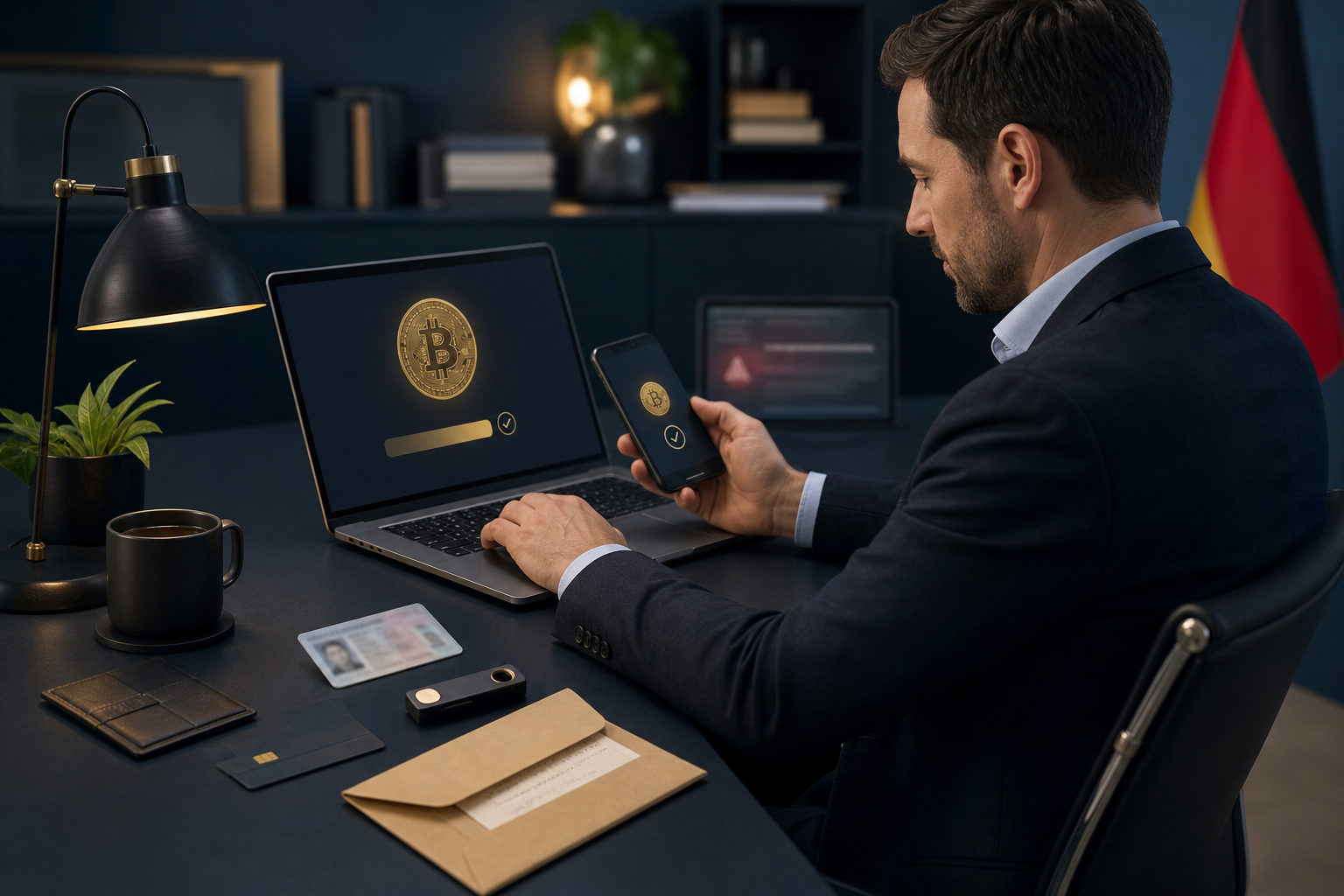
Buying bitcoin in Germany, in practice, comes down to three things: picking a service that is actually licensed to operate here, moving euros into it through a method your bank will not flag, and deciding upfront how long you plan to hold before you touch it again — because in Germany, that holding period changes your tax bill more than almost anything else you will do.
Figure out what you actually want first: a purchase, or a position
Most people who search for how to buy bitcoin in Germany are really asking where to click buy. That is a fine starting point, but it is not the question that decides whether the whole experience goes smoothly. The real question is what you plan to do after the purchase clears.
If you just want to try the process once and see how it feels, focus on account setup, identity checks, payment options, and how easy the order screen is to read. If you are planning to hold bitcoin for years, what matters more is whether you can withdraw to your own wallet, how strong the account security options are, and whether the platform keeps customer assets separate from its own operating funds.
Decide which one you are doing before you register anywhere. It changes which questions you should be asking.
Step 1: Choose a platform that is actually authorized to serve Germany
Crypto exchanges operating in Germany fall under the supervision of BaFin, the Federal Financial Supervisory Authority, and since 2026 that oversight runs through the EU's Markets in Crypto-Assets Regulation, known as MiCA. The transitional grace period that let unlicensed firms keep operating ended on December 31, 2025. As of January 1, 2026, any platform serving German customers without a BaFin authorization as a Crypto-Asset Service Provider is operating outside the rules. By early 2026, BaFin had reportedly authorized roughly 18 MiCA-licensed CASPs, said to be the largest number under any single national regulator in the EU.
What you will actually run into as a German resident falls into a few rough categories. There are brokerage-style apps built on traditional German exchange infrastructure — BISON, for example, runs on Börse Stuttgart and keeps customer crypto in German custody through its regulated custodian, blocknox, without charging a separate trading fee; it earns money through a buy/sell spread of roughly 1.25%, and euro balances carry statutory deposit protection up to €100,000 per person. There are larger international exchanges that set up a dedicated EU entity to serve German and European customers under MiCA — Kraken, for instance, has served German clients since August 2025 through its licensed European entity, Payward Europe Solutions Limited, supporting SEPA, SEPA Instant, PayPal, and SWIFT deposits, with free euro funding and trading fees reported up to around 0.40%. And there are Vienna-founded platforms like Bitpanda that built a German-language product with euro SEPA support, reported trading fees up to around 1.49%, and a lineup that extends well beyond crypto into stocks, ETFs, and savings plans.
None of this is a recommendation to use any specific one of these. It is meant to give you a sense of what properly licensed for Germany actually looks like in the market, so vague marketing claims do not stand in for real verification. Fees, terms, and even licensing status change over time, so check a platform's current status yourself rather than trusting an old screenshot or a review site.
How to actually check this
- Look the platform up in BaFin's public register, or check the EU-level list of MiCA-authorized entities, instead of relying on a "regulated" badge on the platform's own homepage.
- Read the fine print on identity verification, supported payment methods, withdrawal rules, and fees — most platforms split these into spread, trading fee, and withdrawal fee, and they are rarely the same figure.
- Check whether you can withdraw bitcoin to an external wallet, not just hold it inside the platform.
- Confirm two-factor authentication, login alerts, and address whitelisting are available, and check whether euro balances carry any deposit protection.
Why this matters more than it seems
"You can buy bitcoin here" does not tell you much on its own. Some platforms are built for simple purchases, others for active trading; some are beginner-friendly with a narrow feature set, others pack derivatives and margin products right next to the basic spot market. For someone buying in Germany, whether deposits and withdrawals move smoothly through your bank, whether verification follows a clear process, and whether the platform is actually licensed to serve you usually matters more than how polished the marketing page looks.
Watch out for
- Slogans like "zero fees," "instant payout," or "expert-managed trading" that are not backed up by an actual fee schedule you can read for yourself.
- Assuming a platform is trustworthy because of screenshots circulating on social media — screenshots can be faked, and reviews can be paid for.
- Platforms that stay vague about withdrawal limits, account freezes, or how to appeal one. That vagueness tends to become a real problem later, not a minor annoyance.
Step 2: Register and verify with your own information, not someone else's
Once you have picked a platform, the part that trips people up is identity verification. Under EU anti-money-laundering rules that apply to MiCA-licensed platforms, you will typically need to submit a government ID and have your name, date of birth, and address checked against it. This is not the platform being difficult — it is a legal requirement, and it is also what lets you unlock withdrawals and get help if your account ever gets flagged.
How to actually do this
- Register with an email address you actually check, not a throwaway one.
- Use a unique, strong password — not the one you use for your bank or your email.
- Complete verification with real, current, consistent information. Do not guess on details.
- Turn on two-factor authentication, and use an authenticator app rather than relying only on SMS codes.
Why it is worth doing properly
Mismatched details, a family member's ID, or someone verifying an account on your behalf all look minor until the platform's risk team flags something — and then the account, and whatever is in it, can get frozen while you sort it out. That is a bad time to discover your paperwork does not line up.
Watch out for
- Never buy a pre-verified account or pay someone to complete verification for you. An account where the name on file does not match the person using it is a red flag on its own.
- Never forward a verification code, confirmation email, or login prompt to anyone claiming to be support. Legitimate support does not ask for these.
- Anyone offering "fast-track verification" or an "internal bypass" is not someone you want handling your account.
Step 3: Fund your account in euros, and test with a small amount first
Buying bitcoin in Germany means funding your account in euros, not dollars, and that affects both the price you see and how fees get calculated. The common ways to get euros into a crypto platform are a standard SEPA bank transfer, SEPA Instant, PayPal where a platform supports it, and debit or credit card. They differ a lot in speed, cost, and how likely they are to trigger a hold.
| Funding method | Typical speed | Typical cost | What to watch for |
|---|---|---|---|
| Standard SEPA transfer | Around one business day | Usually free or low-cost on most platforms | Get the reference number and payee details exactly right, or the deposit can be delayed or bounced back |
| SEPA Instant | Seconds to a few minutes | Free on some platforms, a small flat fee on others | Not every German bank supports instant transfers — check with your own bank first |
| PayPal | Instant, where supported | Varies by platform, sometimes no extra charge | Not all exchanges accept PayPal deposits, so confirm before you plan around it |
| Debit or credit card | Instant | Card issuers often treat this like a cash advance (fees can run up to roughly 5%), the platform typically adds its own 1 to 3 percent on top, and a platform based outside the country may add another 1 to 3 percent foreign transaction fee | Plenty of German card issuers block crypto purchases outright or flag them for review, so a small test transaction before committing more is worth the extra step |
Fee figures move around depending on the platform and your card issuer's current policy, so treat the ranges above as a starting point, not a quote. Check what your bank and your chosen platform actually charge before you send anything larger.
How to actually do this
- Use a bank account or payment method that is in your own name.
- Send a small test deposit first and confirm how long it takes to land and what reference details the platform expects.
- Double-check the payee name, payment reference, and any required note — a typo here is a common reason deposits get stuck.
- Check the full cost before you buy: the spread, the trading fee, and any deposit or withdrawal charge, not just the headline number.
Why bother testing small first
For most beginners, the hard part is not clicking buy — it is getting money to actually arrive where it is supposed to. A small test deposit surfaces problems early: a bank block, a wrong reference, a name mismatch, a pending review on the platform's side. Once that path is confirmed to work, deciding whether to add more money is a much easier call.
Watch out for
- Never wire money to a stranger's personal account because they are offering an off-platform deal or a better rate. If they stop responding, getting your money back is genuinely difficult.
- Ignore any private message claiming pay first and we will credit your account manually. A legitimate purchase happens on the platform's actual interface, not through a chat conversation.
- If someone is pressuring you to pay immediately because the price is about to move or spots are limited, that is a pressure tactic, not real urgency.
Step 4: Place a simple order first
Once your account, verification, and funding are sorted, it is time for the actual purchase. For most beginners, the safest way in is a simple, transparent order type you actually understand, not the most advanced tool the platform offers.
How to actually do this
- Confirm you are buying BTC specifically, not a similarly named token.
- Pick the most basic order type available and check the quantity, expected price, and total cost before confirming.
- Look at the fee breakdown one more time and check where the coins will actually sit after the purchase.
- You do not need to buy everything in one go — splitting a first purchase into smaller pieces makes it easier to spot anything unusual at each step.
Why this matters
Most stories about buying the wrong asset, overpaying, or losing track of a purchase come down to not checking the order screen carefully, not some technical failure. Platforms with a lot of features often put spot trading, derivatives, leverage, and copy-trading side by side. If all you want is spot bitcoin, stay away from anything you do not fully understand yet.
Pricing structures differ too. Some platforms do not charge a separate trading fee and build their margin into the buy/sell spread instead — a spread around 1% is common on brokerage-style apps. Others charge a per-trade fee that can range anywhere from roughly 0.1% up to 1.5% or more, depending on the platform and your trading volume. Add both possible costs into your total before comparing "cheap" platforms against each other — a zero-fee headline can still leave you paying a wide spread.
Watch out for
- Do not confuse buying bitcoin with opening a leveraged position. The risk profile is completely different.
- Ignore "signals" or "insider levels" from chat groups. Your purchase should be based on your own budget and risk tolerance, not a stranger's tip.
- Any guarantee of profit, guaranteed principal, or offer to trade on your behalf is a reason to walk away, not a reason to sign up.
Step 5: Decide whether to move your coins to your own wallet
Once you have actually bought bitcoin, the step beginners skip most often is deciding whether to leave it on the platform or move it to a wallet you control. There is no single right answer here, but the responsibility involved is very different depending on which you choose.
How to actually do this
- If you are still getting familiar with the process, it is fine to leave coins on the platform for now, as long as your account security is fully set up.
- If long-term holding and full control matter to you, consider a self-custody wallet for receiving your bitcoin.
- Before withdrawing, confirm the network and address are correct for BTC, and send a small test amount first.
- Store your seed phrase offline. Do not screenshot it, and do not save it in a chat app's favorites or a cloud note.
Why this decision matters
Keeping coins on a platform is simple, and recovery paths are relatively clear if something goes wrong with your account. The tradeoff is that you are relying on that platform's operations and risk controls. A personal wallet gives you full control, but a lost seed phrase, a wrong address, or approving the wrong permission is usually on you to fix — there is no support line that can reverse it. Buying is just the start; how you store it shapes the risk you carry afterward.
Watch out for
- Whoever has your seed phrase can take your coins. Do not share it with anyone, including someone claiming to be technical support.
- Do not click wallet download ads from a random search result. Verify the app name and developer against an official source first.
- When withdrawing, copy the address and check the beginning and end characters carefully — clipboard-hijacking malware is a real thing.
Step 6: Understand German crypto tax rules before you sell anything
In Germany, if you sell or exchange bitcoin more than one year after buying it, the resulting gain is currently tax-free under the private-disposal rules that apply to individuals. This one-year holding-period exemption remains in force for the 2026 tax year, and as of now no bill has actually changed it. If you sell within that first year, the gain is generally added to your other private-disposal income for the year, but if your total gains from this kind of transaction stay under roughly €1,000 for the year, you owe nothing. One detail people miss: that €1,000 figure works as a threshold, not a straightforward allowance — go even slightly over it and the whole amount is typically taxed, not just the portion above €1,000.
It is also worth knowing that groups such as Germany's Bitcoin association have flagged this one-year exemption as a likely target if the government looks for more tax revenue from crypto, with some discussion pointing toward possible changes around 2027. Nothing formal has passed as of this writing. Rules, thresholds, and rates can change, and how they apply to you depends on your broader income and other capital gains — this is not tax advice, and you should check current guidance from Germany's federal finance ministry, your local tax office, or a tax advisor familiar with crypto before you file anything.
| Situation | Likely tax treatment | Key condition | Note |
|---|---|---|---|
| Held more than 1 year before selling | Gain is currently tax-free | Keep records of purchase and sale dates and prices to prove the holding period | In force for the 2026 tax year; could change in the future |
| Sold within 1 year of buying | Depends on total annual gains versus the roughly €1,000 threshold | Under the threshold, no tax; at or over it, the full amount is generally taxed | Combined with other private-disposal transaction gains for the year |
How to actually handle this
- Keep a record of the purchase date, quantity, price, and fees from your very first purchase, so you can calculate holding periods and cost basis later.
- If you are aiming for the one-year exemption, avoid frequent trading that resets or complicates your holding-period math.
- If you are unsure whether your annual gains cross the threshold, or your situation involves mining, staking, or airdrops, talk to a tax advisor who actually knows crypto rather than piecing together an answer from forum posts.
Watch out for
- Do not take "crypto is tax-free in Germany" at face value — it is conditional on holding period and amount, not a blanket rule.
- A platform not withholding tax for you does not mean you are off the hook for reporting. Declaring private-disposal gains is generally your own responsibility.
- Rules can shift year to year. What applied last year is not guaranteed to apply next year, so check current guidance regularly.
Step 7: Put scam-prevention ahead of chasing gains
The most useful thing to research about buying bitcoin in Germany is not which platform is trending — it is how to spot the scams that actually cost people money. Most losses are not from market swings. They come from fake platforms, fake support agents, fake wallets, and fake trading groups walking someone through it step by step.
Common scam patterns
- Fake support: someone posing as platform staff who pushes you to share a verification code, reset your password, or turn off security features.
- Fake sites and apps: pages that look nearly identical to a real platform but exist purely to steal your login and your funds.
- Off-platform "deals": someone offers a below-market price if you send money directly to their account, then disappears once you have paid.
- Signal groups and copy-my-trades schemes: they build trust with profit screenshots first, then push you to deposit funds or grant account access.
- Wallet-approval traps: you are asked to connect your wallet and approve a request you do not fully understand, and your assets move out shortly after.
BaFin, Germany's financial regulator, issued more than 150 new warnings about fraudulent crypto providers in just the first months of 2026 alone. German consumer protection groups have also flagged a newer pattern: AI-generated deepfake videos using the faces and voices of well-known German media figures to make it look like they are personally endorsing a trading platform. The video can look completely convincing and still be entirely fabricated.
How to lower your risk
- Do everything that matters — deposits, verification, withdrawals — inside the platform's official app or website, not through a link someone sent you in a chat.
- Turn on two-factor authentication, and secure your email too, since it is usually the key to resetting everything else.
- Screenshot order numbers, timestamps, amounts, and any relevant messages before and after transactions, so you have your own record if something looks off.
- Check whether a platform actually appears in BaFin's licensing register or the EU's MiCA list before trusting it with real money — that is the first thing consumer protection groups tell people to do.
- Walk away the moment you hear a guaranteed return, a guarantee of your principal, or an offer to trade on your behalf.
A useful rule of thumb: the moment someone tries to route you around the platform's normal process and pushes you to transfer money privately, hand over a code, or share your screen, the risk level just went up sharply.
One more thing before you buy: what actually moves the price
A lot of people searching for how to buy bitcoin in Germany really want to know whether now is an expensive time to buy. Without pulling live market data, the more useful thing to understand is that price is not a fixed number — it moves with supply and demand, liquidity, sentiment, macroeconomic conditions, regulatory expectations, and where capital is flowing at the moment.
If you want the actual current price, check it directly on a licensed exchange, a mainstream market data page, or a dedicated market app, quoted in euros since that is what you will be transacting in, and keep in mind the buy price, sell price, and the price you actually get filled at will not always match exactly. For most everyday buyers, guessing short-term moves matters less than deciding your budget, your buying pace, and how you plan to hold.
Frequently asked questions
What do German residents need before buying bitcoin?
Start with an email address you actually use, valid ID documents, and a payment method in your own name, then check that the platform you are considering is actually licensed to serve Germany. Do not rush to place an order before you understand the verification, deposit, and withdrawal rules.
Do platforms in Germany need a license?
Yes. Since the MiCA transition period ended on December 31, 2025, platforms serving German customers are generally expected to hold a BaFin authorization as a Crypto-Asset Service Provider. You can check a platform's status in BaFin's public register or the EU-level MiCA list rather than taking its marketing at face value.
Do I need a wallet before I buy bitcoin in Germany?
Not necessarily. Plenty of people make their first purchase on an exchange and decide about a personal wallet afterward. If you are planning to hold long-term, though, it is worth understanding wallet custody and seed-phrase responsibility sooner rather than later.
Why start with a small test purchase?
It lets you confirm the whole chain — account, payment, order, withdrawal — actually works before you commit more money, and it tends to surface hidden fees or mistakes early. Once the process is confirmed, adding more is a lower-risk decision than going all in on the first try.
Is holding bitcoin for over a year always tax-free in Germany?
Under current rules, gains from bitcoin held longer than one year are generally tax-free, and that rule is in force for 2026. But it is a rule that could change, and it still depends on your broader tax situation. Confirm with a tax advisor rather than relying on a summary like this one.
Can I use a "buying service" someone recommended to me?
Be very cautious. The moment a transaction moves off the platform's own process, into a private transfer, a verbal promise, or a chat confirmation, the risk jumps sharply, and disappearing after payment is a common outcome in exactly these setups.
Is it fine to just leave bitcoin sitting on the exchange after buying it?
It can be, but you are accepting custodial risk in exchange for convenience, so make sure your account security is fully locked down. If controlling your own coins matters more to you, look into a personal wallet, as long as you are prepared to manage the seed phrase and withdrawal details responsibly.
Before you actually do this: write down your budget, the payment method you will use, whether you plan to withdraw to your own wallet, how long you intend to hold, and what you will do if something on your account looks wrong. Working through those five things first, before you click buy, cuts down the odds of something going sideways later.
Disclaimer: This article is for general information and educational purposes only and does not constitute investment, financial, legal, or tax advice. Crypto asset prices are highly volatile and you could lose your entire investment. Regulatory status, platform licensing, and tax rules change over time and vary by individual circumstances — verify current details through official sources and a qualified advisor, and make your own decisions carefully.