
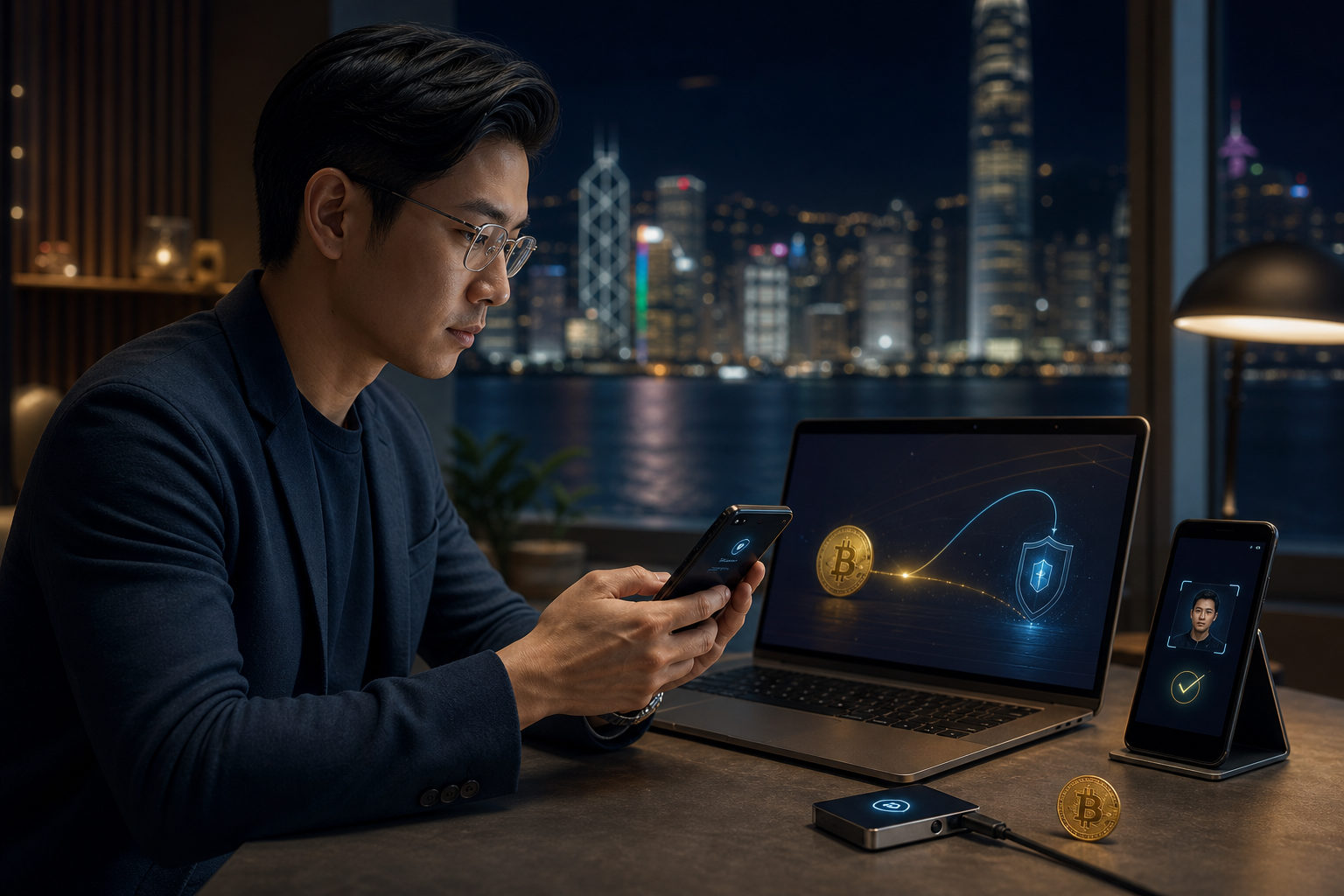
Buying Bitcoin in Hong Kong in 2026 isn't really about finding the fastest "buy" button. The order that actually protects you is: check whether the platform is licensed by the Securities and Futures Commission (SFC), work out a funding method that your bank will actually let through, understand what you'll pay in fees (and possibly tax), and only then move the coins into a wallet you control. Hong Kong has built a fairly mature licensing regime for virtual asset trading platforms (VATPs), and that regime is your first real filter for telling a trustworthy platform from a risky one.
First, be clear on what you're actually buying
Bitcoin is a digital asset that runs on a public blockchain, capped at 21 million coins, first described in a 2008 white paper published under the name Satoshi Nakamoto, with the genesis block mined in January 2009. When you buy Bitcoin in Hong Kong, you're converting Hong Kong dollars (or sometimes US dollars) into BTC on-chain — not opening a loyalty-points account. The Hong Kong dollar itself runs under a Linked Exchange Rate System pegged to the US dollar, so your fiat side of the trade is relatively stable day to day. Bitcoin's price, on the other hand, floats completely independently of that peg. Don't confuse the two kinds of risk.
Get this straight before anything else, because every later step depends on who actually controls the coins. A balance showing "BTC" in your account doesn't automatically mean you understand how it's held. Knowing the difference between a platform holding your assets in custody and holding your own private keys is what keeps you from leaving risk sitting in the wrong place.
Step 1: Check whether your chosen platform is actually licensed
Hong Kong's VATP licensing regime has been in force since June 2023, administered by the SFC, and licensed platforms generally need to hold both a Type 1 (dealing in securities) and Type 7 (providing automated trading services) licence under the Securities and Futures Ordinance. Based on public information from the SFC and several financial news outlets, as of February 2026 thirteen platforms held a full SFC VATP licence, including HashKey Exchange, OSL Digital Securities (the first platform to hold both Type 1 and Type 7 licences and generally described as Hong Kong's first fully licensed digital asset exchange), PantherTrade (a Futu Holdings subsidiary), YAX Hong Kong (backed by Tiger Brokers), Victory Fintech (VDX), and Bullish. This list changes as new applicants are approved, so treat the number as a snapshot rather than a permanent fact — always check the SFC's own "List of Licensed Virtual Asset Trading Platforms" page for the current version before you sign up anywhere.
Getting licensed isn't a rubber stamp. Applicants need to be Hong Kong-incorporated companies with genuine local operations, at least two Licensed Representatives, and at least two Responsible Officers who pass the SFC's "fit and proper" test. Licensed platforms must also keep at least 98% of client assets in cold storage, run proper KYC checks, follow AML rules, and monitor trading activity. For a first-timer, the safest starting point is a name that actually appears on the SFC's own list — not a slick landing page or a fast-replying support chat, neither of which tells you anything about regulatory status.
Here's the blunt truth: most money lost buying crypto in Hong Kong isn't lost to price swings. It's lost by sending funds to the wrong party or leaving coins sitting somewhere opaque. A legitimate platform will spell out account registration, login protection, deposit methods, withdrawal rules, fee structure, risk disclosures, and how to reach support. If any of that is vague or hard to find, treat it as a warning sign before you go any further.
- Check the SFC's official list of licensed VATP operators directly — don't rely on a platform's own marketing claims about being "licensed" or "compliant."
- Look for independent security controls: two-factor authentication, withdrawal address whitelisting, login alerts.
- Confirm you're buying spot BTC, not a leveraged derivative or a wrapped product with extra layers — Hong Kong's licensed VATPs are currently focused mainly on spot trading.
- Don't skip due diligence just because a screenshot on social media, a group chat tip, or a "friend who trades" vouched for a platform.
One thing worth repeating: someone else having used a platform without issue doesn't mean it's right for you. Their risk tolerance, payment method, holding period, and trading habits could look nothing like yours.
Step 2: Sort out identity verification and your funding route
Most licensed platforms require you to register an account and verify your identity using a Hong Kong Identity Card (HKID) or another valid ID document, and some set a minimum first deposit — one major licensed platform, for example, requires an initial deposit starting at HK$10,000. Keep your payment account name consistent with your registration details; this isn't bureaucratic friction for its own sake, it exists to cut down on identity theft, money laundering risk, and account disputes.
The most common and convenient funding method in Hong Kong is the Faster Payment System (FPS) combined with a bank's Electronic Direct Debit Authorization (eDDA). Once set up, deposits typically clear in seconds, and most licensed platforms don't charge a deposit fee. Withdrawals to major banks or virtual banks such as HSBC, Bank of China (Hong Kong), ZA Bank, and Mox often arrive the same day. Ordinary bank wire transfers, by contrast, can take anywhere from a few hours to a full business day, depending on how much AML review a particular bank applies. Credit card purchases sound instant, but tread carefully here: a number of card issuers restrict or flatly block payments to virtual asset platforms citing fraud and consumer-protection concerns, and even where a card payment goes through, it may get coded as a cash advance with a higher interest rate attached. Confirm this with your card issuer before you try it, rather than finding out from a declined transaction or a surprise interest charge.
| Funding method | Typical speed | Cost | What to watch for |
|---|---|---|---|
| FPS + eDDA | Seconds to near-instant | Usually free on licensed platforms | Some platforms set a minimum first deposit (e.g. HK$10,000); eDDA authorization needs setting up first |
| Bank wire / transfer | A few hours to 1 business day | Varies by bank; wire fees may apply | Larger amounts or mismatched account details can trigger extra AML review and delay |
| Credit card | Usually instant | Generally higher fees; may be treated as a cash advance | Many card issuers restrict or block payments to virtual asset platforms — confirm with your bank first |
The part beginners most often overlook is the funding route as a whole system, not just the deposit step. Think ahead to how you'll withdraw both fiat and Bitcoin later, and whether you'll be able to explain your transaction history if risk controls flag something. Starting out with funds from an unclear source, a shared account, or oddly-labeled transfers tends to cause account reviews, delayed deposits, or outright restrictions further down the line.
Before you make your first real transfer, run through this checklist:
- Does your account name match your ID and your payment method exactly?
- Is two-factor authentication turned on, with a backup recovery method saved somewhere safe?
- Do you actually understand the separate limits and rules for deposits, buying, and withdrawals — including any first-deposit minimum?
- Have you saved the platform's official support contact somewhere, so you're not searching for it under pressure later?
The scam-prevention point here is simple: never register an account on someone else's behalf, never borrow someone else's account to buy crypto, and never hand your ID documents to a so-called "verification agent." Once someone else is operating with your identity, you're usually the one left holding the consequences.
Step 3: Before you click buy, understand how the order and the fees actually work
When people get to the actual purchase, most fixate on one number: the price on screen. But placing an order before you understand the fee structure and execution method is a mistake. Work out whether you're looking at a quick-buy interface, a spot order book, or some other packaged product screen. On licensed platforms, fee structures vary — one common rate structure charges roughly 0.29% on both the maker and taker side, and platforms occasionally run zero-fee promotions for a limited period or under specific conditions. Check the fee schedule that's actually live right now, not something you half-remember from a review article.
Quick-buy is the more intuitive option for beginners and has a lower barrier to entry, but the quoted price usually already has a spread baked in. Spot trading generally gives you more control and lets you time your order against the order book, though the interface is more complex. Whichever you use, check the fee disclosure, the minimum purchase size, whether withdrawal is supported, and whether there's extra security review before a withdrawal goes through.
Why does this matter before you click buy? Because the common beginner mistake isn't "not knowing how to buy" — it's buying the wrong thing entirely. Some people think they've bought Bitcoin and actually end up holding a pegged product, a derivatives position, or an asset that only exists as an internal ledger entry on that platform. Until you can confirm the asset can actually be withdrawn to a personal on-chain wallet, don't assume you genuinely hold BTC.
- Read the asset ticker on the trading screen carefully and confirm it says BTC.
- Check the order confirmation page against the fee, the amount you'll actually receive, and the payment details.
- Start your first purchase with an amount you understand and can tolerate losing — don't let "go all in" chatter push you into a bigger position than you're ready for.
- Never share your screen or read out an SMS verification code while being "guided" remotely by a stranger.
Screen sharing looks like someone helpfully walking you through the interface. In practice, it's often the exact step where login sessions, verification codes, and payment confirmations get stolen.
Step 4: Once you've bought, custody is the next thing to sort out
Buying the Bitcoin is only the start; how you hold it is what actually determines your risk level. There are broadly two approaches: leave it in custody on the platform, or move it to a wallet where you control the private keys yourself. Licensed platforms are required to keep at least 98% of client assets in cold storage with proper asset segregation, which does reduce some of the risk of a hack or misappropriation — but it's still custodial. The platform is holding the asset on your behalf; that is not the same as you controlling it directly. For anyone planning to hold long-term, understanding self-custody and gradually moving toward it generally lines up better with the principle of actually controlling your own assets.
The smallest on-chain unit of Bitcoin is one satoshi — one hundred-millionth of a BTC. You don't need to buy a whole coin to get started, but regardless of the amount, don't skip verifying the wallet address, checking network confirmations, or doing a small test withdrawal. On your first withdrawal, send a small test amount first, confirm the address is correct, and only then move the rest. That habit matters more than chasing a one-click transfer.
When picking a wallet, don't judge it purely on how nice the interface looks. What matters more is whether the backup process is clear, whether recovery is something you can actually verify works, and whether you genuinely understand that your seed phrase and private keys must never be exposed. Once a seed phrase leaks, anyone can move the funds out, and that kind of transfer generally can't be reversed.
- Don't store a screenshot of your seed phrase on any device connected to the internet.
- Don't send your seed phrase over chat apps, email, or cloud storage.
- Don't trust anyone claiming to be "support" who offers to verify your wallet is safe.
- Check a withdrawal address character by character before confirming, to guard against clipboard-hijacking malware.
A lot of scams don't try to trick you into buying — they trick you into transferring. Scammers pose as technical support, investment mentors, or tax-assistance agents, and the endgame is always the same: get you to send coins to an address they control.
Step 5: Learn to recognize the scams that actually show up in Hong Kong — and use the official verification tools
The SFC maintains an "Alert List" on its website, specifically flagging unlicensed operators believed to be targeting Hong Kong investors or falsely claiming a Hong Kong connection. Hong Kong Police's Anti-Deception Coordination Centre (ADCC) separately maintains a list of suspected fraudulent investment platforms that the public can check. Spending two minutes searching a platform's name against both of these official resources before you send money is worth far more than trying to recover funds after the fact.
This isn't a hypothetical warning. Public reporting from 2023 documented a Hong Kong case involving a platform called HOUNAX, which reportedly collapsed after taking in more than HK$110 million, having marketed itself with promises of up to 40% "risk-free" returns — and any investment claiming a fixed, high return with "no risk" is contradicting itself on its face; that combination alone is one of the clearest scam signals there is. Separately, in May 2026, Hong Kong Police joined a cross-border operation with counterparts from Macau, Brunei, Canada, Indonesia, Malaysia, the Maldives, Singapore, South Korea, and Thailand, arresting a combined 3,018 people connected to over 138,000 fraud cases and roughly US$752 million in losses; investigators specifically flagged a rising trend of virtual asset platforms being used to launder proceeds. In Hong Kong's own first-quarter 2026 figures, over 9,400 fraud cases were recorded, with roughly 1,200 of them classified as investment fraud, up 16% year-on-year to about HK$920 million in losses. These are published statistics from law-enforcement sources, not scare tactics — they show that getting scammed while buying crypto in Hong Kong is a documented, ongoing pattern, not an edge case.
Whether in Hong Kong or elsewhere, Bitcoin-related scams tend to run on a handful of recurring templates: fake platforms, fake support agents, fake over-the-counter deals, fake investment groups, fake wallets, and fake "recovery" services. What they share isn't technical sophistication — it's constant pressure to make you pay or transfer before you've had time to properly understand what's happening.
The first pattern is the "guaranteed profit" signal group. Someone approaches you on social media, shows profit screenshots, then asks you to send funds to a specific channel or download an app from an unverified source. The real issue isn't whether they're good at reading charts — it's that your money and coins never enter an account system you can independently verify.
The second is fake customer support. Scammers plant supposed "support" contacts in search results, comment sections, and chat groups, claiming they can lift account restrictions, speed up deposits, or recover lost assets. The moment someone asks for a verification code, your seed phrase, or remote-control access to your device, that's your cue to stop responding entirely.
The third is fake over-the-counter trading. The quoted rate might look attractive, but the other side will ask you to pay first, skip the platform's escrow protection, switch to a private transfer, or suddenly swap in a different payment recipient. The moment a transaction path departs from the rules you originally agreed to, the risk jumps sharply.
The fourth is fake wallets and browser extensions — counterfeit copies of legitimate tools designed to trick you into importing your seed phrase. Before downloading anything, verify the source is genuine, and never accept an installer sent through a group file share, a private cloud drive, or a chat window from someone you don't know.
Step 6: Don't just plan the purchase — plan your records, and understand the tax angle
If your search started with "how to buy Bitcoin in Hong Kong in 2026," the finish line shouldn't be the buy button. Build a basic record-keeping habit: when you bought, through which method, where the asset is held, whether your security settings are actually in place, and where you saved the official support contact. That way, whether you're holding long-term, buying again, or need to reconstruct your transaction history, you're not scrambling through scattered information.
On tax: Hong Kong doesn't impose a capital gains tax, so an individual investor who holds Bitcoin and sells at a profit generally doesn't owe tax on that gain as a capital matter. But the Inland Revenue Department (IRD) applies its usual substance-over-form approach under the Inland Revenue Ordinance (Cap. 112) and related guidance — if your trading pattern looks like a business (frequent short-term buying and selling, trading as a primary income source), those profits could fall under profits tax instead. For an individual trading in their own name (an unincorporated business), the standard profits-tax rate is 15% (7.5% on the first HK$2 million under the two-tier system) — the often-quoted 16.5% rate applies to profits earned through an incorporated company, not to most individual traders. Whether your activity counts as "trading as a business" is fact-specific and varies person to person. If you trade frequently or in significant size, it's worth talking to an accountant or tax adviser rather than relying on any single article, including this one, to make that call for you.
As for price, you can check live BTC pricing through mainstream market-data services or a legitimate exchange interface, but a headline number means little until you've confirmed fees, spread, and withdrawal rules. For a beginner, the more useful order of operations is: confirm the channel is licensed and reliable, understand exactly what product you're buying, compare the real cost, and only then execute the purchase.
Frequently Asked Questions
As a first-time buyer in Hong Kong, what's the safest first move?
Check the SFC's official list of licensed VATP operators to confirm the platform you're considering is actually on it, make sure its disclosures and verification process look complete, and only then finish setting up your account security. Don't transfer a large amount before two-factor authentication is on and you understand the withdrawal rules.
After buying Bitcoin in Hong Kong, do I have to move it to a personal wallet right away?
Not necessarily, but you should at least understand the difference between platform custody and self-custody. Licensed platforms are required to keep at least 98% of client assets in cold storage, which lowers some risk, but it's still custodial holding rather than you controlling the keys. If you plan to hold long-term, learning wallet backup, address verification, and small test withdrawals earlier rather than later puts you in a better position than leaving everything on the platform indefinitely.
I haven't bought a whole Bitcoin before — can I still get started?
Yes. Bitcoin can be bought and held in much smaller units; the smallest is a satoshi, one hundred-millionth of a BTC. What matters isn't the size of your purchase — it's whether you understand the fees, the risks, and how custody works.
Do I owe tax on profits from buying and selling Bitcoin in Hong Kong?
Hong Kong doesn't have a capital gains tax, so a typical individual long-term investor generally isn't taxed separately on that gain. But if the Inland Revenue Department decides your activity amounts to a trading business, profits may fall under profits tax instead — 15% is the standard rate for an individual/unincorporated trader (7.5% on the first HK$2 million under the two-tier system), while 16.5% applies only to profits earned through an incorporated company. This determination is fact-specific; if you trade often or in large amounts, speak with a qualified tax adviser rather than applying a general rule from any online guide to your own situation.
Someone is offering to sell me Bitcoin privately at a better price — should I just deal with them directly?
Treat it with more caution before deciding either way. The real problem with private deals isn't the quoted price — it's that identity, payment, and coin-receipt paths are all much harder to verify. If the other party pressures you to pay first, changes the agreed process at the last minute, or refuses to leave a clear record, it's not a suitable setup for a beginner.
Can I trust customer support contacts I find through a search engine?
No. Only use support channels you find inside the platform's own official interface — don't trust "support" numbers or chat links posted in comment sections, group chats, or unsolicited private messages. Anyone asking for a verification code, your seed phrase, or remote access to your device should be refused immediately. If you're unsure whether a platform or contact is legitimate, check it directly against the SFC's Alert List or the Hong Kong Police ADCC's list of suspected fraudulent investment platforms.
Before you actually buy Bitcoin in Hong Kong, do three things first: verify the platform's licensing status on the SFC's own website, turn on two-factor authentication, and write down your own withdrawal test procedure. Do that, and you've already closed off most of the avoidable risk — even before you place a single order.
Disclaimer: This article is for general informational and educational purposes only and does not constitute investment, financial, legal, or tax advice. Cryptoasset prices are highly volatile and you could lose your entire principal. Platform licensing status, fee schedules, and tax rules change — always verify current details directly with the SFC, Hong Kong's Inland Revenue Department, and the platform in question, and make your own decisions carefully.