
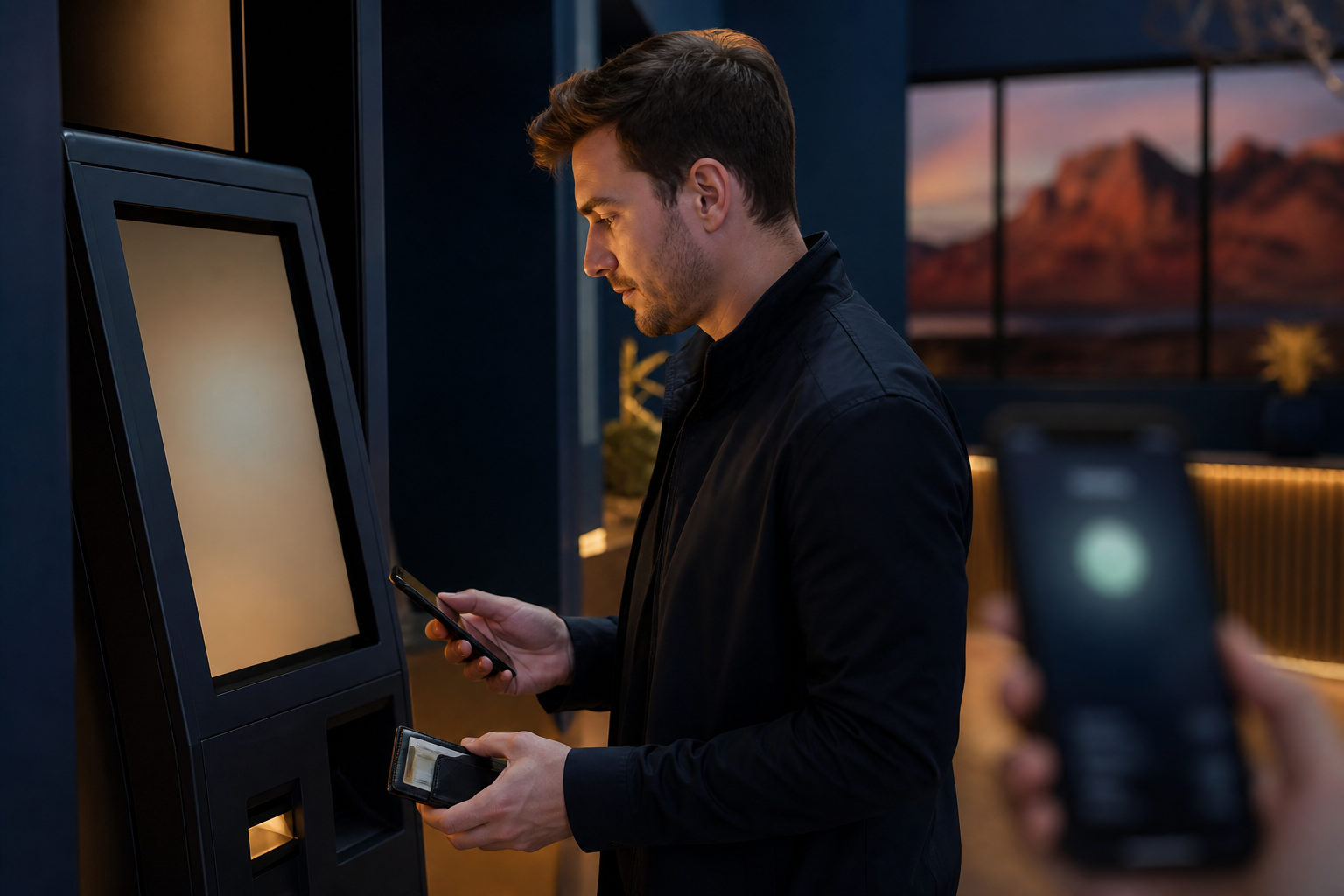
The most reliable way to buy bitcoin in Nevada is through an exchange that's actually confirmed to serve Nevada residents and operates under the state's money transmitter framework -- Coinbase and Kraken are two platforms that currently offer full buy, sell, and withdrawal service to Nevada residents, and bank transfers or debit cards tend to be the cheapest way to fund an account. Buying with a credit card is restricted at most major U.S. banks, and the bitcoin ATMs (often called kiosks) you'll see at gas stations and convenience stores across the state are convenient, but they're also the payment channel Nevada's Attorney General has specifically warned about in 2026. Here's what actually applies locally -- regulation, taxes, channel selection, and the scam patterns worth knowing before you send any money.
What Nevada's rules and taxes actually look like
Nevada regulates crypto exchanges, kiosk operators, and any business that converts cash into digital currency (or back) under its money transmitter statute, Nevada Revised Statutes Chapter 671, which was rewritten in full in 2023 when Nevada adopted the Uniform Money Transmission Modernization Act via Assembly Bill 21 (signed May 24, 2023, effective July 1, 2023). The agency in charge is the Nevada Financial Institutions Division (NFID). In principle, any business that transmits money this way -- whether through a website, an app, or a physical kiosk -- needs to apply for a money transmitter license and post a surety bond. Under current law, the required bond amount is tied to the licensee's average daily money transmission liability in the state, capped at $500,000 -- replacing the older formula of $10,000 plus $5,000 per additional location, up to a $250,000 cap.
On taxes: Nevada is one of nine U.S. states with no personal income tax, and Article 10, Section 1 of the state constitution specifically bars taxing an individual's wages or income. That means any gain you make selling bitcoin owes nothing to the state of Nevada. It does not mean the IRS is off the hook. The federal government treats cryptocurrency as property, so every sale, trade, or purchase made with crypto is a taxable event. Gains on coins held under a year are taxed as ordinary income, up to 37% depending on your bracket. Gains on coins held over a year get the long-term capital gains rates instead -- 0%, 15%, or 20%, again depending on income. You'll typically report this on Form 8949 and Schedule D at tax time. Nevada removes one layer of tax, not both, and it's worth checking your specific bracket with a tax professional rather than guessing.
A step-by-step order that keeps you out of trouble
Step 1: Confirm the platform actually serves Nevada -- and can prove it
Before you open an account, check that the platform accepts U.S. residents and specifically supports Nevada. As of current reporting, Coinbase and Kraken both offer their full range of services, including buying and withdrawing, to Nevada residents -- that's a useful benchmark, though it doesn't mean these are your only options. For any platform you're considering, look for whether it discloses a Nevada money transmitter license through NFID, or at minimum explains clearly how it operates legally in the state.
Don't sign up just because a site looks polished. Find the terms of service, the fee schedule, and the withdrawal policy before you decide to continue. A platform that can't clearly say which states it's licensed in is exactly the kind of platform that gives you trouble later, usually right when you're trying to pull money out.
Step 2: Get your documents ready before you register
Most licensed platforms require identity verification, and that's not the platform being difficult -- it's a legal anti-money-laundering obligation that comes with holding a money transmitter license. Having your ID and proof of address ready ahead of time saves you from repeated back-and-forth, and it lowers the odds your account gets frozen mid-transaction while the platform waits on missing paperwork.
This is also where fake customer support shows up most often. If someone messages you first, pushes you to switch to a different app or page, or asks for your seed phrase or remote access to your device, stop right there. No legitimate platform verifies your identity that way.
Step 3: Understand what a payment method actually costs
A bank transfer (ACH) is usually the cheapest way to fund an account in Nevada -- slower to clear, but with lower fees. Debit cards are faster but cost more. Credit cards deserve real caution: major issuers including Chase, Bank of America, Capital One, and Wells Fargo generally block crypto purchases outright. The smaller number of issuers that do allow them often code the transaction as a cash advance, which means interest starts accruing immediately at roughly 30% APR with no grace period, plus an upfront fee that can run as high as 5% of the purchase.
The platform's own fee structure matters just as much. Using two common platforms as an example -- fees shift over time, so check the number shown at checkout -- Kraken currently lists roughly a 1% fee on its "instant buy" feature, with some allowance waived for higher membership tiers, though spread and payment-processing costs can still apply on top. Coinbase's "simple buy" screen bundles a spread of around 1% with a variable fee that depends on your payment method, and paying by card can push the total cost close to 4%. If you're moving larger amounts regularly, switching to the more advanced trading interfaces on either platform brings the cost down substantially -- Coinbase Advanced Trade starts around 0.60% maker / 1.20% taker and steps down with volume, while Kraken Pro starts around 0.25% maker / 0.40% taker. Both are more complicated to use and make more sense once you're already comfortable with the basics.
Step 4: Make your first purchase small
Don't put your entire budget into your first order. Buy a small amount first, confirm the payment actually cleared, the coins landed, and the order history looks right, and only then think about a bigger purchase. This step isn't about saving money -- it's about catching account limits, payment delays, or withdrawal review requirements while the stakes are still low.
Step 5: Decide whether to move your coins to your own wallet
If you're planning to hold long-term, consider moving your bitcoin to a wallet you control rather than leaving it on the exchange indefinitely. That reduces how much you're relying on a single platform to keep your funds safe and accessible -- but it also means the responsibility for keeping the coins secure shifts to you. Double- and triple-check the destination address before sending anything; blockchain transfers are generally irreversible, and a wrong address, wrong network, or a tampered clipboard can mean a loss you can't recover through customer support.
Licensed exchanges vs. street-corner bitcoin ATMs: what actually differs in Nevada
Nevada has one of the higher concentrations of bitcoin kiosks in the country. Public counts from April 2026 put the statewide total at around 447 machines, with 336 of them clustered in Southern Nevada -- meaning the Las Vegas metro area -- showing up in gas stations and convenience stores under brand names like Coinhub, Bitstop, and RockItCoin. These machines don't require an account, which makes them look convenient, but their fee transparency and fraud protections lag well behind licensed online exchanges, and they're currently the channel where fraud complaints are concentrated.
| Comparison | Licensed online exchange (e.g., Coinbase, Kraken) | Street bitcoin kiosk (ATM) |
|---|---|---|
| Identity check | Full KYC required; review on first deposit/withdrawal | Most require no account -- cash goes straight in |
| Typical fees | Roughly 1%-4% on simple buy screens, under 1% on advanced trading interfaces | Generally noticeably higher than online exchanges; the rate is disclosed on-screen but tends to run steep |
| Daily limits | Varies by platform and verification tier; higher after full verification | Varies by operator -- some Coinhub machines cap cash at $25,000/day, or up to $50,000/day with pre-registration |
| Traceability if something goes wrong | Order history, support channel, and dispute process | Cash transactions are close to impossible to reverse once completed |
| Regulatory basis | NFID money transmitter license under NRS Chapter 671 | Operators are technically required to be licensed too, but Nevada has no kiosk-specific daily limit or fee cap law yet |
The scam pattern most active in Nevada right now
In June 2026, Nevada Attorney General Aaron Ford issued a consumer alert specifically about cryptocurrency kiosk scams. The pattern starts with an unsolicited call, text, email, or pop-up impersonating someone you'd trust -- often a relative, or a representative of a company or government agency -- that manufactures urgency and tells you the only way to fix the emergency is to deposit cash into a bitcoin kiosk. Once that transaction goes through, the funds are essentially irreversible and extremely hard to trace. Data cited by AARP puts nationwide reported losses from crypto kiosk scams at more than $389 million in 2025 alone, with older adults disproportionately targeted, and Nevada has been specifically called out in that reporting. As of now, Nevada's legislature hasn't passed a bill setting daily transaction caps or fee limits specifically for kiosks -- regulation currently relies on the existing money transmitter statute, and advocacy groups are still pushing for kiosk-specific rules.
A related version of this scam poses as a "wallet update" or "account alert" and tries to get you to type in your seed phrase, a verification code, or grant remote access to your device. Your seed phrase exists to let you recover your own wallet -- it should never be typed into a kiosk screen or handed to anyone claiming to help you.
If someone tells you to send coins first and they'll "unfreeze" your account after, or that you need to pay a tax or fine through a kiosk, or promises a bigger payout if you just cooperate -- treat all of that as an immediate red flag. A normal bitcoin purchase never requires you to hand over control of your funds, and no legitimate process will tell you to use one specific machine.
Frequently asked questions
Do I owe Nevada state tax on bitcoin I buy or sell?
No state income tax applies -- Nevada is one of the few U.S. states with no personal income tax, and that extends to gains from selling bitcoin. Federal tax is a different story: the IRS treats crypto as property, and any gain is taxed as either short-term or long-term capital gains depending on how long you held it, typically reported on Form 8949 and Schedule D. Check the current rates and thresholds with a tax professional, since your bracket determines the actual number.
Are bitcoin ATMs legal in Nevada, and are they safe to use?
The machines themselves are legal, and operators are technically required to register as money transmitters with NFID. But Nevada doesn't currently have a law setting daily limits or fee caps specifically for kiosks, and enforcement resources are limited. Nevada's Attorney General has repeatedly and publicly flagged kiosks as the state's most active scam channel right now, so treat any instruction to use one -- especially from an unsolicited call or text -- with serious suspicion.
Do I need a wallet before my first bitcoin purchase?
Not necessarily, but it helps to know where you plan to keep the coins ahead of time. If you're just testing the process, leaving coins on the exchange for now is fine. If you're planning to hold long-term, it's worth learning how self-custody wallets work before you buy. Either way, never share your seed phrase with anyone -- it controls the asset itself, not just account access.
How long does it take to withdraw after buying?
That depends on the platform's review process, your payment method, and its fraud controls -- funds deposited by bank transfer often have a longer hold than debit card purchases. Check the withdrawal policy before you buy rather than after. If a withdrawal is delayed, check the platform's official notifications and order status first, and confirm your payment actually cleared -- don't treat an unverified message from a stranger as an official explanation.
How do I know if I'm being scammed?
If someone is rushing you off the normal purchase process, asking for sensitive information, directing you to a specific kiosk, or insisting you pay before they release anything, stop immediately. The safest move is to go back to the platform's official site and check everything yourself, without following links or instructions from someone you're chatting with. If you're not sure, you can contact the Nevada Attorney General's office or the platform's verified support line to confirm.
Disclaimer: This article is for general information and educational purposes only and does not constitute investment, financial, tax, or legal advice. Crypto asset prices are highly volatile and you could lose your entire principal. Regulatory rules, platform fees, and tax policy can change and vary by individual circumstance -- verify current details through official sources and use your own judgment before acting.