
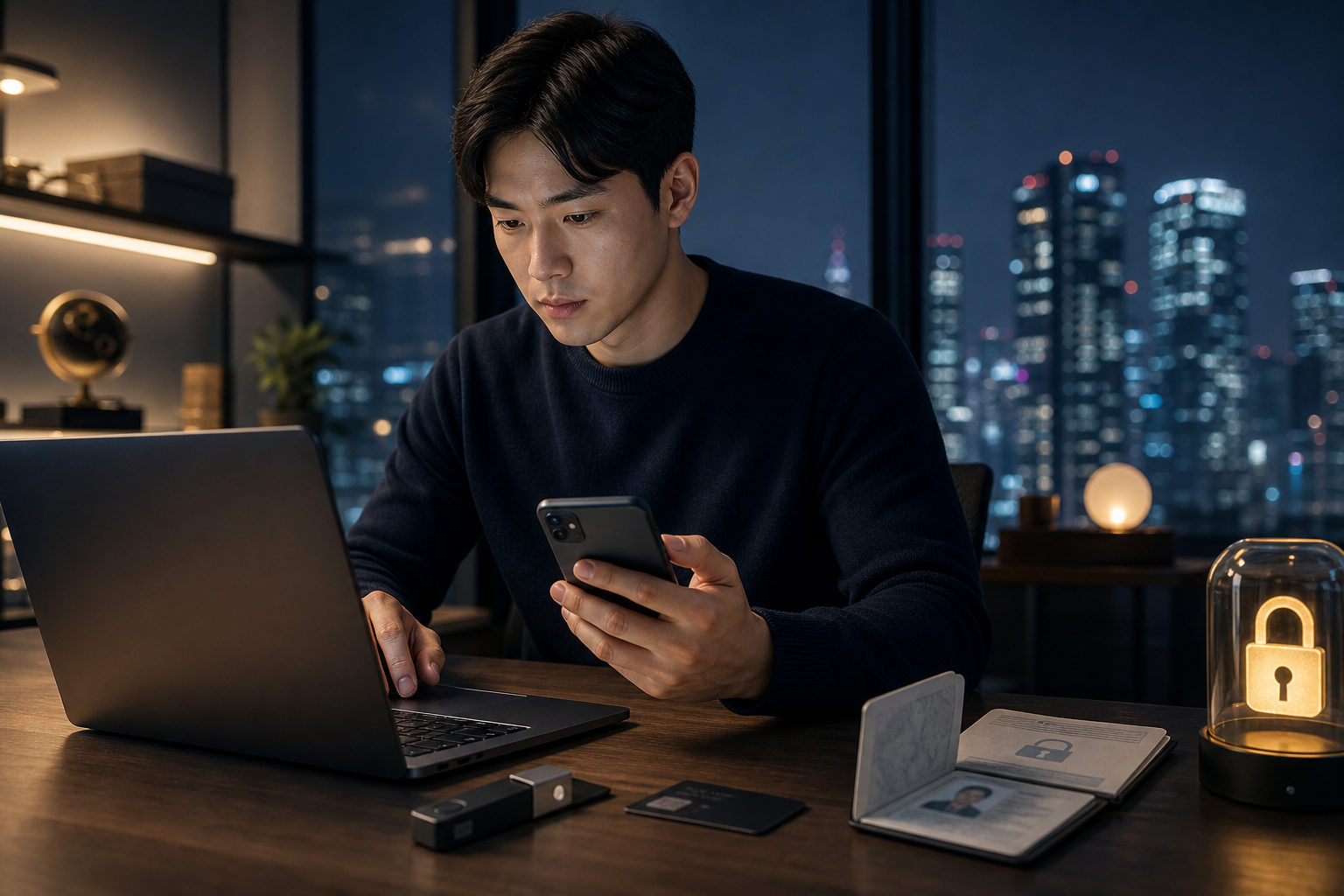
If you're trying to figure out how to buy Bitcoin in South Korea in 2026, the honest answer is that the button-click part is the easy bit. What actually determines whether your experience goes smoothly is whether you're using a licensed exchange with a real bank partnership, whether you can open a real-name account that matches your own name, and whether you understand the tax rules kicking in from 2027 and the scam tactics currently spreading around Korean crypto users.
Three things to sort out before you even open an app
Bitcoin is a digital asset built on a public blockchain, capped at 21 million coins, with the smallest unit (a satoshi) equal to one hundred-millionth of a BTC. You can trade it or hold it for years, but before you buy anything, decide which one you're actually doing — a quick position or a long-term holding — because that choice shapes almost every decision that follows, including which exchange fits you and how you store the coins afterward.
For anyone in South Korea, resident or foreign national on a valid visa, the real bottleneck usually isn't the trading interface. It's whether you can complete "real-name verification" (실명인증) at all. That single requirement is the part of the Korean crypto market that trips up newcomers more than anything else.
Step 1: Confirm you're using a licensed, bank-verified exchange
Regulated crypto trading in South Korea runs through exchanges that have registered as Virtual Asset Service Providers with the Korea Financial Intelligence Unit and signed a real-name account agreement with a domestic bank. As of 2026, five exchanges hold that kind of verified bank partnership for Korean won deposits: Upbit (K-Bank), Bithumb (KB Kookmin Bank), Coinone (Kakao Bank), Korbit (Shinhan Bank), and Gopax (Jeonbuk Bank). These are the mainstream legal on-ramps for KRW right now. Upbit is by far the largest by trading volume, holding roughly 65% of the market as of the fourth quarter of 2025 — down from close to 80% in late 2024, which suggests Bithumb and the others have been clawing back some share.
On the regulatory side, the Financial Services Commission (FSC) is the lead supervisory body for virtual assets, with the Financial Supervisory Service (FSS) handling inspections and investigations. The Virtual Asset User Protection Act, which covers custody of user funds, market monitoring, and penalties for unfair trading, has been in force since July 19, 2024. Through 2026, the FSC has also been pushing forward a broader piece of legislation sometimes referred to as the Digital Asset Basic Act, aimed at covering stablecoins and other areas the first law didn't fully address. It's still moving through committee as of this writing, so treat the details as evolving and check the FSC's own announcements before assuming anything about future rules.
Quick comparison of the five bank-linked exchanges
| Exchange | Partner bank | Approx. KRW trading fee | Worth knowing |
|---|---|---|---|
| Upbit | K-Bank | around 0.05% | Largest market share (~65% in Q4 2025), but some foreign users report K-Bank's internal risk policies blocking account linking for non-Korean nationals |
| Bithumb | KB Kookmin Bank | around 0.15% taker/maker | One of Korea's oldest exchanges; has issued repeated public warnings in 2026 about AI deepfake and voice-phishing scams targeting its users |
| Coinone | Kakao Bank | varies by tier/promotion | Tightly integrated with the Kakao ecosystem; onboarding generally assumes a Korean mobile number |
| Korbit | Shinhan Bank | varies by tier/promotion | One of the earliest exchanges founded in Korea |
| Gopax | Jeonbuk Bank | varies by tier/promotion | Smaller scale, thinner liquidity than the top two |
Take those fee figures as a rough snapshot rather than a promise — exchanges adjust rates and run promotions fairly often, and withdrawal fees for the crypto itself are set per asset and aren't always shown clearly before you confirm a trade. Check the live fee schedule inside your own account rather than trusting a screenshot someone sent you or an old blog post.
Step 2: Get your real-name verification, payment path, and security settings in order
The defining feature of the Korean crypto market is the real-name account system (실명계좌). Your exchange account has to be linked to a domestic bank account that's in your own legal name, and it has to be at that specific exchange's partner bank — you can't substitute a different bank, and a foreign bank account won't work at all. This system dates back to Korea's post-2018 push to cut down on anonymous trading and money laundering, and it's still the first real hurdle anyone faces when opening an account.
If you're a foreign national living in Korea on a valid visa, you can, in principle, open an account using your Alien Registration Card (ARC) plus a matching real-name bank account. In practice, though, this doesn't always go smoothly. There have been reports of partner banks like K-Bank applying stricter internal anti-money-laundering screening that ends up rejecting foreign-national applicants at the account-linking stage, and of Bithumb's system flagging foreign ARC information during that same final step. So "technically possible" is not the same as "reliably works." If you're planning to trade long-term in Korea as a foreign resident, it's worth calling the exchange or your bank ahead of time to confirm your specific visa type and bank will actually let you through — don't leave it until you're mid-purchase.
Once your channel is sorted and your real-name account is linked, the next step is finishing KYC verification, registering a phone number (usually a Korean one is expected), and turning on two-factor authentication, device confirmation, and login alerts. A lot of first-time buyers only start this process once the market is already moving, get stuck on a failed verification or a blocked bank link, and end up hunting for some unofficial over-the-counter seller as a shortcut. That "shortcut" is exactly where Korean police have repeatedly flagged fraud clustering.
Double-check the basics: does the name on your ID, your bank account, and your exchange profile all match exactly? Do you still control the phone number and email tied to the account? Is your password newly created and unique to this account? Are you only ever entering verification codes on the official site or app? Avoid finishing any of this setup on public Wi-Fi, and don't leave yourself logged in on a device that isn't yours.
Step 3: Decide where the Bitcoin will live, then make your first purchase
A lot of guides focus entirely on the buying part and skip the storage decision. Broadly, you have two options: keep it on the exchange for now, which is convenient if you plan to keep trading, or move it to a wallet where you control the private keys, which suits people prioritizing long-term self-custody. Neither is objectively correct — it depends on how you actually plan to use the coins and how much responsibility you want for backups.
Korean exchanges generally don't charge much (often nothing) for withdrawing KRW back to your linked bank account, but crypto withdrawal fees are set separately per asset and aren't always displayed prominently before checkout. It's worth checking your account settings or the help center before you buy, not after.
For your first purchase, size it to something you can watch fluctuate without stress, rather than putting in everything at once. Confirm you're actually buying Bitcoin (BTC) and not something with a similar-looking name, check the quantity, the fee shown, where the coins will land, and whether withdrawal is enabled for that asset. Do every one of those checks yourself — don't let someone else drive the transaction for you.
A small test transfer is worth the extra five minutes
If you're planning to move Bitcoin to an external wallet, send a small test amount first. It confirms the address was copied correctly, that your wallet can actually receive the asset, and that you understand the transfer flow before you're moving anything meaningful.
Pay particular attention to the address itself. Even after copying and pasting, manually check the first and last several characters — clipboard-hijacking malware exists specifically to swap out a copied wallet address for an attacker's own, and a quick visual check is a cheap way to catch it.
Step 4: Know the scams currently circulating in Korea
Anyone searching "how to buy Bitcoin in South Korea in 2026" should probably be asking a follow-up question too: what does fraud actually look like here right now? This isn't a generic warning. Korean police data shows telecom-based fraud losses (보이스피싱, voice phishing) rose about 14.1% in 2025 to roughly 433.8 billion won, the highest figure in five years. In one cross-border money-laundering investigation alone, authorities traced more than 11,000 accounts and confirmed 265 cases of voice-phishing and investment fraud, with victim losses around $17 million.
What's newer in 2026 is the use of AI. Scammers are using deepfake video and voice technology to impersonate family members, exchange staff, or even financial regulators during live video or phone calls, pressuring victims into transferring funds or handing over verification codes in real time. A separate scheme circulating this year targets people with weak credit: it promises a loan in exchange for buying gift cards, then uses the victim's online banking access as a laundering channel for other fraud proceeds. In response, Korea's National Police Agency signed a memorandum of understanding with five major virtual-asset operators — Dunamu (which runs Upbit), Bithumb, Coinone, Korbit, and Streami (which runs Gopax) — to work together on intercepting phishing-related fund transfers.
Common patterns to watch for: someone claiming to be official support who asks for your verification code; a "buy it for you" service that takes payment and disappears; chat apps pushing you to install unfamiliar remote-access software; a video call using a cloned face or voice of someone you know, or someone claiming to be from the "financial authority," demanding an urgent transfer; instructions to send stablecoins first in exchange for a promised payout; and hybrid scams dressed up as romance, part-time job offers, or investment coaching. What they all share is urgency and a push to skip your normal verification steps.
- Anyone promising guaranteed returns or a risk-free trade: treat it as an immediate red flag. Bitcoin's price moves, and nobody can lock in your profit for you.
- Anyone asking for screen sharing, remote assistance, or an on-call transfer during a video chat: decline, even if the face and voice look and sound exactly like someone you know — deepfake impersonation is a documented, growing tactic in Korea this year.
- Anyone asking you to send funds to a personal wallet or a private individual's account, or to buy gift cards to "verify identity" or "process a loan": very high risk, and recovery afterward is genuinely difficult.
- Anyone pressuring you to pay right now: pause. A legitimate purchase flow doesn't fall apart because you took an extra few minutes to double-check it.
One more thing worth tracking: the FSC is rolling out new rules covering refunds for stolen virtual assets, with the enforcement decree scheduled to take effect October 1, 2026. The eligibility criteria and how much gets reimbursed will vary case by case, so don't treat this as a guarantee that you'll get your money back if something goes wrong — prevention still beats recovery every time.
Step 5: After you buy — custody, recordkeeping, and taxes
Buying the Bitcoin isn't the finish line. Once you actually hold it, there are three things to think through: where it should sit, how you'll keep records, and whether you need to start preparing for tax reporting down the line.
If you're using a self-custody wallet, keep your seed phrase and any backup material physically separate from each other — don't screenshot it into a chat app, and don't email it to yourself for convenience. If you're leaving coins on the exchange for now, get in the habit of checking login history, security settings, and any unusual-activity alerts periodically instead of ignoring the account until something goes wrong.
On taxes: South Korea originally planned to tax crypto trading gains starting in 2022, pushed that back to 2023, then to 2025, and has now confirmed the tax will actually begin on January 1, 2027. Annual gains above 2.5 million won (roughly $1,740) will be taxed at a combined 22% — 20% national tax plus 2% local income tax — with the first return covering 2027 income due around May 2028. Given how many times this timeline has already shifted, don't assume the current version is final; check official announcements as the date gets closer. Beyond the headline rate, the filing process and what counts as deductible will depend on your individual situation, so if the amounts involved are significant, talk to a tax professional licensed in Korea rather than relying on a general guide like this one.
Price swings are just part of the deal. Even if all you wanted to know was how to buy Bitcoin in South Korea, it's worth accepting upfront that the purchase itself is the simple part — staying disciplined through the volatility that follows is the actual challenge.
Frequently asked questions
Can foreigners actually open a crypto exchange account in South Korea?
In principle, yes, if you hold a valid visa, an Alien Registration Card, and can open a real-name bank account at the exchange's specific partner bank in your own name. In practice, some partner banks apply stricter anti-money-laundering screening that has led to foreign nationals being rejected at the account-linking step. Contact the exchange or bank directly to confirm feasibility for your visa type before assuming it will work.
What are typical fees for buying Bitcoin in South Korea in 2026?
They vary by platform. Public information points to roughly 0.05% for Upbit's KRW market and around 0.15% taker/maker for Bithumb, but treat these as rough benchmarks — check the live fee schedule in your own account, and remember that crypto withdrawal fees are charged separately per asset.
Should I keep Bitcoin on the exchange or move it to my own wallet?
If you expect to keep trading actively, leaving it on the exchange is more convenient. If your goal is long-term holding, self-custody generally gives you more control over risk, but it also puts backup and security responsibility entirely on you.
What's the most common crypto scam in Korea right now, and how do I avoid it?
The standout trends for 2026 are AI deepfake video or voice calls impersonating family members or "exchange/regulator staff," plus a gift-card-for-loan scheme used for money laundering, layered on top of Korea's long-running voice-phishing problem. The core defense is the same regardless of tactic: hang up or step away from any request for an immediate transfer, a verification code, screen sharing, or gift card purchases, verify independently through an official channel, and only proceed once you're certain.
Do I need to worry about taxes right after buying?
Not immediately, but it's worth preparing early. South Korea has confirmed that crypto gains above 2.5 million won per year will be taxed at 22% starting January 1, 2027, with the first filing due around May 2028. Keeping clean transaction records from now on will make that filing much easier when the time comes — check official FSC and tax authority guidance for the final details.
The practical checklist is straightforward: confirm the exchange is licensed and that you can actually complete real-name account verification, finish KYC and lock down your security settings, decide on storage before you buy rather than after, test any external transfer with a small amount first, stay alert to AI-driven impersonation and phishing tactics, and start keeping records now for the tax rules arriving in 2027.
Disclaimer: This article is for general informational and educational purposes only and does not constitute investment, financial, legal, or tax advice. Cryptocurrency prices are highly volatile and you could lose your entire investment. Exchange fees, regulations, and tax rules change and should be confirmed with official sources before you act. Do your own research and consult a licensed professional for advice specific to your situation.