
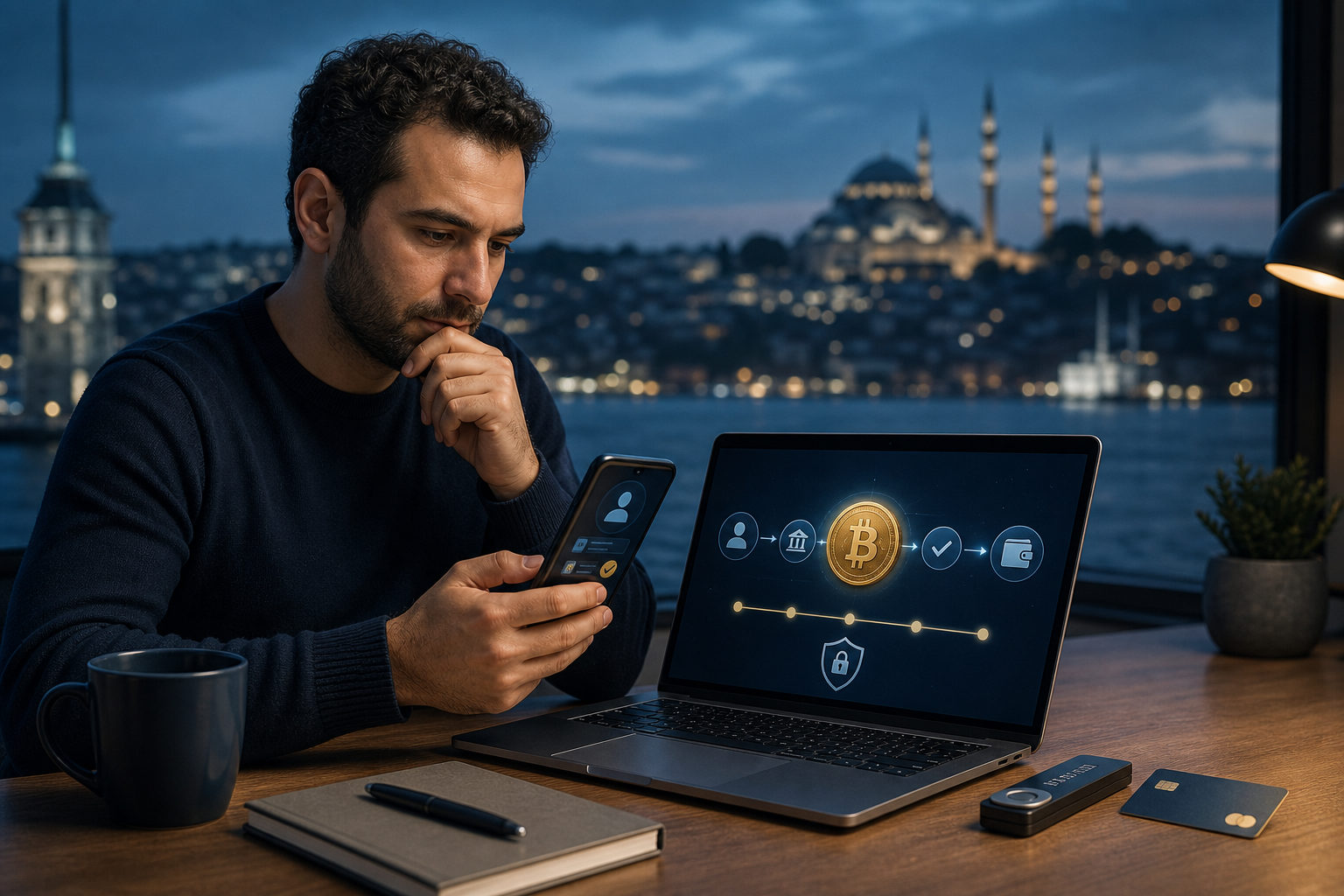
The short answer: to buy bitcoin in Turkey, pick a platform that is either licensed by the Capital Markets Board (Sermaye Piyasası Kurulu, SPK) or operating under its licensing transition period, verify your identity, fund the account with Turkish lira through a bank transfer from an account in your own name, make one small test purchase before doing anything larger, and remember that Turkish rules currently let you own and trade bitcoin but not spend it directly on goods or services.
What actually matters before you buy bitcoin in Turkey
Most people searching for how to buy bitcoin in Turkey jump straight to "which app do I download." The button itself is the easy part. What actually shapes your experience is whether the platform you picked is playing by the current rules, whether your identity documents are in order, and whether you've decided in advance what you'll do with the coins once you own them — leave them on the exchange or move them to a wallet you control.
Bitcoin is a decentralized digital asset capped at 21 million coins, with satoshis as its smallest unit (one satoshi equals one hundred-millionth of a BTC). Its price moves with supply and demand, liquidity, macro sentiment, regulatory news, and how much risk buyers are willing to take on at any given moment. There's also a local backdrop worth knowing: Turkey has been living with persistently high inflation. Annual CPI was still running above 30% in mid-2026 — Trading Economics put it around 31.75% in July 2026 — which is a big part of why so many people here treat bitcoin as one piece of how they hold savings. That doesn't make bitcoin a reliable inflation hedge on any given month; it can still drop sharply, and "the lira is weak" is not a reason to skip due diligence.
The regulatory backdrop: what's actually different about buying bitcoin in Turkey
Before picking a platform, it helps to know a handful of facts about how crypto is actually regulated in Turkey right now, because they change which channels are usable and which ones carry extra risk.
| Area | Current situation in Turkey |
|---|---|
| Main regulator | The Capital Markets Board (Sermaye Piyasası Kurulu, SPK — often written as CMB in English), which licenses and supervises crypto asset service providers |
| Legal basis for platform licensing | Law No. 7518, passed June 26, 2024 and in force since July 2, 2024, brought crypto asset service providers under capital markets law for the first time; on March 13, 2025 the SPK published two implementing communiqués (III-35/B.1 and III-35/B.2) covering incorporation, capital, and governance requirements for platforms |
| Payment-use restriction | A Central Bank of the Republic of Turkey (CBRT) regulation in force since April 30, 2021 bars using crypto assets directly as a means of payment for goods or services, and bars payment/fund-transfer institutions from processing transactions tied to that use |
| Currency | Turkish lira (TRY) is the base currency for deposits, withdrawals, and pricing on essentially every local platform |
| VAT | Buying and selling crypto assets has been exempt from value-added tax since 2021 |
| Personal capital gains tax | There's no dedicated capital-gains statute for individual crypto trading as of this writing. In early March 2026, Turkey's parliamentary budget committee advanced omnibus-bill provisions combining a 10% withholding tax on platform trading gains with a separate 0.03% transaction levy. After strong pushback from opposition lawmakers and industry groups over fears of capital flight, the ruling party withdrew those crypto-tax clauses from the omnibus bill on March 26, 2026, so neither is currently in force. Officials have signaled a revised version could be reintroduced as standalone legislation later. Because this is actively changing, treat any tax figure you read, including the ones above, as provisional and confirm with the SPK or a local tax advisor before you rely on it. |
Here's the detail that trips people up: before the new licensing law, Turkey had hundreds of crypto platforms operating with little formal oversight. After the law took effect, only around 58 companies reportedly filed for a license and are continuing to operate under a transition regime while the SPK reviews them, and the regulator has said its goal is that only fully licensed platforms remain in the market going forward. In plain terms, "I've used this app for years" is not the same thing as "this app is currently compliant." Check the platform's licensing or transition status directly through SPK's public information rather than taking a brand name at face value.
Step one: decide which purchase channel you're actually going to use
Common routes for buying bitcoin in Turkey include locally licensed or transition-period exchanges, the Turkish-facing arms of international exchanges, and peer-to-peer trading. On the local side, BtcTurk is one of the country's oldest bitcoin platforms, running for more than a decade, and Paribu is another long-established Turkish-language exchange. Among international brands, Binance TR launched in 2020 and lists a large number of TRY trading pairs. These names come up repeatedly in local usage and industry write-ups, but being well known isn't the same as being fully licensed — verify that yourself before you commit funds.
For a first-time buyer, prioritize a platform with clear rules, a real identity-verification process, and visible risk warnings — not because rules are exciting, but because a standardized process makes scams easier to spot. When comparing options, look past "how fast can I buy" and check: does it require real identity verification, does it explain deposit and withdrawal rules clearly, can you actually see the fee structure, is it on SPK's licensed or transition list, and does it disclose how it custodies user assets. A polished interface is not proof of safety, and a fast-replying support chat is not proof of compliance.
| Platform | Background | TRY funding method | Indicative fees |
|---|---|---|---|
| BtcTurk | One of Turkey's earliest bitcoin platforms, operating for over ten years | Bank transfer (EFT/FAST) only, from an account registered in the user's own name | Per third-party fee trackers referencing the platform's schedule, roughly 0.10%-0.12% maker and 0.18%-0.20% taker at the entry tier, dropping to about 0.01% maker and 0.04%-0.08% taker at the highest volume tier — check the live fee page for current numbers |
| Binance TR | The Turkish entity of the international exchange, launched in 2020 | Partnered with several local banks; TRY deposits and withdrawals are typically free | Base tier around 0.1% maker / 0.15% taker, dropping toward roughly 0.02% maker / 0.1% taker at higher volume tiers |
| Paribu and other local platforms | Established or regional exchanges serving the Turkish market | Generally bank transfer as well | Fees vary by tier and promotion — check the current schedule on the platform's own site |
- Do this: Shortlist two or three candidates and check, for each one, whether it's on SPK's license or transition list, what verification it requires, how deposits and withdrawals work, and what its risk disclosures say.
- Why: Comparing rules and compliance status before comparing "ease of use" saves you from getting stuck in a review queue, a frozen withdrawal, or a fee structure you didn't see coming.
- Watch for: Anything advertising "no verification, instant credit, insider pricing, we'll buy and hold it for you" deserves skepticism — and the licensing transition period itself has given some scam operators room to claim a compliance status they don't actually have.
If someone reaches out on social media, a group chat, or a DM offering to sell you bitcoin cheaply in Turkey, the safer move is almost never to keep negotiating — it's to stop sending money. Once a bitcoin transfer confirms on-chain, reversing it is extremely hard, and scammers rely on exactly that urgency to keep you moving before you think it through.
Step two: register an account and complete identity verification
Most local and regional platforms require you to register and verify your identity, and that process is generally built around the Turkish national ID number (T.C. Kimlik No). Whether and how foreign residents can open accounts, and what extra documents they'd need, varies by platform — check the exchange's own onboarding help page rather than trusting a third party who offers to "set it up for you." This step feels tedious to a lot of people, but it matters: if your account ever needs a fiat deposit reviewed, an unusual login flagged, a withdrawal cleared, or access recovered, complete verification records are usually what gets you through that process.
When you register, use an email and phone number you control long-term. Don't borrow someone else's account details, and don't buy a pre-verified "aged" account. If ownership of the account is murky, any later risk review, freeze, or appeal becomes much harder to resolve in your favor.
- Do this: Register with an email you actually use, set a strong password, turn on two-factor authentication, then upload the requested ID documents and complete any selfie or liveness check.
- Why: This lowers the odds of account takeover and gives you a real shot at recovering access if something goes wrong, and it tends to make deposits, trades, and withdrawals go more smoothly overall.
- Watch for: Use an authenticator app for two-factor authentication rather than relying only on SMS. Don't screenshot and casually store your codes, backup codes, or recovery keys, and never send them to anyone.
A lot of scams don't ask you to send money directly — they ask you to hand over a login code, approve a device, or install remote-access software. The person on the other end might claim to be support staff, a compliance reviewer, or a mentor, sometimes even offering to "help" you finish registration. Anything involving a login code, a screen-share request, or remote assistance software should be treated as high risk by default.
Step three: pick a funding method and run one small test first
The part that actually determines how smoothly you buy bitcoin in Turkey is how money moves in and out, not the buy button. Right now, the most common and most reliable way to fund a local account is an EFT/FAST bank transfer from a Turkish bank account in your own name — several platforms explicitly require the sender name to match your verified account name, and mismatched transfers can get rejected or delayed. Card payments are supported on some platforms, but plenty of Turkish card issuers apply stricter risk controls to anything tied to crypto platforms, which can mean lower limits, delays, or outright declines. That's usually the issuing bank's policy, not a sign the exchange itself is broken — switching to a bank transfer often resolves it.
One point worth clearing up because it confuses a lot of first-time buyers: the 2021 central bank rule bans using bitcoin itself to directly pay for goods or services, and it bars payment institutions from processing transfers tied to that kind of use. It does not ban using Turkish lira to buy bitcoin on a compliant platform. So the legal picture is: funding an exchange account with lira and buying bitcoin there is fine, but you can't then hand that bitcoin straight to a merchant to pay for coffee or a utility bill — to actually spend it locally, you'd generally need to convert back to lira through a compliant channel first.
Third-party e-wallets and payment apps are another common on-ramp in Turkey, and they deserve a specific word of caution. In late October 2025, Turkey's central bank revoked the e-money license of Papara, a well-known local wallet app, amid an investigation into illegal betting and money laundering — authorities said funds moved through 274 domestic bank accounts on their way to crypto wallets linked to betting networks. A court later suspended that revocation, the central bank reinstated the license, and Papara has continued operating under a state-appointed trustee while the case proceeds. That's a real, documented example of how a third-party payment app in the middle of your funding chain can itself become a source of risk — the more intermediaries your money passes through, the harder it is to get it back if something goes wrong.
On your first attempt, use an amount you're genuinely comfortable losing to a mistake or a market swing. Walk the entire path once: deposit via bank transfer, buy, check that the purchase shows up correctly in your balance, and try withdrawing a small amount to a wallet address you control. Confirm the whole loop works before you scale up. That's not caution for its own sake — it's how you keep the cost of a mistake small.
- Do this: Send a small bank transfer first, confirm it's landed, then place a small market or limit order.
- Why: A test run shows you exactly how execution, fees, order status, and asset transfers actually behave on that specific platform — and whether the deposit speed matches what it advertises.
- Watch for: Double-check the transfer reference, recipient details, and account name match before sending anything larger. If something doesn't line up, pause rather than push the transfer through. And before you route funds through a third-party wallet app, it's worth a quick search for whether it's currently facing any regulatory action.
A lot of beginners don't get tripped up by the buying itself — they get tripped up by mixing up deposits, internal transfers, spot balances, funding balances, and withdrawal networks. Take a minute before your first order to understand how the platform's account sections, transaction history, and withdrawal screen are laid out. It prevents a surprising number of avoidable mistakes.
Step four: when you place the order, look at total cost, not just price
Buying bitcoin usually comes down to a market order or a limit order. Market orders are simple and fine for a first small trade; limit orders let you set the price you're willing to accept but don't guarantee an immediate fill. What actually matters for a new buyer isn't just the headline BTC price — it's total cost: maker/taker fees, deposit costs, withdrawal costs, and the bid-ask spread. Using the two platforms mentioned earlier as a reference point, BtcTurk's fees run roughly 0.10%-0.12% maker and 0.18%-0.20% taker at the entry tier, dropping toward about 0.01% maker and 0.04%-0.08% taker at the highest volume tier, while Binance TR's base tier is around 0.1% maker and 0.15% taker, dropping for higher-volume accounts. Exact numbers shift over time and by tier, so check the live fee page before you place an order.
Searches for how to buy bitcoin in Turkey often surface "zero fee" marketing — free lira deposits and withdrawals, for instance. That claim can be technically true and still not tell you the whole cost story, because some platforms build their margin into the spread between buy and sell prices instead of a visible line-item fee. The process can feel effortless while your actual total cost isn't necessarily low.
- Do this: Before confirming, check the quantity you're buying, the estimated amount you'll receive, the fee shown, and the final total you're paying.
- Why: What matters is how much BTC you actually end up with, not just how many lira left your account.
- Watch for: Don't rush an order because of "it's about to spike" or "this price won't last." Urgency is usually a cue to slow down and re-check the terms, not to act faster.
Another trap is letting someone else "manage" your trades — offering to place orders for you, watch the market, or time the bottom, on the condition that you hand over account access. Giving up control doesn't reduce your risk; it concentrates it. Learning to place an order yourself is easy. Recovering a compromised account is often not.
Step five: decide whether to keep it on the exchange or move it to your own wallet
Buying the bitcoin isn't the end of the process — the real question is how you plan to hold it. If you're just watching the market casually and the amount is small, some people leave it on the exchange for now. If long-term holding and full control matter more to you, moving it to a wallet where you hold the private keys is the more common choice. Neither approach is objectively better; what matters is whether you understand the tradeoffs, and it's worth remembering the payment restriction from earlier — wherever your coins sit, you currently can't use bitcoin directly as payment for goods or services inside Turkey.
Keeping assets on the platform is convenient, but you're exposed to platform-side risks: account compromise, sudden risk-control limits, a change in the exchange's licensing status, or a service outage. Moving to a self-custody wallet gives you more control, but the seed phrase and private keys become entirely your responsibility — lose them or expose them, and there's usually no one who can get your funds back for you.
- Do this: If you're moving funds to your own wallet, set it up first, back up the seed phrase offline, copy the receiving address, verify it character by character, and send a small test withdrawal before moving the rest.
- Why: A mistyped address, a clipboard hijacked by malware, or the wrong network selected are all common ways funds become unrecoverable.
- Watch for: Never store your seed phrase in cloud storage, a chat app's saved messages, or an email draft. Don't type it into any website — a legitimate wallet transfer never requires you to expose it.
For anyone holding long term, wallet security isn't a slogan — it's a set of habits: keep backups in separate physical locations, keep your device software current, only download wallet software from verified sources, double-check addresses before and after sending, and avoid handling anything sensitive on public Wi-Fi. These habits sound minor individually, but collectively they matter more than picking the "perfect" day to buy.
Step six: the scams specific to buying bitcoin in Turkey right now
The part of this process that trips people up isn't understanding bitcoin — it's the fake support agents, fake mentors, fake over-the-counter dealers, fake wallets, and fake investment groups that cluster around it. Turkey's licensing transition period adds a specific wrinkle: it gives scam operators a plausible-sounding line — "we're licensed," "our application is pending" — that's genuinely hard for a beginner to verify on the spot.
Any one of these is reason enough to stop:
- Guaranteed returns, fixed profit promises, or "risk-free" spread trading.
- Being asked to send money to a personal account first so someone can "buy on your behalf."
- Being told to download an unfamiliar app or install a package sent through a chat app.
- Requests for your verification code, two-factor code, seed phrase, or private key.
- Claims that your account is "flagged" and you need to pay a deposit or unlock fee to fix it.
- A platform that claims SPK licensing but can't point you to anything you can independently verify, or that pressures you to pay immediately before a "slot," rate, or channel disappears.
Be cautious of anyone offering to "manage trades for you," too. Bitcoin's price moves unpredictably, and nobody can consistently hand out risk-free calls — and nobody else can absorb your regulatory or legal risk for you. The responsible approach is to understand the buying process yourself, know where Turkey's current rules draw the line, and always know exactly where your money and your coins are sitting.
Frequently asked questions
Is it legal to buy bitcoin in Turkey?
Owning and trading bitcoin is legal. What's restricted is using it directly to pay for goods or services, which has been barred by a central bank regulation since April 30, 2021. Separately, trading platforms have needed to seek an SPK license since Law No. 7518 took effect in 2024, and the industry is currently in a licensing transition period — check a platform's status before you fund an account.
Do I have to pay tax on bitcoin in Turkey?
Buying and selling crypto is currently exempt from VAT. As of this writing, there's no dedicated capital-gains law aimed specifically at individual crypto trading. A package combining a 10% withholding tax and a 0.03% transaction levy on platform trades cleared a parliamentary budget committee in early March 2026, but the ruling party withdrew those crypto-tax clauses from the omnibus bill on March 26, 2026 after opposition pushback over capital-flight concerns, so neither is currently in force; officials have said a revised version could be reintroduced separately. Tax rules here are actively moving — confirm the current position with the SPK, Turkey's tax authority, or a local tax advisor before assuming any figure applies to you.
What do I need to prepare before buying bitcoin in Turkey?
Generally an email address and phone number you actually use, plus the ID documents needed for verification — most local platforms build this around the Turkish national ID number. Requirements differ by platform, so check the verification and withdrawal rules before you sign up.
Why start with a small test purchase?
Because it confirms your bank transfer lands correctly, that you understand the order screen, that your balance updates as expected, and that withdrawals actually work — all before you commit a larger amount. A small test catches most operational mistakes before they get expensive.
Do I have to move my bitcoin to my own wallet after buying it?
Not necessarily — it depends on your goals and how comfortable you are managing keys. If control matters more to you, self-custody is the common route. If you're just observing the market short-term, at minimum turn on two-factor authentication and understand the platform's rules, and remember that bitcoin currently can't be used as direct payment inside Turkey either way.
Someone is offering to sell me bitcoin privately at a better price — should I take it?
For a first purchase, it's not advisable to rely on a private deal with a stranger. However attractive the price looks, if the counterparty's identity, payment path, or delivery method isn't transparent, the risk goes up sharply.
How do I tell whether a platform is trustworthy?
Start with whether it appears on SPK's licensed or transition list and whether its rules are public. Then check whether it requires full verification, discloses fees and withdrawal limits clearly, and offers real security settings and alerts. The more a service avoids talking about its licensing status and the more it leans on promises of speed and profit, the more distance you should keep.
If you're ready to actually do this, narrow it down to one thing at a time: confirm the platform's licensing status, then complete a single round of small-amount registration, verification, bank-transfer funding, buying, and a test withdrawal — and make sure your seed phrase backup, two-factor authentication, and address verification are all actually in place, not just planned.
Disclaimer: This article is for general information and education only and is not investment, financial, legal, or tax advice. Turkey's crypto regulations and tax rules are still evolving — always confirm current requirements with the SPK, the Central Bank of the Republic of Turkey (CBRT), or the relevant tax authority. Crypto asset prices are highly volatile and you could lose your entire principal; do your own research and decide carefully.