
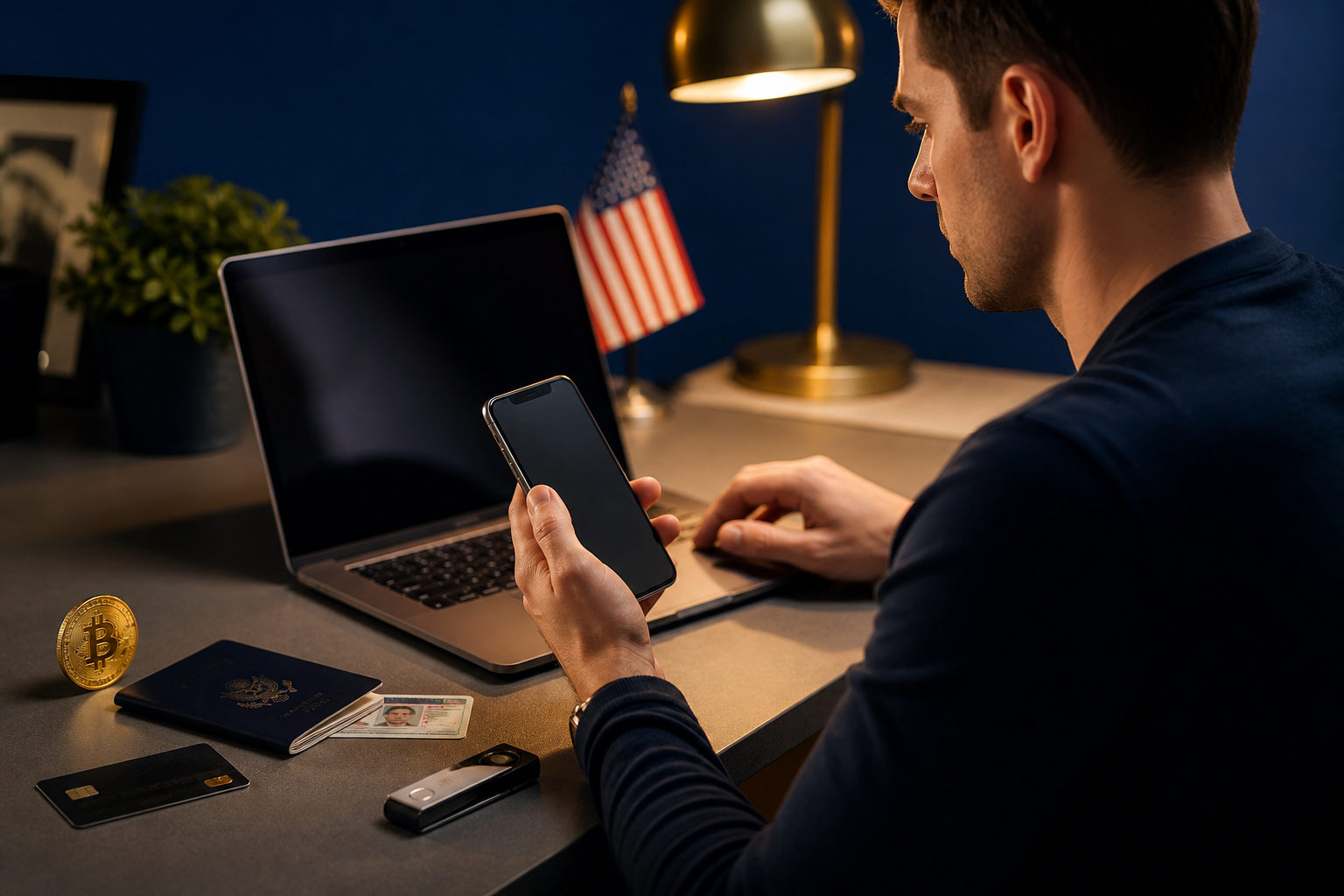
Buying bitcoin in the United States comes down to a handful of concrete steps: pick a platform that is registered with FinCEN as a money services business and licensed as a money transmitter in your state, verify your identity, fund the account through an ACH bank transfer or a debit card, place the order, and then decide whether the coins stay on the exchange or move to a wallet you control. The details that actually trip people up are not about which coin to buy — they are about state-level restrictions, funding fees, and what the IRS expects you to report later.
First, know exactly what you are buying
Before you do anything else, confirm you are buying bitcoin itself, not a similarly named token, a product dressed up as a yield instrument, or an over-the-counter position from someone you cannot verify. Bitcoin is a native blockchain asset, and its smallest unit is a satoshi — one hundred-millionth of a BTC — so you almost never need to buy a whole coin at once.
A lot of first-time buyers treat account creation like the entire process: download an app, sign up, done. In practice, buying bitcoin in the US usually involves identity verification, linking a funding method, setting withdrawal permissions, and eventually choosing how you will store what you bought. Each of those steps affects how safe your money is and how much control you actually have over it.
Step 1: Understand what a compliant US exchange looks like
A legitimately operating bitcoin platform in the US carries two layers of registration. At the federal level, it registers with FinCEN — the Treasury Department's Financial Crimes Enforcement Network — as a money services business (MSB). At the state level, it generally needs a money transmitter license (MTL) wherever it operates. Coinbase, Kraken, and Gemini are all FinCEN-registered MSBs that hold money transmitter licenses across multiple states. None of that guarantees a risk-free experience — regulation reduces certain risks, it does not eliminate them — but it does mean these platforms answer to federal and state regulators instead of operating in a gray zone.
The licensing structure differs enough between platforms that it is worth knowing the specifics before you commit to one:
- Coinbase holds a BitLicense issued by the New York State Department of Financial Services (NYDFS), and its trust entity is chartered as a limited-purpose trust company under New York banking law.
- Gemini operates through a New York trust charter, which exempts it from applying for a separate BitLicense, though it still falls under NYDFS oversight for virtual currency business activity.
- Kraken is a FinCEN-registered MSB with money transmitter licenses in multiple states and a Wyoming Special Purpose Depository Institution charter — but it does not hold a New York BitLicense. As of 2026, that means New York residents cannot use Kraken for crypto trading or related transfers.
These state-level gaps are not rare edge cases. New York's CRYPTO Act (S.8901), introduced in January 2026, would make unlicensed virtual currency business activity a criminal offense in the state — but it is still a pending proposal that has not passed and is not in effect. Under current law, unlicensed activity in New York remains governed by the existing BitLicense regime, with civil penalties. Binance.US's absence from New York is a longstanding, independent business decision unrelated to this proposed bill. Residents there are generally limited to licensed or exempt players such as Coinbase, Gemini, Bitstamp, and Robinhood.
Hawaii offers another useful example of why this matters. For years, the state required exchanges to hold a standalone money transmitter license with capital requirements steep enough that Coinbase and Kraken both pulled out of the market entirely — Coinbase was gone for roughly seven years. Hawaii removed that extra requirement on July 1, 2024, and Coinbase came back the following month, with Kraken and others following. The takeaway applies no matter where you live: a platform being compliant in the US does not automatically mean it is available in your state. Check availability on the exchange's own site before you sign up, not after you have already funded an account.
Step 2: Register your account and complete identity verification (KYC)
Signing up formally starts with account registration. You will set a strong password, link an email address or phone number, and upload identity documents when the platform asks for them. The reason for all of this is straightforward: the platform has to meet regulatory obligations, and thorough verification also cuts down on account takeover fraud.
Legally, compliant US platforms are classified as money services businesses, which puts them under the Bank Secrecy Act's anti-money-laundering and customer identification rules. Under Section 326 of the USA PATRIOT Act, an exchange's Customer Identification Program has to collect, at minimum, your name, date of birth, address, and an identification number — a Social Security Number for US citizens, or a passport or foreign ID number for non-residents. Most platforms also want a photo of your government ID along with a selfie or a live video check to confirm the document actually matches the person holding it.
If you are not willing to hand over a Social Security Number, you are not going to get through full verification at any major compliant exchange. That is not a platform being difficult for the sake of it — it is federal law. Any service advertising no KYC, or the ability to buy large amounts without ID, is trading a few minutes of convenience for a risk that is usually much larger than the time it saves you.
The most common problem at this stage is not slow approval — it is buyers leaving their own security gaps. A few things worth doing right from the start:
- Do not reuse passwords. Your exchange password should not match your email, social media, or shopping accounts.
- Turn on two-factor authentication. Use an authenticator app where possible instead of relying only on SMS codes.
- Double-check notification emails. Only log in through the official app or a URL you typed yourself — never through a link in an unsolicited email.
- Keep records of verification steps. Screenshot identity approvals, linked payment confirmations, and any risk alerts so you have something to reference later.
If you search for the fastest way to buy bitcoin instantly in the US, you will find plenty of services promising speed. But the more something emphasizes speed, the more important it becomes to confirm the login screen, payment page, and support contact are genuine. Do not treat security steps as friction to skip.
Step 3: Link a funding method, and understand what ACH, debit cards, and transfer limits actually mean
Common funding methods include ACH bank transfers, debit cards, and, on some platforms, other local payment rails. The real difference between them is not just how fast the money lands — it is fees, reversal risk, and how soon you can withdraw what you bought. Reading the rules before you order beats asking questions after the fact.
Using publicly listed rates from three major platforms as a snapshot (check the current numbers directly on each platform before you commit, since pricing changes over time): ACH bank transfers are typically fee-free on Coinbase, Kraken, and Gemini, though the funds — and your ability to withdraw crypto purchased with them — may be held for a few business days. If you want the purchase to settle instantly, you will usually pay with a debit card instead, and the cost jumps noticeably. Coinbase's card purchases can run up to roughly 3.99% of the transaction. Kraken's Instant Buy feature charges a flat fee around 1%. Gemini's basic buy flow layers a transaction fee of about 1.49% on top of a roughly 1% convenience fee. If you are not in a hurry to hold the coins, ACH is usually the cheaper path by a meaningful margin.
There is also a federal rule worth knowing about: the Travel Rule requires money services businesses to collect and pass along identifying information on both sides of a transfer once it crosses $3,000. That is why larger transfers sometimes trigger additional verification — it is a regulatory requirement across the industry, not a platform singling you out.
As a general rule, bank transfers suit people who prioritize cost and predictability, while debit cards are more convenient but carry higher fees and, sometimes, tighter limits. Before you place an order, focus on three things:
- Does the purchase settle immediately? Some methods let the trade execute right away while the asset stays locked from withdrawal for a period.
- Could the payment get reversed or flagged? If your bank's fraud controls intervene, know in advance how the platform handles the order.
- Is the fee broken out clearly? Look at the total cost, not just the headline rate.
People often ask how to buy bitcoin in the US with the least hassle, and the answer is usually not find the cheapest entry point — it is choosing a funding method whose rules you actually understand and can use consistently. If the fee structure does not make sense to you, hold off on placing the order until it does.
Step 4: Place the order and confirm you actually received BTC
Once you are on the buy screen, check the asset ticker is BTC before you look at anything else, then review the order details. The reason is simple: plenty of scam pages use lookalike names, or nudge buyers toward thinly traded, higher-risk tokens instead.
A useful order to check things in:
- Confirm the asset name and ticker. The name should read Bitcoin and the ticker should be BTC.
- Read the execution details. Note whether it is an instant market order, a limit order, or something executed in batches.
- Verify the fee and the final amount. Look past what you paid and confirm exactly how much BTC you ended up with.
- Save the order record. Time, quantity, fee, and payment method — keep all of it.
If fees matter to you, check whether the platform offers an advanced or pro trading interface. Coinbase's basic buy page and its Advanced Trade interface run on completely different fee schedules — Advanced Trade starts around 0.40% maker and 0.60% taker at the lowest volume tier, noticeably cheaper than the simple buy button. Kraken's pro interface goes as low as 0.16%/0.26%, and Gemini's ActiveTrader platform is similarly cheaper than its basic buy flow. Spending a few extra minutes learning the advanced order screen can save real money if you buy regularly.
If a page suggests support will buy it for you, send it to this private wallet and we will handle it, or deposit first to unlock high returns, stop immediately. A legitimate buying process never requires sending money to an individual first, and it never requires you to share a verification code with anyone.
Step 5: Decide where the bitcoin lives, and understand cash versus crypto
Once you have bought bitcoin, the next move is not refreshing the price every five minutes — it is deciding how to store it. If you only bought a small amount to learn the process, leaving it on the exchange for now is common. But if you plan to hold long-term, or you want direct control over transfers, moving BTC to a self-custody wallet fits the principle of actually controlling your own asset.
One point that gets glossed over constantly: many platforms note that USD cash sitting in your account is held at a partner bank and may be FDIC-insured, and that is generally accurate — but it only covers the dollar portion of your balance. Bitcoin itself, regardless of which platform holds it, is not covered by FDIC or NCUA insurance. Both the FDIC and the Commodity Futures Trading Commission (CFTC) have published explicit warnings that any claim suggesting crypto assets themselves carry federal deposit insurance is misleading. If a platform fails, gets hacked, or freezes withdrawals, your BTC does not have the same federal backstop a bank deposit has.
The two common custody options each come with tradeoffs:
| Option | Advantages | Watch out for |
|---|---|---|
| Exchange custody | Fast to set up, easy to trade; USD cash portion is typically FDIC-protected through the partner bank | Limited control if the account is hacked, frozen, or withdrawals get restricted; the BTC itself carries no FDIC coverage |
| Self-custody wallet | You hold the private keys, so transfers are entirely up to you | Lose, leak, or mistype the recovery phrase and the funds may be unrecoverable |
A side-by-side look at licensing and fees across three major platforms makes the practical differences behind compliant a bit more concrete:
| Platform | Federal/state status | Available in New York | ACH deposit | Debit card / instant buy |
|---|---|---|---|---|
| Coinbase | FinCEN-registered MSB; holds NY BitLicense; trust charter | Yes | Typically free | Up to roughly 3.99% |
| Kraken | FinCEN-registered MSB; Wyoming SPDI charter; no BitLicense | Crypto trading/transfers not available | Typically free | Instant Buy ~1% flat |
| Gemini | FinCEN-registered MSB; NY trust charter (BitLicense-exempt) | Yes | Typically free | ~1.49% + ~1% convenience fee |
Treat this as a 2026 snapshot rather than a permanent fact sheet — licensing status and fee schedules shift, so confirm the current terms on each platform's own site before you rely on them.
Whichever custody option you choose, never store your recovery phrase as a screenshot in a messaging app, cloud drive, or email draft, and never send it to anyone claiming to be technical support. The habits that actually keep people safe tend to be these unglamorous small ones, not anything exotic.
Step 6: Watch for scams — this is where most losses actually happen
Most losses do not happen before the purchase; they happen after. First-time buyers rarely lose money to sophisticated hacking. They lose it to fake support agents, counterfeit wallet apps, group chats pushing signals, fake investment mentors, and remote-access scams that trick someone into handing over screen control. The CFTC has published its own red-flag guidance aimed at everyday investors, and the core warnings line up closely with the list below.
Stop immediately if you see any of these signals:
- Promises of guaranteed principal or fixed high returns
- Requests to send funds to a personal account or an unfamiliar wallet address
- Pressure to act immediately, with no time to verify anything
- Requests for your verification code, recovery phrase, or private key
- Instructions to download software from an unofficial source
If you want to know how to buy bitcoin in the US as safely as possible, a practical rule is this: it is always better to slow down and confirm than to skip a check just to buy faster. A genuinely trustworthy process holds up to being checked item by item.
Do not skip this: what the IRS expects at tax time
The IRS treats bitcoin and other crypto as property, not currency. Buying and simply holding does not create a taxable event, but selling, trading one crypto for another, or spending bitcoin directly can trigger a capital gain or loss that has to be reported. Starting with the 2025 tax year — meaning forms sent out in 2026 — compliant US exchanges are required to report your gross sale proceeds to both you and the IRS on a new form, 1099-DA. Cost-basis reporting on that same form does not begin until 2027, covering trades executed in 2026, which makes keeping your own purchase records during this transition genuinely useful, not just a nice-to-have.
Sell within a year of buying and the gain is short-term, taxed at your ordinary income rate, anywhere from 10% to 37% depending on your bracket. Hold longer than a year and you qualify for the more favorable long-term capital gains rates. For 2026, those brackets sit roughly at: 0% up to $49,450 in taxable income for single filers, 15% between $49,451 and $545,500, and 20% above that; for married couples filing jointly, the 0%/15% line is around $98,900 and the 15%/20% line is around $613,700. If your modified adjusted gross income exceeds $200,000 (single) or $250,000 (married filing jointly), an additional 3.8% Net Investment Income Tax can apply on top of the capital gains rate. You are required to report your trades even if you never receive a 1099-DA — these thresholds get adjusted periodically, so check the current figures on IRS.gov or with a tax professional before you file.
Frequently Asked Questions
Do I have to buy a large amount the first time?
No. Bitcoin can be purchased in small fractional amounts since it divides down to a satoshi, one hundred-millionth of a coin. It makes more sense to get comfortable with the process first and decide on position size afterward.
Why can't I withdraw right after buying?
This usually comes down to the funding method, routine risk review, platform policy, or federal Travel Rule verification — ACH deposits and transfers above $3,000 are more likely to trigger a holding period. Checking withdrawal conditions before you order avoids the surprise of a purchase you can't move yet.
Is every platform available in every state?
No. States with stricter oversight, New York being the clearest example, impose extra licensing requirements like the BitLicense, and some platforms' crypto trading or transfer services simply are not offered to residents there. Hawaii similarly pushed several exchanges out for years over money transmitter licensing costs before loosening the rule in 2024. Check your state's availability on the platform's own site before assuming access.
Does keeping bitcoin on an exchange mean it's unsafe?
Not necessarily, but it is not the full picture either. Exchange custody is convenient, and the USD cash portion of your balance is often FDIC-protected through the partner bank — but the bitcoin itself carries no FDIC coverage, and you are trusting a third party with part of your control over the asset. Anyone planning to hold long-term often leans toward self-custody instead.
Do I owe taxes on bitcoin, and what happens if I forget to report?
Any realized capital gain generally needs to be reported, whether or not you receive a 1099-DA from the platform. Starting with the 2025 tax year, compliant exchanges report your gross sale proceeds to the IRS directly, and the IRS's ability to cross-check tax returns against exchange data has grown, so underreporting is riskier than it might seem. Rates and thresholds can shift year to year, so confirm current numbers on IRS.gov or with a tax professional before filing.
What's the biggest thing to watch for if I want to buy quickly?
Fake support agents, counterfeit apps, and requests for personal transfers. Anything that asks you to step outside the official interface and send money directly to an individual should be a hard stop.
I placed an order without checking the fees first — now what?
Save the order record, then check exactly how much BTC you received and what the withdrawal rules are going forward. Before your next purchase, put fees, spread, and withdrawal limits on the same checklist so you compare them together rather than discovering gaps after the fact.
The practical approach is to start small: get comfortable with registration, verification, buying, and withdrawal as four steps you can each complete independently, and only then think about scaling up. Confirm your state's platform availability and your future tax obligations ahead of time — not at the moment you actually need to withdraw or file.
Disclaimer: This article is for informational and educational purposes only and does not constitute investment, financial, legal, or tax advice. Crypto assets are highly volatile and you could lose your entire principal. Specific exchange licensing, fees, tax rates, and state rules can change; confirm current terms directly with official platforms and with the IRS or your state regulator, do your own research, and consult a licensed tax or legal professional where appropriate.