
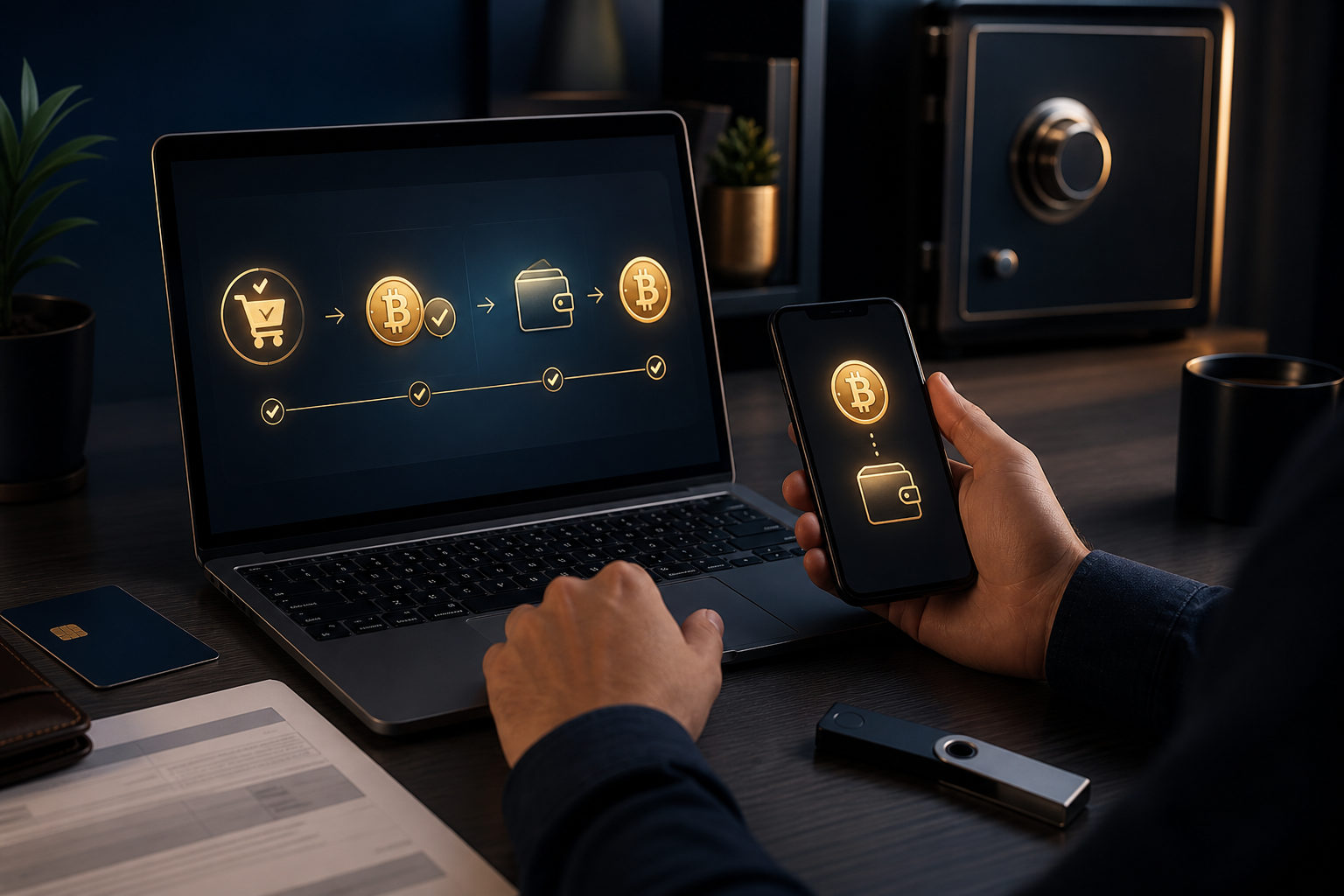
Answer first: paying with a bank transfer — ACH, SEPA, or a wire — is usually the cheapest and highest-limit way to fund a bitcoin purchase, but it is also the method banks scrutinize the most and the one that is hardest to reverse once the money is gone. How much you pay, how long it takes, how much you can send, and whether you can withdraw right away all depend on which type of transfer you use and how your bank currently feels about payments heading to crypto platforms.
What actually happens when you buy bitcoin with a bank account
A lot of people picture this as sending money straight to a seller who then hands over coins. In practice, the safer and far more common route is to open an account with a regulated exchange that accepts fiat deposits, complete identity verification, fund that account through a bank transfer, and then place an order inside the platform.
Not all bank transfers behave the same way. ACH, the standard US bank-to-bank rail, typically settles in one to three business days, and the deposit itself is usually free — though buying crypto with that balance often is not. As one example, a major exchange's published fee schedule shows free ACH deposits but a roughly 1.49% fee when you use that balance to buy, on top of about a 0.5% spread built into the quoted price. In the eurozone, standard SEPA transfers also take one to three business days, and pricing varies by platform — on one major exchange, SEPA deposits are free and buying only costs about a 0.1% trading fee. Since October 2025, SEPA Instant has become mandatory for banks across the EU, meaning a euro transfer can, in principle, land in seconds to a few minutes instead of days. Wires (sometimes called SWIFT transfers internationally) are usually the fastest option — one exchange advertises that domestic wires received before 3pm Eastern time settle the same day with no platform fee and no deposit cap — but your own bank's side of a wire typically still costs something, commonly somewhere in the teens to thirties of dollars. All of these numbers move around, so check the current fee page of whatever bank and platform you are actually using before you send anything.
Bank transfer vs wire vs card: a quick comparison
| Funding method | Typical settlement time | Typical cost | Can it be reversed | Common restriction |
|---|---|---|---|---|
| Bank transfer (standard ACH/SEPA) | 1 to 3 business days | Deposit itself is often free; buying with the balance usually carries a separate fee (roughly 1% and up, depending on the platform) | Once it lands and you spend it, essentially no | Some banks flag transfers to exchanges as higher risk and delay or block them |
| SEPA Instant (eurozone) | Seconds to a few minutes in most cases | Varies by platform; some still charge nothing | Essentially no | Requires both the sending and receiving bank to support instant rails |
| Wire / SWIFT | Often same day or within one business day | Bank-side fee commonly in the teens to thirties (USD or local equivalent), sometimes plus a platform receiving fee | Essentially no, and recall requests are slow with a low success rate | Often the only option once you exceed a platform's daily bank-transfer limit — on one exchange the ACH cap is about $25,000 a day |
| Debit or credit card | Instant | Noticeably higher than a bank transfer, often several times the percentage | Cardholders can usually dispute a charge | Some card issuers block crypto purchases outright |
The reason this table matters up front is that it shows the trade-off you are actually making. Bank transfers are cheap and support much higher limits precisely because the risk sits with you: once the money leaves your account, there is generally no undo button the way there is with a card dispute. Keep that in mind as you go through the rest of this.
Step 1: figure out which type of channel — and which transfer type — you are actually using
Before you do anything else, work out what kind of service you are dealing with: a centralized exchange that accepts bank transfers, a brokerage-style service tied to your bank account, or a peer-to-peer marketplace with escrow. Each accepts different transfer types. Some platforms only take domestic ACH or SEPA and will not touch international wires; others push large amounts toward wire transfers specifically because that is the only rail with no low daily cap. Picking the wrong transfer type does not just slow you down — a rejected or mismatched transfer often means waiting through another full settlement cycle.
What to check before you commit to a platform
- Does it actually verify identity? A legitimate bank-funded crypto purchase almost always requires identity checks. A channel that skips this step is a red flag, not a convenience.
- Which transfers does it accept, and what are the limits? Daily and monthly caps on ACH, SEPA, and wire differ a lot by platform. Knowing this ahead of time saves you from getting stuck mid-purchase.
- Is there a holding period after deposit? Some platforms lock crypto bought with a free bank transfer, ACH in particular, for several days to about a week and a half before you can withdraw it externally. This varies by platform, so read the deposit terms rather than assuming.
- Can you actually withdraw to your own wallet? If you cannot move coins off the platform, what you hold is really just an account balance, not bitcoin you control.
Do not treat someone else's recommendation as the deciding factor. What works depends on your payment method, your bank's policies where you live, what you are using the account for, and whether you plan to hold long term. Someone else's smooth experience does not guarantee yours will be.
Step 2: open the account and complete verification
Once you have picked a channel, the next move is not sending money — it is setting up the account properly: a strong password, two-factor authentication, submitted ID documents, and whatever facial or additional verification the platform asks for. This step is directly tied to bank transfers: most platforms will not show you your dedicated deposit details, the exact account name and reference code you need, until identity verification clears. Skip this and you may not even get a working way to send money.
Do not cut corners on security. Turn on two-factor authentication, ideally through an authenticator app rather than SMS alone. Use a separate password for your email, not one you have reused elsewhere. Most bitcoin theft does not come from a blockchain flaw — it comes from a weak login, where a verification code, email, and password all get compromised together.
Only upload ID documents through an app or website you have confirmed is official. Do not get there through an ad in search results, and never send photos of your ID or bank card to someone claiming to be support staff who says it will speed up your bank transfer approval. That is one of the most common scam scripts out there.
Step 3: before you link a bank payment method, check that the names match
Before connecting a bank account to your buying flow, run the simplest and most important check: does the name on your bank account match the verified name on your exchange account and your submitted ID? A huge share of failed deposits, returned funds, and stuck reviews trace back to a mismatch here. This is not platforms being difficult for no reason — it is an increasingly standard requirement for bank-funded crypto purchases. As a concrete example, one major exchange announced that starting in August 2026, bank transfer deposits must use the currently displayed named deposit details in your account, meaning the sender's name has to match what the platform has on file, or the deposit gets delayed or bounced back.
Why does name-matching matter so much? Because the platform and your bank both need to confirm that the person paying is the account holder — this cuts down on stolen-card use, third-party payments, money-laundering disputes, and refund fights. If a family member, friend, or business account pays on your behalf, even with good intentions, it can trigger automated risk flags. When the platform later asks you to explain why the money came from someone else, that is a hard position to be in.
A few practical rules:
- Only pay from your own bank account. Do not have someone else pay for you, and do not borrow a card or account.
- Confirm deposit details from the official interface only. The account name, reference code, and memo requirements should come from your logged-in dashboard, not a screenshot someone sent you in chat.
- Do not improvise the memo or reference code. Some deposits rely on a unique identifier; getting it wrong or leaving it blank can mean your funds sit in manual review instead of posting automatically.
- Keep proof of payment. Transfer confirmations, reference numbers, and deposit notifications are the only real evidence you will have if something goes wrong.
If you are using a peer-to-peer marketplace instead, the risk is more concentrated, because the bank transfer goes straight to another person rather than to the platform's own account. Confirm the counterparty's payee name matches what is shown in the app, mark payment sent only inside the platform, and never send extra proof through outside chat apps. Refuse any request to send to a different account instead or cancel and reorder. A bank transfer, once it clears, generally has no equivalent to a card chargeback — so anything trying to pull you outside the platform's process should be treated as a warning sign.
Your bank might block the transfer, and that is not necessarily on you
Here is something a lot of first-time buyers do not expect: even if you do everything right, your own bank may delay or block a transfer heading to a crypto exchange. Banks have gotten noticeably more cautious about payments tied to crypto platforms, largely because of rising fraud volumes connected to them. In the UK, for example, it is well documented in industry reporting and user experience that many banks apply extra scrutiny to transfers heading toward crypto exchanges — delaying them, asking for more detail about the purpose, or blocking them outright — and both exchanges and customers often say they get little explanation why. Policies also vary bank by bank and shift over time: some banks tend to release payments after routine fraud checks, some impose monthly caps, and a handful block crypto-related payments altogether. Exactly which banks fall into which camp changes too often and too inconsistently to list reliably here, so check directly with your own bank for its current stance rather than relying on any specific ranking or percentage you see circulating online. The point is simply that bank-side intervention in crypto-bound transfers is real and documented, not something platforms invent to inconvenience you.
If your transfer gets flagged or blocked, the more sensible response is to be upfront with your bank about the purpose of the payment rather than trying to disguise it or route it through someone else. Hiding the purpose tends to look more suspicious, not less, and can lead to further account restrictions.
Step 4: place the order — know what kind of order you are placing
Once your bank transfer clears, you can move to buying. The simplest approach is buying BTC directly with your fiat balance. You will generally see two basic order types: a quick buy at whatever price is currently available, and a limit order where you set your own price and wait for it to fill. Many platforms package the quick buy option as a convenience feature with a fee structure that is easy to misread — on one exchange, instant buy itself carries a flat 1% trading fee whether you are paying from your account balance or freshly deposited bank-transfer funds, but if you choose to pay by debit or credit card at that step, an extra card-processing fee of roughly 3.75% plus a small flat fee gets added on top, and that processing fee applies to card payments specifically, not to bank-transfer funds. Bank-transfer deposits on the same platform are free, and standard limit-order trading fees run lower still. Knowing which fee applies to which payment method is worth checking before you click confirm.
A reasonable order of operations:
- Confirm the trading pair and settlement currency. Make sure you are buying BTC, not a similarly named token or wrapped product.
- Check how the fee is presented. Some platforms list it separately, some build it into the spread, and some charge one rate for quick buy and a lower rate for regular trading. What matters is the amount of bitcoin you actually end up with.
- Start with an amount you can afford to lose while testing. Your first purchase should confirm the process works smoothly, not max out your budget.
- Confirm the asset actually landed. Check your account balance, not just an order-submitted message.
Do not let yield promotions, trending-coin lists, copy-trading features, or lending products creep into what should be a simple purchase. Your goal is buying bitcoin safely with a bank transfer, not switching on every higher-risk feature the platform offers along the way.
Step 5: buying it is not the finish line — moving it to your own wallet is
A lot of people think the process ends once the order fills. The step that actually matters most comes after: moving any bitcoin you intend to hold long-term to a wallet where you control the private keys. There is a bank-transfer-specific wrinkle here that is easy to miss: many platforms apply a holding period to crypto bought with a free bank transfer like ACH, during which you cannot withdraw to an external wallet even though the purchase is technically complete. That window commonly runs from several days up to around ten days, and it exists because the transfer itself could theoretically still be reversed or investigated during that time. Check your platform's deposit terms before you buy, so you are not caught off guard expecting an immediate withdrawal.
When you do withdraw, set up your wallet first and test with a small amount. The Bitcoin network produces a new block roughly every ten minutes, and confirmations take time — seeing withdrawal submitted does not mean the funds are usable yet. On your first withdrawal, copy and double-check the address carefully, confirm the wallet accepts BTC, and send a small test amount before moving the rest.
Never screenshot or store your seed phrase or private keys, never send them through a chat app, and never keep them in a note-taking app connected to the internet. Download wallet software only from official sources, and confirm your backup actually restores before you switch phones or computers. Scammers frequently pose as wallet support at this exact stage, asking for your seed phrase under the guise of syncing your assets or upgrading a node. A real wallet provider will never ask you for that information.
Why money sent by bank transfer is so hard to get back if you are scammed
This is the core difference between a bank transfer and a card payment: if something goes wrong with a card charge, you can usually file a dispute. With a bank transfer, once it is sent and the recipient moves the funds, there is typically no undo option at all. That is exactly why investment scams — the kind often called pig butchering, where a scammer builds a relationship over weeks or months before steering the victim into a fake platform — almost always push victims toward bank transfers to buy crypto and send it onward. According to the FBI's Internet Crime Complaint Center (IC3) 2024 Internet Crime Report — the most recent year with verified, publicly confirmable figures — investment fraud (pig butchering included) cost Americans roughly $6.57 billion, and total crypto-related fraud losses reached about $9.3 billion, a 66% year-over-year jump that made up more than half of the roughly $16.6 billion in total losses IC3 reported that year. The trend has clearly kept climbing since; for the latest full-year figures, check IC3's current annual report directly.
Some regions have started building reimbursement schemes for people tricked into authorizing a transfer, but the coverage tends to be narrower than it sounds. In the UK, the payments regulator introduced mandatory reimbursement for authorized push payment fraud starting in October 2024, covering victims for up to £85,000, with a possible excess of up to £100, and the cost split between the sending and receiving banks. However, that protection is currently limited mostly to cases involving impersonation of a bank or payment provider — most crypto investment scams fall outside it. In other words, even somewhere with one of the stronger reimbursement frameworks in place, someone tricked into wiring their own savings to buy crypto for a scammer likely will not get the same level of protection. Rules like this vary by country, change over time, and depend heavily on the specifics of the case — the broader lesson is simply this: treat a bank transfer as money you probably cannot get back once it is sent, rather than assuming your bank or the platform will make you whole afterward.
Frequently asked questions
Is a bank transfer always safer than a card for buying bitcoin?
Safety and reversibility are not the same thing. Bank transfers usually cost less and allow higher limits, but funds generally cannot be recalled once sent. Cards cost more but leave you with some dispute rights. Real safety comes from sticking to official channels and keeping payment and receipt inside the platform, not from which payment method you pick.
Why does the platform insist my bank account name matches my verified identity?
It is how the platform and your bank confirm the payer is really the account holder, which cuts down on stolen funds, third-party payments, and disputed refunds. It has become a standard rule at several major platforms, not an arbitrary hurdle.
My bank blocked or delayed my transfer — is that the platform's fault?
Not necessarily. Banks themselves have tightened scrutiny on transfers heading to crypto platforms; some cap amounts, some allow it after checks, and some block it outright. This is bank-side risk policy, separate from whether buying crypto is legal where you live. Being upfront with your bank about the purpose usually goes better than trying to route around the review.
Do I need to keep my bitcoin on the exchange after buying it?
If you are trading short-term, keeping it on the platform temporarily is common. For long-term holding, moving it to a wallet you control is the more solid approach — just check whether your platform applies a withdrawal holding period to bank-transfer-funded purchases first.
If I get scammed through a bank transfer, can I get my money back?
It is difficult. Bank transfers do not have a built-in dispute mechanism the way card payments do, so once a scammer moves the funds, recovery odds are low. A few regions have introduced reimbursement schemes for authorized transfer fraud, but most currently exclude crypto investment scams — check your bank's and regulator's current rules where you live.
A practical anti-scam checklist
If this is your first time buying bitcoin with a bank account, treat the following as a standing routine before and after every order. It will not make you more money, but it will cut down on the mistakes that actually cost people money.
- Log in only through an entry point you have verified yourself. Do not click links from strangers, and do not assume a top search result is trustworthy just because it is an ad.
- Double-check payment details before and after sending. Account name, reference code, order status — verify these directly, do not work from memory.
- Never share a verification code with anyone. No legitimate support agent, seller, or helper needs your login code or bank verification code.
- Pause if you feel rushed. Scammers rely on urgency — deadline in an hour, your account freezes if you do not act now — specifically because a bank transfer, once sent, usually cannot be pulled back.
- Separate buying from custody. Get comfortable with the purchase process first, then learn wallet backup separately — do not move large amounts while someone you do not know is walking you through it.
- Keep records of everything. Signup emails, deposit notices, transfer confirmations, order numbers, withdrawal records. If something goes wrong, this is worth far more than a verbal explanation.
What actually matters in the end is not chasing the lowest fee or the fastest settlement — it is running through one small, complete cycle first: open the account, fund it from your own bank, buy a modest amount of BTC, withdraw a small test amount to your own wallet, and confirm your backup actually works. Bank transfers do offer real advantages in cost and limits, but precisely because they are so hard to reverse, getting that small cycle right before scaling up is what keeps this safe.
Disclaimer: This article is for general information and educational purposes only and does not constitute investment, financial, or legal advice. Fees, limits, processing times, and regulatory details mentioned here can change over time and vary by bank, platform, and region — always confirm current terms directly with your bank and exchange. Cryptocurrency prices are highly volatile and you could lose your entire investment; do your own research and make decisions carefully.