
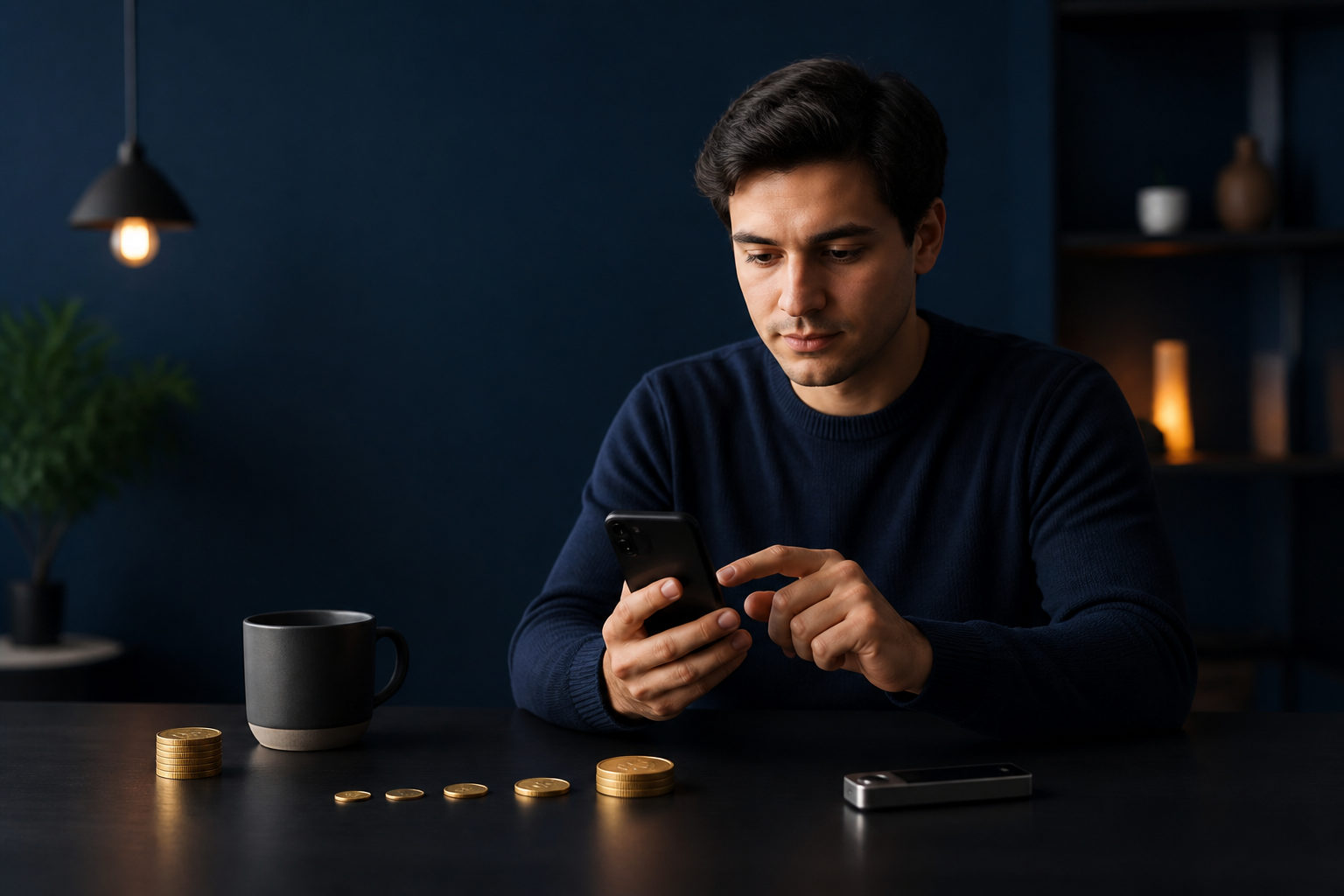
You can invest in Bitcoin with little money if you treat it as a controlled, step-by-step process: set a budget first, buy in small batches, understand fees, and protect your account and wallet before chasing returns.
Start by deciding whether Bitcoin fits your finances
Bitcoin should be bought with money you can afford to leave untouched for a while. It is a poor fit for rent, bill money, borrowed funds, or cash you know you will need soon. The main reason is simple: short-term price swings can be sharp, and forced selling is one of the easiest ways for beginners to lock in a bad outcome.
For a small investor, the first test is emotional as much as financial. If a drop on the screen would make you panic, cancel daily plans, or sell only to stop the stress, your position is probably too large for your situation. A small starting amount works best when it leaves your routine intact.
| Source of funds | Better fit? | Why |
|---|---|---|
| Spare cash | Yes | Gives you room to handle volatility without pressure |
| Living expenses | No | Losses can affect daily needs |
| Borrowed money | No | Debt pressure and market risk can hit at the same time |
| Money needed soon | No | You may have to sell on the market's terms, not yours |
Step 1: Set a total budget and pick a buying method
If your goal is to learn how to invest in Bitcoin with little money, the most useful first move is to define a total amount before you look at the market. That decision matters because a fixed budget creates guardrails. Without it, many beginners keep adding money during excitement and call it a plan.
Small investors often do better with a batch approach rather than putting all funds in at once. Bitcoin is divisible, and its smallest unit is the satoshi. One satoshi is one hundred millionth of a BTC, so you do not need to wait until you can afford a whole coin before getting started.
The caution here is that buying in batches is a risk-management tool, not a profit machine. It spreads out your entry points, but it does not remove volatility. If you change your amount every time the market moves, you are still reacting emotionally even if the purchases are technically split up.
| Method | Who it suits | Main benefit | What to watch |
|---|---|---|---|
| One-time buy | People comfortable with near-term swings | Simple to execute | Your timing may turn out poor |
| Small batch buying | Beginners with limited funds | Spreads entry timing | Needs rules set in advance |
| Buying after sudden hype | Not recommended | Feels like catching momentum | Often driven by emotion |
Step 2: Choose a buying venue by checking rules and safety first
When people ask how to invest in Bitcoin with little money, they often focus on where to click buy. A better question is whether the venue explains identity checks, deposits, withdrawals, fees, and account protection in a way you can actually follow. For a small investor, clarity is a safety feature.
This matters because losses do not only come from price changes. They can also come from confusing account restrictions, unclear fee structures, frozen access after poor setup, or fake support messages that push you outside the official app. A polished interface means very little if the basic rules are hard to verify.
Be extra careful with private messages, comment-section promotions, invite codes from strangers, and pages that promise free Bitcoin for signing up. Scam attempts often copy the language of real services while adding urgency. Once someone pressures you to move fast, stop and verify every step inside the official product you chose.
| Checkpoint | Why it matters | Warning sign |
|---|---|---|
| Identity verification flow | Affects account usability and recovery | Claims of large fast trading with no checks |
| Fee disclosure | Changes your real cost basis | Advertises low fees without full details |
| Withdrawal rules | Determines how freely you can move funds later | Heavy limits with vague explanations |
| Security settings | Reduces theft and account misuse risk | Missing basic account protections |
| Help and support information | Shows whether there is a real process when issues appear | Only chat contacts, no formal guidance |
Step 3: Know what you are buying and where the costs appear
Before you place any order, confirm that you are buying spot Bitcoin rather than a leveraged product, contract, copy-trading arrangement, or packaged exposure that adds another layer of risk. Small investors often think the limited dollar amount makes any mistake small. In practice, a complex product can create outsized damage even with modest capital.
Spot Bitcoin already carries market risk. Add leverage, and the account becomes more sensitive to short-term moves. That can turn a learning exercise into a fast loss. If your aim is to get exposure with little money, keeping the product simple usually gives you a cleaner view of what is actually happening.
Also check every cost line before you confirm the trade. Look at the purchase fee, sale fee, withdrawal fee, and the amount of BTC you will actually receive. Some beginners compare only the cash spent and miss the fact that the final Bitcoin amount can differ because of spread and other charges.
| Item | What to confirm | Common result if ignored |
|---|---|---|
| Product type | Whether it is spot BTC | Accidental exposure to higher-risk products |
| Fees | Buy, sell, and withdrawal costs | Higher real cost than expected |
| Order style | Immediate execution or waiting order | Fill price differs from expectation |
| Asset received | BTC or some other token | Thinking you bought Bitcoin when you did not |
Step 4: After buying, shift your attention to storage and fraud prevention
A common beginner mistake is to spend all their effort learning how to buy and almost none learning how to keep control afterward. Bitcoin transfers are not easy to undo. If you send funds to the wrong address, reveal recovery details, or hand over account access to a scammer, the path back can be very narrow.
You should understand the difference between holding Bitcoin in an account provided by a service and storing it in a wallet you control. If you expect to hold for a longer period, it makes sense to study wallet basics, backup habits, and test transfers instead of assuming custody will sort itself out later.
Fraud protection starts with very ordinary habits. Do not store recovery phrases, private keys, or verification codes in chat apps or cloud notes. Do not trust anyone who claims to be support and asks for those details. Real support does not need your recovery phrase to help you.
| Situation | Safer move | High-risk behavior |
|---|---|---|
| Saving recovery information | Keep an offline backup you control | Store it in messages or cloud notes |
| First withdrawal | Test with a small amount first | Send the full balance on the first try |
| Support contact | Verify inside the official app or site interface | Follow links from direct messages |
| Investment groups | Keep control of your own account | Let others trade or hold funds for you |
Step 5: Build a minimal plan so you do not trade on impulse
With limited funds, overactivity can do more damage than underactivity. Many beginners buy a little, sell a little, then change direction after reading a group message or a viral post. Even when the position size is small, repeated decisions made under stress can add up through fees, poor timing, and inconsistent thinking.
A better approach is to write down a plan simple enough to follow. That can include your total budget, how often you buy, what would make you pause, and how you record each trade. The point is not to create a complicated spreadsheet. It is to place one calm layer between impulse and execution.
You should also define what would make you stop adding money. If you notice yourself checking prices obsessively, stretching your budget, or trying to win back a loss by increasing size, pause the process. A small Bitcoin allocation should remain small enough that it does not take over your decisions.
| Plan element | Purpose | Execution reminder |
|---|---|---|
| Total budget | Limits your overall risk | Do not increase it on excitement alone |
| Buying rhythm | Reduces reactive chasing | Follow the schedule or rule you set |
| Trade notes | Shows patterns in your mistakes | Add a short reason after each action |
| Pause conditions | Prevents emotional sequences | Stop when stress begins to drive decisions |
FAQ
Is it still worth buying Bitcoin if I only have a small amount?
It can be, if the money is truly spare and the goal is measured exposure rather than fast gains. A small position can help you learn the mechanics of buying, storing, and managing risk without putting your wider finances under strain.
How often should I buy if I am investing with little money?
There is no single correct schedule. What matters more is choosing a rhythm in advance and sticking to it instead of changing it every time the market becomes noisy.
Do I need my own wallet right away?
Not always right away, but you should understand the option before your position grows. If you plan to hold longer, learning wallet basics and doing a small test transfer can be more useful than postponing custody decisions indefinitely.
How do I spot a Bitcoin scam when I am just starting?
Watch for urgency, guaranteed profits, account access requests, direct-message links, and anyone asking for your recovery phrase or verification code. If someone wants control over your account or coins, walk away.
What costs matter most for a small Bitcoin investor?
Look beyond the headline trading fee. Your real cost includes the buy price, sell price, spread, withdrawal fee, and the final amount of BTC that reaches your account or wallet.
If you want to begin, the next useful move is practical: write down a strict budget, choose a venue with clear rules, turn on every basic security setting, and run a small test through the full process before adding more money.
Disclaimer: This article is for informational and educational purposes only and is not investment, financial, or legal advice. Crypto assets are highly volatile and you could lose your entire investment. Do your own research and decide carefully.