
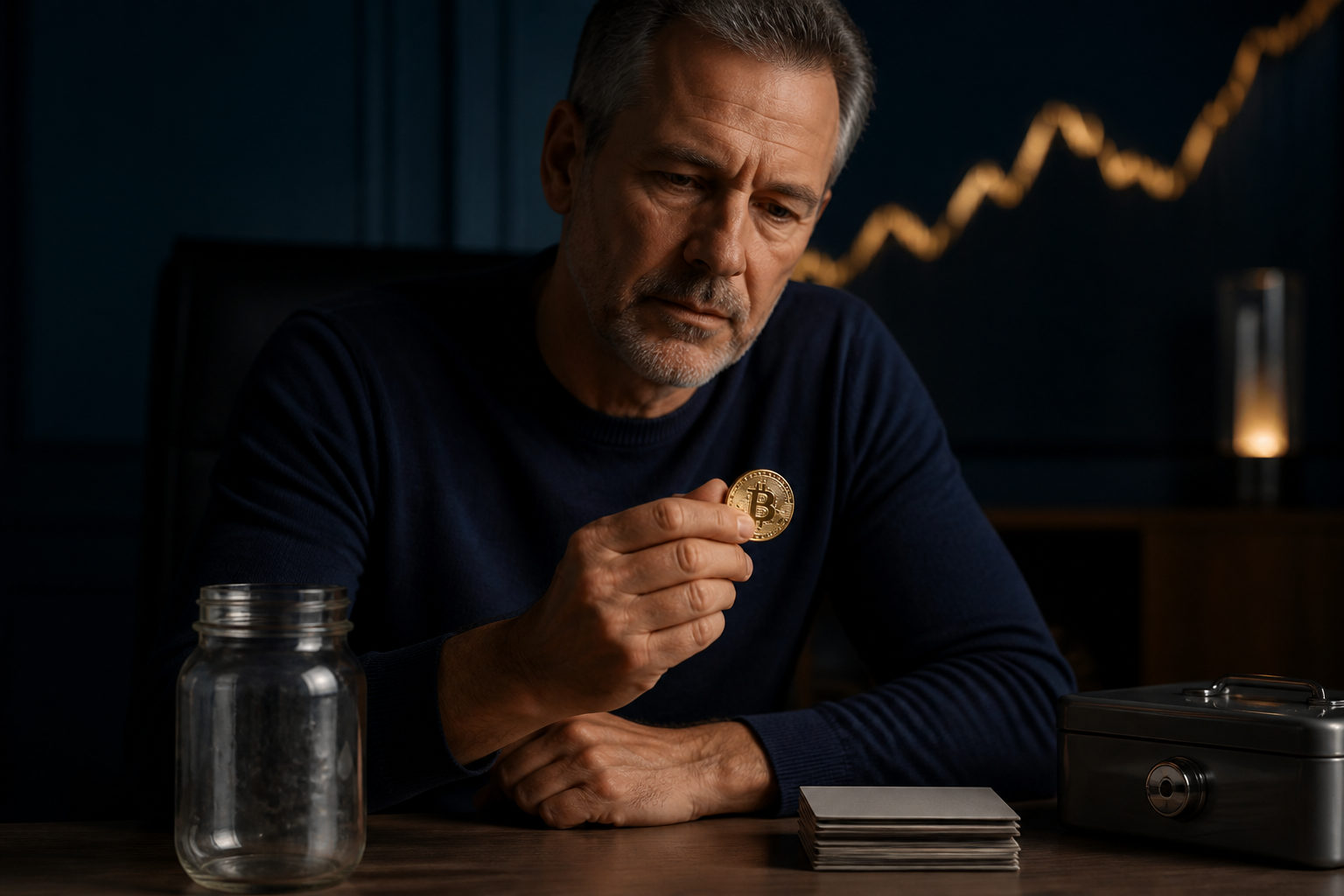
How to retire on bitcoin comes down to one hard question: can your spending plan survive long periods of volatility without forcing bad sales at the wrong time?
Start with fit: is bitcoin suitable for your retirement base?
Bitcoin can play a role in retirement planning, but that does not mean it should carry the whole plan. During your working years, you can focus on accumulation. In retirement, the problem changes. Your assets may need to fund housing, medical costs, insurance, and routine living expenses on a schedule that markets do not respect.
Bitcoin does have a clear issuance structure. Its hard cap is 21,000,000 BTC, with issuance expected to continue until about 2140. The genesis block was mined on 2009-01-03, and the white paper, Bitcoin: A Peer-to-Peer Electronic Cash System, was published by Satoshi Nakamoto on 2008-10-31. Those facts help explain why many people view bitcoin as a scarce asset, but scarcity alone does not answer a retirement question. You still need to know how much flexibility exists in your spending, whether you have income outside bitcoin, and how you react when your portfolio drops hard.
| Question | If the answer is mostly yes | If the answer is mostly no |
|---|---|---|
| Do you have reliable non-bitcoin income in retirement? | You may avoid selling during weak periods | Market timing risk matters much more |
| Can you handle deep portfolio swings without changing course? | Bitcoin may fit as a long-term holding | You may reduce exposure at stressful moments |
| Are you comfortable with self-custody? | You rely less on any single platform | Operational mistakes become a larger threat |
| Is part of your spending flexible? | You can delay some sales when conditions are poor | Rigid expenses can force unwanted selling |
If your retirement plan only works at a specific future price, the plan is fragile from the start. A durable plan has to remain usable even when bitcoin does not cooperate for a long stretch.
The real challenge is withdrawals, not entry timing
Many investors spend their energy on when to buy and too little on how to sell. Retirement turns that mistake into a structural problem. If your bills arrive every month, your portfolio may be tapped every month as well. That creates sequence risk: a weak stretch early in retirement can do more damage than many people expect because you are selling into it rather than waiting it out.
Bitcoin targets roughly one block every 10 minutes. The block subsidy is cut in half every 210,000 blocks, or about every 4 years. The halving dates so far are 2012-11-28, 2016-07-09, 2020-05-11, and 2024-04-19. After the 2024 halving, the current block reward is 3.125 BTC, and the next halving is expected around 2028. At this stage, the network adds about 450 BTC per day in total. That supply path matters for long-run thinking, yet it does not remove short- or medium-term volatility, so a retirement withdrawal plan cannot rest on halving narratives alone.
| Withdrawal approach | Why someone may choose it | Main weakness |
|---|---|---|
| Sell on a fixed schedule | Simple to follow and easy to automate mentally | You may keep selling during bad markets |
| Hold a cash buffer and refill it when conditions allow | Can reduce forced bitcoin sales | Requires managing more than one asset bucket |
| Separate essential spending from optional spending | Lets you adjust lifestyle before touching core holdings | Needs discipline and honest budgeting |
| Use bitcoin for only part of retirement assets | Keeps upside exposure while lowering concentration risk | Total performance will not fully track bitcoin |
For most people, the central retirement issue is not whether bitcoin can appreciate over time. It is whether your life can keep running when the market is down and you still need liquidity.
The risk list is broader than price volatility
Price risk gets the attention, but retirement planning with bitcoin also involves custody risk, platform risk, tax handling, and estate transfer. Those are practical risks. They affect access, control, and continuity, which matter a great deal once your salary is gone.
| Risk type | What it looks like | Why retirement makes it more serious |
|---|---|---|
| Price volatility | Sharp swings in portfolio value | The timing of a sale can affect that year's living standard |
| Custody risk | Lost keys, exposed seed phrases, damaged devices | There may be less room to recover from mistakes |
| Platform risk | Withdrawal limits, service disruption, account issues | Funds may be needed exactly when access is impaired |
| Tax and reporting complexity | Hard-to-track records across sales and transfers | Regular withdrawals can turn this into an ongoing burden |
| Estate transfer risk | Family members do not know how to access the assets | The plan may fail when someone else has to take over |
Self-custody offers control, but control is only useful if you can back up, restore, and pass on access safely. Retirement planning should include periods when you may be ill, unavailable, or less able to manage technical steps. If a spouse or heir cannot follow the process, the asset may exist on paper while being unusable in practice.
Another useful point is divisibility. One satoshi is 0.00000001 BTC, so retirement planning does not require owning or selling whole coins. What matters is whether the amount you hold can support your spending plan under stress.
Build a decision framework before you set an allocation
If you are seriously asking how to retire on bitcoin, write down the rules before the market tests you. A written framework reduces the chance that fear and excitement will rewrite your plan in real time.
| Planning prompt | What you need to define | Why it matters |
|---|---|---|
| Which expenses cannot be interrupted? | Housing, medical care, insurance, basic living costs | Shows how much low-volatility funding you may need |
| Which expenses can be delayed? | Travel, optional purchases, nonessential upgrades | Gives you room to avoid selling in weak periods |
| Where will the bitcoin be held? | On a platform, in self-custody, or split across methods | Balances convenience against control |
| What triggers a sale? | Time, allocation drift, or a spending shortfall | Prevents ad hoc decisions under stress |
| Who can step in if you cannot manage it? | Family, a trusted helper, or a documented process | Keeps the plan usable beyond your direct involvement |
This exercise is not about finding a bullish conclusion. It is about exposing weak points early. If any line in the table remains vague, your retirement plan is not ready for execution yet.
FAQ
Can I retire with only bitcoin and nothing else?
It is possible as a personal choice, but the concentration risk is high. Without other income or a buffer for expenses, your lifestyle may become tightly linked to market swings and sale timing.
What should I calculate first if I want to live off bitcoin?
Start with spending, not price targets. Separate nonnegotiable expenses from flexible ones, because that split shapes your withdrawal rules and your need for cash reserves.
Do bitcoin halvings make retirement planning safer?
Halvings change the supply schedule, and after 2024-04-19 the block reward is 3.125 BTC, with about 450 BTC added across the network each day. That may matter to long-term investors, but it does not guarantee favorable prices when you need to sell.
Do I need to own a whole bitcoin for this to make sense?
No. Bitcoin is divisible down to 1 satoshi, or 0.00000001 BTC. Retirement planning depends on the relationship between your asset base and your spending needs, not on owning round numbers of coins.
Is self-custody always better for retirement funds?
Not always. Self-custody gives more direct control, but only if you can manage backup, recovery, and inheritance procedures correctly. Convenience can matter too, especially if access needs to be simple for a future caregiver or family member.
If bitcoin is going into your retirement plan, do three things first: map essential and optional expenses, define when sales happen, and test your custody and handoff process. Only after that should you decide how large a role bitcoin should play.
Disclaimer: This article is for informational and educational purposes only and is not investment, financial, or legal advice. Crypto assets are highly volatile and you could lose your entire investment. Do your own research and decide carefully.