
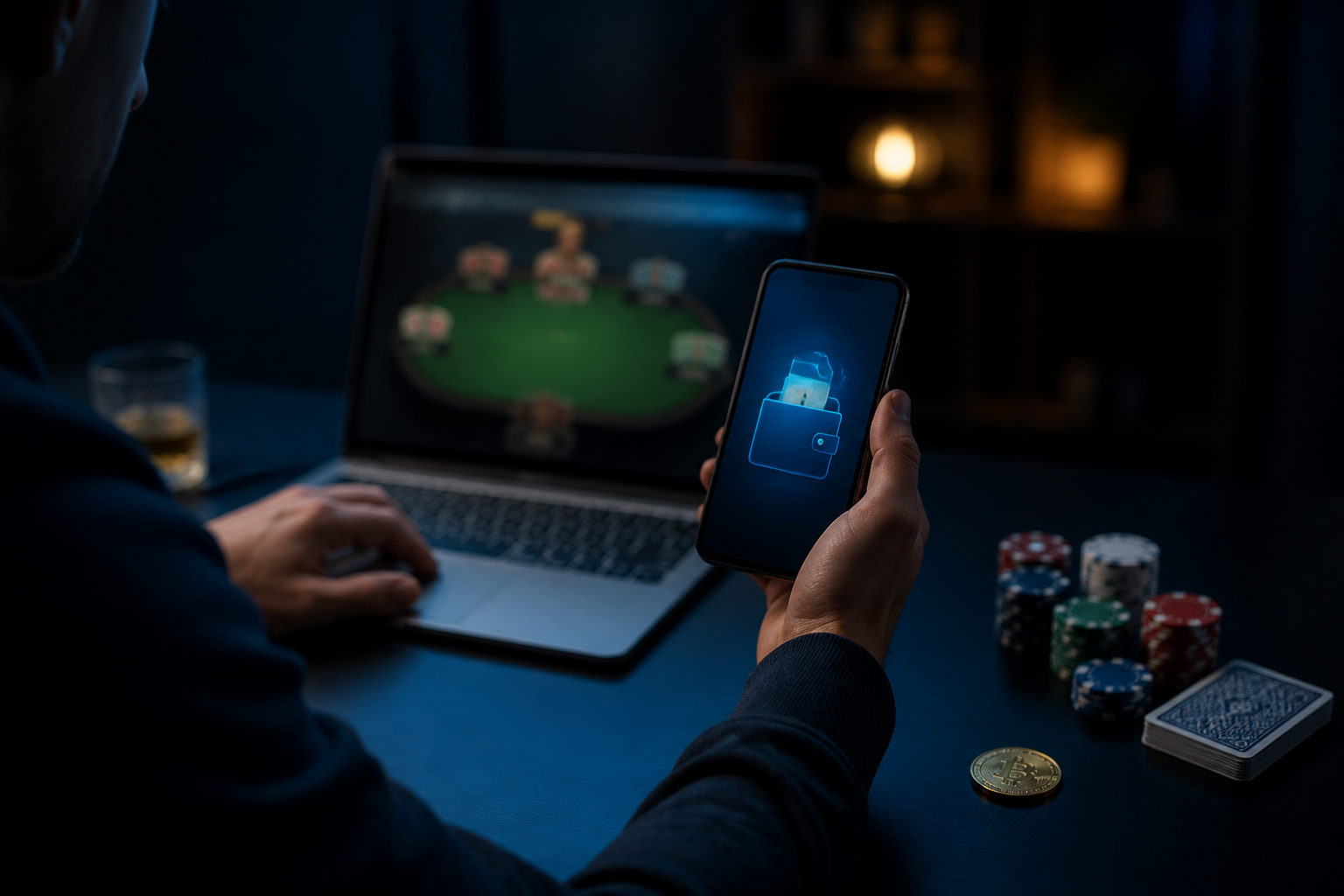
To use bitcoin for online poker, start with your own wallet, confirm that a poker site supports BTC deposits and withdrawals, and run a small test transaction before moving any meaningful amount.
What using bitcoin for online poker actually means
There are two separate parts: using bitcoin as a payment rail for deposits and withdrawals, and using the poker platform's internal balance to join games. Keeping those parts separate makes it easier to spot risk before money gets stuck.
Bitcoin handles transfers on its own network. It does not certify whether a poker operator is honest or well run. The smallest unit of bitcoin is 1 satoshi, equal to 0.00000001 BTC, which makes tiny test transfers easy. That matters because a mistaken address usually cannot be reversed.
| Stage | What you do | Why it matters | Common mistake |
|---|---|---|---|
| Wallet setup | Create and back up your own BTC wallet | You control the keys instead of leaving all funds on a site | Treating the poker balance like long-term storage |
| Platform review | Check deposit, withdrawal, account, and region rules | You avoid sites that accept BTC in but make BTC out difficult | Reading only the homepage |
| First transfer | Send a small test amount | You verify the address, crediting process, and support flow | Sending a large amount first |
| Session bankroll | Separate poker funds from long-term holdings | You reduce emotional and operational errors | Mixing savings with play money |
| Withdrawal test | Try a small cashout early | You learn whether the exit process works smoothly | Testing deposits only |
Step 1: Set up a wallet you control
If you plan to use bitcoin regularly, begin with a self-custody wallet. A poker platform is a gaming service, not the place where your long-term BTC should live. When your private keys or recovery phrase are under your control, you decide when to send, receive, or withdraw.
Install a reputable wallet, create it carefully, write down the recovery phrase offline, and make sure the backup is readable before you fund it. Avoid storing that phrase in cloud notes, screenshots, chat apps, or email drafts. A lot of bitcoin loss comes from exposed backups, infected devices, or fake support requests.
No real support agent needs your recovery phrase. Always double-check the first and last characters of a copied address because clipboard malware can swap it. If your wallet lets you save addresses, review the saved address before every withdrawal request.
Why a self-custody wallet matters here
On a poker site, your balance is still subject to that platform's ledger, review process, and account rules. In a self-custody wallet, control sits with your keys. A site balance can be a temporary working balance, but it should not be your main bitcoin storage plan.
Step 2: Check whether the poker site really works for BTC users
A site saying it accepts crypto is not enough. Confirm whether it supports bitcoin deposits, whether withdrawals can also be made in bitcoin, what identity checks may apply, and whether the service is available in your jurisdiction.
Go past the landing page and read the deposit page, withdrawal policy, terms, and FAQ. Some operators accept BTC but convert the account to an internal balance unit right away. Others let you keep a bitcoin-denominated balance. That affects risk, accounting, and cashing out.
Pay close attention to timing and restrictions. A site may let you deposit quickly but hold withdrawals pending account review. It may apply bonus conditions, ring-fenced balances, or extra checks to newly funded accounts. If a rule matters only after you win, it matters before you deposit.
| Item to review | What to look for | Better sign | Red flag |
|---|---|---|---|
| BTC deposits | Clear bitcoin deposit instructions | Address generation and crediting rules are explained | Only generic “crypto accepted” text |
| BTC withdrawals | Whether BTC cashouts are available and how they work | Steps and conditions are easy to find | Withdrawal terms are vague or buried |
| Verification | When identity or account checks apply | Requirements are stated before funding | Extra documents appear only at cashout time |
| Regional access | Whether your location is allowed | Availability is clearly stated | Service area is unclear |
| Balance handling | How deposits appear inside the account | The site explains its accounting model | Deposit and balance language do not match |
Step 3: Make a small test deposit before you play
Bitcoin targets roughly one block every 10 minutes, but each platform decides when to credit an incoming transaction and what confirmation standard it wants. A small test tells you whether the address is correct, whether the site recognizes the payment as expected, and whether support can explain any delay clearly.
Use your own wallet to send a small amount of BTC to the deposit address shown in your account at that moment. Before you send, confirm the coin, the address, and any on-screen instructions. After sending, save the transaction ID and note the time. Once the funds appear, verify that the balance displays properly and that you can use it as intended.
If withdrawals are supported, perform a small withdrawal back to your own wallet soon after. This gives you a full round-trip test: wallet to site, site crediting, site to wallet.
Why the small withdrawal test is just as important
The real operational check is the exit. If a site accepts BTC instantly but creates friction when you try to cash out, you need to know that before your balance grows.
Step 4: Keep poker funds separate from your main bitcoin holdings
Online poker is a high-frequency activity. Long-term bitcoin storage is a different discipline. If you mix those two pools of money in one wallet or treat your entire BTC stack as available for play, mistakes become much easier.
Create a dedicated play bankroll that you can afford to lose. Move only that amount to the poker site, keep the rest in your own wallet, and withdraw unused funds when you are done. This also shortens the time your BTC sits under platform risk.
Turn on two-factor authentication for the poker account if available. Keep your operating system and wallet app updated. Avoid making deposits or withdrawals on public Wi‑Fi. Ignore direct messages from “VIP managers,” “payment agents,” or anyone offering to speed up deposits, restore balances, or process manual withdrawals. Many users lose bitcoin to fake support, cloned login pages, and malicious apps rather than to poker itself.
| Practice | Who it suits | Main benefit | What to watch for |
|---|---|---|---|
| Separate long-term BTC from poker bankroll | Anyone who also holds bitcoin outside gaming | Protects savings from impulsive transfers | Do not mix backups or wallet labels |
| Withdraw leftover BTC after sessions | Occasional players | Reduces time exposed to platform risk | Review the destination address each time |
| Keep only a working balance on site | Frequent players | Limits the amount at risk in one place | Avoid topping up emotionally after a bad run |
| Enable two-factor authentication | All users | Lowers account takeover risk | Do not keep every recovery method on one device |
Step 5: Treat withdrawals as the real trust test
Depositing is easy to advertise. Withdrawing is where a site shows how it actually operates. A good withdrawal process is clear about account checks, processing status, and what information you need to provide. A weak one feels inconsistent, vague, or reactive only after you request a cashout.
When you withdraw, send BTC only to an address you control. Avoid sending to a stranger's wallet or an unknown intermediary. Save screenshots of the request, note the time, and keep the transaction details. When the funds arrive, compare the result with the site's stated rules so you can spot any mismatch early.
If a platform suddenly changes the explanation, asks for unclear extra steps, or gives you different answers each time, stop sending more money until the issue is resolved. Keep transaction IDs, timestamps, screenshots, and support messages.
FAQ
Is using bitcoin for online poker automatically anonymous
No. A bitcoin address does not display your name by default, but blockchain transactions are public, and the poker site may still require account verification, device checks, or location checks. Privacy and anonymity are not the same thing.
If a poker site accepts bitcoin deposits, does that mean bitcoin withdrawals are guaranteed too
No. Some sites accept BTC in while applying different conditions to withdrawals. That is why a small deposit test should be followed by a small withdrawal test as early as possible.
Can I keep my bitcoin on the poker site for convenience
You can keep a short-term working balance there if you choose, but it is not a good default for long-term storage. A site balance depends on the platform's systems and rules, while a self-custody wallet depends on your keys.
My deposit has not shown up yet. Should I send another one
Usually no. First check whether the transaction was broadcast, whether the site requires confirmations, and whether you used the exact deposit address shown for that session. If those points look correct, contact support with the transaction record before sending anything else.
Is it safe to use a third party to deposit or withdraw for me
No. A third party can introduce address mistakes, fund diversion, account flags, and proof issues later. Doing your own small test is safer.
Use your own wallet, read withdrawal rules before funding, test with a small BTC amount, separate play money from savings, and cash out unused funds back to self-custody.