
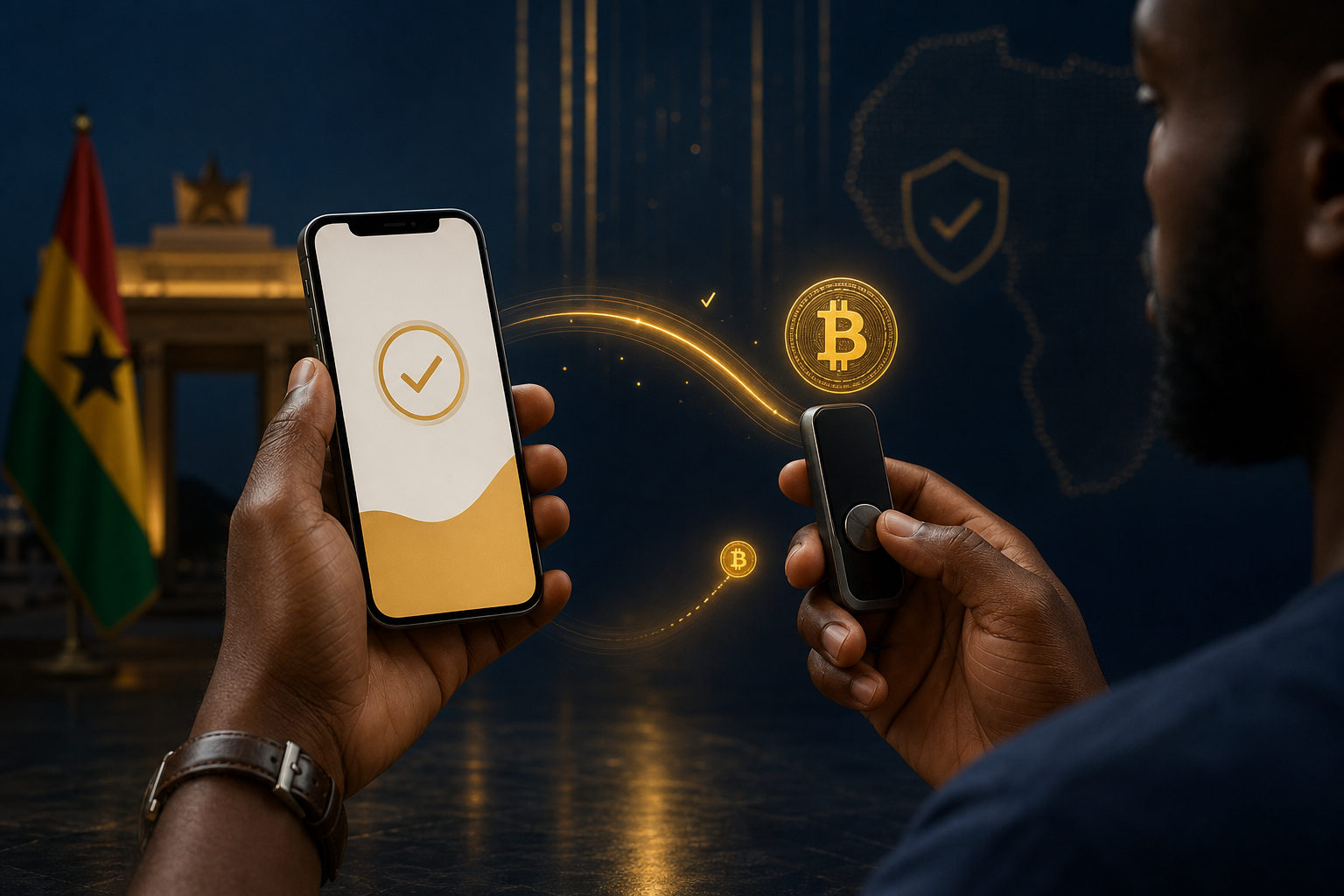
If you want to buy Bitcoin in Ghana using mobile money, the short version is this: confirm which wallet you're using (MTN MoMo, Vodafone Cash, or AirtelTigo Money) and make sure it's fully registered against your Ghana Card, pick a channel that clearly supports mobile money funding and lets you withdraw actual Bitcoin to a wallet you control (Binance P2P, Bitget P2P, CoinCola, Yellow Card, and Quidax are the names that keep showing up for Ghana), test with a small order first, then move the coins off the platform once you've confirmed everything works. One thing has changed recently and it matters: Ghana's regulatory picture for crypto shifted substantially between late 2025 and 2026, and that shift should shape how you pick a platform, not just how you send a payment.
Ghana's crypto rules aren't a blank page anymore
For years, the Bank of Ghana's public position on crypto was blunt caution. In notices dated January 2018 and again in March 2022, the central bank stated that Bitcoin and similar assets are not legal tender in Ghana, are not regulated under any domestic law, and carry no official guarantee. Banks and licensed financial institutions were told to keep their distance.
That changed at the end of 2025. Ghana's Parliament passed the Virtual Asset Service Providers Act, 2025 — referred to by the Bank of Ghana as Act 1154 — which for the first time creates an actual legal framework for crypto businesses operating in the country. Under this law, the Bank of Ghana and the Securities and Exchange Commission (SEC) share supervisory responsibility, and the central bank has stood up a new Virtual Assets Regulatory Office (VARO) to run day-to-day oversight. Reporting from around the law's passage indicated regulators planned to publish detailed directives and begin phased licensing starting in the first quarter of 2026, and that eleven companies had already been admitted into a regulatory sandbox to test services ahead of full licensing.
What this means practically: whether a given platform is licensed in Ghana is a moving target in 2026, not a fact you check once and file away. A platform's compliance status six months ago may not describe where it stands today. So before you fund an account, it's worth checking the current licensed or sandbox list published by the Bank of Ghana or SEC directly, rather than trusting a "fully compliant" badge on a platform's marketing page.
Mobile money basics you need before you start
Ghana's mobile money market runs mainly on MTN MoMo, with Vodafone Cash (now under the Telecel Cash brand) and AirtelTigo Money as the other major options. Every one of these wallets ties back to your Ghana Card, which functions as the primary identity document for KYC purposes across the financial sector.
Transaction limits scale with how much identity verification you've completed. Accounts that have only done the basic level (Ghana Card only) sit at the lowest daily limits and wallet balance caps. Add information like next-of-kin details and a source-of-funds declaration and you move to a mid tier with noticeably higher limits. Complete an even fuller verification, including proof of address, and the daily ceiling opens up further, with less restriction on how much the wallet can hold overall. The exact cedi figures reported by different telecom trackers don't always agree with each other, and the Bank of Ghana has revised wallet and transaction limits upward more than once during 2026 — so rather than memorizing a number that might already be stale, just open your MoMo app before you buy and check what your account is actually cleared for, especially if the purchase you're planning is close to that ceiling.
On fees, there's a useful piece of background: the Electronic Transfer Levy (E-Levy), which used to sit on top of most electronic transfers, was formally repealed on April 2, 2025, when the President signed the repeal bill. That means there's no longer a nationwide government levy stacked onto your mobile money transfer. That doesn't mean mobile money is free, though — MTN's own transfer and cash-out fees still apply and they do change. As one example, MTN planned to introduce a 0.75% fee on wallet-to-bank transfers starting June 1, 2026, but the Bank of Ghana suspended that fee on May 26, 2026 -- about a week before its planned launch -- and it hasn't been reinstated as of this writing. The takeaway isn't a specific fee number to memorize — it's that mobile money pricing shifts, and checking the fee screen in the app right before you pay beats relying on a fee table someone posted months ago.
Comparing the platforms Ghanaians actually use
The table below covers the names that consistently come up as supporting mobile money funding for Bitcoin purchases in Ghana. Treat it as a starting point, not a final answer — coverage, fees, and licensing status all move, so verify current terms on the platform itself before you commit funds.
| Platform | How mobile money fits in | Fee structure | What to watch for |
|---|---|---|---|
| Binance P2P | Buyers filter listings by MTN MoMo (and other local payment methods) and trade directly with another user | The trade itself may carry no platform fee, but the real cost sits in the spread between the buy and sell quotes sellers post | Funds move through Binance's escrow mechanism during the trade — the thing that actually matters is the counterparty's completion rate and trade history. Don't let anyone move the conversation off-platform |
| Bitget P2P | Explicitly lists support for MTN MoMo, Vodafone Cash, and AirtelTigo Money as payment options | Peer-set pricing, trade secured through Bitget's own escrow system | Same discipline as any P2P trade: check the seller's history, keep every message and confirmation inside the platform |
| CoinCola | Lets you filter sellers specifically by "MTN Mobile Money" | Peer-set pricing | P2P platforms live and die on counterparty reputation — an unusually good rate is a reason to slow down, not speed up |
| Yellow Card | Not peer-to-peer — this is an Africa-focused exchange that converts BTC/USDT/ETH to Ghana cedi directly and pays out to MTN MoMo, AirtelTigo, or Vodafone Cash | Platform sets its own buy/sell spread, and cash-out may carry an additional fee | Long operating history across multiple African markets, but "been around a while" isn't the same as "currently licensed under Ghana's new Act 1154" — check the current status yourself rather than assuming it |
| Quidax | Operates across several African markets including Nigeria and Ghana, offering direct buy/sell of Bitcoin and other assets | Platform-set spread | Quidax holds a provisional digital asset exchange license from Nigeria's SEC — that's Nigerian regulatory approval, not a Ghanaian VASP license. Whether its Ghana operations fall under Ghana's new licensing regime is a separate question worth confirming |
The point of this table isn't to rank these platforms — it's to separate two different questions that people tend to blur together: "does this platform accept my mobile money payment" and "is this platform actually licensed to operate in Ghana." Those are answered differently, and it's worth two minutes to check both before you send money.
Step one: line up your wallet, your ID, and your own limits
What to actually do
Before you buy anything, set up a self-custody Bitcoin wallet and write down the seed phrase somewhere offline. Then confirm the mobile money account you plan to use — pick one of MTN MoMo, Vodafone Cash, or AirtelTigo Money, and don't juggle several accounts across purchases, since that just adds reconciliation headaches later. The name on that wallet needs to match your Ghana Card, and it needs to match whatever identity documents the exchange asks for down the line. While you're at it, get your Ghana Card and any other standard ID documents ready so you're not scrambling when a platform asks you to verify.
Why this comes first
Three reasons. First, having a receiving address ready means you can move coins off the platform the moment a purchase clears instead of leaving them sitting in someone else's custody. Second, having your documents ready ahead of time cuts down on the scenario where your payment has already gone out but your account is stuck in manual review — a real risk given that verification processes on several platforms are still being adjusted around Ghana's new rules. Third, deciding your own boundaries up front — spot buying only, no borrowing, no buying on someone else's behalf, no chasing yields you don't understand — keeps you from improvising decisions under pressure later.
Things to watch
- Never screenshot your seed phrase or send it to anyone. No legitimate support agent, seller, or group admin needs it.
- Check wallet addresses character by character. After you paste one, look closely at the start and end — malware that swaps clipboard contents is a real and common attack.
- Only use a mobile money account registered in your own name. Borrowing a family member's or friend's MoMo account creates a name mismatch that tends to cause trouble later during payment verification, refunds, or fraud checks.
Step two: screen the platform before speed, not after
What to actually do
Working from the comparison above, check whether the platform clearly explains its payment methods, identity requirements, withdrawal rules, dispute process, and whether it lets you move Bitcoin to an external wallet. For P2P trades on something like Binance P2P, Bitget P2P, or CoinCola, focus on the seller's completion history, ratings, and whether they insist on completing the trade strictly inside the platform's escrow system. For a direct-exchange model like Yellow Card or Quidax, focus on whether deposit, purchase, and withdrawal are clearly separated steps, and how the platform confirms your payment landed.
It's also worth spending a couple of minutes checking whether the platform appears on the licensed or sandbox lists published by the Bank of Ghana or SEC, or whether it publicly states its compliance status under Ghana's new framework. Not finding a clear answer isn't automatically a red flag — Ghana's licensing rollout is still in progress, and plenty of platforms operating legitimately may still be mid-application or in a transitional status. The point is knowing which situation you're in, rather than not knowing at all.
Why screen this carefully
The risk with mobile money payments isn't technical complexity — it's that once a payment goes out, clawing it back is usually hard. What you want is a channel with clear rules, a paper trail, a dispute process, and a real withdrawal path — not a verbal promise of "instant," "insider rate," or "better exchange rate."
Things to watch
- Don't jump on a quote just because it's unusually good or unusually cheap. An outlier rate is itself a warning sign.
- Don't move the conversation off-platform. Once you're chatting on WhatsApp or Telegram and paying directly, your ability to dispute anything drops sharply.
- Don't trust "pay first, I'll release after, just send a screenshot" shortcuts. A properly run trade walks you through confirmation steps inside the system, not around it.
Step three: finish verification, then connect your mobile money
What to actually do
Once you've picked a platform, complete registration and security setup first — a strong password and two-factor authentication. Submit your Ghana Card and any other requested ID and wait for approval. Only then move into payment setup or place an order, and check whether the platform or seller actually supports the specific wallet you're using (MTN MoMo, Vodafone Cash, or AirtelTigo Money aren't universally accepted by every seller or platform). Confirm the recipient's name, any required payment reference or note, and how the system confirms your payment landed.
If the system requires the payer's name to match your verified identity, don't route the payment through a relative's, friend's, or shop's mobile money account. If the platform requires a specific payment reference format, follow it exactly — a mismatched note is a common reason reconciliation fails.
Why you shouldn't skip this
A lot of failed purchases aren't failures of technique — they're failures of sequence. Someone pays first and submits documents afterward, the account lands in manual review, and both the money and the order are stuck in limbo. Getting verification out of the way first cuts down on exactly this kind of post-payment stall.
Things to watch
- Use an authenticator app for two-factor authentication rather than relying only on SMS. SIM swap fraud is a well-documented attack pattern connected to mobile money in Ghana, and SMS codes are the weak point it targets.
- Verify the recipient's identity on screen. If what's displayed doesn't match the order details, stop and double-check before paying.
- Only write what the payment system actually asks for in the reference field. Don't add anything mentioning Bitcoin or anything unrelated.
Step four: run a small test order before going bigger
What to actually do
For your first mobile money Bitcoin purchase, place an order small enough that a mistake wouldn't hurt. Pay exactly as the order screen instructs, keep your payment confirmation (the MoMo transaction SMS, the in-app transaction record), but don't treat a screenshot as a substitute for confirming inside the platform itself. Once you've paid, mark the order as paid through the proper flow and wait for confirmation from the counterparty or the system. After you've actually received the Bitcoin, don't rush into a bigger purchase — first check that it landed, that it's withdrawable, and that the withdrawal process behaves normally.
Only scale up once the small test has gone smoothly end to end. And even on larger purchases, keep the same pace — don't skip steps because a seller is rushing you or the market is moving.
Why the small test matters
You're not just testing "can I buy Bitcoin" — you're testing the whole chain: does the mobile money payment go through cleanly, does the counterparty release coins as agreed, can the platform actually handle a dispute if one comes up, and is withdrawal free of hidden friction. A small test order is a low-stakes rehearsal of that entire chain.
Things to watch
- Don't make your first order a large one. The goal of order one is verifying the process, not maximizing how much you buy.
- Don't let "only a few minutes left" or "pay now" pressure rush you. Read the order terms fully before paying.
- Don't mark an order as received or complete before you've actually confirmed receipt. A premature confirmation weakens your position if something goes wrong.
Step five: check what you bought and move it to your own wallet
What to actually do
Once your order settles, check that the Bitcoin in your account is actually withdrawable, then send a withdrawal to your own wallet address. Before you submit, double-check the network type and address format — confirm you're withdrawing on the Bitcoin network itself, not a similarly named token on a different chain. After submitting, watch the transaction status and wait for on-chain confirmation. The Bitcoin network produces a new block roughly every 10 minutes on average, and how quickly your withdrawal settles also depends on network congestion and how fast the platform processes withdrawals on its end.
Once the coins are in your own wallet, store the seed phrase properly and don't leave large amounts sitting on any trading platform long-term. The thing worth caring about isn't where you bought it — it's whether you're the one holding it afterward.
Why moving it off-platform matters
As long as your Bitcoin sits in a third-party account, you're carrying extra platform risk, the risk of account freezes, and limits on what you can actually do with it. Ghana's licensing framework is still being built out, and it's entirely possible some platforms adjust their operations — or exit the Ghanaian market altogether — as requirements firm up. Moving coins to a wallet you control is what actually completes the process, from payment, to platform ledger entry, to something you personally hold.
Things to watch
- Test with a small withdrawal first, especially the first time you send to a new address.
- Never store a seed phrase in cloud storage, a chat app's saved messages, or an email draft. If any of those get compromised, the loss is usually permanent.
- Don't mix up Bitcoin with similarly named tokens. If you bought Bitcoin, confirm what landed is actually BTC, not something with a similar-sounding name.
Scams that specifically target Ghana's mobile money and crypto users
Mobile money fraud in Ghana is a significant problem on its own, separate from crypto. Local tech media, citing Bank of Ghana incident reporting, put estimated losses from mobile money fraud across MTN, Telecel, and AirtelTigo users at roughly GHS 47 million over 2025. The scam patterns that show up specifically around Bitcoin purchases tend to layer on top of that same fraud ecosystem:
- Fake mobile money agents. Scammers pose as legitimate MoMo agents at markets, lorry stations, and street kiosks, offering to "help" you top up or cash out and then either grabbing your PIN or handling your phone directly. Ghana's mobile network operators generally offer a way to verify an agent's registration through official channels — if you're funding your wallet through a street agent before buying crypto, verify them through the operator's own verification process rather than trusting a badge or uniform.
- Off-platform payment requests. A "seller" asks you to leave the trading app and move to WhatsApp or Telegram, then gives you a personal number to send money to directly. This cuts you off from escrow and dispute resolution entirely.
- Fake support scams. Someone posing as platform support claims your order is flagged and asks you to send a "verification payment" or hand over your seed phrase. This is always a scam — no legitimate support process works this way.
- "Automated trading bot" investment schemes. This is a pattern local outlets have flagged repeatedly — someone builds trust over weeks through a dating app or social media, then introduces a supposed automated trading bot promising 30% to 100% monthly returns, and encourages you to move your Bitcoin or mobile money funds into a platform they control. Once the funds move, control is essentially gone.
- "Payment reversed" pressure. A seller claims your payment never arrived and asks you to pay again or cancel the order. Handle this strictly through the platform's own evidence and dispute process — never by paying twice outside it.
- Pay-on-my-behalf requests. Someone asks you to use your own mobile money account to pay for "their" purchase in exchange for a cut. This can pull you into a money flow you know nothing about, and if it triggers an anti-money-laundering review, your own account gets caught up in it too.
What about taxes on Bitcoin in Ghana
There isn't yet a clearly published, crypto-specific tax statute in Ghana that can be cited with confidence. What's publicly documented is that the Ghana Revenue Authority (GRA) announced in 2025 that it intends to step up tracking of crypto traders and deploy technology to capture relevant transaction data. Some industry publications suggest that profits from crypto trading could fall under Ghana's general income tax or capital gains tax rules, but the specific rate, filing requirements, and thresholds aren't consistent across the sources reporting on this, and none of it traces back to a dedicated crypto tax rule published directly by GRA. The sensible approach: keep a record of every trade, wallet address, and mobile money payment confirmation, and check with a Ghana-based tax advisor or GRA's current official guidance for your specific situation rather than assuming a rate from another country applies, or assuming nobody's tracking this.
If price is what you're really after, here's what actually determines it
Searches like this one are often really about price, but without live market data, the useful thing isn't a number that can't be verified — it's knowing what to look at. Bitcoin's price is set by market supply and demand, shaped by liquidity, sentiment, regulatory news, macro risk appetite, and the quote spread between different venues. In a market like Ghana's, where a lot of activity runs through P2P trades, the cedi price you actually get usually carries an extra markup or discount the individual seller sets — that's a separate thing from "the global Bitcoin price" you might see quoted elsewhere.
If you want a real-time number, check a mainstream market data source or a major exchange's live market page, and expect some variation between platforms and sellers. What actually matters isn't a number someone tells you — it's reading the buy price, fees, slippage, how much you're actually credited, and the withdrawal rules before you place the order.
Frequently asked questions
Is it legal to buy Bitcoin with mobile money in Ghana right now?
Ghana passed the Virtual Asset Service Providers Act, 2025 at the end of 2025, putting crypto activity under joint Bank of Ghana and SEC oversight with a phased licensing process now underway. That means crypto trading is moving into a formal regulatory framework, but whether a specific platform is currently licensed — and whether your particular transaction is fully compliant — depends on the current published lists and guidance from regulators, not on a platform's own marketing claims.
What's the first thing to do before buying?
Set up a self-custody wallet, and confirm the mobile money account you'll use (MTN MoMo, Vodafone Cash, or AirtelTigo Money) is fully verified and matches your Ghana Card. That way you can withdraw promptly after buying instead of getting stuck with a completed payment and nowhere to receive the coins.
How long after paying with mobile money will I actually receive Bitcoin?
It depends on the order confirmation process, how fast the counterparty releases the coins, and how quickly withdrawal gets processed. Once you move it to your own wallet, on-chain confirmation time also depends on network congestion — Bitcoin blocks land roughly every 10 minutes on average.
Should a beginner start with a large purchase?
No. Your first purchase should be small enough to test the full chain — paying, receiving coins, withdrawing, and confirming they land in your wallet. Only after every step has worked cleanly should you think about buying more, and that's especially true right now, with Ghana's licensing framework still mid-rollout.
Why shouldn't I just leave my Bitcoin on the platform I bought it from?
A platform account isn't the same as a wallet you control. If you can't withdraw independently or hold your own private keys, you don't have full control of the asset, and the risk is more concentrated. It's also possible individual platforms adjust their Ghana operations — or leave the market — as the new licensing regime settles in.
Someone offered me a cheaper rate outside the platform — should I take it?
Generally, no. A private deal that looks like a better rate usually comes with more financial risk, more identity risk, and a much weaker path to recourse if something goes wrong — and it's a beginner-unfriendly setup for exactly the reasons covered in the scams section above.
Checklist: before and after you buy
Before placing an order, confirm three things: you have a self-custody wallet ready, you understand the payment rules, and you know how you'll withdraw after the purchase — plus make sure the mobile money account you're using (MTN MoMo, Vodafone Cash, or AirtelTigo Money) is verified in your name with sufficient limits for the amount you're buying. While trading, stay inside a platform with clear rules and some visible compliance information, keep your payment records, and don't make side payments outside the system. After buying, test a small withdrawal first, then store your seed phrase offline. Keep records for tax purposes and check with a local advisor as needed. And every time you switch devices or wallets, verify your backup actually restores before you trust it with real funds.
Disclaimer: This article is for general informational and educational purposes only and does not constitute investment, financial, tax, or legal advice. Cryptocurrency prices are highly volatile, and you could lose your entire principal. Regulations, fees, and platform availability in Ghana are subject to change — verify current rules with the Bank of Ghana, the Securities and Exchange Commission, and your mobile money provider, and consult a qualified professional before making financial decisions.