
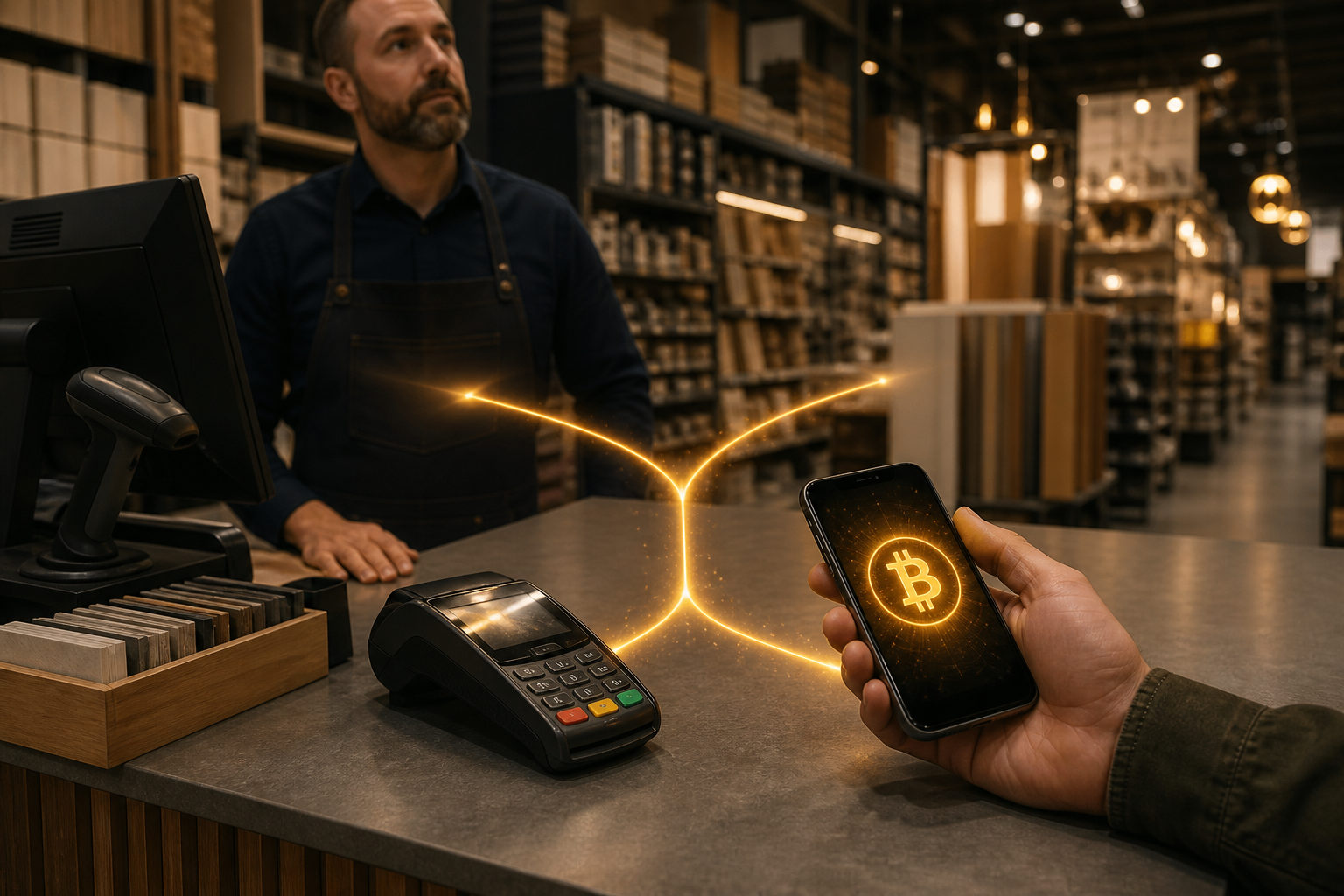
As of August 2, 2026, there is no clear information showing that Lowe's directly accepts Bitcoin. For most readers, the practical question is not just whether the retailer says yes to BTC, but whether shoppers can use Bitcoin through a payment intermediary, a gift-card route, or another conversion layer at checkout.
What people usually mean by “will lowe bitcoin”
This keyword is awkward in wording, but the intent is easy to read. One group of users wants a plain answer about payment: can Bitcoin be used to buy tools, home improvement supplies, or appliances at Lowe's? Another group is really asking something different: if a large retailer moves closer to crypto payments, does that matter for BTC adoption and price expectations?
Those are related questions, but they are not the same. Merchant acceptance depends on checkout systems, refunds, accounting treatment, customer support, and compliance overhead. Bitcoin price outlooks, by contrast, are usually framed around capital flows, volatility, market positioning, and cycle structure. A retail-payment headline can affect sentiment, but it does not replace the bigger drivers.
If your goal is simply to make a purchase, the useful test is operational. Can you pay online, in store, or both? If an order is canceled, how is the refund handled? If a third-party processor sits between you and the merchant, which terms govern the transaction? Those details matter more than a headline-friendly claim that a retailer “accepts Bitcoin.”
Why big retailers tend to move carefully on Bitcoin payments
For a large retailer, adding direct Bitcoin acceptance is not a cosmetic change. It touches the point-of-sale system, ecommerce checkout, order management, fraud review, refund handling, customer service scripts, and internal finance controls. A home improvement chain has a wide product catalog and a steady flow of returns, exchanges, and partially fulfilled orders. That makes the payment stack more sensitive than it may look from the outside.
Volatility is another major issue. If a merchant directly holds BTC after a sale, it takes balance-sheet exposure to price swings. If the merchant uses a processor that converts Bitcoin into dollars right away, implementation becomes easier, but the meaning of “accepting Bitcoin” changes. In that setup, Bitcoin functions more as a customer-facing payment rail than as a treasury asset the company wants to keep.
Refunds are often the hardest part. A consumer may return an item, cancel a shipment, or receive a partial order adjustment. When crypto touches that process, the experience can vary widely depending on the provider. Is the refund issued in dollar value, in the original asset form, or under the processor's own rules? Retailers usually want very clear answers before they expand support for this kind of payment flow.
That is why the right way to evaluate whether Lowe's might accept Bitcoin is to look beyond the headline. The real questions include:
- Would support apply online, in stores, or only through a limited channel?
- How would cancellations, returns, and partial refunds be processed?
- Would a third-party payment company handle the crypto leg?
- Would Lowe's receive dollars immediately or keep any BTC exposure?
- Would customer service and accounting systems be ready for disputes?
For shoppers, this distinction matters. “Direct acceptance,” “indirect payment through an intermediary,” and “buying through a gift-card path” may all feel similar on the surface, yet the risks and user experience are very different.
If support ever appears, what would it probably look like?
The most realistic path for a large retailer is indirect acceptance first. That usually means the shopper pays with Bitcoin on the front end, while the merchant receives dollars on the back end. It reduces volatility exposure for the retailer and pushes exchange-rate handling toward a specialist processor.
There are a few common formats. One is a payment processor that takes BTC from the customer and settles in dollars to the merchant. Another is a gift-card route, where the customer converts Bitcoin into spending value before shopping. A third is a wallet or payment app that bridges crypto spending into conventional merchant settlement. All three can make it feel as if Bitcoin is being used for the purchase, but they do not create the same rights or responsibilities.
That is where many headlines become too loose. A consumer may accurately say, “I used Bitcoin to buy something,” while the merchant may never have held BTC at all. From an adoption standpoint, that still matters. From a corporate-finance standpoint, it is a very different event.
If you are checking whether such a method is actually usable, work through a simple list before paying:
- Look at the official checkout page for listed payment methods.
- Check whether support applies online, in store, or both.
- Read the terms on refunds, disputes, and canceled orders.
- Confirm how long the quoted conversion price is locked.
- Save the transaction record, order number, and processor receipt.
That process is less exciting than a rumor, but much more useful. In practical shopping terms, payment certainty and refund clarity are usually the real make-or-break factors.
Would a Bitcoin payment move at Lowe's change the BTC outlook?
It could help the adoption story, but it would not be enough on its own to define Bitcoin's price path. Public market views on BTC still revolve more around ETF flows, volatility conditions, cycle behavior, and macro risk appetite than around a single merchant's payment options.
As of August 2, 2026, the spread in published institutional views is wide. Bernstein, in a report published on June 15, 2026, set a target of 150,000 dollars for the end of 2026. The tone was bullish, with the firm framing the move as a recovery into the 100,000 to 150,000 dollar range after cutting its earlier, higher objective.
Standard Chartered, in a view published on February 12, 2026, gave a target of 100,000 dollars for the end of 2026. That was still constructive, but more cautious. Its core point was that ETF flows remain the key variable, even after the bank cut its target more than once while keeping a longer-run 2030 call intact.
JPMorgan, in a forecast published on February 1, 2026, projected 150,000 to 170,000 dollars for 2026. The basis was a relative-volatility model comparing Bitcoin with gold, and the bank also argued that support existed near 94,000 dollars. That makes its stance one of the more optimistic views in the current group.
There are also clearly more restrained takes. Galaxy Digital CEO Mike Novogratz, in comments published on July 10, 2026, argued that Bitcoin was more likely to trade in a 60,000 to 80,000 dollar range through 2026. His view was that, without a strong catalyst, the market would struggle to reclaim 100,000 dollars.
Fidelity's Jurrien Timmer, in a view published on June 1, 2026, placed Bitcoin in a 65,000 to 75,000 dollar consolidation zone for 2026. His reasoning was that the four-year cycle had not been broken and that the market looked more like a post-peak consolidation phase than a fresh breakout setup.
Put together, these calls show a market with real disagreement. Some see recovery and upside extension. Others see a broad consolidation range and limited momentum without a new trigger. That is why it makes little sense to treat a possible Lowe's payment update as a stand-alone signal for BTC price direction.
| Institution | Published | Timeframe | Target | Stance |
|---|---|---|---|---|
| Bernstein | 2026-06-15 | End of 2026 | 150,000 dollars | Bullish |
| Standard Chartered | 2026-02-12 | End of 2026 | 100,000 dollars | Cautiously bullish |
| JPMorgan | 2026-02-01 | 2026 | 150,000 to 170,000 dollars | Bullish |
| Galaxy Digital CEO Mike Novogratz | 2026-07-10 | Full year 2026 | 60,000 to 80,000 dollar range | Neutral to cautious |
| Fidelity's Jurrien Timmer | 2026-06-01 | 2026 | 65,000 to 75,000 dollar consolidation zone | Neutral |
How to think about this topic without overreading it
A retailer's payment decision belongs in the adoption bucket, not the price bucket by itself. It can improve visibility, make crypto feel more usable, and give market participants a fresh talking point. None of that guarantees a specific BTC outcome.
The more disciplined approach is to separate the shopping question from the market question. If you are a customer, verify the payment route, refund rules, and settlement process. If you are watching Bitcoin as an asset, place any retail-payment development next to the range of published institutional views rather than treating it as a complete thesis.
FAQ
Can I directly pay with Bitcoin at Lowe's right now?
As of August 2, 2026, there is no clear information showing that Lowe's directly accepts Bitcoin. Before making a purchase, check the official checkout page and the payment terms shown that day.
If direct BTC payment is unavailable, are there indirect options?
Possibly, depending on the tools available to the shopper. Common workarounds include a payment intermediary, a gift-card path, or a wallet app that converts crypto spending into standard merchant settlement.
Would Bitcoin acceptance by a retailer automatically push BTC higher?
No. It can help sentiment and the adoption narrative, but price still depends on broader factors such as ETF flows, volatility conditions, market positioning, and cycle structure.
How different are the major BTC forecasts for 2026?
The gap is wide. Bernstein, in a report published on June 15, 2026, set an end-2026 target of 150,000 dollars, while JPMorgan, in a forecast published on February 1, 2026, projected 150,000 to 170,000 dollars for 2026; Galaxy Digital CEO Mike Novogratz, in comments published on July 10, 2026, saw a 60,000 to 80,000 dollar range, and Fidelity's Jurrien Timmer, in a view published on June 1, 2026, pointed to 65,000 to 75,000 dollars.
What should a shopper pay most attention to?
Refund handling is the first thing to check. If a crypto-linked payment route is involved, the difference between a refund in dollar value and a refund under a processor's own rules can materially change the final outcome.
If you only want to complete a purchase, verify the official payment options and refund terms before you pay. If you care about Bitcoin's market outlook, treat any possible Lowe's payment development as one small input beside the public forecasts from major institutions.
Disclaimer: This article is for informational purposes only and does not constitute investment advice. Cryptocurrency prices are highly volatile. Always do your own research.