
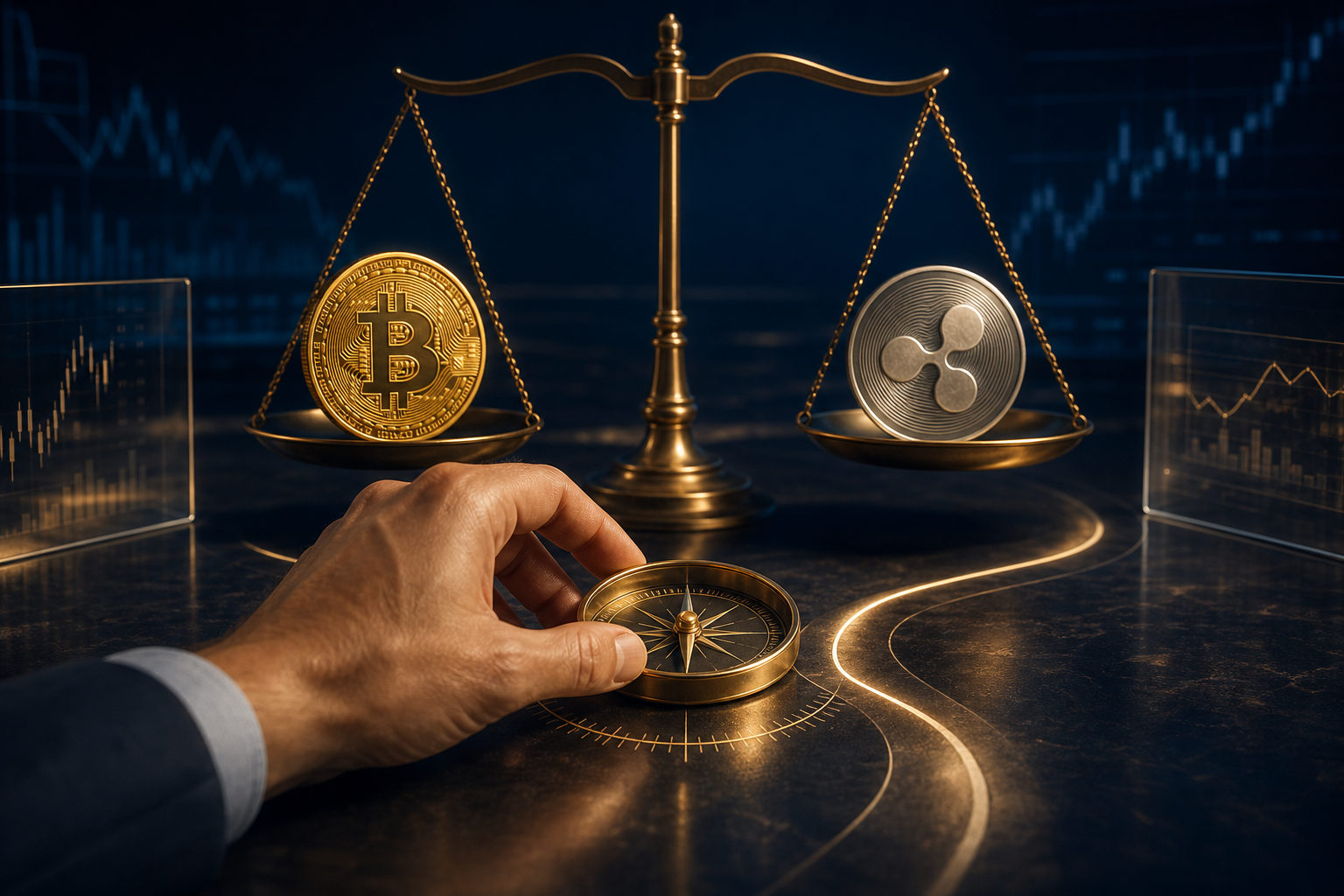
Should you buy Bitcoin or XRP? There is no universal answer. The useful way to approach it is to decide which asset fits your goal, risk tolerance, holding period, and exit rules before you commit any money.
These two assets are often compared as if they belong in the same bucket. They do not. Bitcoin is usually discussed as a more decentralized asset with a simple and transparent monetary design. XRP is more often evaluated through payment use cases, network utility, and expectations around adoption. For a retail buyer, the real question is not which one wins in every market cycle. It is which one you actually understand well enough to hold through stress.
Start with the thesis, not the ticker
A lot of bad decisions begin with the wrong starting point. People look at social chatter, recent momentum, or the fact that one coin looks cheaper per unit. None of those tells you whether the position fits you.
If your thesis centers on scarcity, transparent issuance, and a monetary policy that is easy to verify, Bitcoin usually gets most of the attention. Its supply cap is 21 million coins. The genesis block dates to January 2009, and the white paper, Bitcoin: A Peer-to-Peer Electronic Cash System, was released in 2008 under the name Satoshi Nakamoto, whose identity remains unknown. Bitcoin is often the first asset people study because its core story is relatively easy to state: fixed supply, open rules, and a long-running focus on decentralization.
If your thesis centers on payments, transaction flow, or network-based adoption, you may spend more time studying XRP. That does not make it better or worse by default. It means the case depends more heavily on external developments, market expectations, and whether the network story continues to attract conviction. That kind of thesis can work, but it asks more from the buyer. You need to know what would confirm it and what would break it.
One point matters for beginners: a lower unit price does not mean lower risk. Bitcoin can be bought in fractions. Its smallest unit is one satoshi, which is one hundred millionth of a BTC. So if someone says they are choosing XRP because they cannot afford one full Bitcoin, that is a misunderstanding of how crypto assets are bought and held.
Four questions that should shape your choice
What is your actual goal?
Some people want a long-term core crypto position. Some want exposure to a higher-variance narrative. Others simply want a small position while they learn. Those are different goals, and they should not produce the same answer.
If your goal is to understand the most established monetary thesis in crypto, Bitcoin is often the cleaner place to start. If your goal is to study a payment-focused network thesis and you are willing to track more moving parts, XRP may be the asset you research more deeply. The key test is simple: can you explain, in plain language, why you would hold it? If not, you are not ready to buy it.
How long can you hold through volatility?
Your time horizon changes everything. A short-term trader is exposed to headlines, liquidity shifts, and sudden sentiment changes. A longer-term holder usually cares more about whether the underlying rules are stable and whether the thesis still makes sense after noise is stripped away.
Bitcoin has a predictable issuance schedule. A new block is produced about every ten minutes, and the subsidy is cut in half roughly every four years, or every 210,000 blocks. Halving years so far include 2012, 2016, 2020, and 2024. Buyers who focus on Bitcoin often anchor their view to those public rules. XRP analysis tends to place more weight on usage expectations, network relevance, and how the broader market values that story. Neither path removes uncertainty. They simply package uncertainty in different ways.
What kind of risk bothers you more?
People often say they can handle volatility. What they usually mean is that they like upside. Real risk tolerance is tested when a position drops hard and your original thesis feels less comfortable than it did on the day you bought it.
With Bitcoin, the risk often comes from broad crypto market swings, poor entry timing, and the emotional pressure that comes with a highly visible asset. With XRP, the risk can include those factors plus a heavier dependence on adoption narratives and changing market expectations. If you know you are easily influenced by headlines or community mood, an asset with more narrative variables may be harder to manage than you expect.
Do you already have entry and exit rules?
This is where many buyers fail. They spend time choosing a coin, then almost no time deciding how to manage the position. Will you buy all at once or in stages? Are you using money you can afford to lose, or money tied to near-term obligations? Under what conditions would you reduce the position or close it completely?
Without rules, even a Bitcoin position can become impulsive. With rules, even a speculative thesis becomes easier to handle because you know what would make you stay, trim, or leave. A framework protects you more than a prediction does.
Bitcoin and XRP carry different kinds of uncertainty
It is too simplistic to say Bitcoin is the safer choice and XRP is the riskier choice. The more accurate statement is that their risks come from different places. That difference matters because investors do not all react to the same kind of uncertainty in the same way.
- Common Bitcoin risks: sharp market swings, emotionally difficult drawdowns, buying for the wrong reason because it is the best-known crypto asset, and practical custody issues if you choose self-custody.
- Common XRP risks: market volatility plus greater sensitivity to changing adoption expectations, network relevance, and shifts in how the market prices its utility story.
Another common mistake is to confuse familiarity with safety. A well-known name is not a shield. A large and active community is not proof that an asset fits your portfolio. Both Bitcoin and XRP can move sharply. What protects you is not recognition. It is position sizing, clear rules, and honest self-assessment.
Do not use price per coin as a shortcut. New buyers often see a lower unit price and assume there is more upside. That logic is weak. Potential return depends on how the market values the asset, how the thesis develops, and whether new demand continues to show up. The sticker price of one unit tells you very little by itself.
A practical way to decide without forcing a prediction
If you are stuck, stop asking which asset will do better and ask which one you can explain better. That single shift can remove a lot of noise. If you cannot describe the investment case in your own words, you are probably borrowing someone else’s conviction.
| Decision area | Bitcoin | XRP |
|---|---|---|
| Main lens | Scarcity, transparent rules, decentralization | Payments, network use, adoption expectations |
| Typical reason to hold | Long-term crypto exposure, easier thesis to monitor | Exposure to a specific utility or network story |
| Main uncertainty | Broad market volatility and entry timing | Narrative shifts and changes in perceived utility |
| May suit | Buyers who want a cleaner starting point | Buyers willing to track more external variables |
You also do not have to choose immediately. Doing nothing is a valid decision when your understanding is weak. Many losses come from acting before the thesis is clear, not from missing the first move.
- Write your reason to buy. Keep it short. If it takes a page to explain, the thesis may not be clear enough.
- Write what could prove you wrong. If you cannot define this, you have not really assessed risk.
- Set your position size first. Use money you can afford to lose.
- Choose your entry method. If you struggle with timing, staged buying may be easier to execute than a single all-in decision.
- Define your exit rules before entry. Do not wait for fear or excitement to make that choice for you.
The best answer to the question of whether you should buy Bitcoin or XRP may be neither, at least not yet. If the thesis is vague, the risk limits are not written down, and the time horizon keeps changing in your head, the problem is not coin selection. The problem is preparation.
FAQ
Is Bitcoin the better starting point for beginners?
For many beginners, yes. Bitcoin is often easier to study first because the core thesis is more compact: fixed supply, transparent issuance, and a long track record of being the reference asset in crypto. That does not make it easy or safe; it just makes the learning curve more straightforward.
Does XRP make more sense if I have a small budget?
Not automatically. You can buy a small fraction of Bitcoin, so budget size does not force you into XRP. A lower unit price should not be confused with better value.
If I cannot explain the difference clearly, should I wait?
In many cases, yes. Waiting is often the more disciplined choice when your understanding is incomplete. If you cannot state the thesis, the risks, and the exit conditions, you are probably not ready to take the trade or the investment.
Do I need to watch the market every day if I buy either one?
That depends on your strategy, not the ticker alone. Short-term traders may monitor price action closely, while longer-term buyers with a written plan may gain little from constant checking. Your review frequency should match your rules, not your anxiety.
How should I check the live price if I want to compare them?
Use major exchanges or well-known market data platforms and compare more than one source. Avoid making decisions from isolated screenshots or strong opinions in social feeds. Real-time quotes are easy to find; clear judgment is the harder part.
Before you buy, do these three checks
Make sure you can explain why you want Bitcoin or XRP in one sentence. Make sure a meaningful loss would not disrupt your life. Make sure your custody plan, account security, and exit rules are already in place. If even one of those checks fails, waiting is usually the more rational move.
Disclaimer: This article is for informational and educational purposes only and is not investment, financial, or legal advice. Crypto assets are highly volatile and you could lose your entire investment. Do your own research and decide carefully.