
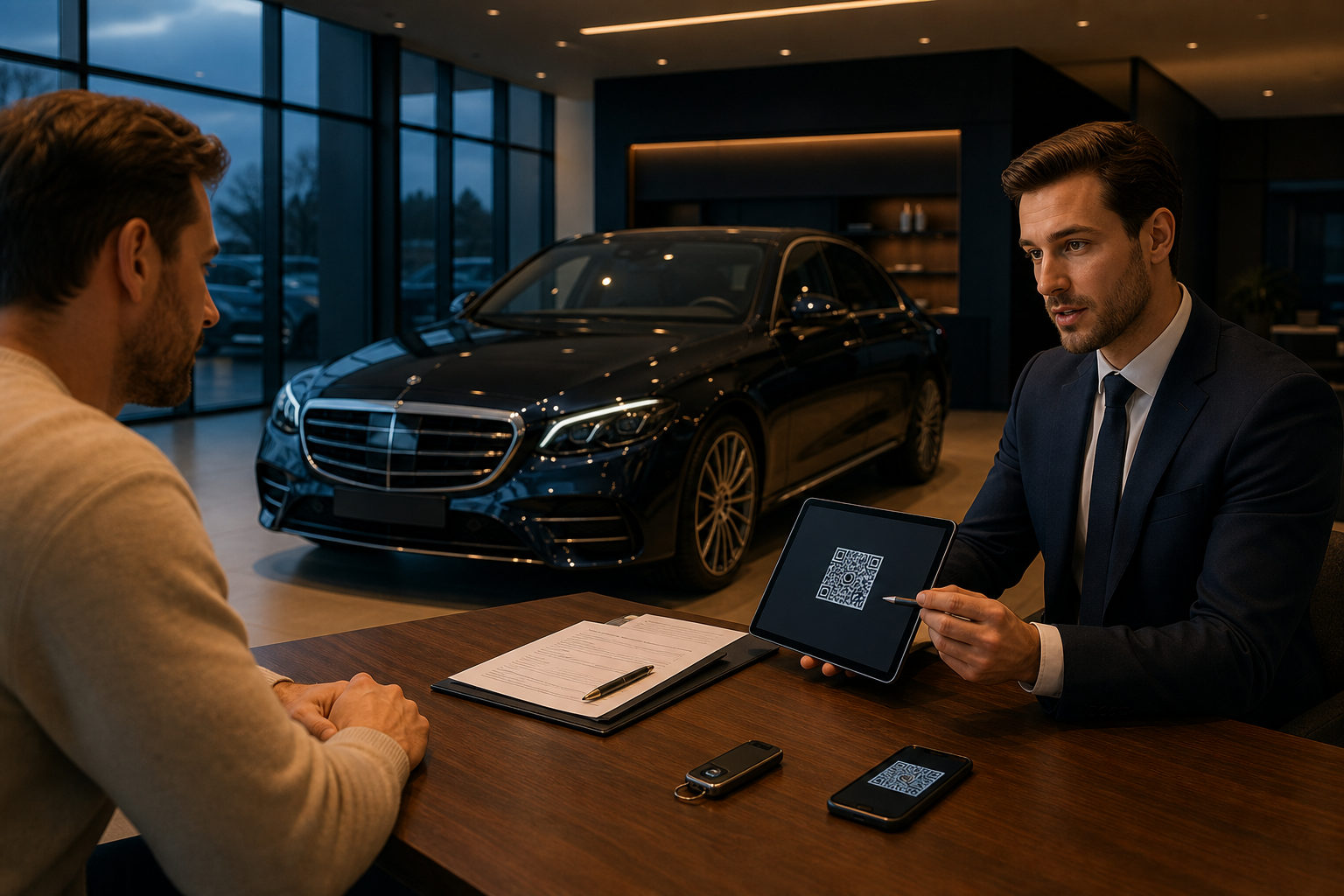
Does Mercedes accept Bitcoin? Sometimes a dealer may allow it, but the practical answer depends on the specific dealership, the payment structure, and the written terms behind the sale.
Start by separating the brand from the seller
Many buyers ask this question as if a global car brand and a local dealership were the same legal and commercial entity. In a real purchase, the party that decides whether Bitcoin is accepted is usually the dealership, the sales company behind it, or a payment processor working with that seller.
That distinction matters because “accepting Bitcoin” can mean very different things. A dealer might receive BTC directly. A dealer might use a third party that converts BTC into dollars before the merchant is paid. A dealer might also accept crypto only for a reservation payment while requiring the rest of the balance through a conventional method.
Those are not small differences. They affect who holds the price risk, what counts as successful payment, how refunds are handled, and what documents you receive. If you skip this first step, you can easily assume more flexibility than the dealer is actually offering.
There is another reason to slow down here. Marketing language can be broad, while purchase terms are narrow. A store may advertise crypto payments but limit them to certain vehicles, certain locations, or certain transaction types. That is why screenshots, short posts, and sales claims are not enough on their own.
A step-by-step way to verify whether you can pay with Bitcoin
Step one: identify the exact receiving party
Your first move should be simple and direct. Ask who is issuing the sales contract, whose account or wallet will receive the funds, and which entity will issue the invoice or receipt. Do not stop at “Do you take Bitcoin?” Ask who gets paid in legal and operational terms.
The reason is straightforward. If the receiving party is unclear, you cannot tell whether you are paying a real business that is selling you a vehicle or sending BTC to an individual wallet with no reliable paper trail. In a large purchase, that difference is huge.
Be careful if a salesperson sends only a wallet address through a chat app and avoids giving company details, formal order documents, or written payment instructions. A car purchase should not depend on informal messages alone.
Step two: ask whether BTC is received directly or converted into dollars
Next, ask how the payment actually works. Does the seller receive Bitcoin directly, or does a payment service take your BTC and settle the merchant in dollars? Then ask whether the contract price is written in dollars and converted at payment time, or written in BTC from the start.
This step matters because the purchase is about more than moving coins on-chain. It is about how the deal is priced and how disputes are resolved. When the vehicle is priced in dollars and BTC is used as the payment rail, there is usually less room for confusion. When the transaction is framed in BTC terms, refunds and changes to the order can become harder to interpret.
One caution here: “we accept crypto” does not always mean the dealer wants to hold Bitcoin. It may only mean the seller is willing to let a payment provider handle conversion. That is not automatically a red flag, but you need to know it before paying.
Step three: get the pricing and timing rules in writing
Before sending anything, ask the seller to confirm the order amount, the exchange-rate reference point, the payment deadline, the required network confirmations, and the rule if the transfer arrives late. Those points should appear in the order documents, written terms, or formal email correspondence.
The reason is simple. Bitcoin moves in price, and network confirmation is not instant in every situation. You may think payment is complete once the transfer is broadcast. The seller may say payment is complete only after enough confirmations. You may think the quoted amount still applies. The seller may say the rate expired.
Without a written standard, both sides can end up using different assumptions. That is exactly the kind of avoidable conflict you want to remove before a large payment.
Step four: ask about identity checks and source-of-funds requests
Ask early whether the dealership will require identification, address details, source-of-funds explanations, or extra compliance review. It is better to know this before payment than to discover it after BTC has already been sent.
There is a practical reason for that. A vehicle is a high-value purchase, and sellers often treat high-value payments with extra caution. A dealer may be open to Bitcoin while still requiring standard customer verification. Those two things are not contradictory.
In fact, the opposite can be a warning sign. If a seller asks no questions at all, wants no order details confirmed, and pushes only for immediate transfer, that is not a sign of convenience. It may be a sign that the process is not properly controlled.
Step five: settle refund and cancellation rules before payment
Ask what happens if you cancel the order, if the seller cannot deliver the vehicle, or if the configuration changes. Ask whether any refund would be sent in BTC, in dollars, or under a store policy tied to the order value. Then ask for that answer in writing.
This is one of the most important parts of the whole process. Accepting Bitcoin is one thing. Refunding a Bitcoin-based transaction is another. A seller may be willing to receive BTC yet choose to refund in dollar terms. A seller may also define a separate rule for deposits, reservation fees, and final payment.
If those points are left vague, you could end up arguing about the most sensitive part of the transaction after the money has already moved. That is the wrong moment to discover there was no shared understanding.
Fraud risks to watch before trying to buy a Mercedes with Bitcoin
Watch for fake dealer payment instructions
One of the most common risks is an impersonation attempt. A scammer may pose as a salesperson, finance employee, or assistant and send a wallet address at the last moment, often with urgency attached. Because blockchain transfers are generally irreversible, one wrong transfer can be enough to create a serious loss.
A safer approach is to verify payment details through at least two independent channels. For example, ask for the same payment instructions through formal order paperwork, a company email address, and a phone confirmation with the dealership. If the details do not match exactly, stop and verify again.
Do not rely on a screenshot or a forwarded message. In a vehicle purchase, payment instructions should hold up under scrutiny.
Watch for pressure to send a reservation payment immediately
Another common tactic is urgency. A buyer is told that inventory is disappearing, that the vehicle will be sold to someone else, or that a BTC transfer must be made right away to hold the car. Pressure changes judgment, and scammers know that.
The correct order is the reverse. First confirm the order, the receiving entity, the refund terms, and the exact payment path. Only then should you consider sending funds. If a seller becomes irritated when you ask for standard purchase documents, that alone is useful information.
Watch for a deal centered on the transfer rather than the vehicle
If the conversation focuses almost entirely on when you will send BTC while the seller avoids finalizing the vehicle details, delivery conditions, and buyer information, the structure of the deal is weak. You are not buying a blockchain transaction. You are buying a car.
That means the paperwork has to define the model, the configuration, the payment method, the delivery terms, and the conditions for cancellation or change. On-chain proof shows that coins were transferred. It does not by itself prove what the other side was obligated to deliver.
Watch for middlemen who want to “help” by taking your BTC first
Some people may suggest an indirect route. They ask you to send Bitcoin to them, and they claim they will settle with the dealer on your behalf. The pitch may sound convenient, fast, or flexible. In reality, it inserts another point of failure into an already sensitive transaction.
Unless you fully understand every contractual relationship, every receipt, and every line of responsibility, there is little reason to accept that extra layer. Fewer participants usually means fewer chances for confusion and fraud.
If a dealer says yes, here is the safer way to proceed
Step one: obtain a full order draft before any transfer
Get the purchase documents first. Review who is selling the vehicle, how the vehicle is described, how the amount is stated, what the payment terms say, and what the delivery conditions are. This is the foundation of the transaction.
The reason is obvious once you think about it. A car purchase is a package of promises, not a single payment event. If the deal terms are not stable on paper, sending BTC only increases your exposure.
Pay attention to vague wording such as “to be confirmed later” or “subject to change at pickup.” The more open-ended the terms are, the less suitable the transaction is for an irreversible payment method.
Step two: a test transfer is a technical check, not a substitute for documentation
If the seller permits it, a small test transfer can reduce the risk of using the wrong address. It confirms that the destination is correct and that the recipient can identify the payment flow.
Still, do not confuse a successful test with a secure transaction. A correct wallet address does not fix a weak contract, unclear refund rules, or missing identity checks. It only confirms one technical point.
Step three: keep a complete record of the transaction
Save more than the transaction hash. Keep the order documents, formal emails, payment instructions, dealership identity details, confirmations of receipt, and any written promises about delivery and refunds. Organize them while the transaction is happening, not later.
This matters because a BTC transfer on its own does not explain purpose. The legal and factual meaning of the transfer comes from its connection to the sale documents. If a dispute appears, that connection becomes central.
Step four: check delivery details again before handover
Even after the payment issue is settled, review the vehicle details one more time before delivery. Confirm the vehicle identification details, configuration, add-ons, pickup timing, and all related paperwork. Do not assume that “payment complete” means “everything else is settled.”
That extra check is especially useful when the payment method is unusual. The more customized the payment flow is, the more important it is to verify that the delivery side remains precise and unchanged.
If the seller starts changing key terms after payment, stop and ask for written clarification before moving ahead. Silence and assumptions help the wrong party.
FAQ
Does Mercedes officially accept Bitcoin everywhere?
No single answer covers every location or seller. What matters in practice is whether the specific dealership or sales entity handling your order accepts Bitcoin, and under what terms.
Always verify the actual contract and payment instructions. Brand recognition is not the same as a confirmed payment option.
What should I ask first if I want to buy a Mercedes with BTC?
Start with the receiving entity, the contract issuer, and the refund rules. If those points are unclear, everything else comes second.
Large purchases should begin with legal and operational clarity, not with wallet logistics.
If a dealer says it accepts crypto, does that always mean direct BTC payment?
No. In some cases, “accepts crypto” means a processor takes your BTC and settles the dealer in dollars. The dealer may never hold Bitcoin directly.
That model can still work, but you need to know how the contract is priced, how timing is handled, and what happens if a refund is needed.
Why are refund terms so important in a Bitcoin car purchase?
Because receiving BTC and refunding a transaction are not always treated the same way. A seller may receive payment one way and return value another way, especially if the order changes or is canceled.
If that rule is not set before payment, you may be left arguing over the most important issue after the transfer is already final.
Is payment complete as soon as the BTC transfer appears on-chain?
Not always. A seller may require a certain confirmation threshold, or may tie acceptance to a pricing window that expires after a set time.
What counts as completion should be defined in writing before you send funds. Do not assume your standard is the seller’s standard.
Use this final checklist before sending any Bitcoin
Verify the dealership identity first, review the purchase documents second, confirm the payment path and pricing rules third, then check identity requirements and refund terms before you send any BTC. If any part stays vague, pause the purchase. The main question is not whether Mercedes accepts Bitcoin in theory; it is whether your specific seller can document the payment, the vehicle, and the refund process clearly enough to make the transaction safe.
Disclaimer: This article is for informational and educational purposes only and is not investment, financial, or legal advice. Crypto assets are highly volatile and you could lose your entire investment. Do your own research and decide carefully.