
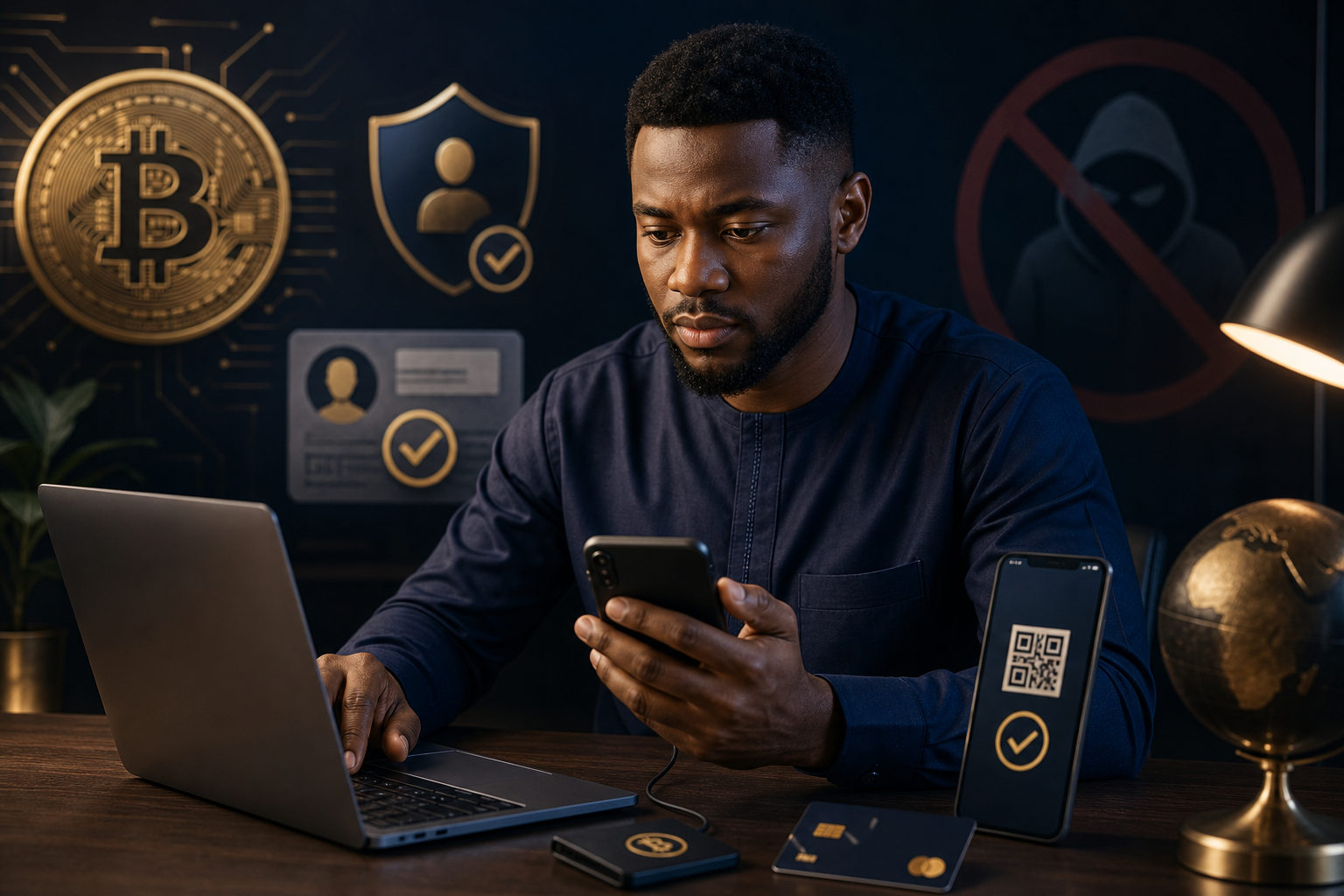
The short version: in 2026, buying bitcoin in Nigeria means opening an account with an exchange operating under the Securities and Exchange Commission's (SEC) regulatory framework — Quidax and Busha are the two that have publicly confirmed provisional or full approval — funding it with naira through a bank transfer or a local fintech app like Opay, Kuda, or Moniepoint, completing BVN and NIN verification, and then buying bitcoin directly against your naira balance. If you go the peer-to-peer route instead, everything needs to happen inside the platform's order system, because a P2P deal gone wrong in Nigeria doesn't just cost you money — it can get your entire bank account frozen by the EFCC. None of this is generic advice copied from a US or European guide. Nigeria's rules, payment rails, and scam patterns are specific enough that treating this like any other country will get you into trouble.
What actually changed in Nigeria's crypto rules by 2026
A lot of guides still describe Nigeria as a place where crypto is effectively banned. That hasn't been accurate for a while. The Central Bank of Nigeria (CBN) did bar banks from servicing crypto businesses back in February 2021, but it reversed that stance with a circular dated December 22, 2023 — the "Guidelines on the Operation of Bank Accounts for Virtual Asset Service Providers." Banks are now allowed to open accounts for exchanges that hold SEC registration or approval, as long as they run enhanced KYC, monitor the flow of funds, and get senior management sign-off before opening the account. Banks still can't deal in crypto themselves, but they can bank the companies that do.
Then came the Investments and Securities Act 2025 (ISA 2025), which took effect in March 2025 and, for the first time, classified virtual assets like bitcoin as securities under Nigerian law. That put exchanges, digital asset exchanges (DAX), and digital asset operators (DAOP) squarely under SEC oversight. The SEC had already launched its Accelerated Regulatory Incubation Programme (ARIP) in June 2024 to fast-track licensing, and Quidax, Busha, Yellow Card, Bitnob, and Borderlesspay are among the companies that applied. As of the information available in mid-2026, Quidax and Busha have both received Approval-in-Principle from the SEC, and several reports indicate Quidax has since received a provisional (Approval-in-Principle) Digital Assets Exchange license, making it the first SEC-approved exchange in Nigeria.
Here's the part that trips people up: in February 2024, the Nigerian Communications Commission (NCC) directed local internet service providers to block access to Binance, Coinbase, OKX, Kraken, Luno, and Bybit's websites, citing concerns about foreign exchange manipulation. That block was reportedly still in place as of late 2025. So you end up with a strange split — crypto ownership and trading is legal, locally licensed exchanges are accessible and can bank normally, but several of the biggest global platforms are simply unreachable from a Nigerian internet connection without a VPN or their mobile app. Those are two separate policy tracks, and conflating them is where a lot of outdated advice comes from.
Step one: pick your channel — licensed local exchange, P2P, or a blocked global platform
What your options actually look like
Practically speaking, Nigerian buyers in 2026 have three lanes. The first is local, SEC-track exchanges — Quidax, Busha, Yellow Card (which operates across several African countries), Luno, and Roqqu — that let you deposit naira by direct bank transfer and buy bitcoin against it. The second is peer-to-peer trading through a larger platform's built-in P2P desk; Bybit's P2P section became a common landing spot for Nigerian traders after Binance pulled its naira services, and it settles through the banks and fintech apps people actually use — GTBank, Access Bank, Opay, Kuda, Moniepoint. The third is a platform like Binance itself, which still works for crypto-to-crypto trading and withdrawals to an external wallet, but no longer touches naira at all, and whose main site sits behind the NCC's block list.
Why Binance dropped out of the naira picture
This wasn't a quiet policy tweak. On February 20, 2024, Binance suddenly suspended all naira P2P trading. The next day, the NCC ordered telecom providers to block the platform. On February 28, two Binance executives — Tigran Gambaryan and Nadeem Anjarwalla — were detained in Nigeria on money laundering and tax evasion allegations. By March, Binance had shut down naira deposits, withdrawals, and P2P entirely, forcibly converting users' remaining naira balances into USDT. If you've read older guides that casually mention "just use Binance P2P for naira," that instruction is out of date and hasn't worked since early 2024.
Things to watch for
- Don't assume a well-known international exchange supports naira just because it's popular elsewhere — check its own help center for current status, because these rules keep shifting.
- Before trusting a local exchange, look for confirmation that it's part of the SEC's ARIP list or holds Approval-in-Principle or a full license. This is usually stated on the exchange's own site or in SEC announcements.
- If you use a P2P desk, stick to the one built into a major platform rather than a "private FX deal" someone messaged you on WhatsApp or Telegram.
Comparing the main options for Nigerian buyers
| Platform | Regulatory status | Naira funding | Blocked by local ISPs? | Good fit for |
|---|---|---|---|---|
| Quidax | SEC Approval-in-Principle; multiple reports say it has advanced to a provisional Digital Assets Exchange license, the first SEC-approved exchange in Nigeria | Direct bank transfer | No | Buyers who want a locally regulated, transparent on-ramp |
| Busha | SEC Approval-in-Principle | Direct bank transfer | No | First-timers who want a simple interface |
| Yellow Card | Pan-African exchange, ARIP applicant | Bank transfer / local payment methods | No | Users who also need coverage in other African countries |
| Bybit (P2P desk) | International platform, not SEC-licensed in Nigeria | P2P settlement via GTBank, Access Bank, Opay, Kuda, Moniepoint | Yes — main site is on the NCC block list, needs app or workaround | Buyers with some experience who understand P2P risk |
| Binance | International platform, not SEC-licensed in Nigeria | Naira deposits, withdrawals, and P2P all discontinued since March 2024 | Yes | Users who already hold USDT elsewhere and only need crypto-to-crypto trading |
This snapshot is based on public reporting current as of mid-2026. Licensing status, block lists, and supported payment rails change as the regulatory situation develops, so confirm current details with the SEC, CBN, NCC, and each platform's own help center before you rely on any of it.
Step two: get your verification documents in order — BVN, NIN, and a valid ID
What to prepare
Locally licensed exchanges in Nigeria generally ask for your Bank Verification Number (BVN) and National Identification Number (NIN), plus a government-issued ID — a national ID card, international passport, or driver's license — and a selfie or liveness check to complete KYC. Reporting from 2026 also notes that, in some cases, exchanges may additionally request a Tax Identification Number (TIN) alongside NIN as part of onboarding.
Why this step matters more than it looks
BVN and NIN are the two numbers that tie Nigeria's banking system to its national identity system. Exchanges use them to confirm you're a real person and to satisfy anti-money-laundering obligations, but they're also what makes your naira deposits and withdrawals match up cleanly with your actual bank account. Get this step wrong or rushed, and you're looking at delayed deposits at best, a frozen account under compliance review at worst.
A few things worth being careful about
- Only submit your BVN and NIN through the exchange's own official app or website — never through a form sent by "support" over DM or a third-party link.
- Double-check the domain name and the app store listing's developer details match the real exchange before you type in anything sensitive.
- No legitimate platform's support team will ask you to hand over your full ID numbers through a private chat. If someone asks, that's your cue to stop.
Step three: fund your account with naira — bank transfer, Opay, Kuda, Moniepoint
How it works in practice
Most local exchanges accept direct naira bank transfers, and several have also plugged into the fintech apps Nigerians actually carry day to day — Opay, Kuda, Moniepoint, PalmPay. Take Quidax and Busha as examples: both are generally reported to sit on the lower end for fees, but the specific figures — whether bank transfer deposits carry a fee, the exact spot trading rate — vary across sources and remain unsettled. Treat any specific number as unconfirmed and check the official fee page or the live rate shown in your own account before you rely on it.
Why the payment path deserves a test run first
Nigeria's instant bank transfer rails (built on the NIBSS instant payment network) are generally fast and reliable, but bank maintenance windows, interbank transfers, and holiday periods can still cause delays. Running a small deposit through the full cycle — funding, order execution, checking your balance — tells you whether this particular exchange plays nicely with your specific bank or fintech app before you commit anything larger.
Practical notes
- Use exactly the deposit account details and reference the platform generates for you — don't improvise or edit them.
- If you're transferring from Opay, Kuda, or a similar app, confirm the receiving account name matches exactly what the exchange displays in your dashboard.
- Keep a copy of every transfer receipt and the exchange's confirmation screen. If a dispute ever comes up, this is what you'll need.
Step four: buy a small amount first and confirm everything lands correctly
Whichever channel you pick, run your first trade with an amount you wouldn't mind losing. Watch whether the deposit clears cleanly, whether your bitcoin balance shows up correctly on the assets page, how long the order takes to fill, and whether withdrawing feels straightforward. If you're trading P2P, a small first order is also how you learn the platform's dispute process, its release conditions, and how quickly support actually responds — information that's only useful once you've seen it in action, not read about it.
Step five: make sure you're buying spot bitcoin, not something else
Both local exchanges and the bigger international apps tend to bundle spot trading, futures, margin, savings, and copy-trading into the same interface. Before you confirm an order, check that the trading pair reads something like BTC/NGN or BTC/USDT on a spot screen, not a page with leverage sliders or margin terminology. If you don't already understand how leverage or futures contracts work, there's no upside to clicking into that section just because the app made it look impressive.
Step six: hold it on the exchange or move it to your own wallet
If you're only testing the process short-term, leaving your bitcoin on the exchange with two-factor authentication switched on is a reasonable choice. If you're planning to hold for the medium or long term, moving it to a wallet you control — a hardware wallet or a well-reviewed software wallet — is usually the safer path, because it reduces how much you're relying on any single exchange staying solvent and compliant. That matters more in Nigeria right now than in a market with a settled regulatory framework, given how fast the rules around exchanges have been moving. Whatever you choose, test with a small withdrawal first, double-check the network type and destination address, and only move larger amounts once that first transfer has confirmed successfully.
Step seven: the risk that's specific to Nigeria — EFCC account freezes and P2P scams
There's one risk that shows up in Nigeria far more than in most other markets, and it deserves its own section rather than a bullet point. If you sell bitcoin peer-to-peer and the buyer pays you with funds that turn out to be stolen or fraudulently obtained, Nigeria's Economic and Financial Crimes Commission (EFCC) has the authority to place a freeze on your bank account — and not just the amount tied to that trade. The whole account can get locked, sometimes for weeks or months, even though you did nothing wrong beyond accepting a payment that looked legitimate at the time. Local reporting on Q3 2024 data found that 78% of the problematic transactions flagged by the EFCC traced back to unregulated P2P trades. That single statistic explains why so much Nigeria-specific crypto advice pushes people toward regulated channels instead of "whoever offers the best rate on Twitter."
The common scam patterns worth knowing by name: a buyer sends you a doctored screenshot claiming payment went through and pressures you to release the bitcoin before you've actually checked your balance; a buyer pays, receives the coins, then files a chargeback or reversal with their bank to claw the naira back after the fact; or a buyer pays you with funds from a hacked or fraudulent account, and you only find out when your own bank flags the deposit weeks later. None of these require anything exotic to defend against — they just require you to follow a few rules without exception.
- Only send and receive payment through the platform's order system. A request to "move this to WhatsApp" is a request to strip away the evidence trail you'd need for a dispute.
- Confirm the money actually landed — don't trust a screenshot. Open your own banking or Opay/Kuda app, see the balance change yourself, and only then release the bitcoin.
- Check that the payer's name matches the counterparty registered on the trade. If the sender's name doesn't match, pause the trade and escalate through the platform's dispute channel instead of trusting reassurance from the other side.
- Never agree to "release now, I'll send proof after." Urgency is one of the most reliable tells in this specific type of scam.
Taxes: what the 2026 rules mean for your bitcoin gains
Under guidelines the Nigeria Revenue Service (NRS) issued in 2026 — built on the Nigeria Tax Act 2025 and the Nigeria Tax Administration Act 2025 — profits an individual makes from disposing of virtual assets, bitcoin included, are now treated as chargeable gains. Multiple financial outlets reported the applicable rate can run as high as 25%, replacing the flat 10% capital gains rate that had applied under the Finance Act 2023. Separately, licensed VASPs (the exchanges themselves) now face a 30% corporate tax on income from their operations, mainly transaction fees, and are expected to report user transaction data to the NRS — failing to do so reportedly carries penalties starting at ₦10,000,000 for the first month and ₦1,000,000 for every month after that. These rules are still fairly new as of 2026, and the fine print — exemption thresholds, exactly how individual filings work, what counts as a disposal versus a transfer — is the kind of thing that's worth confirming directly with the NRS or a licensed Nigerian tax advisor rather than relying on secondhand summaries, this one included.
Timing your purchase without chasing headlines
Bitcoin's price moves on global supply and demand, sentiment, liquidity, and expectations around policy — all of which can swing hard over a short window. Nigerian buyers have an extra variable layered on top: the naira's own exchange rate. Sharp naira devaluations in recent years have been a real driver of crypto adoption here, as people look for a hedge against inflation and a currency that keeps losing value. That's part of why Nigeria ranked #2 on Chainalysis's Global Crypto Adoption Index back in 2023 (behind India), and why it still ranked sixth globally — and near the top of Sub-Saharan Africa — in the 2025 edition of that same report. None of that means buying bitcoin is a guaranteed way to beat inflation. It means the pressure pushing people toward crypto here is real and well documented, not hype. Spreading purchases out over time, sizing positions you can actually afford to hold through a drawdown, and staying away from borrowed money remain the more reliable habits, regardless of what the naira does next.
Frequently asked questions
Is Binance banned in Nigeria?
Not banned outright, but the situation is genuinely mixed. Binance shut down all naira services — deposits, withdrawals, and naira P2P — starting in March 2024, and its website has been on the NCC's block list since February 2024, meaning you'd need a VPN or the mobile app to reach it from a Nigerian connection. If you already hold USDT or other crypto, you can still trade crypto-to-crypto and withdraw to an external wallet, but it's no longer a workable starting point for turning naira into bitcoin.
Is P2P bitcoin trading legal in Nigeria?
Individual-to-individual crypto trading hasn't been outlawed, and simply owning or trading crypto isn't illegal for ordinary Nigerians. What the government restricts is how banks can service crypto businesses, and it requires exchanges to hold SEC licensing. That said, the financial risk in P2P — specifically the chance of your bank account getting frozen by the EFCC over funds a buyer paid you that turn out to be tainted — is very real. Using a P2P desk built into a licensed, major platform and staying strictly inside its order system is meaningfully safer than arranging a private deal with a stranger online.
Do I need to pay tax on bitcoin profits in Nigeria?
Based on the virtual asset tax guidelines the NRS issued in 2026, profits from selling bitcoin or other virtual assets are treated as chargeable gains, with reporting suggesting a top rate as high as 25%, up from the previous 10% capital gains rate. The exact filing process and thresholds are still settling, so check the NRS's own guidance or talk to a licensed Nigerian tax advisor rather than assuming the rules are identical to what applied a year or two ago.
Which platform is safest for a Nigerian beginner?
There's no single right answer, but the general logic holds up: lean toward local exchanges that have Approval-in-Principle or a full license under the SEC's framework — Quidax and Busha both fit that description as of mid-2026 — since they support direct naira bank transfers and operate with more visible oversight. If P2P is unavoidable, use the desk built into a major platform rather than a private arrangement, and treat verified, on-screen bank balance confirmation as non-negotiable before releasing any coins.
Can my bank freeze my account just for buying bitcoin?
Not simply for trading on a licensed exchange — the CBN's December 2023 circular specifically opened the door for banks to service SEC-approved VASPs. The freeze risk comes from a different direction: if you receive P2P payment tied to fraud or theft, the EFCC can freeze the account as part of a criminal investigation, which has nothing to do with your bank's own policy toward crypto. That's exactly why sticking to platform order systems and verifying who you're actually receiving money from matters as much as it does.
Build your checklist before you go looking for another platform
Lock in these basics now: pick a locally SEC-approved exchange or a major platform's built-in P2P desk, gather your BVN, NIN, and valid ID ahead of time, turn on two-factor authentication, run your first deposit and purchase as a small test, understand how you'd move funds to a personal wallet if you decide to hold long-term, treat "order system only, verified balance only" as a hard rule for any P2P trade, and leave yourself room to handle the new tax obligations properly. What actually protects you here isn't memorizing which exchange to use this month — it's a set of habits that keeps working even as Nigeria's rules keep shifting under it.
Disclaimer: This article is for general information and educational purposes only and does not constitute investment, financial, legal, or tax advice. Cryptocurrency prices are highly volatile, and Nigeria's regulatory rules, tax policies, and platform availability continue to change quickly; you could lose your entire investment. Confirm current requirements with official sources — the SEC, CBN, NCC, and NRS — and do your own research based on your personal circumstances before making any decisions.