
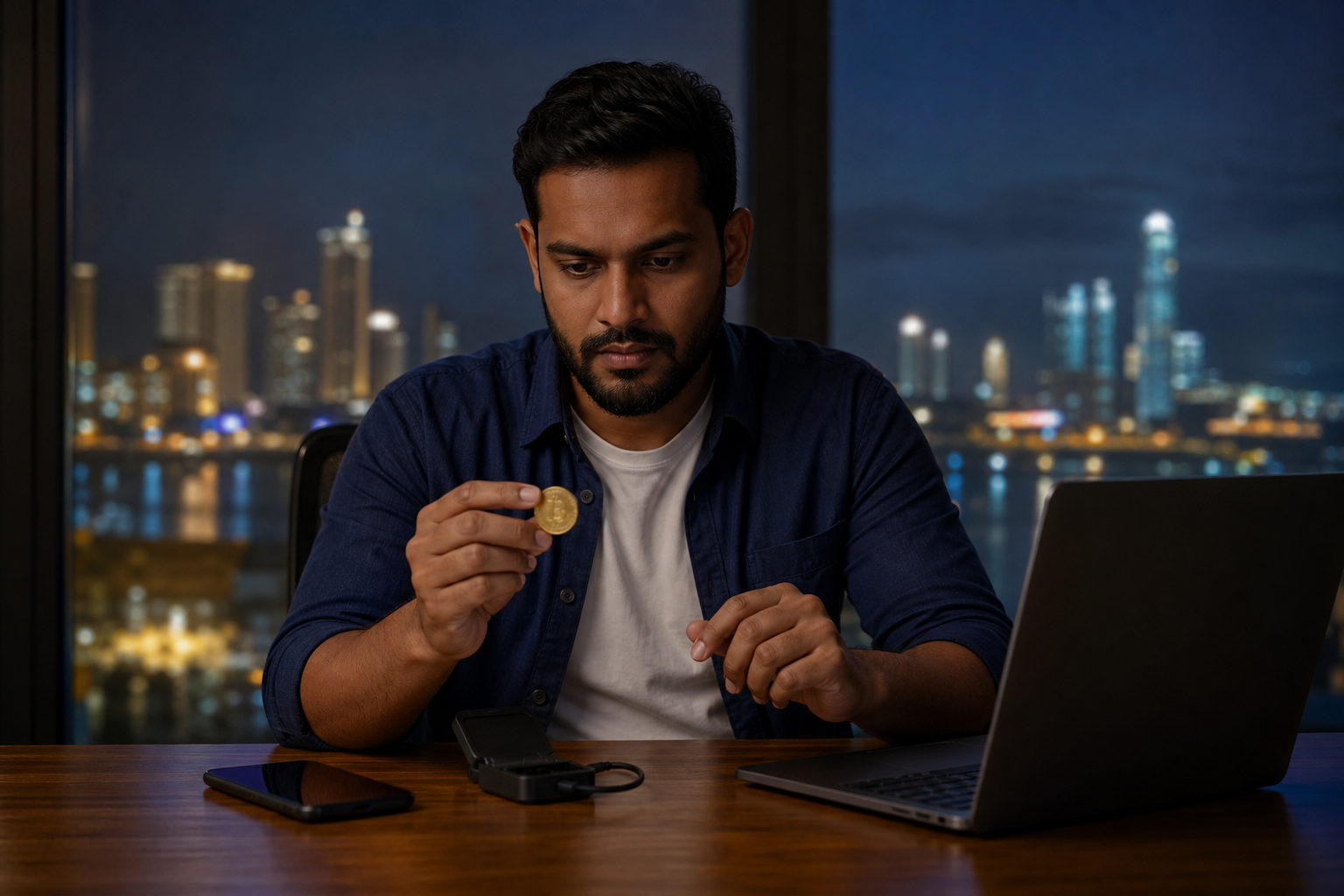
If you're trying to buy bitcoin in Sri Lanka, the honest short answer is this: there's no licensed local exchange, so the practical route almost everyone ends up using is a global platform's peer-to-peer market, funded through an LKR bank transfer, with a self-custody wallet ready before you buy anything sizable. Get the regulatory picture straight first, then pick a route, then test small. Skipping straight to "which app has the best rate" is how people end up with a frozen bank account or an empty wallet.
Start with what Sri Lanka's regulator actually says, not with rumors
The Central Bank of Sri Lanka (CBSL) has been fairly consistent on two points, even though the wider legal picture is still unsettled. First, the Sri Lankan rupee is the only legal tender in the country, and cryptocurrency has no legal tender status and cannot be used for everyday payments. Second, the CBSL has never licensed or authorized any business to run a crypto exchange, mining operation, custody service, or advisory service inside Sri Lanka. At the same time, CBSL Governor Dr. Nandalal Weerasinghe has said publicly that investing in cryptocurrency personally carries "no legal impediment." Put those two statements together and you get the real picture: owning and trading bitcoin isn't illegal for an individual, but the activity sits in a space with no dedicated law, no licensing regime, and no consumer protection fund behind it if something goes wrong.
The part that trips people up in practice is the banking side. Banks in Sri Lanka are barred from processing crypto-related transactions and card payments, and in real life several banks flag accounts that show repeated transfers tied to P2P traders or exchange-linked activity, sometimes freezing them and asking the account holder to explain where the money came from. This isn't internet folklore — it's a pattern that local users and reporters have documented repeatedly over the past couple of years. So the buying itself may not be against the law, but how you move the money can absolutely create a headache with your bank.
One more thing worth clearing up: a claim circulated online that Sri Lanka had banned Binance and Bybit outright. Local fact-checking outlet Fact Crescendo Sri Lanka looked into it and found the story conflated a separate crackdown on illegal betting sites with crypto platforms — the two exchanges were not part of that action and remain reachable from Sri Lanka. That doesn't mean they're regulated locally; it just means the "ban" story was false.
Regulation is moving, but it hasn't arrived yet — know which stage you're in
Sri Lanka isn't ignoring crypto, it's mid-transition from "no rules at all" to "some rules, eventually." In March 2026, the Financial Intelligence Unit (FIU), which operates under the central bank, launched a mandatory survey of virtual asset service providers (VASPs) operating in the country — essentially the government's first organized attempt to figure out who is actually doing this business locally. Separately, the Cabinet has backed, in principle, a legal framework for regulating VASPs, with the Securities and Exchange Commission of Sri Lanka positioned to lead supervision alongside the central bank, the FIU, and the Inland Revenue Department. A sub-committee working under the Deputy Minister for the Digital Economy is handling the technical drafting. On top of that, there are proposed amendments to the Financial Transactions Reporting Act (FTRA) that would require VASPs to register with the FIU and share transaction data — a move aimed at anti-money-laundering compliance, not at protecting individual investors' money.
None of this is finished law yet. If you come across a platform claiming to be "Sri Lanka's first licensed crypto exchange" or anything similar, treat that claim with real skepticism — as of now, the central bank hasn't issued any such license, so a claim like that is either premature marketing or outright false.
Without a licensed local exchange, here's what people actually use
Because there's no domestically licensed exchange, the route most Sri Lankan buyers use is the peer-to-peer marketplace built into global platforms like Binance or Bybit. You place an order in rupees, a counterparty (an individual trader or a market maker) receives your bank transfer, and once they confirm receipt they release the coins — usually a stablecoin like USDT first, which you then swap for bitcoin on the same platform's spot market. The bank transfer itself typically rides on LankaPay's CEFTS network, the real-time interbank clearing system that lets any member bank send funds to any other member bank around the clock. It's the cheapest and most common way funds move for this purpose right now.
A second, riskier path is the informal "broker" or "I'll buy it for you" arrangement that circulates on social media and messaging groups, promising a better price or faster settlement. The catch is that this usually means sending money straight to someone's personal account, completely outside any platform's order system. If that person disappears with your money, you have no order record and no reliable way to prove what the payment was for — this isn't a scare tactic, it's simply how these arrangements are structured to fail in your favor of nobody but the other side. Buying directly with an international card is technically possible on some platforms too, but Sri Lankan banks' restrictions on crypto-related card transactions make success inconsistent, and you'll typically need to ask your card issuer to enable international or foreign-currency transactions first — whether they allow it, and what the limit is, varies bank by bank, so confirm before you try to check out.
| Route | Speed | Cost | Risk of a bank flag/freeze | Recourse if something goes wrong |
|---|---|---|---|---|
| Global exchange P2P + LKR bank transfer (CEFTS) | Usually minutes to a few hours, depending on the counterparty | Built into the buy/sell spread, plus small platform fees that vary by offer | Moderate — unusual transfer notes or high frequency can trigger a bank inquiry | Order stays inside the platform, with a dispute/appeal process, though the platform itself isn't regulated in Sri Lanka |
| P2P via stablecoin, then swap to BTC | Similar to above, plus one extra spot trade | An added spot-trading fee, but often a tighter spread than buying BTC directly in bulk | Similar to above | Also stays inside the platform's order records |
| Informal broker / "I'll buy it for you" | Feels fastest — promises instant turnaround | May look cheaper upfront, but there's no way to verify you weren't overcharged | Higher — large, frequent transfers to a personal account are more likely to get flagged | No platform order trail; disputes are extremely hard to prove |
| International credit/debit card | Instant in theory, often declined in practice | Usually a higher fee and may be treated as a cash advance by your bank | Requires the issuer to enable international transactions first, policy varies by bank | Subject to the card issuer's fraud and risk rules |
Taxes: yes, profits are taxable, and the rate is in flux
A lot of people assume that because crypto isn't formally regulated, profits from it are somehow tax-free. That's not the position the Inland Revenue Department (IRD) has taken. Under the Inland Revenue Act No. 24 of 2017, gains from disposing of a crypto asset — selling it or swapping it for something else — are subject to Capital Gains Tax (CGT), calculated as the disposal price minus your original acquisition cost. Note that the individual rate has since changed: a bill published in February 2026 to raise it from 10% to 15% was passed and certified as the Inland Revenue (Amendment) Act No. 11 of 2026 on June 3, 2026, so the current individual CGT rate is 15% — check the IRD's official guidance for the latest confirmation before you file.
If you trade often enough that it starts to look like a business rather than occasional investing, the IRD can instead classify your profits as "other income" and tax them at Sri Lanka's progressive personal income tax rates, which for the 2025/26 assessment year run roughly from 6% up to 36% depending on your total taxable income. One rule that catches people off guard: Sri Lanka's CGT framework doesn't let you net a loss on one disposal against a gain on another — each disposal is assessed on its own. That means a year with both winning and losing trades can leave you owing more tax than a simple "net profit" calculation would suggest. Because the rules are still being adjusted, it's worth talking to a locally licensed accountant or tax advisor before you file, rather than relying only on articles like this one.
Scams are the most realistic risk in this market right now
The central bank has repeatedly published notices naming specific crypto-branded schemes it considers illegal pyramid or investment fraud operations — entities named in official notices include Sport Chain App, Sports Chain ZS Society Sri Lanka, and a cluster of related MTFE-branded companies and groups. The warning attached to these names is consistent: none of them were ever authorized by the CBSL. The pattern behind most of these schemes is familiar — guaranteed high returns, payouts funded by newer participants' money, and a push to recruit more people, right up until the money runs out and the operators disappear. A simple filter that catches most of these: if something promises a fixed high return, asks you to recruit others, or claims central bank approval without a document you can actually verify, walk away.
A second, more everyday scam pattern targets people who are just trying to buy bitcoin normally. Someone reaches out on social media or a messaging app posing as "official support" or an "OTC agent," offering a better rate or faster settlement, and steers you toward sending money to a personal account or chatting outside the platform. Anything that asks you to pay first and "wait for confirmation" from someone you can't verify is a red flag. What you actually want is a verifiable, trackable order inside a real platform — not a promise typed into a chat window.
Lock down your account and set up a wallet before you place any order
Before signing up anywhere, set up an email address dedicated to crypto activity and use a strong, unique password — not one you've reused on social media or shopping accounts, since one leak elsewhere can cascade into your crypto account too. Once you're logged in, turn on two-factor authentication right away, and use an authenticator app rather than relying only on SMS, since SIM-swap fraud can defeat text-message codes.
Wallets are the next decision. Leaving bitcoin sitting on an exchange is convenient, but it also means the platform controls the asset, not you — and if that platform ever loses its banking rails in Sri Lanka, your funds could be affected too. A steadier approach is setting up a wallet where you hold the private keys yourself, confirming it supports the Bitcoin network before you fund it. When you create it, you'll be given a seed phrase or recovery information — write it down on paper, store it somewhere offline, and never screenshot it, message it to anyone, or save it in a cloud notes app.
Once the wallet's ready, get familiar with a few basics: what a deposit address actually is, why you need to double-check the network before withdrawing, and why arrivals can take a few minutes because of block confirmations — bitcoin blocks land roughly every ten minutes, and network congestion or a platform's own processing queue can add delay on top of that. Understanding this matters because scammers routinely exploit the anxiety of "why hasn't it arrived yet" to push people into repeat payments or fake support links.
Verify your identity, prepare your rupee payment method, then test small
Once you've picked a platform, go through its verification process carefully — make sure the documents you upload match your ID exactly and that photos are clear, since repeated rejections just mean submitting your personal information over and over. Before you enter any details, double-check the URL and app name to confirm you're on the genuine platform and not a lookalike — phishing sites are a real problem in markets like Sri Lanka that don't have an official local storefront to point to.
For payment, most people will send an LKR bank transfer over CEFTS to their P2P counterparty. Confirm the payment details inside the platform's chat before transferring, and avoid putting words like "BTC" or "crypto" in the transfer note, since that can trip a bank's automated flagging system — but don't lie about the purpose either, since that can violate your bank's own terms; if your bank does ask questions, just explain honestly where the funds went. If you're planning to use an international card instead, call your card issuer ahead of time to confirm international transactions are enabled and to check your limit — rules differ from bank to bank, and finding out at checkout that your card is blocked wastes time and can look suspicious to the platform too.
When you actually place your first order, keep it small — an amount you're fully comfortable losing while you're still learning the process. The point of a small test isn't just confirming you can buy successfully; it's checking that payment goes through as expected, the order record is clear, withdrawal works, and the coins actually land in your wallet. Putting your entire budget into a first-ever purchase is a good way to turn an unfamiliar process into a large mistake. If you're using P2P specifically, also check the counterparty's trade history and ratings, and keep every message inside the platform's chat — don't move to an outside messaging app, and don't agree to "I'll send first" or "pay outside the order system" arrangements, because once you're outside the order system, there's essentially nothing to point to if a dispute comes up.
What to do right after your first purchase
Don't stop at "balance shows success." Do three things immediately. First, check the trade record, the fee shown, and the amount that actually landed against what you expected, and save or screenshot that record — you'll want it later for tax filing or explaining the source of funds to your bank. Second, if you're planning to hold long-term, move part of that test purchase to your own wallet and confirm the address copied correctly, the confirmation arrived, and your backup actually works. Third, hold onto your transaction records and bank statements, since you may need them if your bank asks about the source of funds or when it's time to file taxes.
The most common mistake during withdrawal is address errors. Check the beginning and end of the address carefully after pasting it, and send a small test transfer first if the amount is meaningful. Malware on a computer or phone can silently swap a copied address for an attacker's address, so don't just glance at the middle of the string and hit send. If your wallet supports address whitelisting or a withdrawal delay, turning that on adds a real layer of protection against exactly this kind of mistake.
After that, decide how you want to store things going forward. Active traders might keep a modest balance on an exchange for convenience; long-term holders usually prioritize self-custody, partly because it separates their assets from any risk that a bank restricts that exchange's rupee transfers. Neither approach is universally right — what matters is that you understand the trade-off between control, convenience, and operational risk. If you can't clearly explain to yourself why your coins are sitting where they are, that's a sign you're not ready to move larger amounts yet.
Frequently asked questions
Is there an officially licensed crypto exchange in Sri Lanka?
No, not currently. The central bank hasn't issued a license for any crypto exchange, custody, or advisory business, so any platform claiming to be "locally licensed" should be treated with suspicion until you can verify it.
Can buying bitcoin through a bank transfer get my account frozen?
It's a real possibility. Banks are barred from processing crypto-related transactions, and some flag accounts with frequent transfers tied to P2P trading, asking for an explanation of the funds. It won't necessarily happen to everyone, but it's a documented risk — keep transfer notes neutral, keep frequency reasonable, and answer honestly if your bank asks.
How much tax will I owe on crypto profits?
Ordinary investment gains are currently taxed at a 15% capital gains rate, raised from 10% when the Inland Revenue (Amendment) Act No. 11 of 2026 took effect on June 3, 2026. If your trading looks more like a business, profits may instead be taxed as "other income" on a progressive scale roughly between 6% and 36%. Check with the IRD or a local tax advisor for your specific situation.
Is it true the central bank banned Binance and Bybit?
No — that claim was checked by a local fact-checking outlet and traced back to a separate crackdown on illegal betting sites. Both platforms remain accessible from Sri Lanka, though neither is licensed or regulated locally.
Someone offered to buy bitcoin for me at a better price — is that safe?
Treat it with real caution. These arrangements usually involve sending money directly to a personal account, outside any platform's order system, which means you can't verify who you're dealing with and have little to fall back on if things go wrong. Anything that asks you to skip the platform's order flow deserves extra scrutiny.
If I just want to hold long-term, what should I focus on after buying?
Shift your attention to custody, backups, and record-keeping — how your seed phrase is stored, whether your devices are secure, and how you'd recover access if something happened to your wallet. Keep a record of every transaction for tax purposes, rather than checking the price every day.
The bottom line: understand the actual rules the central bank and your bank operate under, choose a route that leaves you with a real, verifiable order record, and run through a small buy-and-withdraw test before you commit anything bigger. Once your account security, wallet backup, tax records, and withdrawal process all feel routine, that's the point to consider scaling up.
Disclaimer: This article is for informational and educational purposes only and does not constitute investment, financial, legal, or tax advice. Cryptocurrency prices are highly volatile and regulations can change without notice; you could lose your entire principal. Do your own research and consult a locally licensed professional advisor before making decisions.