
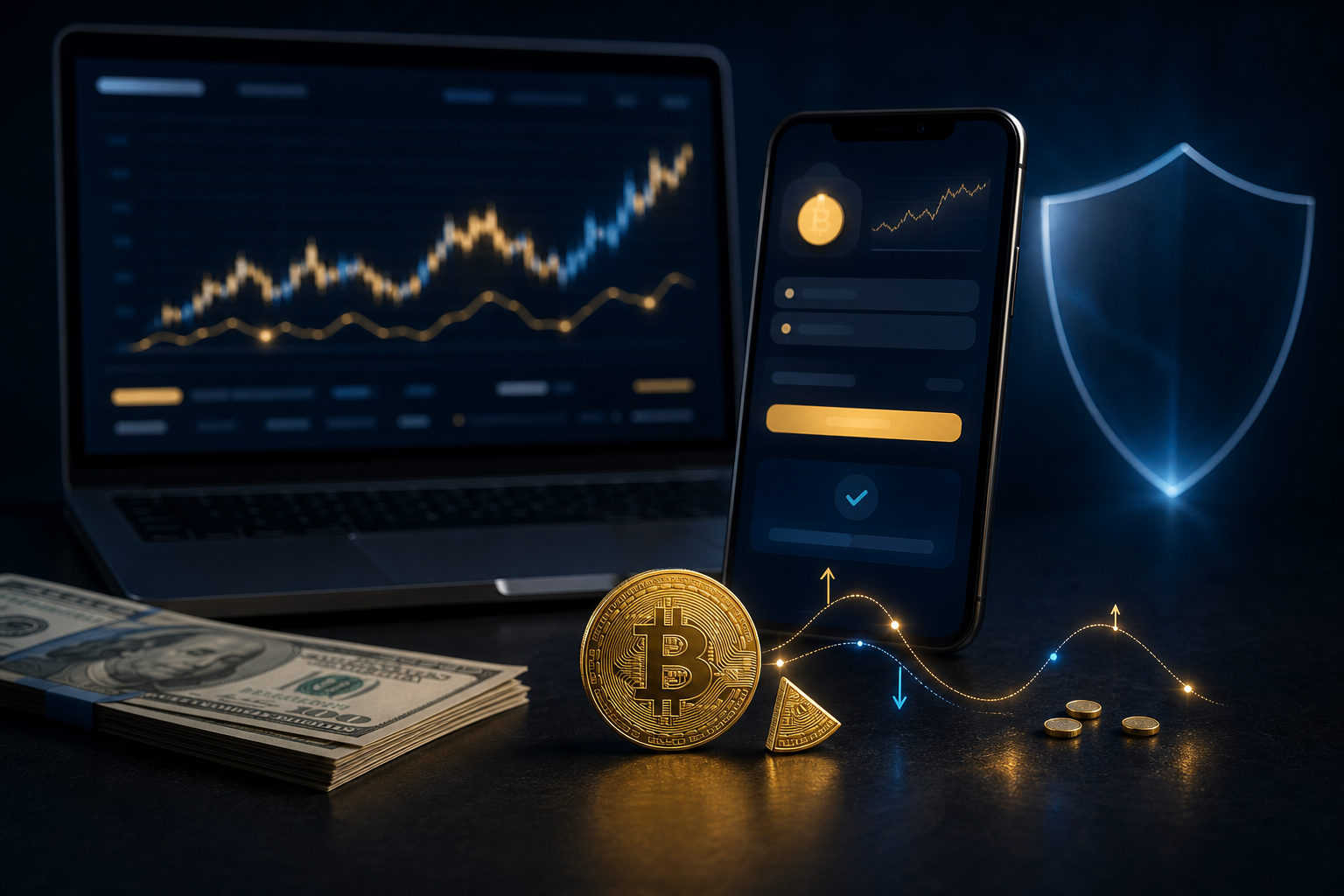
If you buy $20 in bitcoin, you usually receive a small fraction of BTC, then your position rises or falls with the market. The main effects are simple: fees matter more, price swings still apply, and basic security mistakes can cost more than the trade itself.
Step 1: Know what you are actually buying
The first thing that happens is not financial at all. You need to understand that a $20 purchase does not buy one full bitcoin; it buys a small portion of one. Bitcoin is divisible, and its smallest unit is the satoshi, with 1 satoshi equal to one hundred millionth of a BTC, so small purchases are normal.
This matters because beginners often get pushed into the wrong product. A common sales pitch starts with the idea that a whole coin feels out of reach, then redirects the buyer into something else: a leveraged contract, a packaged yield product, copy trading, or a token that only sounds related to bitcoin.
So before you click buy, confirm the product type. Are you buying spot bitcoin, which means actual BTC exposure, or are you only getting a price-linked claim inside an app? With a small amount, the difference is easy to ignore. That is exactly why it should not be ignored.
Step 2: Pick a buying method and read the rules first
Action
Choose the route you plan to use before funding anything. That could be a regulated exchange service, a wallet with a built-in purchase feature, or another custodial app that supports bitcoin buying.
Why it matters
The result of buying $20 in bitcoin depends heavily on the channel. Fees, spread, identity checks, withdrawal rules, and minimum transaction limits can vary a lot. On a small purchase, those details shape the experience more than people expect.
What to watch
Do not let convenience claims make the decision for you. “Instant profit,” “guided setup,” “VIP support,” or “send funds here and we will buy for you” are not harmless extras. A normal purchase flow should keep control in your hands: you create the account, you sign in, you review the order, and you confirm it yourself.
Another point is expectations. A $20 test purchase is best treated as a learning exercise, not as a shortcut to fast returns. If you start with that frame, it becomes much easier to compare services based on safety and clarity instead of marketing noise.
Step 3: Set up security before you place the order
Action
If you use a custodial service, create the account and finish the security basics first. That usually means a strong password, two-factor authentication, and secure access to the email account tied to the service.
Why it matters
Once bitcoin transactions are completed, there is usually no easy undo button. If your account is taken over, the size of the original purchase does not really protect you. Scam attempts often target the weakest point, which is not the blockchain but the person using the app.
What to watch
Never share login codes, backup codes, seed phrases, or one-time authentication prompts. Do not click random links from search results or social messages and assume they lead to the right site. Fake support pages and fake wallet apps are common enough that new buyers should act as if every unsolicited message is suspicious.
Be especially careful with “helpful” strangers. If someone offers to walk you through the purchase by remote access, screen sharing, or direct messaging, the risk jumps right away. A small first purchase is a favorite entry point for social engineering because it feels harmless.
Step 4: Place the order and expect to receive less BTC than you picture
Action
When you finally buy, the service converts your $20 into BTC at the market price available at that moment. The app then shows the amount of bitcoin you receive.
Why it matters
Your final BTC amount is usually reduced by trading fees, payment processing costs, or the spread between the buy and sell price. On a large purchase, people may barely notice. On a $20 purchase, the effect is easier to feel because the starting amount is small.
What to watch
Read the confirmation screen carefully. Make sure you are buying spot bitcoin rather than margin exposure, perpetuals, or an auto-lending product. Check the estimated BTC amount, then check the fee explanation. Many bad first experiences happen because the buyer assumed “it is only $20” and rushed through the screens.
This is also where expectations should stay realistic. A small purchase does not remove market risk. It only limits the size of the dollar gain or loss you feel afterward. The percentage move still applies to your position.
Step 5: After the purchase, your value will move with bitcoin
Action
Once the order goes through, you hold a fraction of BTC. If the market price rises later, the dollar value of your holding rises too. If the market falls, the value drops.
Why it matters
This is the most direct answer to the question. Buying $20 in bitcoin means you now participate in bitcoin's price movement on a much smaller scale. The asset does not become safer because the purchase was small; the absolute amount at risk is simply smaller.
What to watch
Do not confuse a small position with guaranteed safety. A beginner often expects one of two extremes: either instant gains or no visible change at all. In reality, you may see minor fluctuations, and those moves can feel disappointing if you expected the purchase to transform your finances quickly.
That is why a $20 buy often works best as a practical lesson. You learn how the interface works, how balances are displayed, how fees affect small orders, and how your own emotions react to volatility. Those lessons are often worth more than the position size.
Step 6: Decide where the bitcoin stays
Action
After buying, you generally face a custody decision. You can leave the BTC on the service where you bought it, or move it to a wallet where you control the private keys.
Why it matters
Buying bitcoin and storing bitcoin are two different tasks. Leaving it with a third party may be simpler for a first-time buyer, especially for a small amount. Moving it to self-custody gives you more control, but it also gives you full responsibility for seed phrase storage, device security, and transfer accuracy.
What to watch
Do not rush into self-custody just because it sounds more advanced. If you do not yet understand receiving addresses, network selection, or the fact that transfers are generally irreversible, a quick wallet move can create more risk than it removes.
At the same time, do not assume custody risk disappears if the coins stay on a platform. Third-party custody means account restrictions, service limits, and platform-related risk remain part of the picture. Even with a small amount, it is good to know which tradeoff you are accepting.
Why $20 in bitcoin can feel different from what people expect
The first mismatch is scale. Many people imagine that buying bitcoin means joining a big move right away, but a small dollar amount naturally produces small dollar changes most of the time. You are still exposed to bitcoin's percentage swings, just on a small base.
The second mismatch is cost. New buyers often focus on the headline purchase amount and forget that fees and spread affect the actual result. That can make the position look slightly negative soon after the order, even without any dramatic market move.
The third mismatch is process. Some people think $20 will easily cover a full test from purchase to withdrawal to wallet transfer. Depending on the service, that may not be practical or efficient. Small amounts require even more attention to limits and transaction rules.
The last mismatch is psychological. People sometimes relax too much because the amount feels trivial. That can lead to rushed clicks, weak passwords, poor verification habits, or trusting the wrong person. In many cases, the real risk is not the market. It is the beginner mindset.
Scam prevention: a small bitcoin purchase can be the opening hook
Scammers often start with a low amount on purpose. A $20 test feels harmless, which lowers suspicion. Once you complete the first step, they try to build trust, show fake profit screens, or push you into adding more funds.
Common warning signs are easy to spot if you slow down. Someone asks you to send money directly to a person instead of using a normal purchase flow. Someone claims to be support and asks for your codes. Someone says your funds are frozen and you must pay a release fee, tax, or verification deposit. Someone wants you to install software, share your screen, or let them guide every click.
None of that is a normal part of buying bitcoin. A real purchase does not require you to hand over account control to a stranger. It does not require seed phrase sharing. It does not require “unlock” payments before you can access your own balance.
Be careful with social media groups, private messages, and romance-style pitches that turn into trading conversations. The amount used to start is often small by design. The goal is not your first $20. The goal is your trust.
A practical checklist before you buy
- I understand that I am buying a fraction of BTC, not a whole coin. This prevents basic confusion.
- I confirmed the product is spot bitcoin. I am not mixing it up with leverage, copy trading, or yield packaging.
- I checked the fee and spread rules. Small purchases are more sensitive to costs.
- I secured the account first. Password strength and two-factor authentication matter before the first order.
- I will not share codes or seed phrases. That rule should never change.
- I accept that the value can rise or fall after I buy. Bitcoin is not a protected cash balance.
- I am using this small amount to learn the process. Learning first usually reduces later mistakes.
FAQ
Can you buy bitcoin with $20?
Yes, if the service supports small spot purchases. Bitcoin is divisible into very small units, so you do not need enough money to buy a full coin; the real things to check are fees, minimum order rules, and withdrawal conditions.
Is buying $20 of bitcoin worth it?
It can be worth it if your goal is to learn how bitcoin buying works, see how balances change, and practice basic security habits. It is much less useful if you expect that amount to produce a dramatic financial result quickly.
Will I make money right away after buying $20 in bitcoin?
There is no guarantee of that. After the purchase, your BTC position moves with the market, and fees may affect the starting result, so seeing a small unrealized loss early on is completely possible.
Should I move the bitcoin to my own wallet immediately?
That depends on your experience and your purpose. If this is a first test, leaving it with a reputable service while you learn the basics may be simpler; if you already understand private keys, seed phrases, and transfer rules, self-custody gives you more control.
Is scam risk lower because the amount is only $20?
No. Small amounts are often used to lower your guard and start a relationship of trust; the first payment is often just the opening step before pressure to add more funds appears.
Where should I check the live bitcoin price?
You can use major market data sites, established trading services, or wallet apps that display BTC pricing. The key is not memorizing a number, but making sure the quote screen is real, updated, and clearly tied to spot bitcoin rather than a different product.
If you plan to buy only $20 in bitcoin, the smartest move is not trying to predict the next price swing. It is making sure you can complete the purchase safely, understand what you bought, read the fee screen, and keep every login code and seed phrase to yourself.
Disclaimer: This article is for informational and educational purposes only and is not investment, financial, or legal advice. Crypto assets are highly volatile and you could lose your entire investment. Do your own research and decide carefully.