
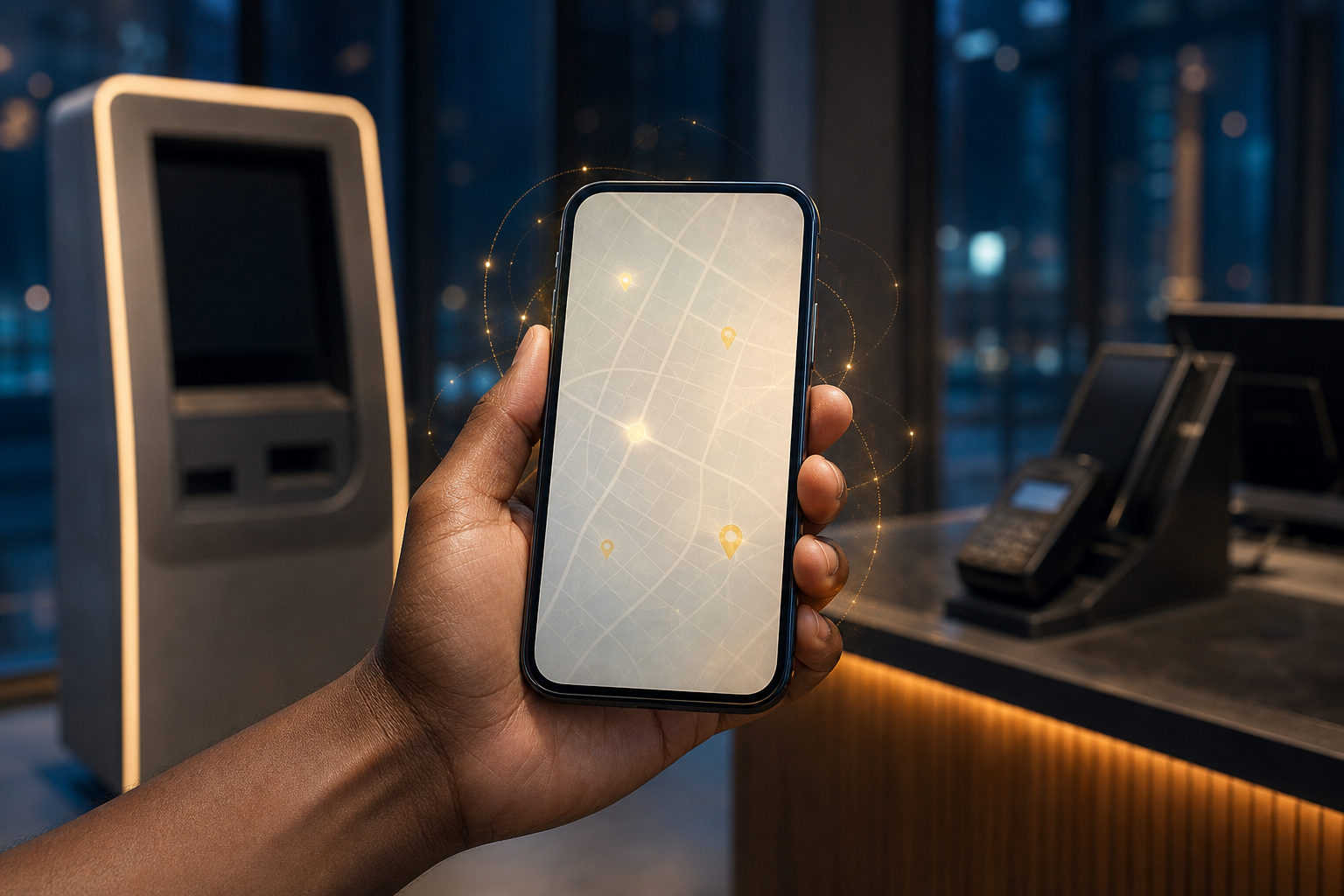
If you search for “where the nearest bitcoin,” the practical answer is this: Bitcoin is usually not sitting in a physical place near you. What you can find nearby are access points such as a Bitcoin ATM, a merchant that accepts BTC, an exchange you can use in your region, or a wallet that lets you receive and control it.
What people usually mean by “nearest Bitcoin”
This keyword sounds like a location question, but the intent is often different. One person wants the nearest Bitcoin ATM. Another wants a local shop that takes BTC. A beginner may think Bitcoin works like cash and expect to pick it up or store it at a specific place.
Bitcoin itself is a record on a public blockchain. The white paper, Bitcoin: A Peer-to-Peer Electronic Cash System, was released by Satoshi Nakamoto on 2008-10-31, and the genesis block followed on 2009-01-03. That matters because it changes the question from “Where is the Bitcoin?” to “Which nearby service lets me buy, spend, or hold Bitcoin?”
| Your real goal | What you are actually looking for | Typical option |
|---|---|---|
| Buy BTC soon | An entry point | Exchange, Bitcoin ATM, over-the-counter service |
| Spend BTC nearby | A merchant that accepts it | Retail shop, service provider, payment processor checkout |
| Keep BTC yourself | A storage method with your control | Software wallet, hardware wallet |
| Check where your BTC is after purchase | Control over an address and its records | Wallet address, transaction history, block explorer |
The nearest access point is often one of these
Bitcoin ATM
A Bitcoin ATM is the most literal answer to a “nearest” search because it has a real-world location. That makes it appealing if you want to do something in person. Still, the machine itself is only part of the decision. Coverage varies by region, and each operator can set different identity checks, buy or sell support, and transaction steps.
Before going anywhere, check what the machine actually supports. Some machines only let users buy BTC. Some support both buying and selling. Some expect you to arrive with a wallet address ready. Others provide a printed receipt that helps you track the transaction. Distance is useful, but support details matter more.
Exchange platforms
Many people think “nearest Bitcoin” must mean a physical kiosk or storefront. In day-to-day use, though, exchanges are often the main route. They are not nearby in a geographic sense, but they are usually the easiest way to complete account setup, verification, funding, and a Bitcoin purchase.
If your goal is to hold BTC for a while, the exchange is often just the first stop. After buying, you may choose to leave the balance there for convenience or withdraw it to your own wallet for direct control. If you only want to learn the process, starting with a regulated service available in your area can be simpler than chasing a local machine.
Merchants that accept BTC
Sometimes the keyword is really about spending, not buying. In that case, the “nearest Bitcoin” may mean the nearest place that accepts Bitcoin payment. That could be a shop, a service business, or an online checkout that offers BTC as a payment method.
There is one detail that trips up a lot of users: a business may say it accepts crypto, but that does not always mean it takes BTC directly in the way you expect. A payment processor may sit in the middle, present a Bitcoin payment option to the customer, and handle conversion or settlement behind the scenes. From the user side, the experience can still feel like paying with Bitcoin.
Wallets
If the real question is “Where is my Bitcoin after I buy it,” the answer usually comes down to a wallet or an exchange account. That is not about physical distance. It is about control. A wallet manages the keys that allow you to authorize transactions tied to a Bitcoin address.
Your phone does not hold coins in the way a pocket holds cash. A wallet app or hardware wallet gives you a way to interact with blockchain records. If you use self-custody, you control the keys. If you leave BTC on an exchange, the service handles custody and you rely on your account access and the platform's withdrawal rules.
| Option | Best for | Main strength | Check before use |
|---|---|---|---|
| Bitcoin ATM | People who want an in-person process | Direct and familiar format | Buy or sell support, identity checks, fee disclosure |
| Exchange | People who want a full buying workflow | Convenient account-based access | Regional availability, withdrawal rules, account security tools |
| Merchant accepting BTC | People who want to spend Bitcoin | Short path from wallet to payment | Whether BTC is truly supported and how payment is processed |
| Self-custody wallet | People who want direct control | You manage access yourself | Backup method, recovery process, device safety |
How to judge whether the nearest option is worth using
The closest option is not always the best one. For a beginner, the bigger risk is often misunderstanding the process rather than failing to find a location. A nearby ATM or merchant can still be a poor fit if the terms are unclear or if you do not know what happens after the transaction.
Start with three checks. First, can you identify the operator or service clearly? Second, are the rules visible, including identity requirements, fees, purchase limits, or withdrawal conditions? Third, can you verify the path of the transaction by checking the receiving address, transaction record, and on-chain status when needed?
Another common mistake is assuming that seeing BTC in an account means you fully control it. The real dividing line is access to the keys or at least the practical ability to withdraw. If the Bitcoin remains inside a platform account, you are using that platform's custody system. When you move it to a wallet you control, you are much closer to direct ownership in practice.
A simple order of operations that saves time
People often search maps first and prepare later. That leads to avoidable problems. A better approach is to decide what you want to do, set up the receiving side if needed, and then choose the access point that matches the task.
- Choose the goal first. Are you buying BTC to hold, spending it, or learning how to self-custody it? Each goal points to a different best option.
- Prepare a wallet if you plan to control the BTC yourself. Make sure you can generate a receiving address and understand where the transaction should arrive.
- Compare available channels. Look at nearby ATMs, exchanges available in your region, or merchants that accept BTC. Focus on support details, not just convenience.
- Test with a small amount. For a first attempt, a small trial helps you confirm the address, the flow, and the records before you do anything larger.
- Verify the result. Check transaction history and, when needed, confirm the on-chain record with a block explorer.
If you want one layer of context beyond the location question, Bitcoin's supply rules explain why BTC enters the market in the first place. The total supply is capped at 21,000,000 BTC, with issuance expected to continue until around 2140. The block subsidy is cut in half every 210,000 blocks, which is about once every 4 years. The halvings happened on 2012-11-28, 2016-07-09, 2020-05-11, and 2024-04-19. After the latest halving, the current block reward is 3.125 BTC, and with a target of about 10 minutes per block, the network adds about 450 BTC per day in total. Those figures do not tell you where the nearest machine is, but they do explain that Bitcoin follows public issuance rules rather than appearing inside a service by magic.
FAQ
What if there is no Bitcoin ATM near me?
You can still buy Bitcoin through an exchange available in your region or use a service that supports BTC transactions online. An ATM is just one access route, not the only one, and many users never need one at all.
Where is my Bitcoin stored after I buy it?
Technically, Bitcoin exists as records on the blockchain. What changes is who controls the keys or withdrawal rights tied to the address that can spend it.
Do I need my own wallet right away?
Not always. If you are only learning the basics, you may begin on a platform. If you want more direct control over your BTC, setting up a self-custody wallet becomes more important.
How can I tell whether a nearby shop really accepts BTC?
Check the payment screen or ask before you pay. Some businesses advertise crypto acceptance broadly, while the actual checkout may only support certain assets or may route the payment through a processor.
How do I confirm that a Bitcoin transfer really happened?
Look at the transaction record in your wallet or service account, then compare it with the on-chain entry through a block explorer if needed. Matching address details and transaction status give you the clearest answer.
Can I start without buying a whole Bitcoin?
Yes. Bitcoin is divisible, and the smallest unit is 1 satoshi, which equals 0.00000001 BTC. That makes small test transactions possible and practical for beginners.
If you are trying to find the nearest Bitcoin right now, define the task before you search the map: buy, spend, or store. Once that is clear, pick the matching access point, set up the receiving side if needed, and run a small test so you can verify each step with confidence.