
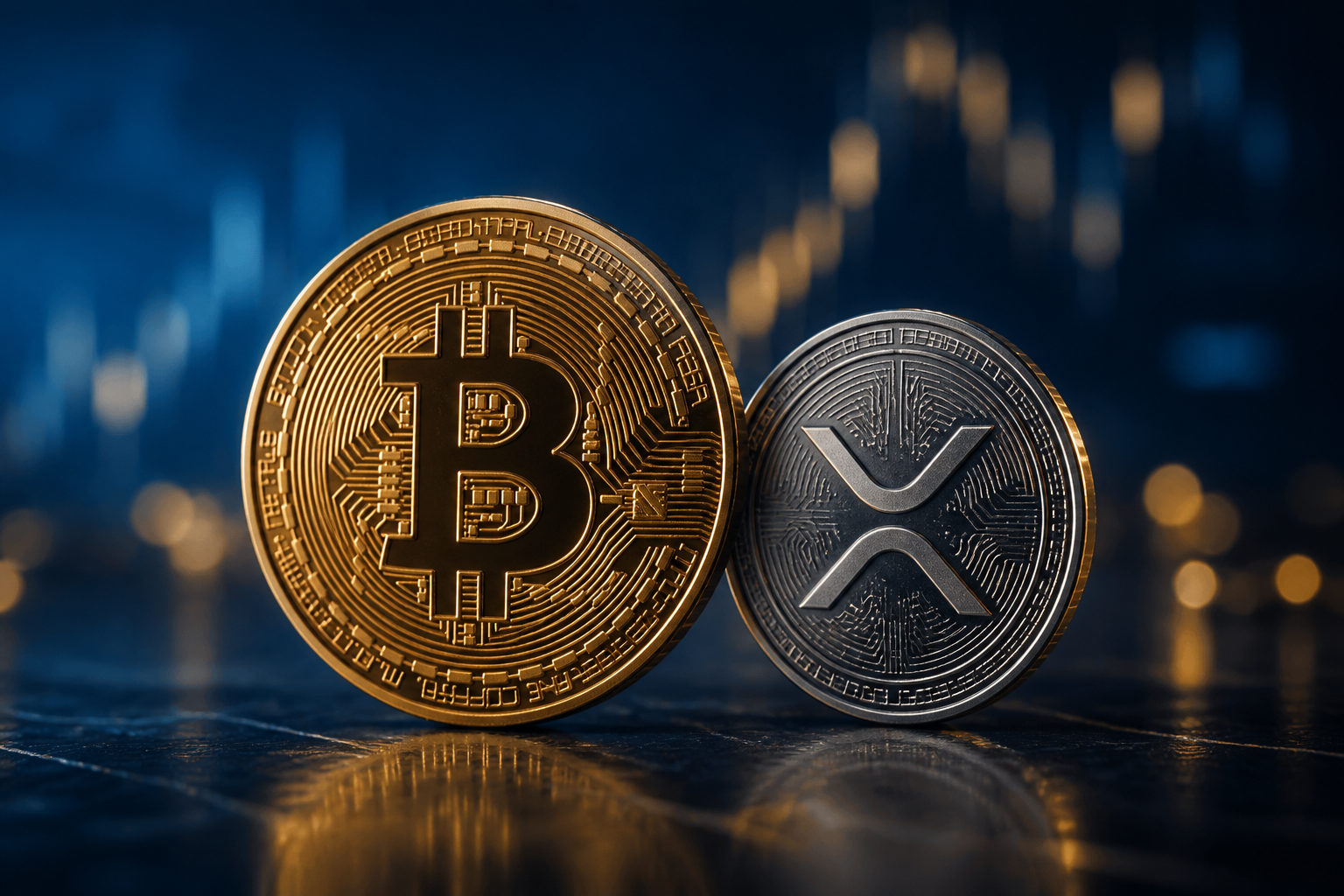
As of August 2, 2026, the short answer to whether XRP will surpass Bitcoin is no in the broader market sense, at least not based on the way investors usually define leadership. XRP may outperform BTC in certain periods, but overtaking Bitcoin in status, capital preference, and market value is a much higher bar.
What “surpass” really means
People use this question in different ways, which is why discussions around it often become messy. Some mean price performance over a short period. Others mean whether XRP could command a larger total valuation than Bitcoin. A few are really asking whether market attention, payment use cases, or narrative momentum could shift away from BTC and toward XRP.
Those are not the same thing. A token can rise faster than Bitcoin without replacing it as the market’s reference asset. It can attract fresh interest without becoming the asset that large pools of capital treat as the core position. So before asking if XRP can surpass Bitcoin, it helps to define the standard. For most investors, the standard that matters most is sustained market cap leadership and the ability to hold that position through different market conditions.
That distinction matters because Bitcoin and XRP are usually valued through different lenses. Bitcoin is often treated as the benchmark crypto asset, the first allocation many market participants think about, and the anchor for broader market sentiment. XRP is more often discussed in connection with payments, transaction efficiency, network usage expectations, and event-driven momentum. That difference in market role is one reason a strong XRP move does not automatically answer the question in the affirmative.
Why this question keeps coming back
The question returns every time the market rotates into higher-beta assets or whenever XRP has a burst of relative strength. In those moments, traders begin to wonder whether the move is just tactical or whether it points to a deeper change in market structure. The excitement is understandable, but the leap from “outperforming for now” to “surpassing Bitcoin” is usually too large.
There is also a psychological reason. Bitcoin is commonly viewed as the core crypto holding, while XRP is often framed as a thematic or tactical position. When market appetite for risk improves, tactical positions can look far more exciting than the benchmark asset. That makes the comparison feel urgent, even if the underlying hierarchy has not actually changed.
A more useful version of the question is this: will capital rotate away from Bitcoin for long enough, and on a large enough scale, that the market starts assigning XRP a higher and more durable valuation framework than BTC? That is the real threshold. It is not about one rally. It is about a lasting change in capital behavior and market trust.
What institutional BTC forecasts imply for the XRP debate
To judge whether XRP can surpass Bitcoin, it is not enough to focus on XRP alone. You also have to ask how the market is still pricing BTC. If institutions continue to assign Bitcoin a high valuation range, then XRP would need more than strong momentum. It would need to absorb a very large amount of capital and hold that capital through changing conditions.
The public forecasts reviewed here suggest that, as of August 2, 2026, major institutions still see Bitcoin as central to the market. They disagree on pace and upside, but they are still debating where BTC could trade, not whether it is losing its role altogether.
- Bernstein, in a report published in June 2026, gave a $150,000 target for the end of 2026. The stance is bullish, though with a clear revision in tone: the firm had cut its earlier view and argued that Bitcoin would first recover into the $100,000 to $150,000 range.
- Standard Chartered, in a view published in February 2026, set a $100,000 target for the end of 2026. That is a cautiously bullish position. The bank had reduced its target more than once, yet still kept a longer-term constructive view and pointed to ETF flows as the key variable.
- JPMorgan, in a forecast published in February 2026, projected $150,000 to $170,000 for 2026. Its case was based on a Bitcoin-versus-gold volatility model and included the view that there was support around $94,000.
- Galaxy Digital CEO Mike Novogratz, in comments published in July 2026, said Bitcoin could trade in a $60,000 to $80,000 range through all of 2026. That was a neutral-to-cautious stance, tied to the idea that without a strong catalyst, getting back to $100,000 would be difficult.
- Fidelity's Jurrien Timmer, in a view published in June 2026, placed Bitcoin in a $65,000 to $75,000 consolidation range for 2026. The stance was neutral, based on the idea that the four-year cycle remains intact and that the market is in a post-peak consolidation phase.
That list matters because it frames the hurdle XRP would face. The forecasts are not uniform, but they do show that major institutions are still treating Bitcoin as the asset worth modeling, defending, and assigning year-end or annual price ranges to. Even the cautious views are not calling for a structural loss of relevance. They are discussing recovery, consolidation, support, catalysts, and flow sensitivity.
That does not prove Bitcoin will stay ahead forever. It does show that the burden of proof remains on any asset that aims to overtake it. As long as BTC is still the asset institutions discuss as the market’s anchor, XRP needs far more than a sharp move or a temporary narrative lead.
The variables that actually matter
If you want to evaluate the question seriously, it helps to stop thinking in slogans and break it into testable conditions. A market hierarchy changes only when several things shift at once. Without those shifts, the debate stays speculative.
Capital allocation habits
Bitcoin still benefits from being the default entry point for many large investors and long-term holders. That matters more than a lot of social media discussion. If major pools of capital continue to treat BTC as the base allocation, then XRP can still have strong periods without changing the overall order of the market.
Valuation logic
Bitcoin’s investment case is relatively easy for the market to frame: scarcity, benchmark status, and broad recognition. XRP’s case usually depends more on adoption expectations, payment-related utility, and market enthusiasm around its network role. A more event-sensitive narrative can produce stronger bursts of upside, but it can also be harder to hold at the same valuation level once sentiment cools.
Behavior after pullbacks
True leadership is not defined only by what happens during risk-on periods. It is also defined by what happens after corrections. Many assets can rally hard when traders are aggressive. Fewer can maintain a premium when the market becomes selective again. Bitcoin’s long-term strength has often come from that re-rating resilience.
Whether BTC stops being the benchmark
The biggest change would be a market in which participants no longer look to Bitcoin as the core reference point. If that happened in a durable way, then the idea of XRP surpassing Bitcoin would move from speculation to something closer to a structural thesis. Based on the institutional forecasts above, that is not the message the market is getting right now.
Common mistakes investors make when comparing XRP and Bitcoin
The first mistake is confusing relative performance with market replacement. XRP can beat BTC over a stretch of time and still remain below it in strategic importance. The second mistake is focusing on token price without thinking about supply structure and total valuation. The third mistake is assuming that a favorable development for XRP automatically means Bitcoin must be losing ground in a lasting way.
Another mistake is to treat cautious Bitcoin forecasts as proof that alternative assets are about to take over. The forecasts discussed here do not say that. Bernstein in June 2026 pointed to $150,000 by the end of 2026. Standard Chartered in February 2026 pointed to $100,000 by the end of 2026. JPMorgan in February 2026 projected $150,000 to $170,000 during 2026. Galaxy Digital CEO Mike Novogratz in July 2026 looked for $60,000 to $80,000 through 2026. Fidelity's Jurrien Timmer in June 2026 expected a $65,000 to $75,000 consolidation zone in 2026. Those are different views, but all of them still center Bitcoin in the conversation.
That is why the better practical question for most readers is not simply whether XRP will surpass Bitcoin. It is whether XRP can outperform BTC for a time, and separately, whether XRP can change the deeper structure of market preference. The first is possible in many cycles. The second requires a much bigger shift.
FAQ
Can XRP outperform Bitcoin for a period of time?
Yes. In stronger risk-on phases, higher-beta assets can post better returns than Bitcoin over shorter windows. That still falls short of proving a lasting change in market leadership.
What is the most important metric when asking if XRP could surpass BTC?
Total market value and the durability of capital flows matter more than a short-term move. The key issue is whether investors treat XRP as a long-term core holding rather than a tactical trade.
Do institutional forecasts show that the market is turning against Bitcoin?
No. The forecasts differ, but they still frame BTC as the central asset being priced. Bernstein in June 2026 gave a $150,000 target for the end of 2026, Standard Chartered in February 2026 gave $100,000 for the end of 2026, JPMorgan in February 2026 gave $150,000 to $170,000 for 2026, Galaxy Digital CEO Mike Novogratz in July 2026 saw $60,000 to $80,000 through 2026, and Fidelity's Jurrien Timmer in June 2026 saw $65,000 to $75,000 in consolidation during 2026.
If Bitcoin stays in consolidation, does that automatically help XRP overtake it?
No. Bitcoin consolidation may signal a more cautious near-term outlook for BTC, but it does not guarantee that capital will rotate into XRP on a scale large enough to change the market hierarchy.
How should a regular investor use this comparison?
Use it to separate trading opportunities from structural changes. If you do not define the comparison properly, it becomes easy to mistake a temporary burst of momentum for a lasting shift in market leadership.
If you want a practical way to track this question, watch two things: whether institutions continue to keep Bitcoin in relatively high valuation ranges, and whether XRP can attract durable capital without relying on short-term excitement. Unless both conditions change together, the case that XRP will surpass Bitcoin remains much weaker than the headline question suggests.
Disclaimer: This article is for informational purposes only and does not constitute investment advice. Cryptocurrency prices are highly volatile. Always do your own research.