
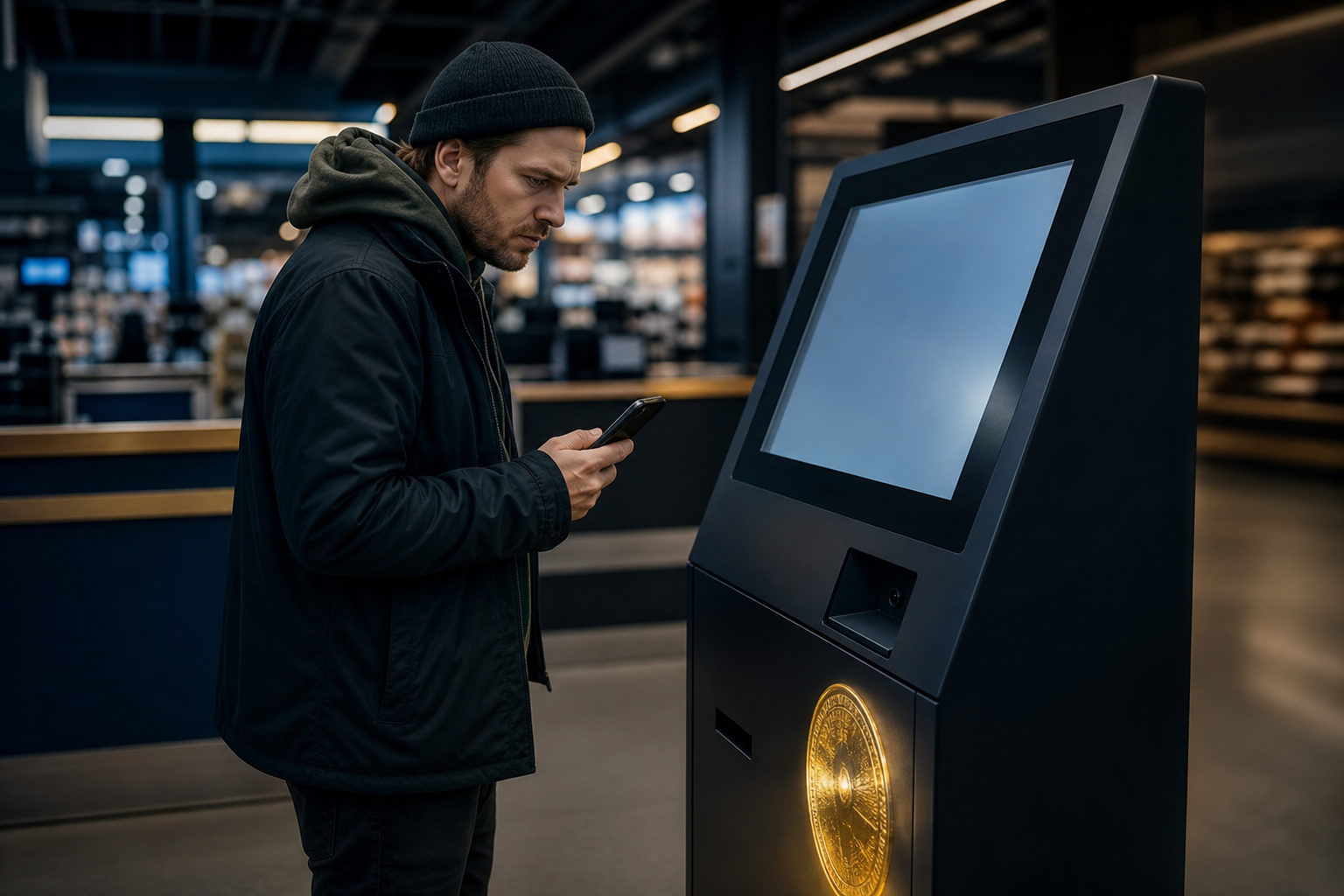
Walmart generally does not sell Bitcoin the way it sells ordinary retail products. To answer whether Walmart sells bitcoins, you need to separate a store location, a third-party service, and the question that matters most: do you end up with Bitcoin in a wallet you control?
Why this question is easy to misunderstand
People often see crypto-related signage, a kiosk, a checkout option, or a voucher display inside a large retailer and assume the retailer itself is selling Bitcoin. A store can host a service without being the actual seller, custodian, or support provider behind the transaction.
Two mistakes show up again and again. First, shoppers confuse access with direct retail sale. Second, they confuse an account balance, a code, or a claim on a platform with actual Bitcoin that can be sent to a personal wallet.
Those details decide who takes your money, who handles disputes, what fees apply, and whether you can move the asset after purchase.
A step-by-step way to verify any Bitcoin-related service you see at Walmart
| Step | What to do | Why it matters | What to watch for |
|---|---|---|---|
| Step 1 | Identify the service provider | You need to know whether Walmart is involved directly or a third party is operating the service | Check the receipt, kiosk label, app screen, and terms |
| Step 2 | Confirm what you are actually buying | Bitcoin, a redemption code, and account credit are very different products | Words like crypto or digital do not guarantee on-chain Bitcoin |
| Step 3 | Ask whether identity verification is required | Legitimate services usually have an account and compliance process | Claims of instant large purchases with no verification deserve extra caution |
| Step 4 | Check where the asset will be delivered | This tells you whether you control withdrawal rights | If it stays as platform balance only, understand the custody risk |
| Step 5 | Review the full fee structure before paying | Convenience often comes with layered costs | Look at service fees, spread, timing, and refund policy |
| Step 6 | Run a small test first | You can confirm the full path from payment to receipt | Do not commit your full budget on a first attempt |
Start with the provider name. If a machine or checkout flow appears inside Walmart, that only tells you where you found it. It does not tell you who is contractually responsible for the transaction. If something goes wrong, the answer is usually on the receipt and the service terms.
Next, define the product. Some services sell a code that must be redeemed later. Some fund a hosted account first. Some may connect to a wallet after registration. A shopper who thinks all of these are the same is likely to be surprised by delays, limits, or extra steps.
Verification is another filter. Bitcoin transactions are hard to reverse once sent on-chain, so legitimate access points often require account creation and identity checks before a purchase is completed. Anyone advertising a no-check, no-account, high-value shortcut should make you slow down.
Then look at custody. Bitcoin began with the genesis block on 2009-01-03, and one of its defining features is that users can hold it in wallets under their own control. Ask: can the Bitcoin be withdrawn to your own wallet, or are you left with a balance on someone else's system?
Do not skip fees. A store-based option may feel simple because payment happens in a familiar place, but the total cost may include a service charge, a pricing spread, withdrawal conditions, or time delays.
If your goal is to buy Bitcoin safely, use this order
Prepare a wallet first. You should know what a receiving address is, what your password protects, and what wallet recovery information means. New users often mix up exchange login details with wallet control, and that creates avoidable risk.
After that, read the service description with a narrow focus. You need answers to three questions: can you withdraw, when will the asset arrive, and who handles support if the process breaks. If those points stay vague, the location does not make the service safer.
Run a small test before doing anything bigger. Copy the receiving address, compare the opening and ending characters, and wait for the result. Bitcoin can be divided into very small units, with 1 satoshi equal to 0.00000001 BTC, so the system can handle precise amounts; human error in address handling is still a common problem.
Only after the test succeeds should you think about increasing size. Many scams begin with a smooth first experience, then push the user into a larger transfer or ask for coins to be sent to a so-called verification wallet, security wallet, or support address. A real Bitcoin purchase does not require that kind of detour.
Common risks: why a big retail setting does not remove fraud risk
| Risk scenario | How it appears | Why it is dangerous | Practical response |
|---|---|---|---|
| Fake helper or fake support | Someone offers to guide the process or asks you to install unfamiliar software | The store setting lowers your guard | Use only the official interface and do not hand over your phone |
| Gift card trap | You are told to buy gift cards first and convert them later | Gift card codes are hard to recover once shared | Stop if anyone insists on gift cards as an intermediate step |
| Address replacement | Copied wallet address changes before you send | On-chain transfers are usually not reversible | Check the first and last characters before confirming |
| Custody confusion | You assume a platform balance means you hold Bitcoin directly | You may not have withdrawal rights when you need them | Confirm withdrawal to a self-controlled wallet in advance |
| Retail refund assumption | You expect the same return process as ordinary store goods | Digital asset transactions may follow different rules | Read cancellation, refund, and dispute terms before payment |
A familiar store environment can create false comfort. The real friction often appears later: account review, delayed redemption, withdrawal limits, or poor support. None of those issues are solved just because the first payment happened inside a well-known retailer.
Another risk is the person who offers to do it for you. They may present themselves as a staff member, a helpful customer, or technical support. Once someone else handles your phone, your verification code, or your wallet details, you have already given away too much control.
If you plan to hold Bitcoin rather than just experiment with access, it helps to know the basic monetary rules. Bitcoin has a hard cap of 21,000,000 BTC, expected to be fully issued around 2140. The block reward halves every 210,000 blocks, roughly every four years. The latest halving took place on 2024-04-19, making the current block reward 3.125 BTC until the next halving, expected around 2028. Those facts do not tell you whether to buy, but they do remind you that Bitcoin is a separate network asset, not a store points program or prepaid retail balance.
How to judge claims that say Walmart sells Bitcoin
Look for a vague subject. If a post turns “a Bitcoin-related service exists inside Walmart” into “Walmart directly sells Bitcoin,” the wording is doing too much work.
Watch for pressure. Scammers like urgency because it cuts short verification. If someone says the deal disappears soon or the machine is about to go offline, pause.
Check whether the claim avoids the withdrawal question. If the pitch explains how to pay but not how to move the asset to your own wallet, the most important part is missing.
Reject profit promises. Bitcoin prices move. Any claim that packages a buying method as guaranteed profit belongs in the fraud bucket.
Focus on four points only: who receives your money, what you receive in return, when you get it, and whether you can withdraw it. If even one answer stays blurry, stop there.
FAQ
Does seeing a machine in Walmart mean Walmart itself sells Bitcoin?
No. A machine or service inside Walmart may simply mean a third party uses that location to reach customers. It does not automatically make Walmart the seller or support provider for the Bitcoin transaction.
Check the receipt, on-screen company name, and terms of service to find the real counterparty before you pay.
Is buying Bitcoin in a retail store safer than buying online?
Not by default. A physical setting may reduce some website risks, but it can add other problems such as in-person pressure, confusion about who operates the service, or someone trying to handle the process for you.
Safety comes from independent verification, clear withdrawal rights, and proper control of wallet information.
If I only receive a redemption code, do I already own Bitcoin?
Usually not yet. A redemption code is often just the first step in a longer process that may include registration, identity checks, and later delivery.
Before buying, make sure you understand the redemption deadline, any restrictions, and whether the final asset can move to your own wallet.
How can I check the live Bitcoin price if store signage is not enough?
Use a mainstream market data page or the live quote shown in the service interface at the moment you are about to buy. Bitcoin prices change continuously, and printed or posted store information may not match the final execution price.
You should also include service fees, spread, and withdrawal conditions in the comparison instead of looking at one headline figure.
What is the biggest scam risk for a first-time buyer?
The biggest one is letting someone else operate on your behalf. That includes a stranger who offers to buy for you, register for you, verify for you, or hold the asset for you.
If anyone asks you to move Bitcoin to a verification address, release address, tax wallet, or security wallet, stop immediately.
If you only want one practical rule to follow, use this one: identify the provider, confirm withdrawal to a wallet you control, test with a small amount, and scale only after the full process works.
Disclaimer: This article is for informational and educational purposes only and is not investment, financial, or legal advice. Crypto assets are highly volatile and you could lose your entire investment. Do your own research and decide carefully.