
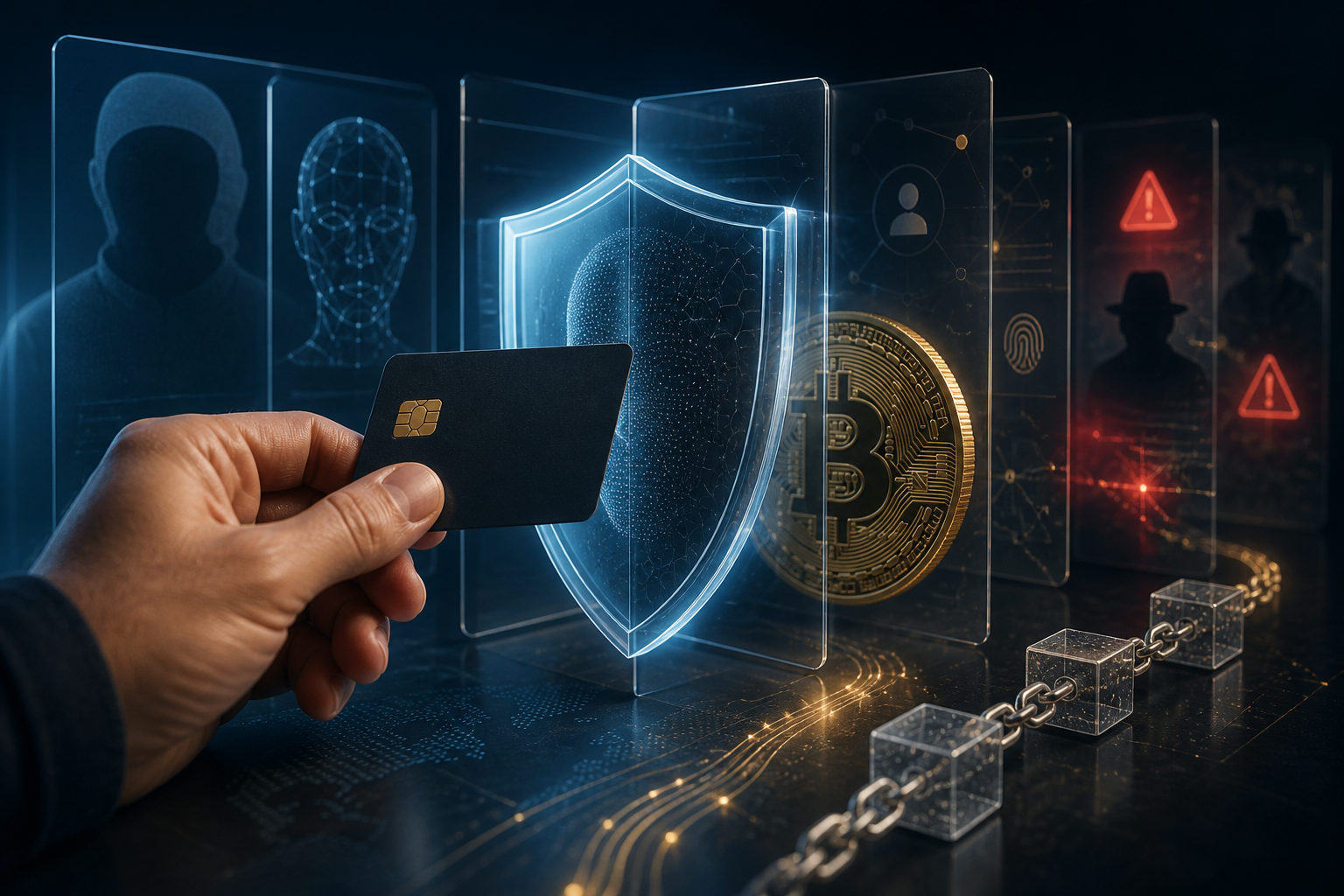
Short answer up front: no, you can't buy Bitcoin with a credit card and stay completely anonymous. Card payments run through a chain of banks and networks that keep their own records no matter what a crypto platform advertises about "no verification." What you actually can do is get realistic about the goal. Instead of chasing zero trace, aim for less unnecessary exposure on small purchases, and put real effort into privacy after you're holding the coins — self-custody, fresh addresses, and not tying your buying history to your public identity. This piece walks through which purchase methods genuinely skip identity checks at small amounts, why credit cards specifically fight against that, and where the scams in this space tend to hide.
The honest starting point: "anonymous" and "credit card" don't sit well together
A lot of people typing some version of "buy Bitcoin with a credit card anonymously" into a search bar are really asking one of two things: can I avoid handing over a pile of personal documents, or can I keep my Bitcoin purchase from being permanently glued to my other online identity? Both are reasonable things to want, and neither one actually requires full anonymity — which matters, because full anonymity on a card-funded purchase basically isn't on the table.
Here's why. A credit card transaction touches at least three parties before it settles — the issuing bank, the card network, and whatever processor the platform is using — and each one keeps its own records for its own compliance reasons. That's a separate question from whether the crypto platform itself asks for ID. Even a platform marketing itself as "no verification required" is still routing your card through a processor that watches for fraud signals: transaction size, card history, IP or billing-address mismatches, chargeback rates. Cross a threshold on any of those and you'll get a verification prompt or a declined charge, platform policy notwithstanding.
Once that's clear, the rest of this gets a lot more practical. You're not trying to disappear. You're trying to avoid oversharing on the front end and avoid careless mistakes on the back end — and both of those are very doable.
Why credit cards specifically clash with "no KYC"
If you're still set on paying by card, it helps to understand the mechanism you're up against. Credit card payments are reversible. Bitcoin transactions are not. Put those two together and you get a structural mismatch that platforms have to design around, whether they say so or not.
Concretely: someone can buy Bitcoin with a card, receive it, move it to a wallet they control, and then — weeks or even months later — file a chargeback with their bank claiming the charge was unauthorized or fraudulent. The Bitcoin is long gone and can't be clawed back on-chain, but the bank can still claw back the dollars from the merchant on the other end. That's a real, well-documented risk in crypto payments, and it's exactly why legitimate platforms tend to scrutinize card payments harder than bank transfers, not less. Any service advertising instant card purchases with zero review is quietly skipping over a cost that somebody in that chain is absorbing, and that should make you suspicious rather than relieved.
Practical takeaway: if what you actually care about is submitting less paperwork, you're often better off looking at purchase methods that were never built around card rails or centralized accounts in the first place, rather than trying to force a credit card into a no-KYC mold it doesn't fit. Those methods are covered next.
Purchase paths that genuinely skip ID checks — with a catch
Peel back the marketing and a handful of methods really do let you transact without handing over identity documents, at least at modest amounts. The catch, and it's an important one, is that almost none of them take a credit card directly — which is really just the flip side of the chargeback problem above.
- Tor-based, Lightning-native peer-to-peer trading. Platforms in this category — RoboSats is the commonly cited example — run over Tor, skip account registration entirely, and settle trades peer-to-peer over the Lightning Network. Because there's no centralized user ledger to subpoena, there's genuinely nothing to KYC. The tradeoff is a per-trade cap, roughly 4,000,000 sats (about 0.04 BTC) on RoboSats, which tells you this is built for smaller, more frequent trades rather than moving serious sums.
- Decentralized desktop P2P software. Bisq is the usual example: no company behind it, no central servers, a downloadable app that matches you with a counterparty and holds funds in multisig escrow until the trade completes. New accounts default to an overall 0.1 BTC trade limit; on riskier fiat rails (SEPA, Zelle, and similar) the buy limit starts lower, around 0.002 BTC, and phases up over the 30–60 days after account signing, while sell limits aren't restricted by that signing process and start at the full cap from day one. Funding is typically bank transfer, again, no card rails.
- Some Bitcoin ATMs, depending on operator and location. This is the messiest category because policy varies by machine. Several operators skip ID for transactions under a threshold that commonly falls somewhere between roughly $200 and $900, then require verification above it — but policies shift constantly and are usually cash- or debit-based rather than credit-card-based.
The common thread is decentralized matching or cash-based operation — funding mechanics that are structurally different from a strongly identity-linked payment rail like a credit card, which is what lets them stay small-amount-friendly without breaking any compliance framework. They're not exploiting a loophole; the product itself was never built on a payment rail that leaves that kind of trail.
Worth flagging clearly: all of these have a real learning curve — Lightning wallets, Tor, multisig escrow aren't exactly beginner-friendly concepts — and the limits are modest by design. Treat them as a starting point for getting comfortable with decentralized trading, not a wholesale replacement for larger routine purchases. And any third party offering to run "unlimited, instant, credit-card-funded" purchases through these decentralized tools on your behalf is, essentially by definition, running a scam.
Method comparison
| Method | ID required? | Takes a credit card directly? | Typical limit | Privacy level | Main risk |
|---|---|---|---|---|---|
| Tor-based Lightning P2P (RoboSats-type platforms) | No registration or ID | Usually not — Lightning wallet counterparties | ~4,000,000 sats (~0.04 BTC) per trade | High — no central account | Steep learning curve (Lightning, Tor); counterparty risk |
| Decentralized desktop P2P (Bisq-type platforms) | No account, no central ledger | Usually not — mostly bank transfer | 0.1 BTC default overall limit; ~0.002 BTC buy to start on riskier fiat rails (phases up over 30–60 days), sell limit unrestricted from day one | High — no servers to subpoena | Multisig escrow complexity; counterparty default |
| Bitcoin ATMs (varies by operator) | Often waived under ~$200–$900; several operators tightened in 2026 | Rarely — mostly cash or debit | Threshold-dependent, e.g. a sub-$900 no-info tier at some operators | Moderate — cash-based, but the machine may log data | Policy varies widely and changes fast; check before you go |
| Regulated exchange + credit card | Full KYC | Yes | Higher, platform-dependent | Low — fully identified | None of the above apply; this is the compliant, non-private path |
One more thing worth saying plainly: ATM policy is a moving target. An operator that skipped ID last year might require it on every single transaction today after a compliance update — that's not hypothetical, it's already happened with more than one major operator in 2026. Don't plan a purchase around a year-old blog post; check the machine's on-screen terms or the operator's current site before you show up.
What actually protects your privacy happens after the purchase
This is the part most guides skim past, and it's arguably the more important half. Buying without handing over ID does very little for you long-term if you then reuse the same receiving address forever and post it somewhere public.
Move the coins to a wallet where you hold the keys, first thing — not a wallet parked on the seller's or platform's servers. Then get in the habit of using a new address every time you receive funds. This isn't some advanced privacy-hacker technique; it's the default behavior of basically every modern HD wallet (the BIP32/BIP44 standard, if you want the technical name), which generates a fresh address automatically each time you go to receive. Bitcoin's ledger is public, and address reuse is what makes it easy to link activity: once someone has seen a given address, they can connect any prior payment to it with any future one. A wallet that hands you the same address twice, or a habit of pasting the same address into a public bio to collect tips, undoes a lot of the privacy work you'd otherwise get for free.
If you want more control, desktop wallets like Sparrow or Electrum — or running Bitcoin Core yourself — let you manage UTXOs manually, choosing which specific coins fund a given transaction rather than letting the wallet auto-select and potentially merge unrelated funds together, which is its own quiet way of linking activity that didn't need to be linked.
The boring but essential stuff still applies: keep your seed phrase offline, never in a screenshot, cloud drive, or email to yourself, and never hand it to anyone claiming to need it for "verification." A service asking for your seed phrase before it'll release funds to you isn't a service. It's a theft in progress.
The scams cluster around exactly this search term
Be blunt with yourself about this one: "credit card," "anonymous," and "crypto" strung together in a single search is one of the most heavily scammed phrase combinations online. Victims of this particular scam are often reluctant to report it — nobody loves explaining why they were trying to buy crypto anonymously in the first place — and scammers know that reluctance is worth exploiting.
Watch for these patterns specifically: a wallet app that asks you to import your seed phrase right after installation; a payment page that exists purely to harvest card numbers; "support" that asks for a one-time verification code because of "unusual account activity"; a seller who goes quiet the moment payment clears; or an "unlock" process that keeps demanding one more fee before your funds get released. That last one is close to a guarantee of a scam — legitimate platforms don't charge you extra money to give you access to money you already paid for.
Large purchases or long-term holding: verification is basically unavoidable
If your actual need is a large purchase, long-term holding, or eventually cashing out through a compliant channel, don't keep chasing no-KYC in that scenario — just use a fully identified, regulated exchange.
Nearly every regulated platform in a major jurisdiction requires identity verification once you cross a certain amount or trading frequency, and that's a baseline anti-money-laundering requirement, not something any single platform invented on its own. The decentralized paths described above are also built for small amounts by design; forcing them to handle serious sums usually backfires through thin liquidity, slow fills, and higher counterparty risk than it's worth.
Keep no-KYC and compliant-large-purchase as two separate lanes in your head: one fits small, privacy-conscious buying, the other fits long-term portfolio building. They're not in conflict, but trying to solve both with the same playbook usually doesn't work well.
FAQ
Can I actually buy Bitcoin with a credit card with zero identity checks anywhere?
Not really, not in any way that holds up. Card payments run through banks and processors that apply their own compliance checks independent of whatever the crypto platform advertises. Treat "100% anonymous, instant, no review" claims as a red flag rather than a feature.
If I skip the credit card and use a decentralized P2P tool instead, am I automatically safer?
Not automatically. You cut out the centralized account and the paperwork, but you take on a steeper learning curve and real counterparty risk — the other side of the trade could still stall or scam you. Safety here comes from holding your own keys, verifying who you're trading with, and backing things up properly, not just from the absence of an ID check.
Do all Bitcoin ATMs require zero information for small amounts?
No. Thresholds vary by operator — roughly $200 to $900 is the common range — and quite a few operators tightened their rules in 2026 to require verification on every transaction regardless of size. Check the specific machine before you count on it.
Is it fine to just leave coins sitting in the seller's or platform's account after I buy?
Not ideal. If you don't hold the private keys, you don't fully control those coins, and you may run into withdrawal limits, account holds, or an operator that simply disappears. Move funds to a wallet you control as soon as the purchase clears.
What's the simplest way to lower how traceable my on-chain activity is?
Use a new receiving address every time — modern wallets do this automatically — avoid tying a purchase address to your public identity long-term, and store your seed phrase offline. These basics do more real work than any tool promising to "launder" or "hide" your coins with one click, and frankly, a lot of those tools are scams that will just take your funds outright.
If you're actually going to go through with this, the order of operations that keeps people out of trouble looks like this: decide upfront whether you're in a small, privacy-focused situation or a large, long-term-holding one; for the small case, look at decentralized P2P, Lightning, or a local ATM and confirm its current on-screen rules before you commit; for the large case, just use a regulated exchange, since trying to force privacy onto a big purchase mostly adds risk without adding much actual privacy. Whichever path you take, move funds into your own wallet immediately, get into the new-address habit, and treat anyone who reaches out promising instant, anonymous, credit-card-funded purchases as someone to ignore.
Disclaimer: This article is for informational and educational purposes only and does not constitute investment, financial, or legal advice. Platform names, limits, and policies mentioned here are based on publicly available information at the time of writing and may change by region or over time — verify current terms directly with the operator or platform before acting. Cryptocurrency prices are highly volatile and you could lose your entire principal. Do your own research, make decisions carefully, and comply with the laws of your jurisdiction.