
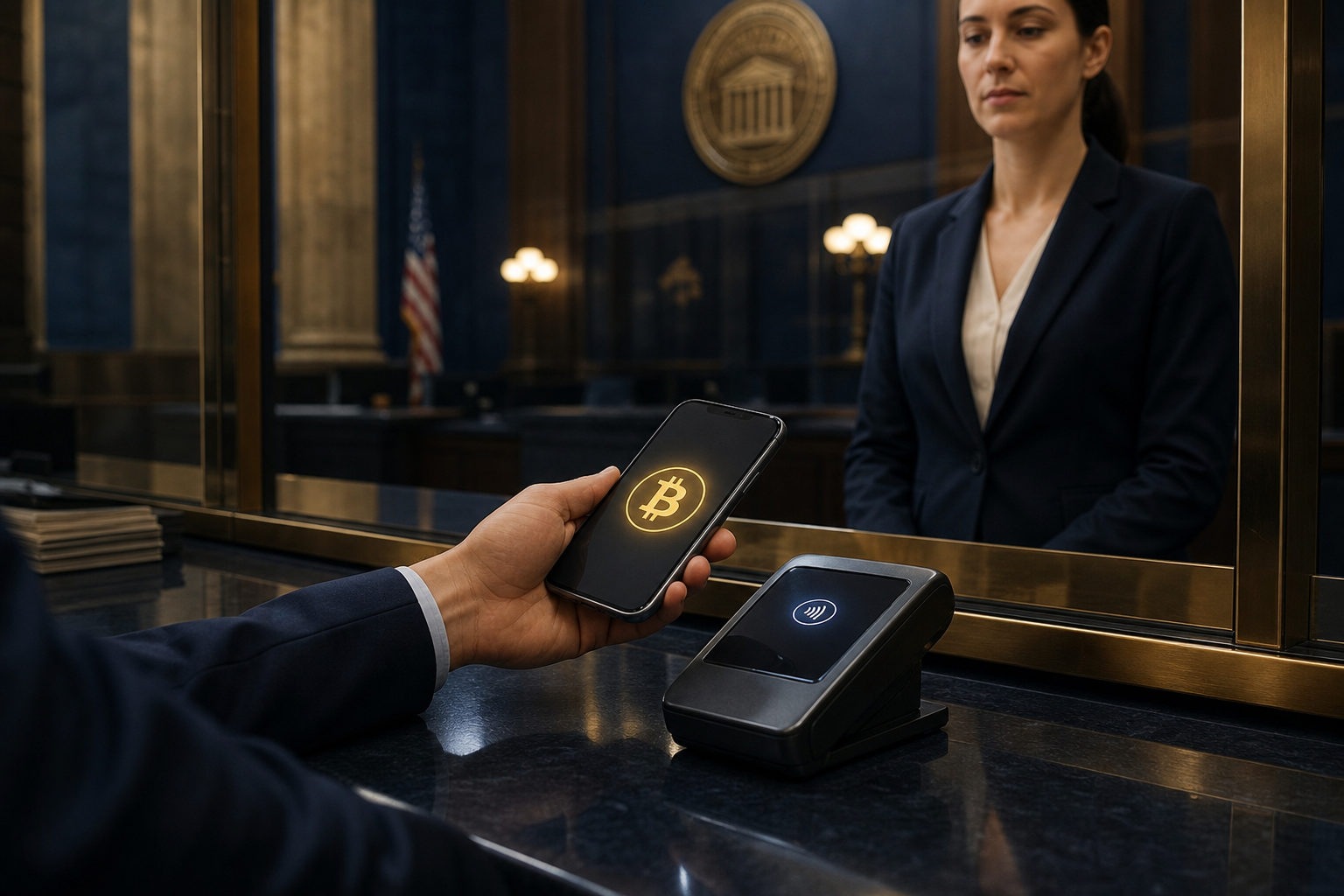
Can you pay taxes with bitcoin? Sometimes yes, but usually only through an approved payment flow, and in many cases the tax is still settled in dollars rather than kept as BTC by the tax authority.
Step 1: Figure out who is actually receiving the payment
That sounds obvious. It is not. A page that says it supports crypto payments does not always mean the tax office is directly accepting bitcoin into its own wallet.
In practice, there are two very different setups. One is direct acceptance through an official tax system. The other uses a payment processor that takes your BTC, converts it under its own rules, and sends the tax amount onward in dollars. Those are not small differences. They shape fees, timing, refunds, and what happens if something breaks.
| Model | How to spot it | Why it matters | What to watch |
|---|---|---|---|
| Direct acceptance by the tax authority | The official tax site or official notice clearly says bitcoin is accepted for a specific tax payment | You need to know whether you are paying a government-controlled address or system | Check the official domain, the tax type, and whether the notice is still current |
| Third-party processor | The payment flow moves you to an outside payment service that handles conversion or settlement | Exchange timing, fees, disputes, and refund rules may sit with the processor | Do not assume “crypto accepted” means the authority itself holds BTC |
Start there. Always there. If you skip this and jump straight to your wallet, you may end up treating a processor payment like a direct tax payment, and that can lead to bad assumptions about the final dollar amount, the deadline, or who to contact when the payment does not post.
Another warning sign: if the only “proof” comes from a social post, an ad, or a how-to page that is not run by the tax authority, stop. Taxes are not the place to trust a forwarded link.
Step 2: Check the tax bill, the payment rules, and the order details before you send BTC
Once you confirm there is an official route, do the boring work. This is where people save themselves from expensive mistakes.
| Step | What to do | Why | Watch for |
|---|---|---|---|
| Match the tax bill | Confirm the tax type, taxpayer name, bill or reference number, and deadline | A correct blockchain transfer can still fail as a tax payment if the system cannot match it to your liability | Different taxes may use different payment paths |
| Read the payment rules | Check whether BTC is accepted, when conversion is set, and what happens if time runs out | Your obligation is tied to how the system measures the dollar amount | Some pages support only certain assets or a specific network |
| Use a wallet you control | Pay from a wallet where you can review the destination, network fee, and broadcast status | Once sent, a mistaken bitcoin payment is usually hard to reverse | Exchange withdrawals can be delayed by internal review |
| Review the order carefully | Check the destination, payment amount, required reference fields, and time limit | Many failures happen at the order-matching stage, not on-chain | If the system does not allow split payments, do not improvise |
| Save records | Keep the order page, transaction hash, and completion screen | You will need them for support, disputes, or later tax records | Keep text details, not screenshots alone |
People often try to simplify this by paying straight from an exchange account. Sometimes that works. Sometimes it does not. Withdrawals may queue, compliance checks may slow things down, and your payment can miss the deadline even though you clicked the button in time. That is your problem, not the system's.
If the page shows a countdown, treat it seriously. That timer often controls how long the order stays valid or how long a conversion quote is held. Miss it, and the amount or instructions may change. Quietly. Fast.
Step 3: Watch the real danger points during the transfer
This is the moment when a simple payment turns into an irreversible one. Bitcoin does not behave like a card charge that can be waved back later. You send it. Then you live with what you sent.
| Risk | What it looks like | Why it is a problem | How to reduce it |
|---|---|---|---|
| Fake official site | Search ads, copycat domains, or links shared in messages | You may send BTC to a scam address that only looks official | Enter through the official tax site or an official notice only |
| Fake support contact | Someone tells you the system is down and gives you a manual address | Real tax payment instructions should not rely on private chat messages | Use the address generated inside the official payment interface |
| Wrong asset or wrong network | BTC sent in a way the payment flow does not support | The funds may not be recoverable, and the tax may remain unpaid | Follow the exact asset and network rules shown on the payment page |
| Timing delays | Exchange withdrawal lag, blockchain congestion, or an expired order | You may think you paid on time while the system treats it as late | Do not wait until the last minute |
| Amount mismatch | Fees, quote expiry, or a recalculated order amount | Underpayment can leave a balance due; overpayment may be messy to recover | Read who bears the fees and what happens after expiry |
Here is a plain rule that saves people money: never trust a tax payment address sent through private chat, email reply chains, or social media messages. High-pressure instructions are a bad sign. So is a demand for a “test payment” to verify your wallet.
Timing needs a bit of care too. Bitcoin targets roughly 10 minutes per block, but that does not mean your tax payment will be recognized by the receiving system on a fixed schedule. Your wallet saying “sent” is not the same as the payment system saying “posted.” Those are two separate milestones.
Step 4: Keep records and think beyond the transfer itself
A bitcoin tax payment is not finished when the transaction leaves your wallet. You still need a paper trail. Maybe more than one.
If a processor is involved, there can be three different views of the same event: your wallet record, the processor order status, and the tax account posting status. They do not always update at the same speed. That is normal. It is also exactly why incomplete records become a headache later.
| Record to keep | Why you need it | Practical note |
|---|---|---|
| Tax bill and reference number | Shows which liability you intended to pay | Save the original page or downloaded file |
| Payment order details | Shows the quoted amount, timing, and payment rules | Useful if the posted amount is disputed later |
| Transaction hash and wallet history | Shows when and where you sent the BTC | Keep the full hash, not a cropped image |
| Completion or posting notice | Shows the system accepted or settled the payment | If it says pending, keep checking |
Do not rush to pay again if the status looks wrong. First ask where the failure actually happened. The order may have expired. The blockchain confirmation may still be pending. The processor may not have matched your order. The tax account may simply not have updated yet. A second payment made in panic can turn one problem into two.
It also helps to separate bitcoin the network from bitcoin as a payment option offered by a government office. Bitcoin began with the genesis block on 2009-01-03. Its total supply is capped at 21,000,000 BTC. The smallest unit is 1 satoshi, equal to 0.00000001 BTC. None of that forces any tax authority to accept it for taxes. Acceptance depends on local rules and on the payment system actually in place.
FAQ
Does “crypto accepted” mean the tax authority directly receives bitcoin?
No. In many cases a processor takes the BTC and settles the tax in dollars. Read the official payment terms to see who controls the conversion and who handles disputes.
Can I pay from my exchange account instead of my own wallet?
You might be able to, but it adds timing and matching risk. Exchange withdrawals can be delayed, and order details may not line up cleanly with the tax payment flow.
If my wallet shows the payment was sent, is my tax bill paid?
Not automatically. A broadcast transaction only shows the transfer left your wallet. The tax system still has to recognize it under its own posting rules.
What does the countdown on a crypto tax payment page usually mean?
Usually it marks the order validity window or the period during which a conversion quote is held. If the timer runs out, the old instructions may no longer apply.
What scams are most common when paying taxes with bitcoin?
Fake websites, fake support staff, and private messages with replacement payment addresses are the big ones. Stay inside the official payment flow from start to finish.
Before you send any BTC, confirm the payment path on the official tax site, check whether the tax is posted in dollars, and save every order detail and transaction record. That work takes minutes. Fixing a bad crypto tax payment can take much longer.