
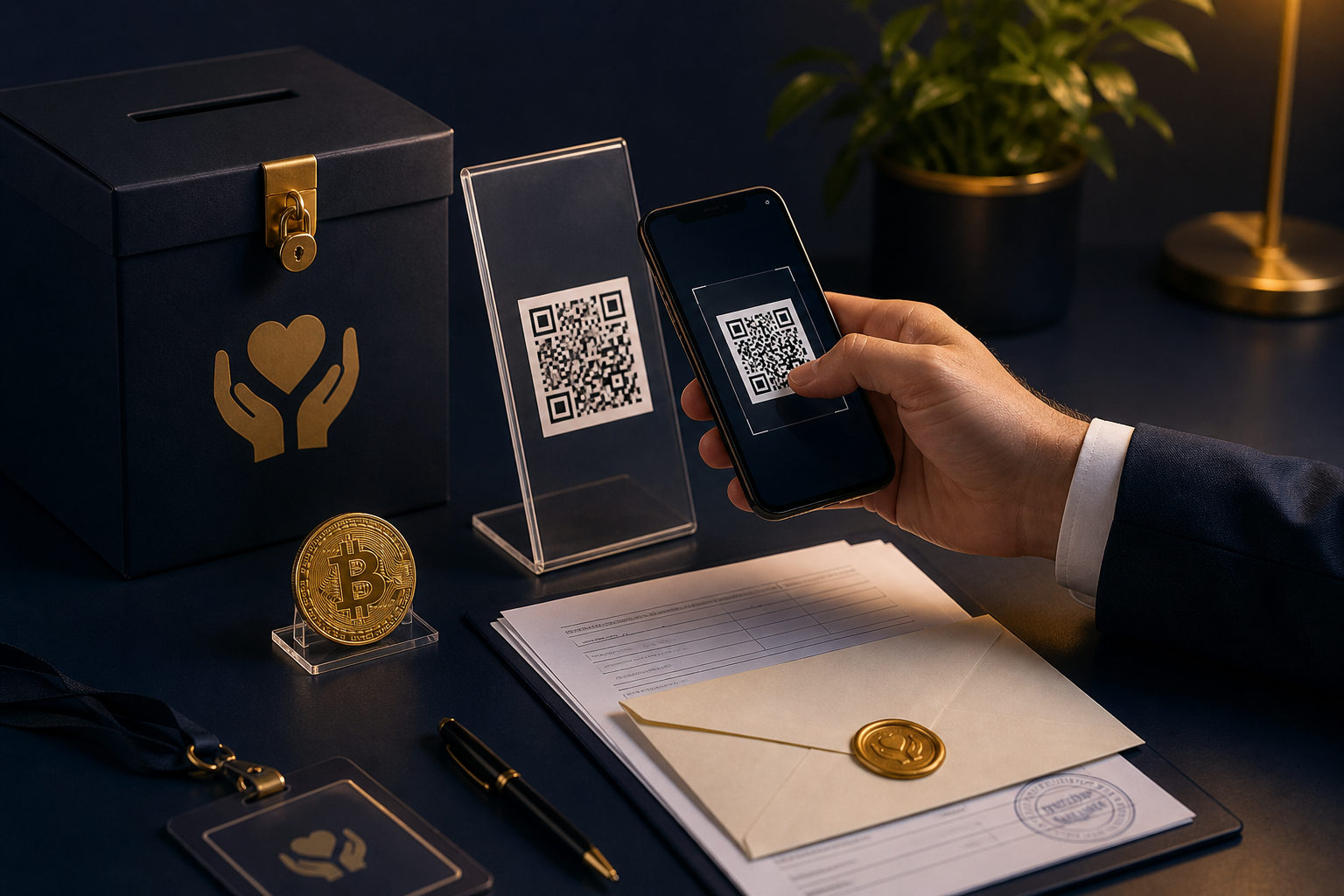
Yes, you can donate bitcoin to charity if the organization actually accepts bitcoin and you verify its payment process, wallet details, and recordkeeping before sending anything.
Why bitcoin donations are possible
Bitcoin is a transferable digital asset, so a charity can receive it if the organization has a wallet, a custodian, or a payment processor that handles crypto donations. From the donor’s side, the basic idea is simple: you send BTC to an approved destination, and the charity either keeps it or converts it based on its own policy.
The practical question is not whether bitcoin donations exist. It is whether a specific charity has a real, documented way to accept them. Some organizations publish a direct wallet address. Others use a donation platform that accepts crypto on their behalf. That difference matters because it affects how you verify the recipient, how you confirm receipt, and what kind of donation record you can expect afterward.
What to confirm before you donate bitcoin
Check that the charity clearly accepts bitcoin
Do not assume every nonprofit or charitable group accepts BTC. Some accept only cards, bank transfers, or standard online payment methods. Others accept crypto donations only through a dedicated service rather than a wallet address listed on their own site.
If the instructions are vague, ask first. You want clear answers to a few basic points: whether the organization accepts bitcoin directly, whether it uses a third-party processor, whether it converts donations into fiat currency, and whether it can provide some form of acknowledgement. If the charity cannot explain its own process, that is a warning sign.
Verify the source of the receiving address
Bitcoin transactions are generally not reversible once sent, so address verification is one of the most important steps. Get the address or donation page from the charity’s official website, official communications, or a confirmed support channel. Do not rely on screenshots, reposted messages, search snippets, or a random social media image.
When you are ready to donate, compare the beginning and end of the address after pasting it into your wallet. If your wallet supports labels or an address book, use them. For a larger donation, a small test transaction can reduce the chance of a costly mistake.
Make sure the charity wants native bitcoin
New donors often confuse bitcoin with wrapped assets, exchange balances, or tokens on other networks. If the charity says it accepts bitcoin, confirm that it means BTC on the Bitcoin network, not a substitute on a separate chain and not an internal transfer system inside an exchange.
If your bitcoin is sitting on a trading platform, check the withdrawal options before sending. The network you choose has to match what the receiving side expects. A mismatch can create delays, failed delivery, or a hard recovery process.
Understand how the charity handles the donation
Not every organization treats donated bitcoin the same way. Some may keep it for a period of time. Some may convert it quickly into fiat currency for operating expenses or program funding. Others may let a processor handle that decision based on pre-set rules.
This does not make one charity better than another by itself, but it does affect your expectations. If you care about the use of funds, transparency, or internal handling, read the organization’s donation page and financial disclosures carefully before sending anything.
How to donate bitcoin to charity step by step
The process is not complicated, but it does require care. Most donation errors come from human mistakes rather than from bitcoin itself.
- Confirm the charity’s identity: review its official site, donation instructions, and support contacts.
- Get the official payment details: use the published wallet address or the approved donation page.
- Check the asset and network: confirm you are sending BTC on the Bitcoin network.
- Review the fee settings in your wallet: the network fee affects confirmation speed, not the charity’s donation policy.
- Consider a small test transaction: this is useful if the amount is meaningful to you or the setup is unfamiliar.
- Send the full donation: save the transaction ID, timestamp, receiving address, and your own screenshots.
- Follow any reporting steps: if the charity asks donors to submit the transaction hash or fill out a form, do that so the donation can be matched internally.
A common mistake is treating a successful send screen as the end of the process. It is better to think in two parts: the blockchain transfer itself and the charity’s internal confirmation. You want both.
Fees, privacy, and tax records
Network fees are separate from the donation itself
When you send bitcoin, you usually pay a network fee so the transaction can be processed. That fee does not mean the charity is charging you extra. As a result, the total amount leaving your wallet may not exactly match the amount the recipient sees as donated.
If a charity uses a processor, there may also be service-related handling on that side, depending on how the donation page is built. Read the instructions before sending, and if anything is unclear, ask for clarification instead of guessing.
Bitcoin donations are not automatically anonymous
People often assume bitcoin donations are anonymous by default. That is not quite right. Blockchain activity is public, even if addresses do not show a person’s name on their own. Once you combine that transaction with an exchange withdrawal, a donation form, an email confirmation, or a request for a receipt, your identity may be connected to the transfer.
If privacy matters to you, check whether the charity allows anonymous donations, whether it publishes donor names, and whether it requires personal details for acknowledgements. At the same time, recognize that some organizations keep records for compliance, accounting, or audit purposes.
Tax treatment depends on where you live
Whether a bitcoin donation creates reporting duties, potential deductions, or asset disposal questions depends on local tax rules and on the legal status of the receiving organization. There is no single answer that applies everywhere.
A sensible approach is to keep complete records from the start. Save the transaction hash, the date and time, the receiving address, your wallet screenshots, and any email or donation confirmation from the charity. If you later need to support a filing position, incomplete records can create avoidable problems. This article is not tax advice, but careful documentation is useful in almost any jurisdiction.
How to evaluate a charity before sending BTC
- Clarity of instructions: the charity should explain how it accepts bitcoin and how donors should proceed.
- Transparency of use: look for a clear explanation of the charity’s programs, mission, and reporting practices.
- Confirmation process: there should be a way to confirm receipt or submit donation details.
- Security awareness: good organizations warn donors about fake addresses, impersonation, and the need to verify official channels.
- Quality of communication: if you ask a question, the reply should be specific and competent, not generic or evasive.
If a charity offers nothing more than a bare address with no explanation, no support path, and no donation policy, pause before sending. Good intentions are not a substitute for verification.
Common mistakes to avoid
Using an exchange transfer without checking the charity’s instructions
Some donors assume that sending from an exchange account is always fine. It may be, but only if the charity accepts that method and the withdrawal settings match the required network and asset. The fact that your platform shows a bitcoin balance does not remove the need to verify details first.
Trusting a QR code without checking the text address
QR codes are convenient, but convenience is not the same as safety. It is still wise to compare the pasted address and confirm it came from an official source.
Failing to keep records
A single screenshot of “sent” is often not enough. If you later need proof for accounting, internal reconciliation, or tax support, you will want the transaction hash, address, date, and any communication with the charity.
Assuming the charity will hold bitcoin long term
Many charities focus on funding operations and programs, not managing crypto exposure. Some may convert donated bitcoin quickly. If that matters to you, ask before donating rather than assuming.
FAQ
Can I send bitcoin directly to a charity?
Yes, if the charity accepts bitcoin directly or through an approved crypto donation service. The key is to confirm the official payment route before you send BTC.
Do I need to sell my bitcoin before donating?
Not always. If the charity accepts bitcoin, you can usually send BTC from your wallet. You would only need to sell first if the organization accepts only fiat currency or another payment method.
Can a bitcoin donation be reversed after I send it?
In general, no. Once a bitcoin transaction is broadcast and processed, there is usually no built-in reversal like a card chargeback. That is why address and network checks matter so much.
How do I know the charity really received my bitcoin?
Start by checking the transaction status on a block explorer. Then follow the charity’s process, if it has one, to submit the transaction hash or request confirmation so its internal records match the blockchain transfer.
Are bitcoin donations anonymous?
Not automatically. The transaction may be public on-chain, and your identity can still be linked through exchange activity, forms, receipts, or direct communication with the charity.
Before sending any donation, review the official page, confirm the receiving address, check that you are using the right network, and decide what records you need to keep. If any part of the process is unclear, stop and verify it first.
Disclaimer: This article is for informational and educational purposes only and is not investment, financial, or legal advice. Crypto assets are highly volatile and you could lose your entire investment. Do your own research and decide carefully.