
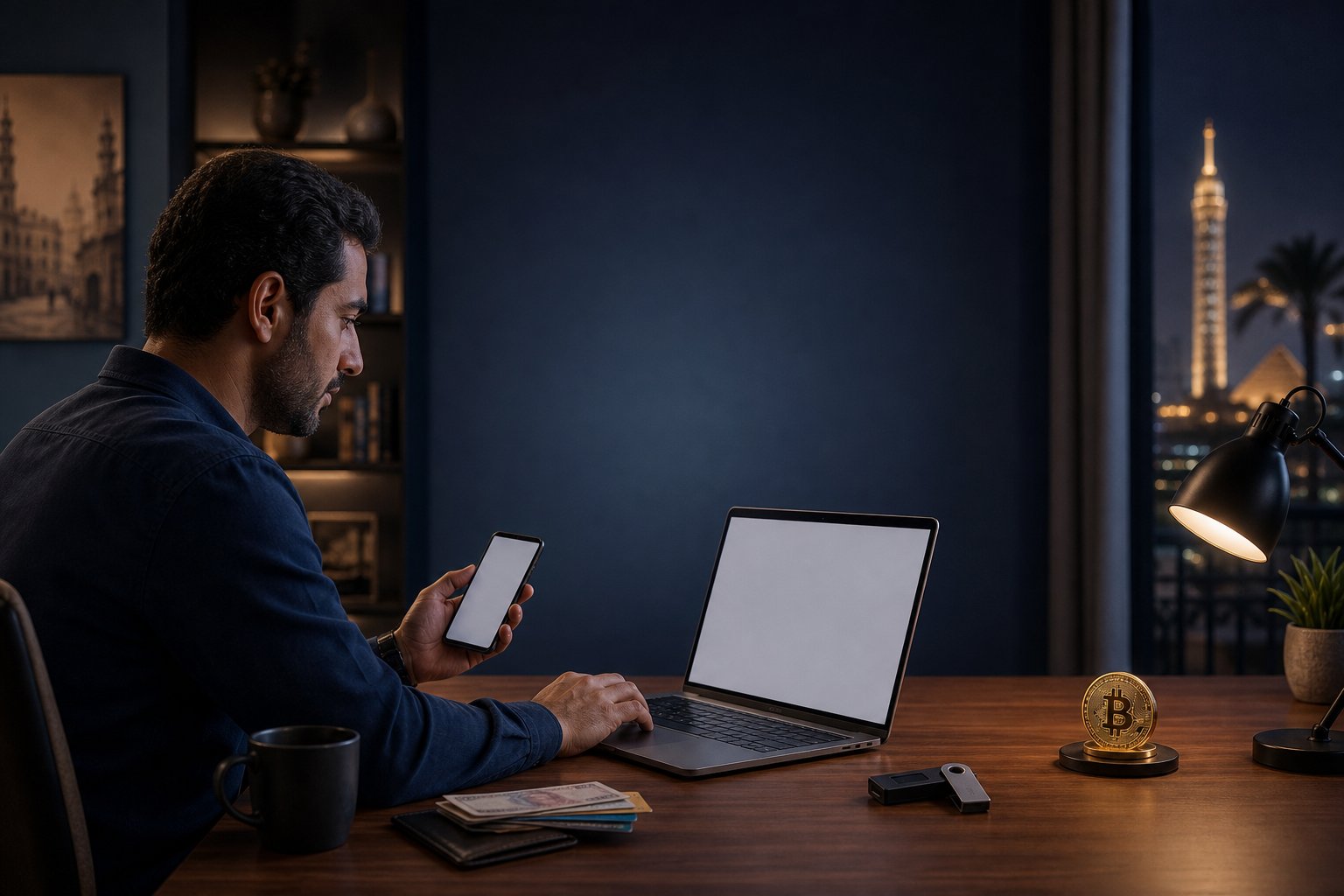
Before you think about which platform to use, there's a more basic question to settle: in Egypt, buying and trading Bitcoin currently sits outside the law. The Central Bank of Egypt has never issued a single license for crypto-related activity, and under Article 206 of the Central Bank and Banking System Law (Law No. 194 of 2020), issuing, trading, promoting, or operating a platform for cryptocurrencies without that license is illegal, punishable by imprisonment and fines of up to EGP 10 million, roughly $200,000 at current exchange rates (the dollar figure moves with the rate). That doesn't mean nobody in Egypt is buying Bitcoin. Plenty of people are, mostly through peer-to-peer trades on international platforms. But going in without understanding the legal picture first would be a mistake, so that's where this guide starts.
Is Bitcoin actually legal in Egypt right now?
Law No. 194 of 2020 is blunt about it. Article 206 bans issuing, trading, or promoting cryptocurrency, or running any platform that facilitates crypto transactions, unless the Central Bank of Egypt (CBE) has granted a license. The catch is that no such license has ever been granted to anyone, which turns a theoretically possible legal path into one that simply doesn't exist in practice. The CBE hasn't stayed quiet about this either. It has repeatedly issued public warnings against crypto investment, citing volatility, fraud, and the risk of funds being used for money laundering or terrorism financing.
There's a religious dimension too. Egypt's Dar al-Ifta, the country's official Islamic legal authority, issued a fatwa in late 2017 declaring that trading, holding, or leasing Bitcoin and similar cryptocurrencies is haram, forbidden under Islamic law. The ruling, issued by then Grand Mufti Shawky Allam, pointed to the lack of central oversight, extreme price swings, and the potential for the currency to fund illicit activity. A fatwa isn't binding civil law, but it carries real weight in how Egyptian society, and by extension banks and payment providers, treat the topic. People routinely mention the CBE ban and the fatwa in the same breath, even though the two are legally distinct.
Enforcement isn't just theoretical either. In March 2023, Egyptian authorities arrested 29 people, including 13 foreign nationals, connected to an app called HoggPool that marketed itself as a crypto mining and trading platform. It launched in August 2022 and simply went dark in February 2023, after allegedly taking around $620,000 from thousands of investors. Whatever you think about the ban itself, that case is a useful reminder that crypto investment scams targeting Egyptians are a documented, real problem, not a hypothetical one.
Looking ahead, there's no real sign of the rules loosening. The CBE is piloting its own digital pound, the E-pound, part of a roadmap that reportedly runs through 2030, and the bank has explicitly framed one of the project's goals as curbing cryptocurrency use, alongside reducing cash dependency and improving payment efficiency. So if you're hoping the legal situation might flip soon, there's currently no official signal pointing that way.
How Egyptians actually acquire Bitcoin in practice
Here's the part that surprises a lot of people: Egypt isn't on the restricted-country list published by major international platforms like Binance. An Egyptian passport can pass identity verification there without special obstacles, at least in principle. The real friction shows up at the network level. One of Egypt's largest telecom providers, which reportedly handles around 70 percent of the country's internet bandwidth, has restricted access to the websites and apps of several major exchanges. Users routinely report that these sites either won't load or load unreliably on local connections. That's a separate problem from the legal one, and most generic guides never mention it at all.
For people who do get through, the typical path is peer-to-peer trading on an international platform, settled in Egyptian pounds. Buyers and sellers pay each other through Vodafone Cash, InstaPay, or direct bank transfer, with counterparties commonly settling through banks like the National Bank of Egypt, Banque Misr, CIB, or QNB. Vodafone Cash and InstaPay transfers tend to clear in minutes; bank transfers can take longer depending on which institutions are involved. None of this changes the underlying legal status described above. It's simply what's happening on the ground, not an endorsement of it.
Banks themselves are not neutral bystanders here. Egyptian banks routinely flag, freeze, or ask for explanations on transfers heading to known crypto-exchange accounts, and card payments aimed at buying crypto directly are often declined by risk controls. Foreign-currency card limits have also been a moving target: during 2022 and 2023, as Egypt's foreign-currency reserves tightened, some banks capped monthly overseas card spending as low as EGP 3,000 to 7,750. The CBE instructed banks to lift those foreign-currency credit card restrictions in March 2024, easing things somewhat, but the history shows that relying on a card as your main funding method in Egypt hasn't been a stable strategy in recent years.
| Funding method | Typical settlement time | Exposure to FX limits or bank risk controls | What to watch for |
| Vodafone Cash | Minutes | Less tied to foreign-currency card limits, but still subject to flagging | Dispute resolution is harder outside the platform; keep communication inside the order page |
| InstaPay | Minutes | Instant bank-to-bank rail, can still trigger source-of-funds checks | Requires a linked local bank account; confirm the recipient name matches the platform exactly |
| Bank transfer, NBE, Banque Misr, CIB, QNB, etc. | Tens of minutes to one business day | Transfers to known exchange accounts are commonly held or questioned | Avoid crypto-related wording in payment references; follow the platform's instructions |
| Credit or debit card in foreign currency | Instant, but approval is unreliable | Repeatedly tightened in 2022 to 2023; eased somewhat from March 2024 | Limits, FX markup, and risk rules change often; not a method to depend on |
Why the pound's slide matters to this whole conversation
The Egyptian pound has lost more than 70 percent of its value since a series of devaluations starting in early 2022. By mid-2026, the dollar was trading around 50 EGP, with annual core inflation still running near 14 percent. That backdrop explains a lot of the real-world demand: for many Egyptians, dollar-pegged stablecoins or Bitcoin look like a way to preserve some purchasing power against a currency that keeps losing ground. It's a genuine economic motive, and understanding it helps explain why the practice persists despite the legal risk, but it doesn't shrink that risk. High inflation and a strict crypto ban are two separate problems, and treating one as justification for ignoring the other is a mistake.
If you still decide to go ahead: account setup and verification
Once you've picked a platform, register with an email and phone number you actually use, and set a strong, unique password. This matters because login alerts, device-change notices, and withdrawal confirmations all depend on that contact information being correct. Then complete identity verification as the platform requires, which usually means submitting an ID document and a selfie check, sometimes proof of address too. Don't skip this by registering under someone else's name, and don't lend your verified account to someone else. If a dispute comes up later, sorting out responsibility gets messy fast.
Submit verification documents only inside the official app or website. If someone messages you offering to “speed up” your verification, ignore it; legitimate review processes don't ask for ID photos over chat apps. As soon as your account is set up, turn on two-factor authentication and save your backup recovery codes somewhere offline. Don't reuse your login password for your payment PIN, and don't make either one match your email password. If the platform offers device management, an anti-phishing code, or a withdrawal address whitelist, turn those on too. You're focused on getting a good price; someone trying to break into your account is focused on catching you off guard.
Moving money: a small test trade beats going all in
Before committing real money, run one small transaction all the way through: payment, confirmation, order execution, checking the result. Most problems don't show up at the moment you click buy; they show up in payment references, mismatched recipient names, delayed bank risk reviews, or a counterparty who simply won't pay. If you're using Vodafone Cash or InstaPay, double-check that the recipient name on your screen matches what the platform shows. If a counterparty asks you mid-chat to send money to a different account than the one listed, treat that as a hard stop.
Keep all communication inside the platform's order page rather than moving to WhatsApp or a similar app; it's much harder to dispute a problem once you're off-platform. Avoid writing anything crypto-related in payment memos, and follow whatever wording the platform recommends instead. Save screenshots of payments, order numbers, and any chat logs, because that's the evidence you'll actually be able to use if something goes wrong. Anyone who insists on releasing coins before payment clears, or the reverse, asking you to pay first with nothing in escrow, is a red flag regardless of how reasonable they sound.
Placing the order, withdrawing, and long-term storage
Before you buy, double-check the asset ticker is actually Bitcoin and not something with a similar-sounding name. New buyers more often mess up which asset or network they're using than they misjudge the price. A simple market buy is easier to get right the first time; save limit orders and other tools for once you understand how the order book behaves, since more control also means more ways to misconfigure something or make an emotional decision mid-swing.
Don't leave your holdings sitting in the exchange account any longer than necessary. Even a well-run platform can suffer account breaches, risk-engine freezes, or plain human error, and in Egypt's case, that platform is also operating outside any local regulatory umbrella, so if something goes wrong, your options for recourse are limited. If you intend to hold long-term, move funds to a wallet where you control the private keys. Test the withdrawal with a small amount first, copy-paste the receiving address instead of typing it by hand, and check it carefully. Never screenshot your seed phrase onto a device connected to the internet, and never share it with anyone claiming to be support staff, a seller, or a paid “mentor.” Blockchain transactions generally can't be reversed once sent; a wrong address or a leaked seed phrase usually means the funds are simply gone.
Do you owe tax on Bitcoin held in Egypt?
Egypt's tax authority currently has no category for reporting crypto gains, largely because the state doesn't officially recognize cryptocurrency as a legal asset or currency in the first place, so there's no established capital-gains filing process to follow. That's a separate issue from Article 206, which governs whether trading and promotion are permitted at all; don't conflate the absence of a tax form with the absence of legal exposure. For general context, Egypt's top personal income tax bracket is 27.5 percent (on annual income above EGP 400,000, a bracket added in the 2023/24 tax reform) and VAT is 14 percent, but neither figure is crypto-specific, and Egyptian tax policy has shifted more than once in recent years. If you're dealing with meaningful amounts or cross-border transfers, talk to a licensed local tax or legal professional about your specific situation rather than relying on a general article like this one.
Frequently asked questions
Is buying and selling Bitcoin actually illegal in Egypt?
Under Article 206 of Law No. 194 of 2020, trading or promoting cryptocurrency without a CBE license is illegal, and no license has ever been issued, so there's currently no legal pathway in practice. Simply holding Bitcoin isn't explicitly criminalized on its own, but trading, promoting, or running a related platform clearly is. The fact that plenty of people are doing it doesn't mean it's sanctioned.
Does the Dar al-Ifta fatwa carry legal force?
No. A fatwa is a religious legal opinion, not binding civil law. But it reflects the position of Egypt's official religious authority and shapes public attitudes and, to some degree, how banks and payment providers approach the topic. People often mention it alongside the CBE ban, even though the two are legally distinct.
Why won't some exchange websites or apps load in Egypt?
That's a separate, technical issue from legal compliance. Some Egyptian telecom providers have restricted access to the domains and apps of major exchanges, which is a network-level obstacle rather than a reflection of whether the exchange itself accepts Egyptian users.
Can I just use a bank card to buy crypto directly?
Some international platforms technically support card payments, but Egyptian banks commonly flag or decline transactions headed to known crypto platforms, and foreign-currency card limits have shifted several times in recent years. Relying on a card as your primary funding method hasn't been reliable in practice.
Who's responsible for wallet security after I withdraw?
With a self-custody wallet, you alone hold the private key and seed phrase, and no platform can recover them for you. That's the whole point of self-custody, since no third party can freeze or seize it, but it also means backup mistakes, lost devices, or a leaked seed phrase are entirely on you.
How do I tell a real opportunity from a crypto investment scam?
Guaranteed returns, “insider” tips, or someone offering to trade on your behalf are all warning signs on their own. Egypt has a documented case to point to: the HoggPool app disappeared in 2023 after allegedly taking roughly $620,000 from investors, leading to 29 arrests. Anyone pushing you off-platform into private chat, asking you to pay before receiving coins, or requesting your seed phrase should be cut off immediately.
A quick before-and-after checklist
Before you buy: make sure you actually understand both the legal ban and the religious ruling, confirm your intended payment method, Vodafone Cash, InstaPay, or bank transfer, is currently working reliably, turn on two-factor authentication and an anti-phishing code, and have a wallet ready with a backup plan you understand. After you buy: verify the trade record and asset ticker are correct, double- and triple-check the withdrawal address, store your seed phrase offline, and keep every order confirmation and chat log in case you need them later.
If you've read all of this and still want to go ahead, start with one small test trade, registration, verification, payment, order, withdrawal, the whole sequence, before putting any real amount of money on the line. It's not a glamorous approach, but it's a lot safer than starting big.
Disclaimer: This article is for informational and educational purposes only and does not constitute investment, financial, or legal advice. Egyptian law currently places significant restrictions on cryptocurrency trading and promotion, and these rules may change; always check the latest public guidance from the Central Bank of Egypt and other relevant authorities, and consult a qualified local legal or tax professional where needed. Crypto assets are highly volatile and you could lose your entire principal, so do your own research and decide carefully.