
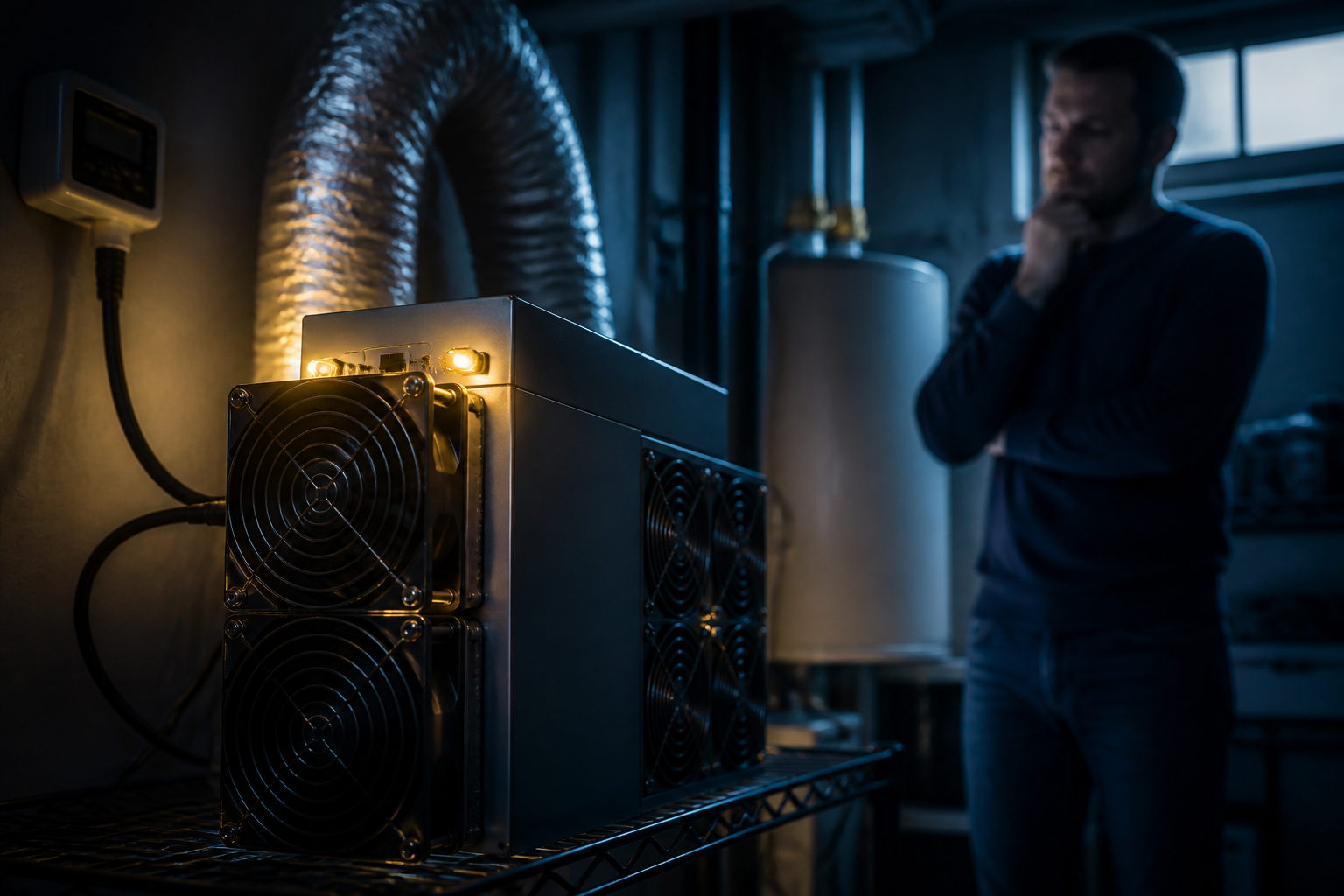
Is home bitcoin mining profitable in 2026? Sometimes, yes. For most people, though, the real issue is not whether mining works at home, but whether power cost, machine efficiency, and downtime leave any room for profit.
What home mining is really competing for
A simple way to picture Bitcoin mining is a nonstop race to win the right to add the next page to a public ledger. Miners run specialized machines that keep making guesses until one participant meets the network target and earns the chance to add a new block.
Bitcoin produces a new block about every 10 minutes, so the contest never really pauses. A home miner is not competing with a few hobbyists in the neighborhood. The competition is the global network, which means efficiency and uptime matter as much as enthusiasm.
That is why many first-time miners get the setup wrong. They think in terms of buying a machine, plugging it in, and waiting. In practice, home mining is closer to running a small industrial device inside a living space.
Why profitability in 2026 comes down to costs, not excitement
Power cost usually decides the outcome
Electricity is often the first filter. Mining hardware has to run for long periods, and if your household power rate is high, that recurring bill can eat through mining revenue fast.
Many people focus on the market price of Bitcoin because it is easy to watch. The harder part is accepting that power is a fixed real-world expense that shows up whether the market feels good or bad.
Machine efficiency matters more than having any machine
Home bitcoin mining in 2026 is not a case of using whatever computer is available. Bitcoin mining has become specialized, and older hardware tends to draw more power while producing weaker performance.
That gap matters. If two miners face the same network conditions but one uses a more efficient machine, the less efficient setup has a much thinner margin for error. At home, thin margins disappear quickly.
Heat, noise, and downtime are not side issues
A mining machine creates heat and noise from the start. In a home setting, those are not small annoyances. They affect room temperature, airflow, family comfort, and sometimes even the willingness of neighbors to tolerate the setup.
Poor ventilation can lead to throttling or shutdowns. Dust can add maintenance trouble. Every hour offline matters because the network competition continues even when your machine is not running.
Mining pools smooth payouts, but they do not create profit
Most home miners join a mining pool instead of mining alone. A pool combines the work of many participants and shares rewards under its own rules, which can make results feel less random.
That helps with consistency, but it does not solve expensive electricity, weak hardware, or repeated downtime. Pool fees and payout rules also matter, so reading the details is part of the job.
Who may still find home mining worth trying
Home mining can make sense for a person who has favorable power costs, space for ventilation, tolerance for noise, and the patience to manage hardware. Without those conditions, the idea often looks better on paper than it does in daily life.
There is also a difference between mining to learn and mining to earn. If your goal is to understand how blocks, pools, wallets, and settlement work, a home setup can be a hands-on lesson. If your goal is steady profit, your standards have to be much stricter.
- Better fit: people who can monitor equipment, deal with noise, and manage heat
- Poor fit: people looking for passive income with no operational work
- Common mistake: assuming a bullish market alone makes home mining profitable
How to evaluate a home mining setup before spending money
If you are asking whether home bitcoin mining will be profitable in 2026, start with the variables you control. That framing is more useful than trying to guess a future outcome from market sentiment alone.
- Check whether your living space can handle a high-load machine for long periods
- Review your electricity cost structure before choosing hardware
- Plan for airflow, dust control, room temperature, and noise management
- Compare machine efficiency, maintenance demands, and resale flexibility
- Study mining pool payout rules, fees, and wallet handling
- Leave room for repairs, downtime, and hardware aging
People often underestimate the operational side. That is where many home mining plans fail. The machine may work exactly as intended, yet the environment around it makes the project unattractive or uneconomic.
FAQ
Can a regular person still make money mining Bitcoin at home in 2026?
Possibly, but the answer depends more on costs than on interest in Bitcoin. A regular home miner usually runs into power bills, noise limits, and maintenance work before anything else.
If those conditions are weak, profit can be hard to achieve. Participation is one thing; running a workable setup is another.
Does a higher Bitcoin price automatically make home mining profitable?
No. A stronger Bitcoin price can help the revenue side, but profitability also depends on electricity cost, machine efficiency, repairs, and uptime.
When those expenses are too high, gains from market strength may not be enough. One variable never tells the full story.
Can I mine Bitcoin at home with a normal computer?
In theory, any device doing the required work is attempting to mine. In practice, Bitcoin mining is highly specialized, so a normal computer usually cannot compete effectively.
That is why serious discussions focus on dedicated hardware, power conditions, and stable operation rather than general household devices.
Does joining a mining pool mean more stable profit?
Joining a pool can make payouts less uneven, but it does not guarantee profit. It changes how rewards are shared, not the basic economics of your setup.
You still have to deal with power cost, fees, hardware efficiency, and downtime. A pool can reduce variance without fixing bad inputs.
What should I check first before starting home mining?
Start with electricity cost and home conditions, then look at hardware. Many beginners research machines first and only later realize their space is a poor fit.
If airflow, noise, and electrical capacity are wrong, the rest of the plan can fall apart fast. The order of evaluation matters.
Before deciding whether home bitcoin mining is profitable in 2026 for you, write down your electricity cost, hardware options, pool rules, and housing limits in one checklist. That practical review is more useful than guessing future returns.
Disclaimer: This article is for informational and educational purposes only and is not investment, financial, or legal advice. Crypto assets are highly volatile and you could lose your entire investment. Do your own research and decide carefully.