
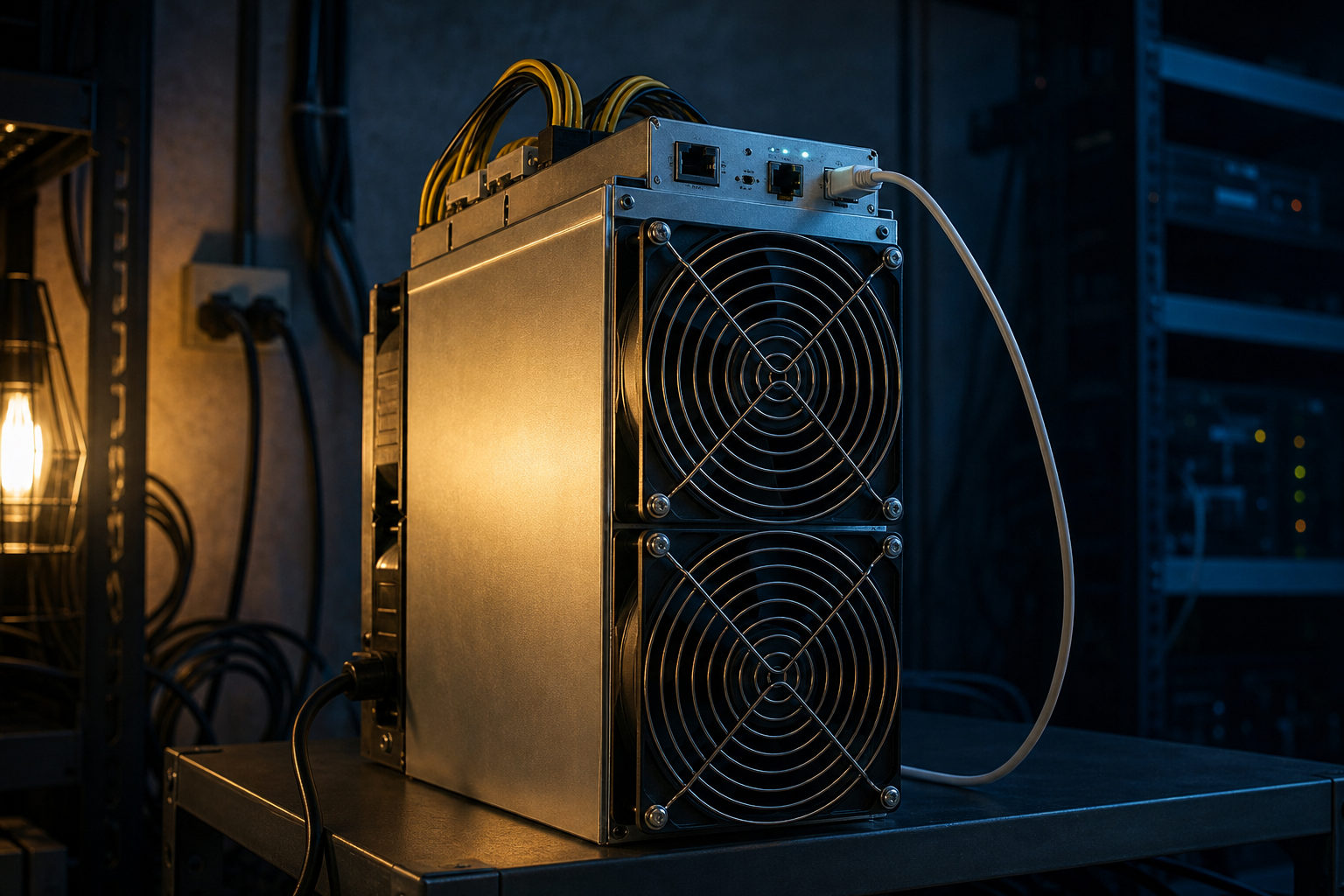
An AM-1700 bitcoin miner is a specialized machine used to compete for Bitcoin block production. It is not a plug-in money machine, and the right starting point is understanding how mining works, how people join it, and what real-world costs make the difference.
What an AM-1700 bitcoin miner actually does
A simple way to think about Bitcoin mining is to picture a nonstop bookkeeping contest. The Bitcoin network needs new blocks to be added under shared rules, and miners compete to produce the next valid block. An AM-1700 bitcoin miner is built for that single purpose.
That makes it very different from a normal computer. A laptop or desktop is meant to handle many tasks: browsing, office work, media, communication, and general software use. A mining machine is designed to repeat the same hashing process again and again, as efficiently as possible, in pursuit of valid proof-of-work results.
So when people ask about an AM-1700 bitcoin miner, the useful answer is not just whether it can mine Bitcoin. The better answer includes where it will run, how it will be powered, how heat will be removed, how much noise it creates, and whether the owner is ready to manage it over time.
Bitcoin mining explained as a bookkeeping race
Bitcoin does not rely on one company or one bank to maintain the ledger. Instead, a distributed network of participants checks transactions and validates blocks. Miners help package transactions into candidate blocks, then compete to find a valid hash that meets the current network target.
The process is easier to follow in steps. Users broadcast transactions to the network. Miners gather eligible transactions into a candidate block. Mining hardware keeps trying different values in the block header and runs the Bitcoin hashing process repeatedly. If one miner finds a result that satisfies the difficulty requirement, the new block is broadcast, and other nodes verify it.
The network is designed to produce a block about every 10 minutes. The difficulty adjusts over time so that block production stays near that pace even as total network mining power changes. In practice, that means mining is not just about owning hardware. It is about running that hardware reliably under competitive network conditions.
There is another point that new users often miss. Mining is not a free-form puzzle game where creativity wins. It is a rule-based race of repeated computation. Because the competition is global, many individuals do not try to mine alone. They join a mining pool, combine their hashing power with others, and receive payouts according to the pool's methods.
What matters before you try to run one
Most beginners spend too much time staring at machine names and too little time on operating conditions. With an AM-1700 bitcoin miner, the environment around the machine can matter as much as the machine itself. If power, cooling, and maintenance are a poor fit, ownership can turn into frustration very quickly.
Power supply and electricity costs
Mining hardware is meant to run under sustained load. That makes stable electrical supply a basic requirement, not a minor detail. In a home setting, the questions start with outlets, wiring, breaker limits, and whether the location is suitable for long-running high-load hardware. In a commercial setting, the focus shifts toward uptime and fault handling.
Electricity costs are part of the core reality of mining. Without live market data, nobody should present a fixed profit claim. A more honest approach is to look at local electricity pricing, operating restrictions, and how reliable the power setup is before making any purchase decision.
Heat and noise
A bitcoin miner produces heat continuously while hashing at full load. If the heat is not handled well, the system may throttle, shut down, or wear out faster. That is one reason many first-time buyers underestimate what ownership feels like in practice.
Noise is just as important. Dedicated mining machines are often far louder than normal consumer electronics, and that changes where they can realistically be placed. A spare corner in a room may sound convenient at first, but living with the heat output and fan noise is a different story.
Dust, airflow, ambient temperature, and room layout all affect day-to-day operation. A machine that can turn on is not always a machine that can run well for long periods. That distinction matters.
Network connection and maintenance
A miner does not need extraordinary internet bandwidth, but it does need a reasonably stable connection to stay in sync with the mining pool and submit work consistently. Frequent interruptions can reduce effective performance even if the machine itself seems fine.
Ownership also includes routine management. That may involve pool settings, firmware management, dashboard checks, restarts after faults, and basic monitoring for abnormal behavior. Buying an AM-1700 bitcoin miner is not the end of the task. It is the start of an operating routine.
How people participate in Bitcoin mining
For most readers, the better question is not whether an AM-1700 bitcoin miner can make money. The better question is what type of participation you are prepared for. Different paths come with different levels of control, complexity, and responsibility.
- Buy and run your own machine: This gives direct control over the hardware and setup. It also means you carry the burden of power issues, cooling, downtime, hardware faults, and ongoing maintenance.
- Connect to a mining pool: This is the common route for individual miners. A pool combines hash power from many participants, which reduces the waiting uncertainty that comes with trying to find blocks alone.
- Learn the process first: If terms like wallet, payout address, pool account, and miner dashboard are still blurry, taking time to understand the workflow is often the smartest first step.
One common mistake is to focus too narrowly on a single model name. The machine matters, but it does not operate in a vacuum. Two people can own similar hardware and end up with completely different experiences because their locations, electricity costs, cooling methods, and maintenance habits are different.
It also helps to separate three things clearly. The miner performs the computation. The mining pool coordinates pooled participation and payout rules. The wallet handles private keys and asset control. Mixing those concepts together is a frequent source of confusion for beginners.
Common misconceptions about mining hardware
Discussion around mining hardware often includes sales language, forum shorthand, and assumptions that do not hold up well in real use. Before buying an AM-1700 bitcoin miner, it helps to strip those away.
- Owning a miner means guaranteed output. Not true. The machine is only one part of the equation. Network competition, uptime, faults, pool rules, and operating costs all affect the result.
- If I have internet at home, I can mine without much trouble. Home internet is only one small piece. Heat, noise, power limits, and ongoing management are often the real barriers.
- If someone else had a good experience, I can copy it exactly. Mining conditions are highly location-dependent. Another person's electricity price, room layout, climate, and tolerance for noise may be nothing like yours.
- Newer or stronger hardware is automatically the right choice. A machine is only a good fit if your environment can support it properly.
- Security only matters for the wallet. Pool credentials, device access, and payout settings also need protection. A weak password or sloppy setup can create avoidable risk.
There is also a basic reality that marketing often softens: mining is operational work. Even if the interface is simple, you are still dealing with a piece of specialized hardware that runs hard for long periods and depends on stable conditions around it.
FAQ
Can an AM-1700 bitcoin miner be replaced by a regular PC?
No. Bitcoin mining today is associated with specialized hardware rather than general-purpose computers. A regular PC is built for flexible computing, while a mining machine is tuned for repeated proof-of-work hashing.
Can I run an AM-1700 bitcoin miner at home?
That depends on your power setup, cooling options, available space, and tolerance for noise. Many people find that the limiting factor is not software setup, but the reality of heat and sound during long operation.
Do I need a mining pool for an AM-1700 bitcoin miner?
Many individual users join a mining pool because solo mining means facing the full scale of network competition alone. A pool changes the participation model and makes payout rules something you need to understand carefully.
Where do mined bitcoins go?
They are usually directed to a payout address that you control through a wallet setup. The miner does the work, the pool coordinates participation, and the wallet manages access to the assets.
How should I check price or payback expectations for this miner?
Without live market data, fixed claims about price or payback should not be trusted. A better method is to check real-time Bitcoin pricing on major market platforms and then compare that with your electricity costs, pool terms, and operating conditions.
If you are seriously evaluating an AM-1700 bitcoin miner, write down four things before you do anything else: whether your location can support sustained power use, whether you can handle the heat, whether the noise is acceptable, and whether you are willing to manage the machine regularly. If any one of those is still unclear, pause there before buying.
Disclaimer: This article is for informational and educational purposes only and is not investment, financial, or legal advice. Crypto assets are highly volatile and you could lose your entire investment. Do your own research and decide carefully.