
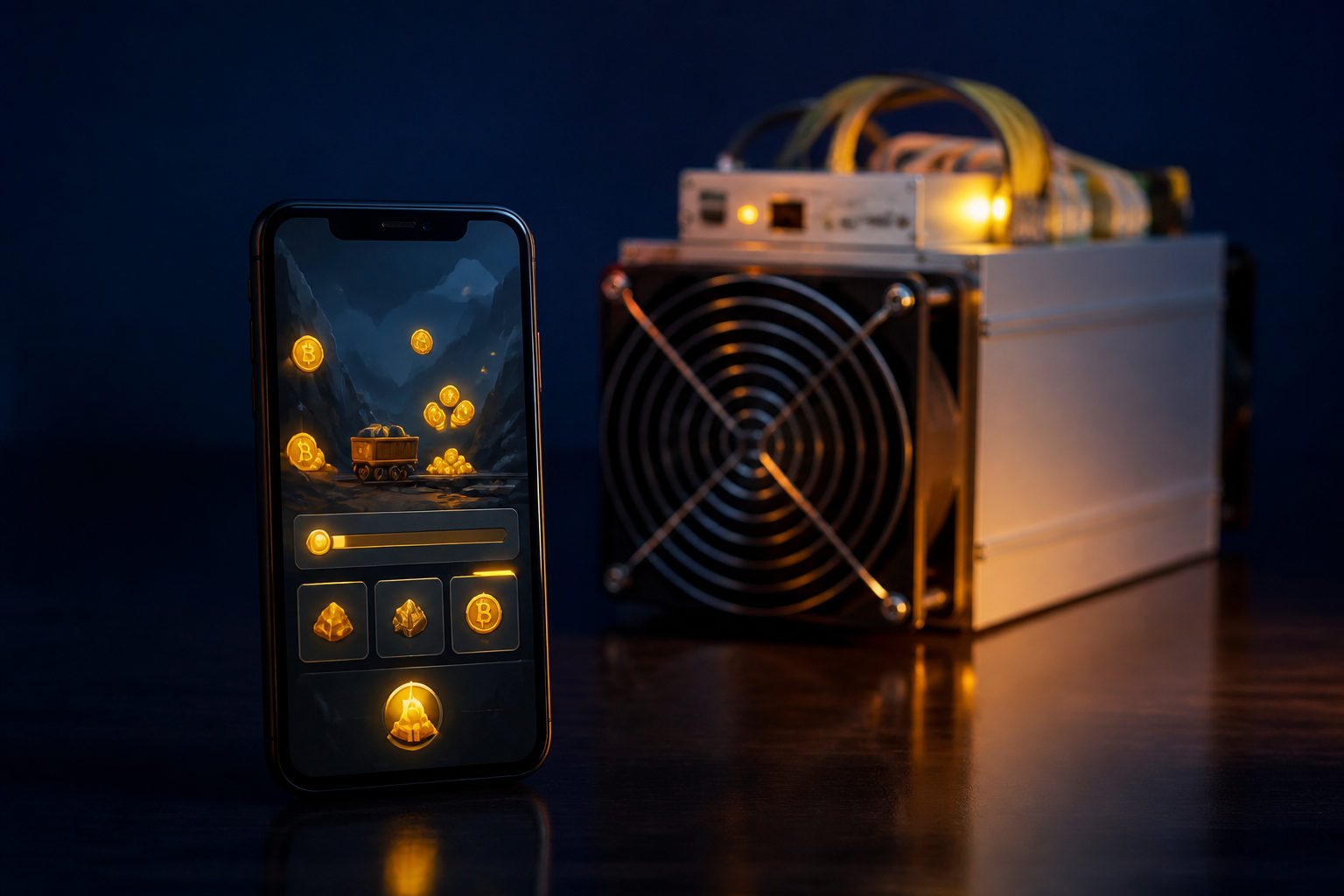
Most bitcoin miner games are legitimate as games, but they usually are not legitimate Bitcoin mining. The key test is whether the app actually participates in Bitcoin network record-keeping and whether any payout can be verified outside the app.
What people usually mean by a bitcoin miner game
The phrase covers several very different products. Some are idle or simulation games that borrow mining themes. Some are reward apps that hand out points after ads, check-ins, or referral tasks. Others present themselves as cloud mining products and use game-like design to make the offer look simple.
That difference matters because the word “miner” creates a strong assumption. Users often see virtual rigs, hashrate meters, warehouse graphics, and BTC labels, then assume the app must be tied to real Bitcoin mining. In many cases, those elements are only part of the game loop.
| Product type | What the user is doing | Relation to real Bitcoin mining | Best way to view it |
|---|---|---|---|
| Simulation game | Tapping, upgrading, waiting for progress | Usually no direct participation in Bitcoin | Entertainment with a mining theme |
| Reward app | Watching ads or completing tasks | Rewards often come from app economics, not mining | Attention monetization dressed as crypto |
| Cloud mining style offer | Buying a plan, slot, or virtual machine | Needs separate verification | Higher risk, check claims carefully |
| Actual mining setup | Running specialized hardware with pool or network access | Direct participation in block production competition | Operational and capital-intensive activity |
So if you ask whether a bitcoin miner game is legit, the first answer is: legit in what sense? It may be a real app with a working reward system and still have little to do with actual Bitcoin mining.
How real Bitcoin mining works
A cleaner way to explain Bitcoin mining is to think of it as a competition to earn the right to add the next page to a public ledger. Miners use specialized hardware to compete under a fixed set of rules. When a valid block is found, the wider network checks it.
Bitcoin launched with the genesis block in January 2009, and its system is built around block production that happens about every 10 minutes. None of that resembles the usual mobile game pattern of tapping a button, opening a chest, or leveling up a cartoon machine. Real mining depends on hardware, electricity, cooling, uptime, maintenance, and connection quality.
That is why a mining game can teach a rough idea while still being far removed from the real thing. A progress bar inside an app is a design choice. A valid contribution to Bitcoin block production is an infrastructure activity with technical and economic constraints.
Why the bookkeeping race analogy helps
Many beginners picture mining as if coins are physically extracted from somewhere. The bookkeeping race analogy is closer to the truth. Miners are competing to package transactions into a block that the network accepts.
Game developers like this framing because it turns an abstract process into familiar mechanics: upgrades, speed boosts, resource management, and rankings. Those mechanics can be useful for learning at a very basic level, but they do not prove that your phone or browser session is contributing meaningful work to Bitcoin.
How to judge whether a bitcoin miner game is credible
The fastest way is to stop looking at the marketing and start asking operational questions. What exactly is the reward? Where does it come from? Can you withdraw it? Once withdrawn, can you verify it independently? If those answers stay vague, treat the product as a game first and a Bitcoin claim second.
| Checkpoint | What a credible product should explain | Warning sign |
|---|---|---|
| Reward label | Clear distinction between bitcoin, tokens, points, and in-app items | Mixing all of them under one “earn BTC” message |
| Reward source | Explanation of whether value comes from ads, promotions, or actual mining activity | No source given, only claims of passive earnings |
| Withdrawal rules | Transparent conditions, limits, and processing steps | Changing thresholds or payouts that never arrive |
| External verification | A way to confirm transfers outside the app if real bitcoin is involved | Every balance exists only on an internal dashboard |
| Cost disclosure | Honest discussion of fees, hardware, or operating limits | Claims of easy, free, riskless bitcoin |
| Account controls | Published moderation, lock, and appeal rules | Balances frozen without clear reason |
This is where many users get misled. An app can be genuine in the narrow sense that it exists, functions, and gives out some kind of reward. That does not mean the reward is bitcoin in the same sense as coins held in a wallet you control. It may be a platform balance, redeemable credit, or a conditional promise subject to app rules.
Look for separation between in-app numbers and real assets. If the product constantly shows rising balances but avoids explaining transfer mechanics, you are looking at a closed system. Closed systems can be fun, but they should not be confused with Bitcoin itself.
Where miner games can still be useful
A bitcoin miner game can have educational value when used for the right purpose. It can help a beginner understand that mining involves competition, changing conditions, equipment choices, and trade-offs. Those ideas are easier to grasp in a game than in a technical paper.
Its limits show up quickly, though. A game usually skips the parts that make mining difficult in practice: operating hardware, handling failures, dealing with heat and noise, managing energy costs, and understanding that rewards depend on a much bigger network process. If your goal is to learn how Bitcoin works, a game can be a starting point. If your goal is to take part in real mining, it is only a loose metaphor.
| Goal | What a miner game can help with | What it usually cannot replace |
|---|---|---|
| Basic concept learning | Shows competition and resource allocation in simple form | Real network validation and block mechanics |
| Getting bitcoin | May expose you to wallet terms and payout claims | Direct control of actual bitcoin holdings |
| Understanding mining operations | Introduces the idea of upgrading equipment | Hardware deployment, maintenance, and operating realities |
| Risk awareness | Teaches you to question labels like hashrate and reward | Independent verification of asset ownership |
A practical rule helps here: ask what you still own if the app disappears tomorrow. If the answer is “nothing outside the app,” then what you had was mainly platform exposure, not independently controlled bitcoin.
The cost reality behind real mining
Any discussion of legitimacy should include cost, even without quoting return figures. Real Bitcoin mining is tied to resource consumption and operational discipline. Specialized hardware does not run itself. It needs setup, monitoring, maintenance, and a suitable environment.
That is why “free bitcoin mining” inside a simple game interface should trigger skepticism. If your device is not truly contributing specialized computational work to Bitcoin under real mining conditions, then the app’s reward must come from somewhere else. Common alternatives include ad revenue, promotional budgets, referral structures, or internal accounting.
That does not automatically make the app fraudulent. It simply means the user should name the model correctly. A reward app can be real. A mining-themed game can be real. A cloud product can even operate as described. None of those facts alone proves that the user is performing Bitcoin mining in the strict sense.
FAQ
Can a bitcoin miner game actually pay out?
Some do pay out something, but the important question is what that “something” is. You need to check whether it is real bitcoin sent to a wallet you control or just an in-app balance subject to platform rules.
Is phone mining in a game the same as Bitcoin mining?
Usually no. A normal phone game or lightweight app does not match the way real Bitcoin mining operates, which is built around specialized hardware and continuous operation.
Does the hashrate shown in the game mean real hashrate?
In many games, hashrate is just a progression stat. It may affect rankings, speed, or rewards inside the app without representing any measurable contribution to Bitcoin block production.
What should I check first before trusting one of these apps?
Start with the reward description and the withdrawal process. Then check whether any claimed bitcoin transfer can be verified outside the app, not just on an internal screen.
Is a bitcoin miner game useless for beginners?
Not at all. It can be a decent teaching tool for the broad idea of mining, as long as you keep a clear boundary between simulation and actual participation in the Bitcoin network.
The most useful next step is simple: treat every miner game as a closed product until it proves otherwise. Check asset type, withdrawal path, and external verification before you give it time, money, or account permissions.
Disclaimer: This article is for informational and educational purposes only and is not investment, financial, or legal advice. Crypto assets are highly volatile and you could lose your entire investment. Do your own research and decide carefully.