
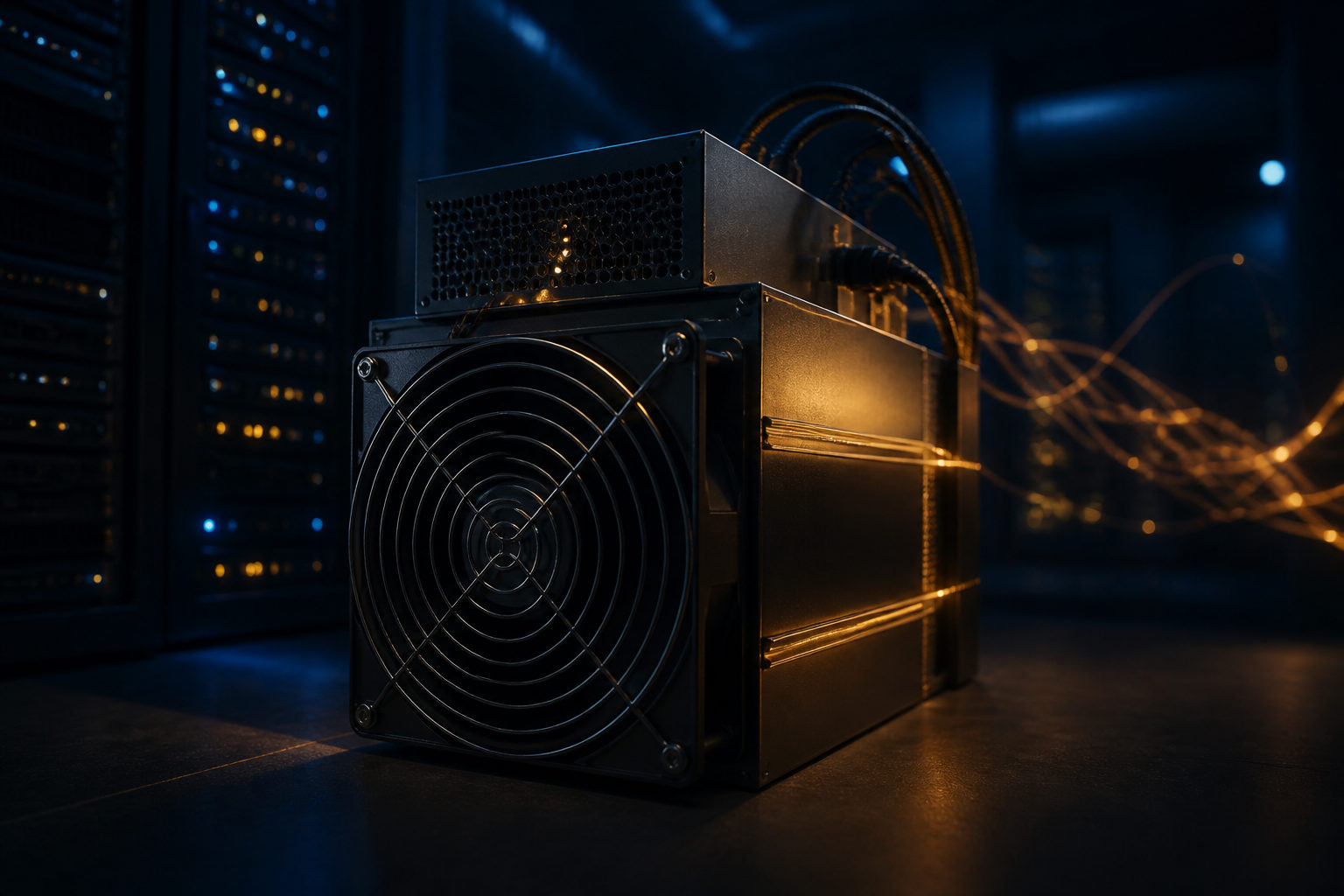
A bitcoin miner is a person or machine that competes to add new blocks to Bitcoin by using computing power to win a record-keeping race.
What a bitcoin miner actually does
The simplest way to understand a bitcoin miner is to picture an open bookkeeping contest. Bitcoin transactions are constantly waiting to be confirmed. Miners gather those pending transactions, build a candidate block, and keep running calculations in search of a result that satisfies the network's current rules.
The miner that finds a valid result first can broadcast that block to the network. If other nodes verify it and accept it into the chain, the winning miner receives the block reward plus transaction fees. The current block reward is 3.125 BTC, following the 2024-04-19 halving, and the next halving is expected around 2028.
Bitcoin targets roughly one block every 10 minutes. That leads to about 450 BTC in new issuance across the entire network per day. That figure describes total network issuance, not what any single miner, company, or machine can expect to produce.
So miners do more than “make new coins.” They order transactions, help confirm which payments are valid, and make it expensive to rewrite the ledger after the fact. That cost is a big part of why Bitcoin can operate without a central bookkeeper.
Why mining is a competition in computing power
Bitcoin uses proof of work. In practice, miners keep changing block data and trying new hashes until one of those attempts meets the current difficulty target. There is no shortcut that lets a miner skip the work. The process is built around repeated trial and error.
That design solves a basic problem in a decentralized system: who gets to write the next page of the ledger when nobody is in charge. Bitcoin answers that by letting anyone compete under the same rules. A miner that commits real resources such as electricity, hardware, maintenance time, and stable connectivity has a chance to win the next block.
Mining difficulty does not stay fixed forever. It changes as total network hash power changes, which means mining conditions shift over time. Newcomers often assume that turning on a machine leads to a stable output. Mining is closer to a probability game where your odds depend on how much effective hash power you control compared with the rest of the network.
| Stage | What the miner does | Why it matters |
|---|---|---|
| Collect transactions | Builds a candidate block from pending transfers | Moves payments toward confirmation |
| Run hashes | Tries many possible inputs to meet the difficulty target | Determines who wins the right to add the next block |
| Broadcast block | Sends the proposed block to the network | Lets nodes verify the work |
| Receive reward | Earns block subsidy and fees if the block is accepted | Creates the economic incentive to mine |
Bitcoin's supply is capped at 21,000,000 BTC, with issuance expected to continue until around 2140. New coins enter circulation through block rewards, and those rewards are reduced every 210,000 blocks, roughly every four years. Halvings took place on 2012-11-28, 2016-07-09, 2020-05-11, and 2024-04-19.
Can an individual still become a bitcoin miner?
Yes, but the path is very different from Bitcoin's early years. The genesis block was mined on 2009-01-03, and the network was far less competitive at that stage. Over time, mining moved from general-purpose computers to specialized hardware. Today, using a standard home computer as a serious Bitcoin mining tool usually does not make sense from a competitiveness standpoint.
Individuals who want to take part usually consider a few routes: running their own hardware, joining a mining pool, using hosted infrastructure, or studying the mining business before committing capital. Mining pools combine the hash power of many participants and distribute results according to pool rules. That smooths the experience because a solo miner might wait a very long time before finding a block alone.
A pool does not make the network easier to mine. It changes how results are shared and how often participants see payouts. That distinction matters, because many beginners hear “pool” and assume it creates guaranteed output. It does not.
| Participation route | Best suited for | Main hurdle | What it feels like in practice |
|---|---|---|---|
| Solo mining | Operators with strong technical and operational skills | Hardware, power, cooling, noise, uptime | Very uneven results; long waits are normal |
| Mining pool | Most individual participants | Need to understand pool rules and payout methods | Smoother distribution, but less control over payout structure |
| Hosted mining | People who do not want to run equipment on site | Dependence on the host's quality and transparency | Less hands-on work, weaker direct control |
| Research first | People still testing whether mining fits them | Time needed to learn the business model | Useful for avoiding rushed decisions |
The real barrier is rarely “can I install software.” It is whether you can manage continuous high-load equipment, power delivery, cooling, dust, repairs, monitoring, and downtime. Many first-time buyers focus on hardware specs and only later discover that the operating environment is the harder part.
Why costs matter more than simple output questions
Asking how much a bitcoin miner earns sounds natural, but the answer is never fixed for long. Results depend on hardware efficiency, mining difficulty, pool terms, transaction fee conditions, and how consistently the machines stay online. Without live data, a hard output number would be misleading.
Mining is also a full cost chain, not a one-time equipment purchase. You need to think about electricity, ventilation, heat removal, noise, replacement parts, failed fans, firmware management, remote monitoring, and the possibility that the machine stops when it should be running. Even a small amount of downtime changes the real result.
Another common source of confusion is the network issuance figure. About 450 BTC per day describes total new bitcoin created across the whole network at the current block reward and target block pace. It does not tell you what one machine can mine, what one pool member will receive, or how much one company can produce in a given day.
| Cost or risk area | Why it matters | Frequent mistake |
|---|---|---|
| Electricity | Often the largest ongoing operating cost | Looking only at machine purchase price |
| Cooling | High heat can hurt stability and hardware life | Assuming a normal room is enough |
| Noise | Mining equipment is often too loud for typical living spaces | Realizing this only after setup |
| Maintenance | Downtime and hardware faults reduce actual output | Treating mining as fully hands-off |
| Network competition | Difficulty changes alter output per unit of hash power | Projecting one short period into the future |
If you are learning the basics, one more detail is useful. The smallest bitcoin unit is 1 satoshi, equal to 0.00000001 BTC. That matters because pool payouts, fees, and balances are often discussed in very small denominations rather than whole bitcoin.
FAQ
Does “bitcoin miner” mean a person or a machine?
Both uses are common. Strictly speaking, the miner can mean the operator participating in mining, while the mining machine performs the calculations. In everyday discussion, people often use the term for either one.
Can I mine Bitcoin with a regular PC?
You can use a regular computer to understand the process, but it is usually not competitive for real Bitcoin mining today. The sector has become specialized, so general-purpose machines are mostly educational in this context.
Does joining a pool mean I will get steady results?
A pool can smooth distribution compared with solo mining because rewards are shared across many participants. Your outcome still depends on pool rules, your share of the hash power, and whether your equipment stays online.
Why does the block reward keep getting smaller?
That is part of Bitcoin's issuance schedule. The reward is cut in half every 210,000 blocks, roughly every four years, which is why the current block reward is 3.125 BTC after the 2024 halving.
How long does one miner need to produce 1 BTC?
There is no universal timeline. The answer changes with machine efficiency, network difficulty, pool method, fees, and downtime, so the better approach is to build a cost model and then judge long-run output under changing conditions.
Before you start, check these points first
Confirm that your location can handle constant power draw, strong heat output, and sustained noise. Then compare hardware sourcing, after-sales support, pool payout rules, and how downtime is handled. Finally, test your plan under conservative assumptions, including maintenance time and changing competition, and only proceed if the setup still makes sense on those tougher terms.
Disclaimer: This article is for informational and educational purposes only and is not investment, financial, or legal advice. Crypto assets are highly volatile and you could lose your entire investment. Do your own research and decide carefully.